Blog
Saturday, February 25, 2017 - 10:51

It's the last weekend of the month, so it's time for another Lesbian Historic Motif Podcast to go live! This month we're looking at the exciting and implausible life of 17th century playwright, poet, world traveler, and spy Aphra Behn. Check out the show on your favorite podcast aggregator. If you enjoy it, I strongly urge you to subscribe and to rate the hosting show (The Lesbian Talk Show) to help others find it more easily.
Now with transcript!
* * *
Lesbian Historic Motif Podcast: Episode 7 - Aphra Behn - transcript
(Originally aired 2019/02/25 - listen here)
* * *
(Transcript commissioned from Jen Zink @Loopdilou who is available for professional podcast transcription work. I am working on adding transcripts of the existing interview shows.)
I confess that, although there’s a lot of validation in finding historic evidence of ordinary everyday women who loved women, I’m a bit of a sucker for real-life stories that might be considered unbelievable as fiction.
One such person is the 17th century novelist, playwright, and spy Aphra Behn. Behn had an interesting and colorful career, the early parts of which are clouded by deliberate mythologizing.
What is clearly fact is that during the mid 1660s, when she was in her 20s, she worked as a spy for King Charles II in the period shortly after his restoration to the throne. Her espionage career may have begun in the Dutch East Indies, and is more solidly known from her time later in the Netherlands, where she operated under the code name "Astrea" which she also used as a pen name.
She was a staunch royalist, though one must assume her loyalty to King Charles was strained a bit by the efforts she had to go through to get paid for her work. Her career as a playwright was somewhat more lucrative, though not without occasional reverses. Her works were in the libertine style of the restoration era when the playhouses that had been closed under Cromwell turned to rather free-spirited works, in a sort of artistic whiplash. Her personal life was also free-spirited and she was linked romantically with a number of artistic figures. The late Mr. Behn had left the stage before her writing became popular.
During her heyday, she was a prolific playwright, second in productivity only to John Dryden the Poet Laureate and her poetic output was enormous, both published and private.
So what is Aphra Behn doing on this podcast? Behn was also openly bisexual--or at least as open as one could be about it at the time. Indeed, her pen name Astrea, is taken from the play L’Astrée whose plot involves several erotic scenes between female characters (or characters passing as female). And certainly her poetry and correspondence with a number of women had no hesitation in expressing sentiments that would be clearly understood as romantic and erotic if directed at a man. Or rather, that are accepted as romantic and erotic on those occasions when she directs them at men, for she was promiscuous with her attentions and her most well-known lovers are male.
Behn addressed several poems to a woman named Emily Price, possibly an actress, when the two were briefly separated, including a love song that begs for her affection to be reciprocated, and with acts, not words. The following poem of the group expresses a somewhat different emotion: the vain hope that absence from her beloved might diminish her desire.
It is entitled: VERSES design'd by Mrs. A. Behn, to be sent to a fair Lady, that desir'd she would absent her∣self, to cure her Love. Left unfinish'd.
IN vain to Woods and Deserts I retire,
To shun the lovely Charmer I admire,
Where the soft Breezes do but fann my Fire!
In vain in Grotto's dark unseen I lie,
Love pierces where the Sun could never spy.
No place, no Art his Godhead can exclude,
The Dear Distemper reigns in Solitude:
Distance, alas, contributes to my Grief;
No more, of what fond Lovers call, Relief
Than to the wounded Hind does sudden Flight
From the chast Goddesses pursuing Sight:
When in the Heart the fatal Shaft remains,
And darts the Venom through our bleeding Veins.
If I resolve no longer to submit
My self a wretched Conquest to your Wit,
More swift than fleeting Shades, ten thousand Charms
From your bright Eyes that Rebel Thought disarms:
The more I strugl'd, to my Grief I found
My self in Cupid's Chains more surely bound:
Like Birds in Nets, the more I strive, I find
My self the faster in the Snare confin'd.
The poetic circles Aphra moved in often used pastoral nicknames, which can conceal the identity of the people they are written to. She addressed several poems to “Aminta”, which may have been an alias or may have been a generic name. In some Aminta has experienced the pangs of heterosexual love, but in the poem entitled “The Dream” she is the subject of the poet’s desire:
All trembling in my arms Aminta lay,
Defending of the bliss I strove to take;
Raising my rapture by her kind delay,
Her force so charming was and weak.
The soft resistance did betray the grant,
While I pressed on the heaven of my desires;
Her rising breasts with nimbler motions pant;
Her dying eyes assume new fires.
Now to the height of languishment she grows,
And still her looks new charms put on;
Now the last mystery of Love she knows,
We sigh, and kiss: I waked, and all was done.
‘Twas but a dream, yet by my heart I knew,
Which still was panting, part of it was true:
Oh how I strove the rest to have believed;
Ashamed and angry to be undeceived!
Shall we hope that the Aminta--whoever she may have been--that Aphra dreamed of bringing to “the last mystery of love” entertained the same dreams?
The poem that is most often discussed in the context of Aphra’s playful takes on gender and desire is “To the Fair Clarinda Who made love to me, Imagin'd more than woman.” One should understand that the phrase “make love” was not used as a euphemism for sex in this era and might be read as meaning something more like “to court, or to flirt.” We see here some of the troubling contradictions of the 18th century, where love between women was considered inherently “innocent” and yet the object of a woman’s desire might be imagined as masculine to some degree in order to justify the intensity of the emotion. And so the poet compartmentalizes her desire as friendship for the feminine part (Aphrodite) and love for the masculine part (Hermes), playing off the image of the gender-queer hermaphrodite.
Fair lovely Maid, or if that Title be
Too weak, too Feminine for Nobler thee,
Permit a Name that more Approaches Truth:
And let me call thee, Lovely Charming Youth.
This last will justifie my soft complaint,
While that may serve to lessen my constraint;
And without Blushes I the Youth persue,
When so much beauteous Woman is in view.
Against thy Charms we struggle but in vain
With thy deluding Form thou giv'st us pain,
While the bright Nymph betrays us to the Swain.
In pity to our Sex sure thou wer't sent,
That we might Love, and yet be Innocent:
For sure no Crime with thee we can commit;
Or if we shou'd - thy Form excuses it.
For who, that gathers fairest Flowers believes
A Snake lies hid beneath the Fragrant Leaves.
Though beauteous Wonder of a different kind,
Soft Cloris with the dear Alexis join'd;
When e'er the Manly part of thee, wou'd plead
Though tempts us with the Image of the Maid,
While we the noblest Passions do extend
The Love to Hermes, Aphrodite the Friend.
Although Aphra’s poetry often couched love between women in sentimental terms, her plays were most famous for their bawdy humor and that could include a recognition of the erotic potential between women, as when a character in “The False Count” asserts, "I have known as much danger hid under a petticoat as a pair of breeches. I have heard of two women that married each other," which may, in fact, be a reference to the marriage between Amy Poulter and Arabella Hunt, discussed in a previous podcast.
The most intriguing romantic possibility in Aphra’s life is suggested by the dedication she wrote in 1689 to Hortense Mancini, Duchesse Mazarine, the niece of the great Cardinal Mazarin who, with her sisters and cousins, were known as the Mazarinettes, the glitterati of their day, lovers to a parade of great men and not a few women. Hortense Mancini enjoyed a number of unambiguously sexual relationships with women, both as an unhappy newlywed in France, and later in England, where she counted the young Countess of Sussex among her lovers, though the primary reason she had some to England was to elbow out a rival as the official mistress of King Charles.
In any event, Hortense Mancini had a reputation even more flagrant than Aphra’s own, and it is with that in mind that the following dedication has led some historians to conclude that the two women had most likely been lovers at some point. The dedication reads in part:
…to the Most Illustrious Princess, The Dutchess of Mazarine...how infinitely one of Your own Sex adored You, and that, among all the numerous Conquests, Your Grace has made over the Hearts of Men, Your Grace had not subdued a more entire Slave. I assure you, Madam, there is neither Compliment, nor Poetry, in this humble Declaration, but a Truth, which has cost me a great deal of Inquietude, for that Fortune has not set me in such a Station, as might justify my Pretence to the honour and satisfaction of being ever near Your Grace, to view eternally that lovely Person, and hear that surprising Wit. What can be more grateful to a Heart, than so great, and so agreeable, an Entertainment? And how few Objects are there, that can render it so entire a Pleasure, as at once to hear you speak, and to look upon your Beauty?
To be sure, much of this may be the simple flattery that was common in such dedications. But Aphra Behn’s life, taken as a whole, suggests that the inquietude in her heart was genuine.
If you’re interested in further information about Aphra Behn and discussions about the queer and feminist elements of her life, see the show notes for links and references. And if you’d like to read a fictional imagining of an encounter between Aphra Behn and Hortense Mancini, there’s a link to a novelette that features them.
Show Notes
This episode is about the 17th century novelist, playwright, and spy Aphra Behn.
In this episode we talk about:
- Behn’s careers in espionage and literature
- Her bisexuality and some of the complexities of how desire between women was portrayed in the 17th century
- Poem: VERSES design'd by Mrs. A. Behn, to be sent to a fair Lady, that desir'd she would absent her?self, to cure her Love. Left unfinish'd
- Poem: The Dream
- Poem: To the Fair Clarinda Who made love to me, Imagin'd more than woman
- Dedicatory text to Hortense Mancini, Duchesse Mazarine
Books mentioned:
- Todd, Janet. 1996. The Secret Life of Aphra Behn. Rutgers Univ Press, New Brunswick. ISBN 0-8135-2455-5
- If you’d like to read some historical fiction that includes an entirely imagined meeting between Aphra and Hortense Mancini: ”The Mazarinette and the Musketeer” by Heather Rose Jones
This topic is discussed in one or more entries of the Lesbian Historic Motif Project here:
Links to the Lesbian Historic Motif Project Online
- Website: http://alpennia.com/lhmp
- Blog: http://alpennia.com/blog
- RSS: http://alpennia.com/blog/feed/
- Twitter: @LesbianMotif
- Discord: Contact Heather for an invitation to the Alpennia/LHMP Discord server
- The Lesbian Historic Motif Project Patreon
Links to Heather Online
- Website: http://alpennia.com
- Email: Heather Rose Jones
- Twitter: @heatherosejones
- Facebook: Heather Rose Jones (author page)
Major category:
LHMP View comments (0)
Thursday, February 23, 2017 - 10:00
You might think the subject line is an elaborate metaphor, but you'd be wrong.
You know that logic puzzle where you have to transport a wolf, a sheep, and a bale of hay across the river in a canoe and can only carry one of them at a time? My current logic puzzle involves two very skittish cats, a house with many hiding places, a garage with many hiding places, and a house-to-garage door that doesn't always latch properly. It happened something like this...
About a month ago, I took delivery of two new-to-me cats whose owner had died. Between the disappearance of their owner, the chaos of large numbers of strange people packing up their home, the trauma of being forcibly caught and put into carriers, and the strangeness of their new environment, the cats decided that they were in imminent danger of being devoured alive and promptly hid (see inventory item "house with many hiding places"), only sneaking out in the dead of night to eat, drink, and use the litter box.
They became, in a word, invisible. There were occasional brief sightings at night (did you know that all cats are gray in the dark?) but other than that the only evidence of their presence was what was taken and left. Hold on to that thought.
Due to seasonal house settling, the house-to-garage door currently needs forcible encouragement to latch properly. (See relevant inventory item.) This is done when I leave the house, but not always when I'm at home. Air pressure differentials sometimes leave the door slightly ajar. See also inventory item "garage with many hiding places".
After a while, the gray cat (did I mention there is a gray cat and a black cat? but all cats are gray in the dark?) began venturing timidly into visibility. This was reassuring. The black cat had not yet made an appearance for some time, but was known to have been the more skittish of the two. And the amount of food disappearing and...um...deposits in the litter box seemed consistent with the presence of two cats, though it varied from day to day.
And then, Sunday afternoon, I opened the door to the garage to move the laundry to the dryer and saw a black cat dash for cover. See inventory item "garage with many hiding places". See also "door that doesn't always latch properly." So now I had confirmation that the black cat was located in the garage (and was alive!), but no confirmation of how long it had been there or where it was hiding. I also made an assumption, though a warranted one, that the black cat in question corresponded to the one I had taken delivery of.
Here, then, is the logic puzzle: how does one move the black cat from the garage to the house under the following restrictions:
- Neither cat will appear in the open when human is present
- Gray cat must not leave house
- Black cat must not leave garage by door to street
- Both cats must have regular access to food, water, and litter box
- Neither cat can be relocated by physical interaction
- Presuppose a non-finite number of food and water dishes and litter boxes
Oh, and one bonus given condition is that the gray cat likes to hide under the bed in the master bedroom and can be identified in that location via flashlight.
Here, then, is my strategy for herding invisible cats. (Please note that this story is told for entertainment purposes and is NOT a request for advice, assistance, or catsplaining.)
- Move one (1) litter box, one (1) water dish, and one (1) food dish into the master bathroom. (A previously unmentioned logistical requirement is that said items may only be located in non-carpeted areas.)
- Ascertain that the gray cat is under the bed in the master bedroom.
- Close and latch the master bedroom door. Keep door closed at all times except when human is entering or exiting. The first bullet point ensures that there will be no cat movement in or out of the master bedroom under these conditions.
- Place one (1) litter box in garage and one (1) litter box in family room. Also one (1) water dish in both locations. Clean and rake litter boxes so that any activity is visible.
- Place one (1) food dish inside the house visible from the house-to-garage door.
- Prop house-to-garage door open when going to bed. (Shudder at the anticipated heating bill.)
- On rising, check and re-clean litter boxes in garage and family room. Verify that water is available in both house and garage but food only in the house. Close and latch house-to-garage door. Double-check proper latching. Go to work.
- (To be completed) Return from work at ascertain based on litter box status whether the black cat is now located in the garage or the house.
- If garage, repeat from #5. If house, remove cat equipment from garage and use a combination of heavy object and latch double-checking to prevent regression into garage. Open door to master bedroom. Adjust locations of interior cat equipment.
You may notice that the third bullet point (black cat must not leave garage by door to street) has not been accounted for. On this one, I must trust to previous behavior (obviously the cat is still in the garage despite the coming and going of the car twice a day), presumably driven by the first bullet point (neither cat will appear in the open when human is present).
When I took delivery of the cats, they came with names that didn't feel right to me. Thanks to a suggestion on Twitter, the top name candidates are currently Schrodinger (for the cat that either is or is not in the garage) and Cheshire (for the cat visible only as glowing eyes under the bed).
Wednesday, February 22, 2017 - 11:00
I decided that the end of 1864 was a good point at which to go back and cover the earlier material. When I decided to start creating this edited and annotated version of the material, I was in the middle of processing the 1864 entries, so it made sense to start from where I was and go forward. But since it's time to start setting up the fixed version of the material on my other website, I want to go back and fill that gap.
Abiel enlisted in Company C of the 85th New York Volunteers in October 1861, so his first letter below is only a couple months after his elistment. This first year is only letters. He didn't start keeping his "mems" (memorandums) until later. As that later parallel material shows, his daily diary entries had a somewhat different flavor from the letters he wrote for family consumption, even though the diaries were also being sent back to his sister Susan and he must have assumed she would read them.
This set of letters will also explain how it was Abiel was separated from the 85th NYV and what landed him in "Camp Convalescent" where we saw him in the previous material on this blog. Contemplate that he contracted dysentery in mid 1862 and didn't return to active duty until two years later (although it feels like part of that was due to the slow machinery of military bureaucracy).
Those who have been following along may be startled at how much less sophisticated the opening of Abiel's first letter sounds, but he seems to settle into his style rapidly.
The Diary and Letters of Abiel Teple LaForge 1842-1878
Transcribed, edited, and annotated by Phyllis G. Jones (his great-granddaughter)
Copyright © 1993, Phyllis G. Jones, All rights reserved
December 1861-March 1862
[PUNCTUATION AND SPELLING ARE COPIED FROM THE ORIGINALS. EDITORIAL COMMENTS ARE IN BOLD TYPE.]
1861-2 Contents
- December 23, 1861
- January ?, 1862 - Camp Conditions and Comfort
- February 5, 1862
- February 27, 1862
- March 2, 1862
- April 2, 1862 - The First Real Action
- May 4, 1862
- May 25, 1862
- June 10, 1862 - The Up Side of Dysentery
- September 13, 1862
- September 26, 1862
- October 1, 1862
- November 9, 1862
- December 22, 1862
LETTER
Monday December 23 1861
Dear father, Sister, and friends,
It is with pleasure that I improve the leisure furnished by a rainy day to inform you of the reception of your kind letter [of] the 16th, which I was rejoiced to receve. It found me well and waiting most impatiently for a letter from you. You cannot imagine how delightedly I read it now! Don't wait so long again. I will try to write as often as once a week and I hope you will do the same.
I could not help laughing at the news you had received of two of our men being shot while out on picket duty. There has not been a man shot. There is not any danger in standing on picket duty while on this side of the river. Over on the other side, they have some fun with the rebels sometimes. I was sent out as picket last Sunday. I had to take my blanket, a canteen of water, and one day's provisions in my haversack. It's fun to be off in the woods with two or three jolly companions. I like it.
In the first sheet of my letter I was extoling the fine weather. Yesterday there was a change in the prospect. It commenced raining about dark and rained all night. All of today, so far, and some snow fell also. But as I was saying, about dark it commenced raining, and before midnight we were drowned out. Yes, fairly drowned out. The water came in under our tent, wetting our bedding, which caused us to get up quicker than ever we did for roll call.
We at once procured a lantern and spade and went to work, and soon had the satisfaction of seeing the water retire from the tent into the ditch we had made. If it had been the retreat of a body of rebels it could not have given us more satisfaction! We then went into the tent and built up a good fire, without which we would have been very uncomfortable the next day. Today we put a brick floor in our tent, which will protect us against any future incursion of water enemies.
Our tent is wedge shaped and about eight feet square. Five of us occupy one of them. We have bought a little stove which, with furniture, cost us five dollars and which comes very handy to cook, warm our tents, etc. The canvas of which our tents are made is thick enough to prevent the rain from penetrating by falling on it, but it will come under, of course, if not properly protected by a ditch.
I hope it will soon clear off, for sunshiny weather is much more agreeable than stormy in camp. I thought we had got here too late for any of the southern fruit, but we are just in time for persimmons. They are a rich lucious fruit about as large as a good-sized green gage. I wish you could have some; They would suit you.
I understood that somebody had sent you [inserted above the line] meaning the people there [end of insertion] word that our regiment was dying off at the rate of ten a day. It is not so. There has [been] not one died since we came here that I know of. You tell the people so.
Write all the particulars, for they are what I like. Yours with love dear friend.
[The following letter was probably actually written in January of 1862, although it was filed with letters from December of 1862. The reference to New Years being past and the fact that it was written from Camp Warren are the basis for my assumption.]
LETTER
Company C, 85th Regiment New York S[tate] Volunteers, Camp Warren, December [January] 7th
Dear friends,
It is with great pleasure that I now seat myself for the purpose of writing to you and informing you of my excellent health and spirits, and also of the receipts of your kind letter, for which accept my thanks.
It was with was with wonder and gratitude that I received your letter so soon after writing to you. I was greatly amused to read the account in your letter of the reports which had reached you of a party of our men, of which Studer was one, being attacked at a bridge which they went to guard. Nothing of the kind has happened. None of us have had a chance to try our spunk with the rebels yet, but our Colonel has promised us that we shall have a chance before long to try our mettle.
We have had the promise of some reconnaissance duty. If we do, we shall probably have a sight of the enemy, which we have not had as yet. We are just as much out of the danger of the enemy here as at Elmira, but we shall have a chance before long.
You seem to have formed a wrong idea of our manner of living. We don't have beds; we sleep on the ground on straw. We each have two blankets and most of us have quilts from home. First, on the straw we place our India rubber blankets, then on this we put our quilts. Our blankets we spread over us.
Since I wrote my last letter, we have been moved into large round tents, eighteen feet in diameter. In this there are fifteen men. We sleep in a half circle around the tent, our feet to the center. We have a stove in our tent and everything handy. All the boys from our place [Note: presumably "our place" being his home town] with the exception of Ira Crandall live in here.
We have potatoes part of the time. We expect our pay to the fifteenth of this month, but cannot tell as yet. I do not know the fare from Andover [to] here, but I believe it about ten dollars, but I don't know. Tell Willie to enquire at the depot. Lieutenant Green is some sick at present, not bad, however all the rest of our boys are well. Lester Eaton is over the river at present, visiting the second Wisconsin and some other Regiments over the Potomac.
But would you not be pleased to see fifteen men In a tent only eighteen feet in diameter? I tell you, we soon learn to accommodate ourselves to all most anything now. I suppose you think we cannot live with any comfort, but we do live with comfort too. The money you sent me I bought an India rubber blanket. I have not bought a pistol yet.
I bought wages with the rest when pay day comes I have my my pay when pay day comes. [Note: I've set off this line due to the difficulty of interpreting it. I'm guessing there may be a transcription issue for the duplication in the second half of the line, but I don't know what it would mean to say "I bought wages with the rest [of my money?]" I guessing this should be emended something like: "I bought wages(?) with the rest. When pay day comes I'll have my pay."]
I hope It will not be much longer before we shall make an advance on the Potomac. With as large an army as we have at present, we might make an advance on. [Note: possibly he intended to repeat "on the Potomac" then realized he was repeating the phrase?] I hope It will not be so much longer so.
We have had considerable cold weather since New Year. It has snowed about an inch, but It has been warm enough in our tents for anybody.
Last week I was corporal of the pickets of this regiment. We had a piece of woods to guard, which was on a hill commanding a fine view of the city of Washington. At night I had just taken on the men--ten in number--of which I had command, and I had just given them their places to guard, when I saw a strong light toward the city. I at once got in a place where I could see the fire, for such it was. Oh how bright! It was the government stables on fire. There were some fifteen hundred horses in them, of which one hundred fifty were burned to death. It was dreadful. All of the horses were turned out that they could. It was bad enough, I tell you. I suppose you read of it in the papers.
We got that butter, and a more thankful set of fellows than we were you seldom see. It is enough to make a fellow homesick. Some of the boys here are wishing themselves home with their mothers, but I have not seen the time yet when I wished myself out of this. I came here with the expectation of of much worse fare than we had here, and so I was pleasantly disappointed. Our bread is baked for us, and many other things which I did not expect.
Father, I shall be glad to go up West with you when I get through with this war, but it will be a good while first, and I hope by that time I shall get to be a man and able to do some work. But I am afraid that I shall be very lazy at first.
Last night, we agreed to have readings in the Bible and prayer every night. Last night we did so, and I don't think we shall drop it. We have the praise of being the most quiet and orderly tent in the company. Still, we have plenty of fun, but have it in a quiet way.
We have had news today from the colonel that we shall go down the Potomac to Mathias Point where the rebels are blockading the Potomac. They are collecting in great numbers. It will take a large force of ours to dislodge them, so it wont be long before we have a chance to to try our mettle. I have no doubt you think because we sleep on the ground we sleep uncomfortable, but I tell you I never slept better in my life, or with less dreams.
But my dear friends, I can write no more at present. Give my love to all,
A T La Forge
Pleas excuse my many mistakes. You know that we don't have a table to write on.
LETTER
Washington D. C. Camp Warren February 5th 1862
Dear Friends,
I am happy to say that I received your kind letter of January 18, which I should have answered before, but I expected another letter from you. I sent one when I sent the money. I understand the money arrived at Andover safe, whether the letter did or not.
Your letter found me well, but deep in the mud, however the going is better now. Night before last, I was on guard and it snowed nearly all night. The snow fell to the depth of several inches (about three). Still, there is no sleighing. Three inches of snow is not apt to make sleighing where the mud is a foot deep. You would probably never have heard from me again if we had not moved our camp. The mud was getting so deep there that we must have inevitably stuck fast before long. We have moved about one hundred rods. We are camped on a side hill, where it is sandy, dry, and nice, in full view of the city of Washington. I like our present camp ground first rate.
I was very sorry to hear that mother was hurt. I hope she is well by this time. How I should like to see her! I can imagine how she sits by the stove, enjoying her pipe. I can imagine what you are all at, but none of you can guess anything about what I am at, because you never saw anything of the kind.
You must never think we are suffering with cold because we never do. Our tents are full as warm as board shanties, then it is never very cold here. The coldest is only 20° below zero, and that only once [in a] while. Some times it seems almost like summer does there. And another thing which adds to our comfort is there is but thirteen of us in a tent now. And when we moved, we managed to cabbage enough fence boards to make a floor to our tent. Then again, we sold our little stoves and bought a larger one with an oven. The advantage can readily be seen by any woman. [Note: I'm wondering if "cabbage" is some sort of rhyming slang for "scavenge". Or perhaps Abiel was unfamiliar with the word and misheard it? The sense is clear from context.]
The water is mostly bad. I know of but one good spring anywhere about. George Green has been sick and in the hospital for some time, but is well and out around at present. One of the hospitals on this hill is the large Columbian College. Another is the residence of old Commodore C. Porter, of whom we read in the war of 1812-14. The commodore's son is now an officer in the rebel army. The house was once a beautiful residence and is splendidly situated just back of our camp. The house is badly used and is going to decay as fast as the material of which it is built (brick) will allow it to.
Now here is something which will be interesting for father. The grave of old Lorenzo Dow is within a half mile of here. The tombstone is common brown stone. It is raised on pillars above the grave two feet, and with this inscription on it:
The Repository
of
Lorenzo Dow
Who was born in Coventry Conn.
Oct. 18th 17.77
Died Feb 2nd 18.34 aged .56. Years.
And also a couple of his quotation, of which I am sorry I failed to copy.
[Note: I've left the memorial inscription as is.]
February 6th
I had to leave my unfinished letter yesterday, on account of an order which I received to go out target shooting. Our company made first rate shots. The target was about forty-five rods off. We have changed our guns since I wrote last. We now have the Austrian rifle. The gun is not as handsome as the Enfield, which we had before, but it is more serviceable. I think we made a good trade.
Last week I went down to the city and visited the patent office. It is a large marble building filled with all the machinery in the United States, and there also is the coat, pants, sword, money safe, and some of the tea set of General George Washington, and many other relics of great value to the people of the nation.
My love to all, Father, Mother, Brothers, and Sisters from your loving friend.
A T La Forge
To Mr Joseph Potter
Direct to Company C, 85th Regiment New York State Volunteers, Camp Warren, D.C.
[Note: There are a number of later references to going to see the Patent Office while on leave in Washington, but I think this suggests the clearest picture that it served as something of museum, as well as a government office.]
LETTER
Washington DC, Camp Warren, 85th Regiment, Company C, New York State Volunteers February 27th 1862
Dear sister,
It is with pleasure that I seat myself in great haste to write you a few lines to inform you of the reception of your kind letter, for which receive my thanks. You will doubtless see the haste in which I write by the writing. Tonight our company fell in as usual for dress parade, when the Captain came down and told us that our company need not go on dress parade, for the reason that companies A, B, C, and H were to be sent across the Potomac tonight, about 12 miles from here. They are expecting to have a battle over there very soon, and by our earnest solicitation we were permitted to go over. [Note: I think it's important to read Abiel's letters always alert for his very dry sense of humor.]
We are not going to stay over there. We take four days' rations, and probably shall not have to stop over there longer than four days. Whether we shall have a fight or not, we cannot tell. [inserted] We do not take our tents with us. [end of insertion] After I wrote that, the order not to take our tent was countermanded and we took them. We shall not have any to sleep in. We shall have to bunk down on the ground while we are gone. [Note: Disentangling the contraditions, I suspect that Abiel first wrote that they wouldn't be taking their tents and would have to sleep on the ground, but that this order was then countermanded. It would make more sense, though if the sentence beginning "After I wrote that..." was the one that had been inserted.]
But I must bid you good bye for the present my love to father and all the f [torn corner] Your brother, A T LaForge
[letter continued on]
March 2nd
Dear friends,
It is with mortification that I finish this letter. We have not realized the fond anticipations which we had on starting the night of February 27. We were then in fond hope that we should be in an engagement before we got back again, when we started at last with this expectation.
We did not get started until after dark that night. We were accompanied by the band for a short distance. They finally turned, and we cheered them and kept on our journey. We had not gone more than 1/4 of a mile before we had to halt and send back for a couple of lanterns. The roads are so muddy. We marched through Georgetown and about 2-1/2 miles beyond when we halted, and the Major who commanded went to the headquarters of the Brigade with which we were to go for orders.
He was gone about an hour, and we built fires by the road and made ourselves as comfortable as possible. When he returned, he said that we were to return to our old camp. That the order for an advance had been countermanded. That he had telegraphed back to headquarters for instructions, and he should have to go back to Camp Warren.
He then gave the order of "about face" and "forward march", and back we marched through the mud to our old camp, where we arrived about two o'clock AM. A tired set of men! We had only marched about ten miles, but owing to the state of the roads it was worse than a twenty miles' march. As soon as the wagons came, we picked our tents--not being over particular--bunked down, and was soon fast asleep.
We did not get up until the sun was an hour high. Just as Orvill Barney and me (who slept together) got up, Leander Liveson, Lester Eaton, and Albert Heseltine came in. They had slept in a covered baggage wagon about a mile back all night. We had a good laugh [about] our adventure and then went to work and pitched our tents in proper shape, laid our floor again, and got things arranged as we had them before.
And we were inspected for pay today, but the prospect is that we shall not get our pay until the first of April. If we do not get it until then, I shall be out of money and therefore I wish you would send me one dollar. [Note: A number of these early letters show fascinating evidence of the micro-finance life of Abiel's community. Here he borrows--or perhaps "withdraws" from money previously sent home--in the next line he lends. It feels like money rarely sat still.]
Joseph, I wish you would use that money that I sent you. Or if you do not want to use it yourself, put it out until the first of Sept 1862, so that it may be increasing slowly.
You were right in supposing that I was wishing that the war was over and I was home. That is perfectly natural. But I never have wished that I was home unless this war was over.
You wrote Jane [Mary Jane Potter, Susan's sister-in-law] was sick with the sore throat. I am glad she does not have the treatment which we do in such a case: we have our throat burned out with an acid. You were safe in guessing that I do not gain in flesh as fast as I did at Elmira. If I had gained all the time as fast as I did when I first went there, I should now be the heaviest man in the army. The other day, there was such a heavy wind that a steeple 200 ft high was blown down. Heavy metallic roofs were blown off, chimneys were blown off, and lots of damage done in the city. This is a specimen of our North West wind.
I believe I have nothing more to write at present, only my love to father and all the rest of my friends.
Yours Truly A. T. La Forge
[letter on same paper]
Washington D.C. March 2nd 1862
Camp Warren, Company C. 85th Regiment
Dear Sister & Friends,
It is with pleasure that I once more seat myself for the purpose of again improving this opportunity of writing to you. I received your kind letter of February 22, for which receive my thanks. Your letter found me well, and glad to hear from you.
The weather has been quite pleasant here for some time. An old contraband told me that this kind of weather will last until the last of March. It will rain every two or three days, and then clear up with a cold North West wind, which will last about a day. Then it will be pleasant a day or two, then rain again, and so on. However the mud is drying up and a change is much better than to have it rain all the time. Today we have had the heaviest fall of snow that we have had here this winter. For a short time the snow fell--about two inches deep in two hours. Still it is very warm, just snow enough to make good snowballing, and i tell you the boys have improved the opportunity They snowballed one other until they got tired of that, and then they picked on the commissioned officers whenever one made his appearance. The Colonel and nearly all the Captains and Lieutenants had their share. [Note: Evidently snowball weather suspended normal military order! I'm trying to imagine enlisted men throwing snowballs at officers with impunity.]
The day before yesterday I received a letter telling me that Sam Van Gordon and two of his brothers were in the 56th Regiment New York State Volunteers. Now I must tell you they were old acquaintances of mine, therefore you must know that the reception of this news gave me a considerable pleasure, for the 56th is encamped not more than an hundred rods from our camp. As it was Sunday today, and I had plenty of extra time, I accordingly went over to the 56th, found my old friends, and in course of conversation asked if any of the New Burgh boys was in the Regiment. They told me yes. I asked them if they knew of a fellow by the name of Richard Swort. [Richard Swart was his stepbrother, the son of his father's second wife] They told me yes, he was in the company. I soon found him out, and I tell you we had a good time talking over old times. He hardly knew me. He is to return the visit this week sometime. The Colonel of that Regiment is Van Wyk, congressman from New York. He resigned his position in congress to take command [of] the Regiment. [unsigned -- perhaps a page is missing]
Major category:
LaForge Civil War DiariesTuesday, February 21, 2017 - 07:00
No more Mother of Souls teasers! So while I'm plugging away at Floodtide I'll have to come up with some new writing-related things to talk about.
I received a lovely bit of fan e-mail from a reader last week, and she had some questions that she has graciously allowed me to use as a jumping off point for a blog. The first question was whether I put my Alpennian research and development notes somewhere (presumably, somewhere that an interested reader could look at them!) and the second was whether I had a map of Alpennia.
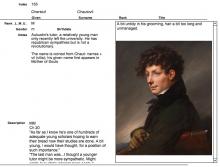
To tackle the first: hoo boy do I have research notes! Do I have them in a form that would make sense to a casual reader? Not so much. I think I've previously mentioned that I have a database for characters, locations, and key vocabulary. The character records include a reference image (if I have one) and any key bits of description that I need to keep consistent. It might include notes on where the person lives, what their background is, relevant events in their history, and other characters they have important relationships to. Here's an example of my quick-reference page for Maistir Chatovil, the tutor to Aukustin Atilliet.
But that's more for keeping track of story elements, rather than background research. For the latter, I keep things in three types of places. One is a folder of webarchive files, downloads, and images that I've collected either for immediate use or future reference. Some topics are organized in folders (alchemy, clothing, European flooding, food and dining, gemstones, universities), others are individual items that I haven't classified (pdf of "A handbook for travellers in Switzerland", notes on early 19th century Heidelberg, list of Jewish salonnieres in Berlin in the 19th century, article "revolutions and nostalgia", article: The first Muslims in England").
I also have a massive list of web bookmarks (though I'm more likely to save off pages if it's something I really think I'll use). Along with the more usual topics, I have bookmark folders named things like "historic calendars", "music and opera", and "money wages and finance".
Once I started using Scrivener for writing, I've also made use of its scrapbooking function. So I have pages of links, clips of images, extracts of texts, and so forth. I tend to use that method for details that are relevant only to a specific story because I have a different Scrivener file for each book. (One reason I don't use the Scrivener character sheets is because I don't want to deal with copying over continuing characters for each new file. Also, I need the flexibility of a database format.) An example of how I use those pages is a detailed timeline of European political events in the 1820s and 1830s, with notes about what's going on in the novels and how the two interact. Another example is a page of notes on the structure and genres of early 19th century opera, and then an outline of the two versions of Tanfrit with notes about the named songs that get mentioned in the story.
All this, of course, is in addition to the actual physical books I use for research. I love an excuse to buy history books! But the diffuse nature of my research notes means that there isn't a good way to let readers "look over my shoulder".
Now... maps. Maps are a harder question. Alpennia is like one of those hypothetical geometric shapes that can't be represented in three dimensions. From the outside, I can point to a real-world map and say, "Here's the area where the borders of Alpennia touch the real world." And from the inside, I can say, "Here's what Alpennia looks like when you're traveling in it." But it's impossible to do both at once. I can't show a map of Europe that shows Alpennia as an actual country occupying space within it. So let's split it up into the two separate questions. Here is a political map (courtesy of wikimedia) of Europe after the Congress of Vienna in 1815 (which is going to be approximately correct for the start of the novels) with a red circle identifying the approximate place that Alpennia intersects it.

So what about an internal map of Alpennia? I confess that I've sketched up initial stabs at it several times, but have never sat down and worked out exactly what the distances are. And I'm definitely at a point where I need to do that. I have a fairly solid notion of the layout of the city of Rotenek. And I know the general compass direction and general spatial relationships of key locations. For example, here's my database entry for the town of Iser:
"Town on the Rotein, about 4 hours by coach from Rotenek, but more by river as it's around a long bend. It's a key staging place for river commerce as some barges unload there and cut across land; also the stretch above it is tricky and extra hands are needed to navigate it. It's on the road back from Fallorek and is where Chustin falls ill in Mystic Marriage."
Or similarly, I know that Margerit's home town of Chalanz is at a distance to the east of Rotenek that could be traveled in a single day in high summer by a hard rider who could afford to change horses regularly, but ordinarily is more like three day's travel by coach. The enormously varied travel times based on method and resources can cover up a lot of plotting needs! Need more travel time? Make the road bad.
One reason I'm hesitant about creating a public map of Alpennia is that one never knows when one need to put a town or river somwhere. Right now, significant parts of the territory are hidden by mist. In Daughter of Mystery I knew that Jeanne's family came originally from the region of Helviz, but it wasn't until Mother of Souls that I placed it in the northeastern part of the country, just on the border and crossed by the road Jeanne and Antuniet are traveling as they return from their summer trip to Prague. There are a lot of other places that haven't been pinned down sufficiently that I'd want to write their names on a map yet. Sometimes it's good to have the details shrouded in mist. But perhaps sometime in the near future I'll draw up some vague, sketchy, incomplete representations that I can share.
Monday, February 20, 2017 - 14:58
Didn't make it to the reading and discussion yesterday? You're in luck because a recording of it is up on YouTube. I haven't had a chance to review it yet, so please be gentle if I ended up sounding ridiculous.
Major category:
PromotionPublications:
Mother of SoulsMonday, February 20, 2017 - 06:30
The current installment of working through the People/Publication/Event tags is a somewhat uncomfortable topic. One of the ways in which lesbian desire has been dismissed in literature (and then used to "prove" that lesbian behavior is sick or evil) is to take the trope of an asymmetric desiring/desired pairing and frame it as inherently non-consensual and abusive. The reasoning goes something like this. Lesbian desire always exists between an "abnormal" desiring woman and a "normal" desired woman. A "normal" woman will not be open to the erotic advances of another woman, therefore any such advances are by definition unwanted, and the "normal" partner in such a relationship must be coerced in some fashion, either physically, by power differentials, or by psychological manipulation. This framing presumes that the desiring partner is inherently disordered. Her disorder may result in genuine, sincere desire, but she will be unable to find a partner who willingly answers that desire, therefore she will be tempted into using coercion or force to satisfy it.
As can be seen from the dates below, this trope existed in parallel with the heyday of romantic/passionate friendship. What distinguished the two? The existence or implication of erotic rather than platonic love is one feature. Some of the works in this category make that plain: a passionate friendship turns destructive when it goes beyond the allowed limits--when one party becomes too exclusively possessive, tries to interfere with the other's heterosexual relationships, or initiates a more physical relationship. But to some extent, the two modes seem to have existed as part of a continuum. The specter of being deemed "predatory" may have been used to limit the aspirations of romantic friends, while the conventions of romantic friendship provided a setting which some people--in the way of all human relationships--turned to their own purposes.
Of course, we must keep in mind that these are literary examples and created to serve an author's purpose, not the characters' purposes. The full tag essay for Literary Relationships is linked here.
Literary Predatory Erotics
I've taken this label from Denise Walen's discussions. It includes non-consensual relationships, cases where a woman initiates erotic contact (or pretends to) in order to further the interests of a male character, and cases where the lesbian character is portrayed as literally monstrous.
- A Drama in Muslin (George Moore) - 19th century English novel in which a woman’s erotic desire for a woman is paralleled by physical deformity and is portrayed as outside the conventions of passionate friendship.
- A Game at Chess (Thomas Middleton) - 17th century English play in which a female character makes sexualized overtures to a woman as part of serving a man’s purpose.
- A Sunless Heart (Edith Johnstone) - Late 19th century English(?) novel including an obsessive emotional relationship in the context of a girls’ school.
- Allan’s Wife (H. Rider Haggard) - 19th century English adventure story (in the Allan Quatermain cycle) that includes a literally monstrous female character whose jealousy over the title character results in tragedy.
- Belinda (Maria Edgeworth) - 19th century English novel involving an aggressively “masculine” woman who pursues the title character romantically.
- Carmilla (Joseph Sheridan Le Fanu) - 19th century Irish novel involving a lesbian vampire.
- Christabel (Samuel Taylor Coleridge) - 19th century English supernatural poem involving a seductive female monster that targets both women and men.
- Cuck-Queanes and Cuckolds Errants (William Percy) - 17th c English play involving predatory lesbian themes.
- Dangerous Liaisons (Pierre Choderlos de Laclos) - 18th century French novel that includes an older woman expressing desire for the young woman she is setting up for (heterosexual) seduction.
- Desperate Remedies (Thomas Hardy) - 19th century English novel that includes a predatory homoerotic episode between the protagonist and her employer.
- Juliette (Marquis de Sade) - 18th century French pornographic novel involving sadistic lesbian activity.
- La Prisonniere (Edouard Bourdet) - Early 20th century French play involving a woman trapped in an obsessive lesbian relationship.
- La Religieuse (Denis Diderot) - 18th century French novel involving predatory sexual relations in a convent.
- Matrimonial Trouble (Margaret Cavendish) - 17th century English play in which a jilted woman passes as a man to try to seduce her female rival in revenge.
- Memoirs of the Life of Count de Grammont (Antoine Hamilton) - 17th century English fictionalized biography depicting a woman in charge of young maids of honor as sexually predatory towards her charges.
- Pericles (William Shakespeare) - 17th century English play with a passing incident which suggests the motif of a bawd using seduction to draw an innocent girl into prostitution.
- Regiment of Women (Clemence Dane) - Early 20th century English novel involving a destructive romantic relationship between teachers at a girl’s school.
- The Bird in a Cage (James Shirley) - 17th century English play involving one woman’s non-consensual erotic attentions to another.
- The Changeling (Thomas Middleton) - 17th century English play involving a woman’s erotic overtures to another in service of a man’s goals.
- The Girl with the Golden Eyes (La fille aux yeux d’or) (Honoré de Balzac) - 19th century French novel in which a man and his half-sister are rivals for the same woman’s love.
- The Governess (Sarah Fielding) - An English novel (1749) about how class differences turn a passionate friendship into sadistic exploitation.
- The Haunting of Hill House (Shirley Jackson) - Mid-20th century American novel that mixes themes of the supernatural and lesbian obsession.
- The Revenger’s Tragedy (Thomas Middleton) - 17th century English play involving a woman’s erotic overtures to another in service of a man’s goals.
- The Siege of Rhodes (William Davenant) - 17th century English play in which female homoerotic desire is Orientalized as well as framed as predatory.
- The Three Ladies of London (Robert Wilson) - 16th century English play in which a bawd attempts to corrupt a woman sexually to recruit her for prostitution.
- Titus Andronicus (William Shakespeare) - 16th century English play that suggests predatory homoerotics in a woman’s support of another woman’s rape.
- Upon Appleton House (Andrew Marvell) - 17th century English poem that combines anti-Catholic and anti-lesbian themes in a story about a girl rescued from a convent.
- Venus dans le Cloître (Abbe du Prat) - 17th century French erotic novel involving sexual activity in a convent.
- Volpone (Ben Jonson) - 17th c English play involving predatory lesbian themes.
Major category:
LHMPFriday, February 17, 2017 - 07:00

There have been several times in conversations on facebook groups where people threw out the question "what do you look for in a LesFic book?" My answer has often been "beautiful writing," but it can be hard to explain what I mean by that. So now I have something I can point to and say, "That's what I mean by beautiful writing in LesFic."
Minotaur by J. A. Rock isn't a book that would ordinarily have caught my attention. In fact, I bought it entirely because it appeared on the Book Clips series at The Lesbian Talk Show podcast(*). (I confess it's the first time I've bought a book based on being included in the series.) I was so impressed by what I heard that I think I pulled out my iPhone and called up the iBooks store while still sitting in my car at the end of the commute when I listened to it.
Minotaur is a fantasy. Or maybe it's a YA-ish story of adolescent rebellion in a home for wayward girls. Maybe the titular minotaur actually did terrify the town in a previous generation. Or maybe it's an urban legend, whispered among the girls at the Rock Point Girls' Home as a terrifying entertainment. Maybe Thera has a vivid imagination, or maybe the tangled imagery in the opening monolog is remnants of her being hopped up on stolen drugs. Maybe she's an unreliable narrator...or maybe she really will become a hero that slays a monster.
I read this story not knowing whether the promise of fantasy was genuine or a misdirection, and I won't spoil that aspect for other readers. At its heart, this is the story of an unwanted, neglected girl who turns herself hard to survive, then learns how to open herself again for love--both the love of friends and romantic love. The setting is a dreary, narrow-minded small town, still stuck in an era when the sympathetic counselor at the Girls' Home who shows too much affection for the girls is whispered visciously to be a "BD," which it took me a while to decode as "bull-dyke." So when roommates Thera and Alle begin exploring their tentative desire for each other, there are layers of confusion, ignorance, and despair to work through. They promise to stay together when they age out of the home, not truly believing such a thing is possible and each doubting that she is worthy of that sort of love.
As I said above, on the surface, it isn't the sort of story that usually attracts me. But the language--oh my, the language. J. A. Rock has an extraordinary command of voice, of description, of easing you into an alien world (in this case, the world of Rock Point) and making you care about the inhabitants, even when they're people you wouldn't much like in real life.
The only place where the book faltered for me was in an extended descriptive passage after the book changes gears when Thera leaves the Home. (I'm being a little cagey here to avoid spoilers.) There was a section that went on aimlessly and--dare I say--self-indulgently just a bit too long. The plot picked up again just about when I was at the edge of my patience, but I certainly wasn't sorry I kept going.
This is not a light and fluffy book. There are dark bits and violent bits and a few squicky bits. But it's solid and compelling and ultimately triumphant. (I'd consider that last a spoiler, except that too many readers of queer stories need to know they aren't going to get punched in the face by Queer Tragedy.)
(*) Full disclosure: my own podcast series "The Lesbian Historic Motif Podcast" also runs on The Lesbian Talk Show.
Major category:
ReviewsThursday, February 16, 2017 - 13:38
This Sunday February 19th at 4pm, a group of six Bella Books authors (including yours truly) will be reading and talking about why we write at Laurel Bookstore in downtown Oakland. (See link for details.) I'd love to see people there! Laurel Bookstore is incredibly convenient to public transit (literally just on top of the 12rh St BART station) and on a Sunday the parking should be easy as well.
Of course you'll want to buy some books while you're there, but as an extra enticement, I'll have some hard copies of my free story "The Mazarinette and the Musketeer" to give out.
Major category:
PromotionWednesday, February 15, 2017 - 08:00
December is filled with bitter weather, made all the sharper by the constant troop movements that undermine all efforts to settle themselves in more comfortably. There's an eternal optimism (or perhaps just dogged persistence) in how the soldiers begin throwing up semi-permanent structures at each stop only to be ordered to abandon them before they can be enjoyed.
In my final copyediting pass of these entries, I always find that some of Abiel's regular spelling idiosyncrasies have slipped past me: staid for stayed, buisy for busy, prety for pretty. No doubt I've still missed some. I've only just noticed the auto-spellcheck function in this blog editor, so perhaps that will help with my regular spelling idiosyncrasies too.
Toward the end of December, there's brief note about Abiel being appointed to serve on a Court Martial (i.e., not a specific case but as a regular participant). As I mention below, this will be an unexpected turning point in his life, although I'm reconsidering the spin put on it that I'd picked up from family folklore about the matter. More on that later as events progress.
The Diary and Letters of Abiel Teple LaForge 1842-1878
Transcribed, edited, and annotated by Phyllis G. Jones (his great-granddaughter)
Copyright © 1993, Phyllis G. Jones, All rights reserved
December 1864
[PUNCTUATION AND SPELLING ARE COPIED FROM THE ORIGINALS. EDITORIAL COMMENTS ARE IN BOLD TYPE.]
DIARY
Thursday December 1st 1864
Still fair weather. I sent a letter to my sister in the mail which went out this morning. I sent 7 letters. I was in command of the Regiment two hours today. This P.M., took out all the men who had loaded guns and fired them off. The 1st Division of our corps moved this A.M.; where they are going we do not know but suppose to Petersburg. We expect to move soon. Hard at work on my clothing for June and July. Today got those two months nearly finished.
[Note: There are a couple of cryptic references in this entry. What was the purpose of firing all the loaded guns? It doesn't sound like a target practice exercise--more like "guns shouldn't be sitting around loaded if we aren't going to use them, so we fired them to empty them out." But that's just a wild guess from context. The reference to working on clothing for June and July sounds like this may have been an inventory/supply record that Abiel is a bit behind on. This is supported by the reference to "clothing rolls" in the next entry.]
Friday December 2nd 1864
Very busy again at the clothing rolls. The fair weather with which we have been blessed for several days seems about to cease. Considerable rain fell this P.M. and the sky looks like one of those long winter storms. Still warm, however. Battalion drill this P.M. Dress Parade postponed on account of the rain. Wrote to Mrs. Anst Ogdensburg N.Y. I also wrote to Sherman Crandall. Indications of a move of men of our corps as a body. We dread Petersburg.
Saturday 3rd
Last night had orders to be ready to move at 7 O.C. A.M. today. It only broke my rest for a few minutes. I went to sleep again. We packed up with rather heavy hearts and started for the R.R. station four miles below Winchester. We could not take our pack animals on the cars with us, so we took what things we wanted for a few days with us and then sent the rest by the "overland" route, as we called it. We had rather a cold ride on the cars (box cars) but lots of fun.
Sunday 4th
Arrived at the Capitol a little after sunrise, although we are feeling rather as though we were wronged in being sent away from the Valley. Still, the joyful nature of a soldiers' disposition has overcome the feelings which tend to make them despond. They are now making lots of fun--fine lusty-limbed fellows. I wonder how many of those sturdy chaps will live to see Washington again.
Our Brigade were all embarked by one P.M. Brigade Head Quarters was on our boat the "Matilda". Besides our Regiment, the 10th Vermont Volunteers was on board. We left the wharf by 2 P.M. I stood at the bow pointing out the various places of interest to the rest who were less acquainted with the notorieties. Farewell Washington, with your magnificent public buildings, palatial residences of your aristocracy, your rich upper ten, and poor "lower thousand", your churches and haunts of iniquity, your sirens and your vices. When shall we see you again? We are bound on an expedition where hard knocks will be more plenty than good times. I was detailed as "officer of the day" to keep things in order on the boat.
[Note: Abiel sounds a bit more mindful of the statistical hazards of war than at some points in the past. Possibly a bit depressed, though it has inspired him to a rather lyrical flight of rhetoric.]
Monday 5th
Found ourselves going up James River this morning. Arrived at City Point at 10 A.M. Disembarked and moved up on the hill. Here we stacked arms and waited for the cars. While waiting, I found George Battersby. He belongs to the sanitary commission. Ezra Rounds (sister, you remember his likeness?) he has charge of the 9th Corps Commission. They wanted me to come down and stay all night with them, if the Division stayed here all night. We built fires at dark. The officers of the Regiment all got together at one end of a large wood pile and built a rousing big fire. We laid down near it and had lots of fun.
Took the cars by 8 P.M. for the front. Went up 15 miles and got off in the rear of the 5th corps, whose position in the line we are to occupy. We were short of blankets and tents as they are with the packs. The ground [was] wet, so we built up a large fire of pine boughs. The sparks in millions were soon flying high above the tallest trees. Our men cut down some trees and, breaking bushy boughs from them, soon made us a good bed to spread our blankets on. Then, after taking a drink to keep the rheumatism away, we laid down with our feet to the fire and faces to the sky, and went to sleep amid much more comfortable circumstances than one would have thought possible when we first came up.
Lieutenants Cox and Moor and seven men were left behind in Washington. They left the boat and did not get back in time to start with us. It was not right for them to leave.
[Note: I'm guessing "our men" who made up the brush beds may have been the officers' servants? Or would they be coming behind with the baggage train? I have no idea whether Abiel would have come back to the same servant he had before his leave, or whether they would have been rotated around as needed. We only had the one reference to "Mr. Griffis" by name and no sense that Abiel related to his servant as an individual, so we may not be given any clues on this point.]
Tuesday 6th
Five months ago today we left this place for "My Maryland" with light joyful hearts. Since then we have lost in battle 12 officers and some 250 men. Still we hate to return to this place where our losses were not nearly so great. We stayed there until after dark when, just as I had laid down, the order came to move. To pack up was a short job and we were soon under way. We moved about a mile, which brought us on to the ground of the 2nd Division 5th Corps. They were not to move until daylight, so we had orders to make ourselves comfortable where we were. We spread our blankets on the hard Parade Ground and without fir[e] slept very comfortably even if it was the 6th day of winter. [Note: I'm emending "fir" to "fire" on contextual grounds, but given the mention of making up pine bough beds previously, the may not be as much of a no-brainer as it appears.]
Wednesday 7th
Up and breakfasted at daylight. Did not move into our quarters until two hours after, at which time it had been raining for half an hour. The quarters into which we moved were nearly as good as those we left in the Valley. They were not quite finished yet, however. I forgot to mention that one of our new Colonel's 2nd Lieutenants arrived while we were waiting at Harpers Ferry. None of our companies were large enough to muster a 2nd Lieutenant, so this one had to shoulder his gun as a private! When we were on the boat, I saw him standing among the men and looking pretty sad, so I got him to go up in my state room and occupy one of the berths. I could see he was unused to the society in which he was thrown and felt sorry for him. Rained until after dark, then cleared off. I am stopping with Lieutenants Chilrton and Hepburn until my baggage comes down.
Thursday 8th
Morning broke fair. We were up and under arms at daybreak, merely as a precautionary measure. Pretty cold in the A.M., but warm after sunrise. At work on our new quarters. Mine are very good, but I have nothing to cover it with yet. Nothing of importance transpired today. We have not heard of the 5th Corps yet. It was sent yesterday on some movement to the left. What it was, of course, we do not know.
Friday 9th
Very cold, looks like snow. At M. [i.e., noon] the Strike Tents was sounded and we were soon ready for anything. We got out in line two hours before dark. We did not leave the camp ground until nearly dark. Very cold standing around so long, trying to keep ourselves warm. Moved out beyond our left flank towards the South Side Railroad. Found one Division of the 2nd Corps on picket there. They had been out four days. Our force consisted of the 1st and nearly all the 3rd Divisions of the 6th Corps: a Division of Cavalry and three Batteries of Artilary. We moved on beyond the 2nd Corps and about 9 P.M. camped in a bitter North East wind blowing.
Before we could make fires and get supper, a cold sleet commenced falling, so our prospect for the night was anything but inviting. Still all was not so bad. My servant put up a shelter tent, then at the back he piled some cedar brush and in front built up a huge fire in front. Then spreading our blankets down in it for a floor, it was quite comfortable. Soon, my supper consisting of fried pork, hot coffee, hard tack, and butter was set before me and I was soon immused [?] in deep thought and supper. [Note: the contextual sense of "immused" is clear but I'm not entirely certain what word Abiel is aiming for here. Possibly "immersed"?]
As I sat gazing into the fire and listening to the damp wind soughing through the waving pine tops--and occasionally giving an eye or ear to the groups of soldiers sitting around their blazing bivouac fires, wrapped in their blankets, smoking and chatting with as much unconcern as if they were surrounded by the most favorable circumstances in the world--I could not help remarking to my self, what a happy nature a soldier is blessed with! I also wished for a moment that my friends in old Allegheny could get a glimpse of my present surroundings. Then I took it back, for fear it would spoil their night's rest. Shortly after, I laid down and was soothed to sleep by the crackling fire at my side and slept very comfortably all night. My servant kept the fire going.
Saturday, December 10th
On waking this morning, I found two inches of snow, an inch of water, and six inches of mud. Very agreeable for us to be sure! After an early breakfast, we moved into line of battle, sent the Cavalry to the front, stacked arms in the snow, and kept ourselves warm until after noon. We could hear cannonading away off to the left, probably the 5 corps engaged. About 3 P.M., considerable firing was heard at our front. (I afterwards learned it was the Cavalry coming in and discharging their carbines to have them empty.) Then we got the order to move back to camp where we arrived an hour before dark. [Note: the reference to "discharging their carbines to have them empty" seems to answer my earlier question about the purpose of firing off guns.]
We went to work putting up our houses, but that was soon stopped by an order that we were to move again. After dark, we moved half a mile, up to near Fort Keen, and went into some miserable quarters, all mud and snow and not room enough for all the men. Remonstrance was useless, so we took them "as they were" and put our shelters over them. Hardly had this been done when an order came around to have the men ready to move at a moment's notice. Lots of swearing, but no good. Pack up they did, and then we stayed all night after all. I slept very cold and was up and about nearly all night. Moving around through the slush today has made me nervous.
Sunday 11th
A good breakfast this morning makes me feel much better. Thaws a very little today, no orders to move so far. I must write to sister. We have had no mail since we have been here, owing to some unaccountable reason. When one comes, I expect some letters and others. There is a rumor in camp, which I can trace to no reliable source, that this division is ordered back to the Valley, as Early has set Sheridan back. This I do not believe, although it gives the boys a good deal of satisfaction to contemplate such a possibility, for they all disliked very much to leave the place where their principal laurels have been gained.
Most of the troops on this line have erected cantonments for themselves so as to keep themselves comfortable as possible, but they cannot work with the feeling that they are to enjoy them long, for too much uncertainty envelopes all our movements at present. So they do not take as much pains as they would otherwise. Were we sure of staying we would soon have good quarters that we should not be ashamed to bring our wives and sisters to look at.
LETTER Head Quarters "I" Company 106th New York Volunteers
Near Fort Keen, Virginia, Sunday 11th December 1864
My Dear Sister,
I have as yet received no letter from you since I have been here, but this is in all probability owing to the fact that we have received no mail since I have been here. That is, not since you could have answered my other.
The old 6th Corps is soldiering in earnest again: marching, countermarching, skirmishing, sleeping in the open air, and so on. Such is life as a soldier. We know not one minute what will befall us the next. Running around the country seems to be the order of day, but when it comes to marching through the cold slush--which we have for the past two days--why it is pretty cold work.
How is the weather up there? Pretty cold, I suppose. Baby stands it well, I hope. Have you heard from father yet? How is mother and the rest of the family this cold weather? For I am sure it must be cold there.
What is the gossip of the place? Is anybody talking about my being partial to white stockings and long dresses? If they are, just tell them, they are my sentiments on the subject. As long as Janey and you agree with me, I don't care so much for the rest.
Yours in love,
A. T. LaForge
DIARY
Sunday December 11th 1864
This evening Captain Briggs and Lieutenants Cox and Moore, with 13 recruits and 20 Convalescents, came into camp tonight. They left Washington day before yesterday, stayed two nights on the boat. Cox and Moor were left by accident, they say, in the city, but had a pretty good time. [Note: see Abiel's previous comments on Cox and Moor's absence. His "they say" suggests that he's still suspicious of how accidental it was.]
Monday 12th
I slept very cold last night. I gave Cox my bed and slept in Shaw's tent on the ground. It was extremely cold and I almost froze. Tonight he must look out for himself, for I can't afford to freeze. The day has been very cold. Ice has formed over an inch thick. Pretty cold for such houses. No mail.
Tuesday 13th
Wrote to Government Claim Agent Johnson. Still very cold. No thaw. Captain Robinson came back from home today, bringing with him our new battle flag with him. It was made by a firm in New York. It is of blue silk, with the U.S. Coat of Arms in the center. The names of the battles in which we have been engaged are formed on it with yellow silk thread. They are: Fairmont, Martinsburg, Wapping Heights, Culpepper, Kelleys Ford, Locust Grove, Spottsylvania, Cold Harbor, Petersburg, Monocacy, Winchester, Fishers Hill, Cedar Creek. Also the Wilderness. Some are not mentioned. This is, I think, as good a record as most regiments can show. These are only the names of the pitched battles; skirmishes are not mentioned. The flag cost over four hundred dollars, $400.37. We expect the flag will be formally presented to the regiment tomorrow, if nothing prevents. Had Brigade Dress Parade tonight.
Wednesday 14th
The wind is from the South today and its moderating effects on the weather is felt by us all. The flag presentation did not take place. Tomorrow will see the event, I believe. We drew some clothing, of which the men were very much in need. Did not get all we wanted. Wrote to Miss Annie Porter.
Thursday 15th
Detailed for picket. Went out. Found our line ran within 400 yards of the Johnnies. It looks strange to see two lines of men, composed of men from two hostile armies, thus pacing up and down in front of each other as quietly as if deadly hate was not rancoring in the bosom of each for the other. The Rebs seemed to feel very sociable today. They came out of their lines shaking papers (the sign that they want to exchange papers, also tobacco, for coffee). Our boys were not allowed to go out to them, as our orders are very strict not to have any communications with them.
This P.M. a few shots were exchanged. One of our men was shot through the body. He had went out beyond the dead line and was shot by Mr. Rebs for it. There is a kind of understood truce between our men and the Johnnies not to fire on each other unless they pass beyond a certain line. Our boys were getting rather careless, which was the cause of the man's being shot.
Down on the left of our Division line, the Rebels breastworks come within three hundred yards of our picket line. I went out there and stood for some time, watching the enemy away off on the hills to their rear. I could see their entrenched camps gleaming in the light of our December Sun. Woe be unto us, I thought, if we have to butt against those fortifications. When I came back, I got some of the men on the reserve post which I command to put me up a pine bough bower. This they done in pretty good style, so that Captain Robinson (who is Division officer of the day) and I will be pretty apt to sleep with considerable comfort tonight.
Friday. December 16th
Another very warm pleasant day. I went into camp this morning to get my breakfast. The men are at work putting up new Shanties and making themselves comfortable. I found a letter for myself from Mrs. Annie Wallace full of kind expressions and very pleasant indeed. It is now evening and I sit down by the light of my blazing campfire to finish the record of the day.
The Rebs have been very uneasy for some reason, firing at our boys without any reason sometimes. But as soon as night set in, they ceased firing, and every thing on the lines are as quiet as if two powerful armies bent on each others destruction did not lay within hearing of each other. Behind us, within sight, our camps stretch away to the right and left. They are now full of the music of hundreds of brass bands, which we can hear as far to the right and left as the ear can reach. I can distinctly hear the band of the 106th playing their favorite pieces. How carelessly they lay there, depending on the eyes and ears, which stretch from the Army of the James away up in front of Richmond about three miles to the left of us, a line nearly 40 miles long. Verily this is an extensive picket line. I wonder what my sister would say to see me preparing to lay down with sword and pistol buckled on. But such is picket duty. We live in constant expectation of an attack, so have to be ready to spring to our feet in a second.
Saturday 17th
Had the men all under arms at 5 A.M., as that is the time the Rebs choose for their attacks. Captain Robinson, who came out as officer of the day, sent in to be relieved as he was sick. Captain Briggs came out early this A.M. to relieve him. One of the soldiers who was killed the 12th of last August, but not buried until Sept 5th, was taken up today. I think [it] is very foolish to remove a body after once being buried, It can be but little satisfaction for his friends to see the disgusting mass humanity becomes after burial. This man was the son of Dr. Johnson of Baltimore Maryland. Many soldiers, both Union and Confederate, lie buried around us in the woods, and the trees and shrubs bear evidence of the fierce conflict which was waged here for the possession of the Weldon Rail Road. One of the trees which stands near my "Sylvan Bower" was struck over 30 times, and it is but a type of the rest. Not one is here but has been hit lots of times.
Last night, an Irishman deserted from the Rebs and came over to us. He was so scared he could hardly tell us anything. He belongs to the 19th Mis[sissippi] Regiment Hills Corps. His mother lives in Boston. We sent him to Corps Head Quarters. The Rebs followed him close to our lines. Rather cold tonight.
Sunday 18th
Commenced raining a little after daylight. Cold wind from the North. We were relieved at 9 A.M. Came into camp, got a wagon, and sent out and got the timber for my house. The boys are at work putting it up. Lieutenant Cox and I are going in together. Hope we will have as fine a time as before. Quite warm yet. No word from our baggage.
Monday 19th
Pleasant warm day. The 106th is acting as picket reserve and we have to be up at 5 A.M. every morning until we have served our time at it. Very warm and pleasant, considering it is the middle of December. The men turn out and work like bees at their cantonments. They wear no coats and none are needed, it is so warm. Battery "M", which was with us up in the Valley, came to us this afternoon. Our trains probably will be here in a day or two. I wrote to Sister and George Batersby, the latter is at City Point.
LETTER
Head Quarters "I" Company 106th New York Volunteers, December 19th 1864
My Sister & Friends,
I wish you a "Very merry Christmas" to commence with, as I suppose this will reach you about the time you are celebrating that time-renowned holiday. Your fireside is not like many in the land--one of mourning for some near and dear friend who has been lost in the tide of battle--but on the contrary, one of joy, for God has preserved your circle of loved ones from death, although they may be scattered far and wide over the land. For this, I join you in thanking our great Preserver.
If nothing happens, I shall spend my Christmas in a new house. My boys are building one for me. They split pine logs, then cut them about seven feet long. These they stand on one end in a trench side by side and [the back of the letter either did not copy well or was poor to begin with and has not been transcribed.]
[New page of diary duplicates entries for Dec. 18th and 19th.]
Sunday 18th
Relieved and came in from picket at 9 A.M. Commenced raining a little after daylight, not much. One hundred guns was fired from our right, in honor of the late successes under Thomas and Sherman. I commenced work on my shanty today. The Chaplain came around where we were at work and I asked him if it was wrong to do necessary things on the Sabbath?
"Whatever thy hand findeth to do, do it with all thy might," said he, and walked off.
So I continued at the work, or rather superintending it.
Monday 19th
The news from the West is glorious. Thomas is driving the enemy before him, "Like the hare before the beagle". The Union horizon looks brighter than it has for many days. Captain McBroom returned to the regiment from Camp Rendezvous of Distribution. He reminds me that Sergeant Beaugureau's time is nearly out, so if I want a letter to reach him at Camp I must write soon.
Tuesday 20th
The flag presentation has not yet came off. The officers are delaying it until they have a house finished for Regiment Head Quarters so that they can have a kind of spree after it is over, I suppose. I wrote to George Battersby, U.S.S. Commission, and to Captain H. Burrows, General Banks' Staff today. Looks like rain, and a rain is sure to bring on cold weather now.
Wednesday 21st
Raining this morning when I woke up. Rained until M. [i.e., noon] then began to grow cold and is now freezing. I have drawn clothing this month on the 14th, 18th, and 21st inst[ance]s. C. Snyder 1st Lieutenant got a leave of absence for 15 days and left for Washington this M. The Quarter Master is going down to City Point to see if our baggage has come, and to bring it up if it has. He will do his best, I warrant.
Thursday 22nd
Froze up hard last night, very cold today. I have been here now nearly a month. Have written home three times, and as yet not had a word in reply. I think I shall stop writing until I learn whether there is anybody to reply to my letters. I confess I feel rather vexed that I can get plenty of letters from every other place but from those I most desire to hear from. I don't see what is the matter. I wrote to Beaugureau. I think he will get my letter before he leaves camp. Very cold.
Friday 23rd
Still very cold. The report is that the 8th Corps is here from the Valley and that the 9th Corps is shipping for this place also. If such is the case, I rather think General Grant will soon be trying to see if he can't induce General Lee to let go his hold on Petersburg. Once set back from here and Richmond, and I believe we could keep him running. The Quarter Master has returned from City Point. Our baggage has not came yet, nor any news of its coming yet. I was up at Head Quarters and a tremendous cheer was set up by the 2nd Corps. We learned that it was caused by a deserter's coming in and saying Savannah had fallen. Our rations are very short. The men have scarcely enough to eat. [Note: Savannah surrendered to General Sherman on December 20.]
Saturday 24th
Still cold. An official report came down that Sherman had captured Savannah, with General Harde and between 15 and 18 thousand prisoners. This is a most gratifying report. I hope it may prove true. Things look bright. Wrote to Mrs. Wallace.
Sunday December 25, 1864
Christmas Day has passed off very quietly, much more so than it would have done had our men received their pay for the last two months. As it was, they had very little money and temperance was forced upon them. How few among the thousands who have celebrated this holiday have given serious thought to the manner of its origin? A painful meaning, and still a hopeful one it has for the Christian believer.
The recent cold weather has had the effect of cooling off the loyalty of the rebel soldiers to their government. They are deserting to our lines in large numbers daily.
Received a letter from my sister. Also one from Uncle John. It was enclosed in the one from sister, but she made no comments upon it, although there was several subjects which I know she must have objected to. Uncle, I am afraid, is a little Copperheadish in his views, as he opposes the administration somewhat. I received communications from the Ordnance Office that my returns for Companies "I" and "F" had been received and found correct. Have not touched a drop of liquor today. Only smoked twice. [Note: The Copperheads were a political party in the north that opposed the war.]
Monday 26th
Wrote to Perry Potter last night. Letter will not go until tonight. I have had my house finished and gave the boys a canteen of whiskey for their work. I could move in now, if my tents were only here, but they are still up to Washington. Lieutenant Snyder writes that they are loaded and the boat froze in below Washington, so of course we will not get them for some time yet.
I reduced 1st Sergeant Hungerford to Sergeant and promoted Sergeant Wilder in his place. I also reduced Sergeant Munroe to the ranks for his long continued absence and promoted Corporal Cook in his place, and promoted private Labrake to Corporal in Cook's place. The officers are going to work in dead earnest to keep Colonel Barney--who is one of Seymour's creatures--and his officers from coming to the regiment. If we can only succeed in keeping them away until Fenton takes the Gubernatorial chair, we can get new commissions in their place. Then getting commissions for the field officers creates a "pisen difficulty" ["poison difficulty"?] in our regiment. There is too much confounded jealousy, what with officers who want to jump others--and others who don't want to [be] jumped. They succeed in keeping themselves in hot water. The probability is that Captain Briggs, who now commands the regiment, will recommend Major McDonald and himself for Lieutenant Colonel and Adjutant Robinson for Major. This last, Captains McBroom and Robinson object to being jumped by, and Adjutant is not what they like.
Rained last night and some to day.
[Note: I'm having a little trouble following the details of the promotion politics described here. But the general sense is that favoritism in promotions is causing disgruntlement at all levels of the regiment.]
Tuesday 27th
Rained some last night, but pleasant today. Just got my house all ready to move in, and tonight the order has came for us to move out and give place to the 67 P[ennsylvania] V[olunteers]. We go to the camp we went into when we first came here. Well, there is no use of swearing. If there was, I am very much afraid I should indulge.
General Seymour, Commanding Division, has issued orders that all men and officers must wear the proper badges. The men must wear caps and non-commissioned officers must wear the proper chevrons, and commissioned officers must wear their proper insignia of office. Any found disobeying these orders will be at once arrested and tried by court martial. All this is very good, but when he comes to moving us about without any apparent reason, although they must be obeyed, still we murmur some. Having to move just as we should be at work on our rolls too, makes it worse.
The sun set beautifully to night. Looks as if we should have a pleasant day tomorrow. I came near forgetting to mention that an order came for us to recommend our enlisted men, who have distinguished themselves for bravery, for badges of honor. But our boys are all so brave that we could not recommend some without doing injustice to others, so we sent up the names of none.
Wednesday 28th
Moved camp at 8 A.M. Considerable swearing. Found quarters enough to crowd the men into for one night. Lieutenant Cox and I took one of his company shanties until we could build a new one, which the boys are willing to do for us. Our baggage came this P.M. and I have been at work on my company accounts until the present moment 10 P.M. Had a letter from Mrs. Green thanking me for getting blanks sent her from Washington to enable her to get the monies due her husband from the U.S. Government. Commenced raining while we were on Brigade Dress Parade. Has rained considerable since.
Thursday 29th
Have been at work on Payrolls nearly all day. Very cold tonight. Cox and I feel very much at home in our own house--much better than living with anybody else. The Adjutant and Lieutenant Chilton each got 20 day leaves today. They will not start home until Monday, on account of muster days being so close at hand. I shall work quite late so as to get the rolls done for the Adjutant to take to Washington.
Friday 30th
My boys are again at work making me a new shanty. I wonder if I shall have to leave it like the other. At work most of the day on the Rolls. Sent my Quarter Master Returns for June and July to Washington. Received a letter from Captain Burrows of Banks' Staff. The young ladies he and I visited while I was in the city send their respects to me. Very kind! I was detailed tonight as a member of a court martial, which commences its sittings next Monday. I expect to get some valuable information while a member of it. A detail for me to act as brigade Officer of the Guard tomorrow. Looks like rain. I'll bet I have a bad day for duty. Nothing uncommon for the time of year.
[Note: Abiel being appointed to serve on the court martial will have significant consequences for the remainder of his life, though the precise nature of the connection is susceptible to debate. I'll discuss it further when the time comes.]
Saturday 31st
Rained A.M. and sleet (very cold) P.M. Old Tom came from Washington with the mule he has got. Our Billy is here all right now, and we cannot keep him after all. Too bad entirely I vow. [Note: I'm not sure I have the preceding sentence parsed correctly. The transcription has essentially no punctuation. Is "Billy" also a mule? Who is Old Tom? Who exactly is it that they can't keep after all? Mysteries abound.]
Could not finish my shanty today, it was so cold. Finished the rolls, and had monthly inspection, and were mustered for pay. My Pay Rolls were the first finished.
My duties as Brigade Officer of the Day have been very light. I cannot help feeling a little vain to learn, as I did today, that my bravery at Winchester was a subject of comment among the officers of the Regiment for a long time. It has been told to others and I find I am considerably known by reputation.
Our usual quiet was disturbed this morning by the Rebs making a dash on our picket line and capturing some of our men. It was before daylight and people thought there was a general attack. Lieutenant Cox rolled over me and said the Rebs were making an attack on us. I listened a moment, made up my mind it was not much, and composed myself to sleep again, as I did not go to bed until late last night. One of the Rebs deserted to our lines and says Lee intends to astonish the world by an attack on our lines tomorrow morning. He will astonish me if he does it.
Received letter from Annie Porter. Answered it.
[Note: There's a part of me that takes satisfaction in Abiel's own satisfaction at having his leadership recognized. Why shouldn't he be "a little vain"?]
Major category:
LaForge Civil War DiariesTuesday, February 14, 2017 - 08:56
Alpennia is all about challenging and subverting default paradigms and tropes, simply by its existence and by the people and stories it focuses on. But it can be tricky to have the characters themselves challenge those paradigms without falling into the trap of pausing for set-piece speeches. Consider, for example, the problem of both portraying and challenging the types of social prejudice endemic to early 19th century Europe without turning my characters into 21st century progressive activists. Even those who were addressing racial, religious, and class issues in that era often did it in ways we'd consider wince-worthy today. And it was functionally impossible for people of that era to think about gender and sexuality in ways that my readers would consider truly enlightened.
So it's not uncommon for the "challenge" on the page to struggle to break free of simply identifying and acknowledging the problem. Luzie ponders how the working class in Rotenek would view all the grand ceremony around mysteries that are intended to benefit them just as much as to benefit the intellectuals and upper class participants who perform them. She has no answers, but we see her recognizing the problem. Akezze regularly tries to push Margerit to understand that the solutions she devises to the question of women's eduction are excluding groups that have barriers she hasn't considered. Antuniet and Jeanne consider Anna Monterrez to be almost like an adopted daughter, without understanding how the religious divide feels from her side, and how carefully she has to balance on that line to be accepted.
One default paradigm that Mother of Souls addresses is that of the standard romance plot. But even when the characters acknowledge the tyranny of that plot, they often seem helpless to challenge it effectively. Serafina watched the illusion of a romantic marriage die slowly, but she hasn't entirely shaken free of the assumption that the ideal form of love is a permanent partnership. The author (no spoilers!) of that annoying roman a clef that causes Barbara and Margerit so much trouble operates from two deep-rooted paradigms: that a close affectionate partnership must be completed by romance...and that a romance must be heterosexual. Our heroines' lives deny the latter, but fail to challenge the former.
When Luzie and Serafina start hammering out the plot for the opera Tanfrit, they butt heads over the question of a romance plot. Luzie knows opera; the shape of the genre absolutely requires it. Serafina only reluctantly surrenders a concern for historical authenticity (to the extent that the concept is even meaningful in opera!) and the contradictory evidence of both their lives. The finished work is a carefully crafted piece of art, but when Luzie falls into metaphoric thinking--into reasoning about the world from the internal rules of their own creation--Serafina reins her in. Tanfrit is fiction, not fact, and as fiction it follows the shape its creators gave it. Taking that shape and considering it to reflect eternal verities of the world leads to error. (Just how complicated those errors are will--I hope--eventually be made clear if/when I write the Tanfrit novel.)
This is the last teaser for Mother of Souls. (The chapter is followed only by a coda that echoes the opening prelude...and contains some very vague hints for Floodtide.) I'll have to think a bit about what sort of writing-related blogging I want to do for the next season.
Chapter 32: Luzie
The scene where Gaudericus refused Tanfrit’s gift of the forbidden book had been expanded and rewritten. Now they both came to realize it was learning, not power, they sought. And in a soaring duet they reject and refuse all sorcery, consigning the text to the fire and pledging themselves to seeking only wisdom and knowledge. That was the heart of the mystery, where the power of the music, amplified through the attention of the audience, would strike out against the…the whatever it was they were fighting. A blow that might be unneeded or might be their last hope of success. In the opera, the moment was Tanfrit’s glorious triumph before her tragic fall, when Gaudericus refused to return her carnal love. And then, as before, the river, the flood, the remorse, the dedication.
She saw that finale differently now.
“Serafina?”
“Yes?” Serafina turned, her hands still trying silently to guide the musicians to her vision.
“It was a tragedy—that Gaudericus couldn’t love her the way she wanted—but it wasn’t wrong. It was only his nature. Serafina, promise me you’ll never throw yourself in a river. Not for me. Not for anyone.”
Serafina looked confused for only a moment, then said solemnly, “I promise I’ll never throw myself in the river. But never forget that we wrote that story. We chose that ending. We don’t know what was truly in their hearts. We don’t even know that Tanfrit really did drown herself.”
That wasn’t what she’d meant. Luzie swallowed hard and tried once more. “I want you to find…to find what you’re seeking. I wish I could have been it.”
Major category:
TeasersPublications:
Mother of SoulsPages
