Blog
Monday, October 28, 2019 - 07:00

I sometimes feel a twinge of guilt when I skip over chapters of books, or articles in collections, with the commen "not relevant to the Lesbian Historic Motif Project." I shouldn't feel that way. The entire project is an exercise in highly subjective filtering of content for what interests me personally. Sometimes chapters or articles aren't relevant to the Project but I find them fascinating enough to write them up anyway. And yet, I twinge.
Major category:
LHMPFull citation:
Cadden, Joan. 1993. Meanings of Sex Difference in the Middle Ages: Medicine, Science, and Culture. Cambridge: Cambridge University Press. ISBN 0-521-48378-6
Chapter 5: Sterility
The concepts and theories around in/fertility have shifted over the centuries much as those around sex/gender. Medieval authors were highly preoccupied with childbearing and anything that helped or impeded it. The expression of this concern was closely connected to theories of reproduction. Medieval treatments for infertility followed from the varied theoretical understandings of the process of conception and gestation.
Procreation was not only an individual concern but a familial one, as social ties, economic strength, and other consequences depended on the production of children. Surplus children presented a different set of difficulties so despite official disapproval of contraception, knowledge about how to avoid pregnancy was also desired.
Sterility might, in an individual instance, be considered an innate property or a fixable condition. The question of the female role in conception affected understandings and treatment of infertility.
But the topic of this chapter is largely outside the scope of the LHMP so I’m skipping a detailed summary of the rest.
Time period:
Place:
View comments (0)
Saturday, October 26, 2019 - 07:00
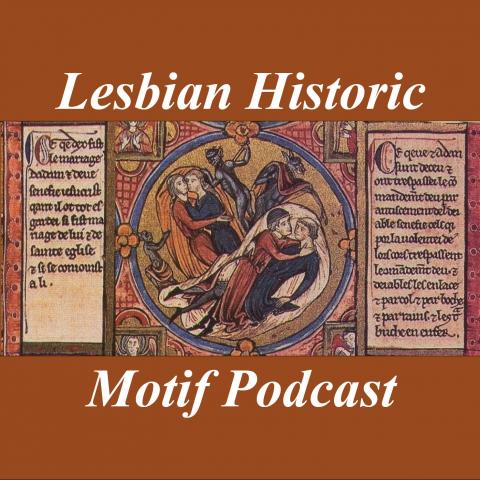
I needed a breather from recording and editing new episodes this month, so I’m reprising a series of episodes on poetry about love between women. If you’ve been a podcast listener from the very beginning, I hope you enjoy them just as much as you did the first time. And if this is the first time you’ve heard these episodes, you have a real treat coming!
This is a reprise of Episode 3 - The Goblin Market, which originally aired on 2016/10/29.
* * *
Lesbian Historic Motif Podcast - Episode 39d - The Goblin Market (Reprise) - transcript
(Reprise aired 2019/10/26 - listen here)
Sheena had an idea to do a collection of Halloween themed podcasts from all the regular contributors to the Lesbian Talk Show, so I wanted to come up with a special Lesbian Historic Motif episode. It took me a while of brainstorming before I hit on a topic: Christina Rosetti’s poem “The Goblin Market”.
Rosetti was part of a talented family of Italian immigrants to England in the mid 19th century. Her father was a painter, but the more famous painter in the family was her brother Dante Gabriel Rossetti, who was one of the founders of the Pre-Rafaelite Brotherhood, a movement known for medievalism and sensuality. Another brother and a sister were writers. And Christina’s mother, Frances Polidori, was the sister of John Polidori, a close friend of Lord Byron and the author of what may be the first modern vampire story. (You see, lots of Halloween references.)
The Goblin Market indulges in a number of long flights of description. But before reveling in the beauty of the language, I want to focus specifically on the erotic imagery. So I’ll start by alternating excerpts from the poem with a synopsis of the overall story.
Two sisters, cautious Lizzie and daring Laura, encounter the goblin men who sell mysteriously tempting fruits.
Morning and evening
Maids heard the goblins cry:
“Come buy our orchard fruits,
Come buy, come buy:
There is a long catalog of the fruits they sell, and then we meet the sisters:
Evening by evening
Among the brookside rushes,
Laura bow’d her head to hear,
Lizzie veil’d her blushes:
Crouching close together
In the cooling weather,
With clasping arms and cautioning lips,
With tingling cheeks and finger tips.
“Lie close,” Laura said,
Pricking up her golden head:
“We must not look at goblin men,
We must not buy their fruits:
Who knows upon what soil they fed
Their hungry thirsty roots?”
“Come buy,” call the goblins
Hobbling down the glen.
Lizzie warns her sister not to take the goblins up on their offered wares and continues on home, but...
Laura stretch’d her gleaming neck
Like a rush-imbedded swan,
Like a lily from the beck,
Like a moonlit poplar branch,
Like a vessel at the launch
When its last restraint is gone.
Definitely a description of someone giving in to temptation! Laura doesn’t have a coin to buy the fruit so instead they demand a lock of her golden hair in payment. Hair had a strong sexual symbolism in the Victorian era, and for a girl to give a man a lock of her hair was practically the next thing to handing him her virginity.
She clipp’d a precious golden lock,
She dropp’d a tear more rare than pearl,
Then suck’d their fruit globes fair or red:
Sweeter than honey from the rock,
Stronger than man-rejoicing wine,
Clearer than water flow’d that juice;
She never tasted such before,
How should it cloy with length of use?
She suck’d and suck’d and suck’d the more
Fruits which that unknown orchard bore;
She suck’d until her lips were sore;
Then flung the emptied rinds away
Lizzie scolds her when she gets home, and reminds her of the cautionary tale of their friend Jeanie:
Do you not remember Jeanie,
How she met them in the moonlight,
Took their gifts both choice and many,
Ate their fruits and wore their flowers
Pluck’d from bowers
Where summer ripens at all hours?
But ever in the noonlight
She pined and pined away;
Sought them by night and day,
Found them no more, but dwindled and grew grey;
This is foreshadowing Laura’s fate. Even as she scoffs at Lizzie’s warning, she says:
I ate and ate my fill,
Yet my mouth waters still;
To-morrow night I will
Buy more;” and kiss’d her:
“Have done with sorrow;
I’ll bring you plums to-morrow
Laura describes for Lizzie all the delicious goblin fruits she’ll bring back to share, and then they go to bed together.
Golden head by golden head,
Like two pigeons in one nest
Folded in each other’s wings,
They lay down in their curtain’d bed:
Like two blossoms on one stem,
Like two flakes of new-fall’n snow,
Like two wands of ivory
Tipp’d with gold for awful kings.
Moon and stars gaz’d in at them,
Wind sang to them lullaby,
Lumbering owls forbore to fly,
Not a bat flapp’d to and fro
Round their rest:
Cheek to cheek and breast to breast
Lock’d together in one nest.
The next day they go about their usual chores, but Laura’s mind is elsewhere. And as they walk home in the evening, she listens for the calls of the goblins in vain. Lizzie can still hear the goblins, which day by day drives Laura to distraction.
So crept to bed, and lay
Silent till Lizzie slept;
Then sat up in a passionate yearning,
And gnash’d her teeth for baulk’d desire, and wept
As if her heart would break.
Laura begins to pine and waste away, just like Jeanie did. Her golden hair grows dull and thin, her spirit fades, she has “sunken eyes and faded mouth”. She stops eating and sits listlessly in a corner.
Lizzie watches her sister decline and decides the only option is to go buy goblin fruit to revive her, even though Lizzie is afraid of what price she might pay.
Till Laura dwindling
Seem’d knocking at Death’s door:
Then Lizzie weigh’d no more
Better and worse;
But put a silver penny in her purse,
Kiss’d Laura, cross’d the heath with clumps of furze
At twilight, halted by the brook:
And for the first time in her life
Began to listen and look.
The goblins come to meet her and not only offer her fruit but harass her physically:
Hugg’d her and kiss’d her:
Squeez’d and caress’d her:
Stretch’d up their dishes,
Panniers, and plates:
“Look at our apples
Russet and dun,
Bob at our cherries,
Bite at our peaches,
Lizzie tosses them her silver coin and holds out her apron for the fruit, but the goblins keep urging her to eat them, right there and then. When she steadfastly refuses, they turn nasty. It’s a bit reminiscent of street harassers when rebuffed. And the goblins try to force Lizzie to consume the fruit in a scene that feels a lot like sexual assault.
One call’d her proud,
Cross-grain’d, uncivil;
Their tones wax’d loud,
Their looks were evil.
Lashing their tails
They trod and hustled her,
Elbow’d and jostled her,
Claw’d with their nails,
Barking, mewing, hissing, mocking,
Tore her gown and soil’d her stocking,
Twitch’d her hair out by the roots,
Stamp’d upon her tender feet
Held her hands and squeez’d their fruits
Against her mouth to make her eat.
Lizzie holds steadfast against this assault and is described as a citadel being unsuccessfully besieged.
One may lead a horse to water,
Twenty cannot make him drink.
Though the goblins cuff’d and caught her,
Coax’d and fought her,
Bullied and besought her,
Scratch’d her, pinch’d her black as ink,
Kick’d and knock’d her,
Maul’d and mock’d her,
Lizzie utter’d not a word;
Would not open lip from lip
Lest they should cram a mouthful in:
But laugh’d in heart to feel the drip
Of juice that syrupp’d all her face,
And lodg’d in dimples of her chin,
And streak’d her neck which quaked like curd.
Having successfully resisted eating the fruit, Lizzie hurries homeward because, of course, she does have goblin fruit to bring home to Laura--the fruit that the goblins have smeared all over her while trying to make her eat.
She cried, “Laura,” up the garden,
“Did you miss me?
Come and kiss me.
Never mind my bruises,
Hug me, kiss me, suck my juices
Squeez’d from goblin fruits for you,
Goblin pulp and goblin dew.
Eat me, drink me, love me;
Laura, make much of me;
For your sake I have braved the glen
And had to do with goblin merchant men.”
Somewhat belatedly, Laura realizes that Lizzie might end up sharing her fate for trying to save her.
Laura started from her chair,
Flung her arms up in the air,
Clutch’d her hair:
“Lizzie, Lizzie, have you tasted
For my sake the fruit forbidden?
And then, not from the addictive hunger for goblin fruit, but in gratitude and fear:
She clung about her sister,
Kiss’d and kiss’d and kiss’d her:
Tears once again
Refresh’d her shrunken eyes,
Dropping like rain
After long sultry drouth;
Shaking with aguish fear, and pain,
She kiss’d and kiss’d her with a hungry mouth.
Laura kisses Lizzie and in the process consumes the juice of the goblin fruits. But that juice has been transformed by Lizzie’s selfless deed.
Her lips began to scorch,
That juice was wormwood to her tongue,
She loath’d the feast:
Writhing as one possess’d she leap’d and sung,
Rent all her robe, and wrung
Her hands in lamentable haste,
And beat her breast.
The fruit burns within her and Laura falls into a swoon. All through the night, Lizzie tends to Laura as if she were in a fever, but when morning comes:
Laura awoke as from a dream,
Laugh’d in the innocent old way,
Hugg’d Lizzie but not twice or thrice;
Her gleaming locks show’d not one thread of grey,
Her breath was sweet as May
And light danced in her eyes.
The poem ends with Lizzie telling the frightening cautionary tale to the next generation. A tale appropriate for a Halloween night.
Laura would call the little ones
And tell them of her early prime,
Those pleasant days long gone
Of not-returning time:
Would talk about the haunted glen,
The wicked, quaint fruit-merchant men,
Their fruits like honey to the throat
But poison in the blood;
(Men sell not such in any town):
Would tell them how her sister stood
In deadly peril to do her good,
And win the fiery antidote:
Thus, the fruit-inspired sensuality has been left behind, as in a fever dream. The sisters have settled down to live conventional lives. What remains is the memory of the deep devotion that risks its life for the beloved.
Despite the rather striking homoerotic imagery in her poem, there is no evidence that Rossetti’s relationships with women went beyond sisterly devotion. On the other hand, she received three proposals of marriage from men and rejected them all so who knows? But my interest here isn’t on Rossetti’s personal life, rather on the strongly sensual imagery in her poem, depicting an intense devotion between two sisters that is expressed in language more suited to lovers.
The Goblin Market’s sensuality--not only the intense kissing and the more subdued scenes of cuddling in bed or “clasping arms and tingling finger tips”--occurs not only in the context of sisterly devotion, but also in scenes where the goblins tempt the women with their sinister fruit, or even try to force it on them. There isn’t a clear correspondence of the sensual with the forbidden.
This was an era when the trope of decadent lesbian sensuality tinged with the supernatural was becoming “a thing”, though primarily among male writers. Samuel Taylor Coleridge’s “Christabel” is a long supernatural-themed poem with lesbian elements that were strong enough to get it condemned as obscene. The content falls in the “monstrous seductress” genre where the noble maiden Christabel encounters the mysterious Geraldine in the forest and brings her home to her father’s castle where Geraldine has a strange and sinister influence on all she encounters. Christabel shares her bed with Geraldine and the significance of this is emphasized with descriptions of disrobing and embraces.
Beneath the lamp the lady bowed,
And slowly rolled her eyes around;
Then drawing in her breath aloud,
Like one that shuddered, she unbound
The cincture from beneath her breast:
Her silken robe, and inner vest,
Dropt to her feet, and full in view,
Behold! her bosom and half her side—
A sight to dream of, not to tell!
O shield her! shield sweet Christabel!
Yet Geraldine nor speaks nor stirs;
Ah! what a stricken look was hers!
Deep from within she seems half-way
To lift some weight with sick assay,
And eyes the maid and seeks delay;
Then suddenly, as one defied,
Collects herself in scorn and pride,
And lay down by the Maiden's side!—
And in her arms the maid she took,
But Geraldine’s eventual goal is not to win Christabel but to supplant her in her father’s affections. The poem shares with the Goblin Market a supernatural force that causes the innocent woman to waste away. But here there is no sister to save her.
The same process of wasting away by the influence of a supernatural intruder who feigns same-sex affection occurs in Sheridan LeFanu’s vampire novel Carmilla. Carmilla appears at the residence of the protagonist in the guise of a young woman, said to be something of an invalid. Despite Carmilla telling little of her background, the two girls become close.
She used to place her pretty arms about my neck, draw me to her, and laying her cheek to mine, murmur with her lips near my ear, "Dearest, your little heart is wounded; think me not cruel because I obey the irresistible law of my strength and weakness; if your dear heart is wounded, my wild heart bleeds with yours. In the rapture of my enormous humiliation I live in your warm life, and you shall die--die, sweetly die--into mine. I cannot help it; as I draw near to you, you, in your turn, will draw near to others, and learn the rapture of that cruelty, which yet is love; so, for a while, seek to know no more of me and mine, but trust me with all your loving spirit."
And when she had spoken such a rhapsody, she would press me more closely in her trembling embrace, and her lips in soft kisses gently glow upon my cheek.
...
In these mysterious moods I did not like her. I experienced a strange tumultuous excitement that was pleasurable, ever and anon, mingled with a vague sense of fear and disgust. I had no distinct thoughts about her while such scenes lasted, but I was conscious of a love growing into adoration, and also of abhorrence. This I know is paradox, but I can make no other attempt to explain the feeling.
...
Sometimes after an hour of apathy, my strange and beautiful companion would take my hand and hold it with a fond pressure, renewed again and again; blushing softly, gazing in my face with languid and burning eyes, and breathing so fast that her dress rose and fell with the tumultuous respiration. It was like the ardor of a lover; it embarrassed me; it was hateful and yet over-powering; and with gloating eyes she drew me to her, and her hot lips traveled along my cheek in kisses; and she would whisper, almost in sobs, "You are mine, you shall be mine, you and I are one for ever." Then she had thrown herself back in her chair, with her small hands over her eyes, leaving me trembling.
Other works from the mid 19th century that carry this association of sensuality between women tinged with a mysterious and malevolent decadence include Honoré de Balzac’s The Girl with the Golden Eyes, and Théophile Gautier’s Mademoiselle de Maupin. All these works have two things in common that contrast with The Goblin Market: they are written by men, and the sensual relationship shown between the women is destructive and a source of guilt rather than being a source of redemption.
Christina Rossetti’s work comes out of an entirely different tradition: that of Romantic Friendship, where close emotional relationships between women were idealized and valorized. Such relationships were not considered to partake of sexuality--though we know that in some cases they did. Within the Romantic Friendship tradition, descriptions of sisters cuddling together in bed or kissing passionately would not have been considered sexual, as such, and so could be portrayed without any sense of self-consciousness or guilt.
The Goblin Market is easily interpreted as an allegory--though an allegory for what is debatable. A Christian interpretation is certainly possible, with its themes of temptation, of a fall, and of redemption through an innocent person’s suffering on behalf of another. It’s also possible to see it as an allegory for drug addiction, and it’s thought that that part of the poem may have been inspired by Rossetti’s work at a charity house for former prostitutes--a context where she may have seen the effects of addiction to drugs or alcohol. Alternately, it can be viewed as an allegory of predatory male sexuality and sexual trauma. It’s worth noting that the goblins are referred to consistently as male and no other male characters figure in the poem.
Given all these considerations, interpreting the sensual imagery and passionate embraces of the poem as depicting lesbian eroticism is not entirely unproblematic. These complexities are always present when modern readers try to find connections with literature from another era.
And now, an entertainment for the night of Halloween, when pathways open up between the worlds, and someone who lingers on the path at twilight may hear goblins calling out, “Come buy, come buy.”
The Goblin Market, by Christina Rossetti, published in 1862 and read by Heather Rose Jones
[The text of the poem has not been included in this transcript. It can be found in many places on the web, including the following page belonging to the Poetry Foundation: https://www.poetryfoundation.org/poems/44996/goblin-market]
Show Notes
This is an analysis and recitation of the poem “The Goblin Market” by Christina Rossetti, with special attention to its homoerotic themes.
Links to the Lesbian Historic Motif Project Online
- Website: http://alpennia.com/lhmp
- Blog: http://alpennia.com/blog
- RSS: http://alpennia.com/blog/feed/
- Twitter: @LesbianMotif
- Discord: Contact Heather for an invitation to the Alpennia/LHMP Discord server
- The Lesbian Historic Motif Project Patreon
Links to Heather Online
- Website: http://alpennia.com
- Email: Heather Rose Jones
- Twitter: @heatherosejones
- Facebook: Heather Rose Jones (author page)
Major category:
LHMPThursday, October 24, 2019 - 07:00

I'm drafting up entries for an Alpennia FAQ based on either overt or implicit questions I get asked about the books. Since this week is asexual awareness week, I thought I'd post the question about sexual content in the books. Because some people get confused about the difference between books that don't include explicit sex scenes and books about characters who don't have sex.
* * *
Content: Do the Alpennia books have sexual content?
The novels and all the short stories that have been written to date do not have on-page explicit sexual content. It is clearly communicated if and when the characters have sexual relationships, and there are scenes involving sharing a bed with an implication that sexual activity has occurred (or will occur). My intent is to continue this mode for the rest of the novels, but some of the short fiction will include more explicit content. Because I've established "no on-page sex" as the default for the series, any stories that do include sex scenes will have a content note to indicate that.
There are two main reasons why I took this approach. First, one of my literary models for the series was Georgette Heyer’s Regency romances. While the current historical romance field has moved on to expecting explicit sex scenes as the default, that isn’t the literary tradition that inspired me. I made a stylistic choice to evoke a particular mood. The second reason is that, as an asexual writer, I’m not entirely comfortable yet with my ability to write good, believable sex scenes. It’s a skill I’m working on acquiring and there’s no reason I shouldn’t be able to. Being an atheist hasn’t gotten in the way of writing believable religious characters (at least so I’ve been told). But explicit sexual content isn’t something that I need as a reader to enjoy a book, and the Alpennia series was--first and foremost--a project to write the books I wanted to read that no one else was writing.
The books do include a viewpoint character who is on the asexual spectrum, and there is a minor character who will later be made explicit as aromantic. My characters occupy a very wide range of sexualities. The lack of on-page sex is not a reflection of their sexuality, but of my choice as the author.
If you find it impossible to enjoy a book, or to believe in the “chemistry” of a romantic couple unless you see them having sex on the page, then it’s possible that the Alpennia series isn’t for you. All I ask is that you don’t claim that the books are badly written because of that one factor.
Major category:
Writing ProcessTuesday, October 22, 2019 - 14:28

Have you ever been on one of those road trips where you're driving all night and it feels like there's nothing left in the universe but you and the road? When time loses all meaning? When past and future merge into an endless now? Now imagine you're in a boat, moving through the flooded streets. That was the feeling I was aiming for in this passage.
Today's blog was a little delayed in getting posted because the activities for the Sirens Studio sessions started early and I'd managed to sleep up to my alarm, thank goodness. I've written up the next FAQ blog for later in the week as well, then I'll be set until next Tuesday. Sirens is a different experience this year -- I really do know a lot of other attendees this time, not only from last year, but from connecting at other events over the year. I'm swinging back toward thinking maybe I'll come back next year.
* * *
By the time it was full dark, we’d worked a path from the rivermen’s street across the warehouse district with its tenements and taverns. Then we set up lanterns at either end of the boats and kept going. I could only imagine how small a part of the lower city we’d seen so far.
Throughout the night we moved along dark waterways that had once been streets, looking for watchers who signaled where to tie up for our next stop. Then there would be another crowded room, just like the last one.
...
It was easier after dawn when it was light again, though there’d been hours when I thought it would never come. I stopped remembering faces. I stopped remembering almost everything, at least, how it connected together. There are bits and pieces I still recall. It’s like one of those paintings that has so many little details it looks like real life, but it’s flat and fixed, with nothing moving. I remember how, more and more, the word had run ahead of us. Especially at night, as the oars splashed slowly down the street, feeling for the depth of the water to make sure we didn’t run aground, there would be a string of lanterns held up to light our way and show us the safe path.
Major category:
TeasersPublications:
FloodtideMonday, October 21, 2019 - 09:00
The blog goes on, even when I'm posting it from an airport boarding lounge. This week will be the Sirens conference on women in fantasy literature. Next week will be a family get-together for my father's 90th birthday. So this past weekend I was scrambling to make sure that everything was set up for the blog and podcast for the next several weeks so I can pretend to be on an actual "vacation". The only time the LHMP has been on posting-vacation since the start back in June 2014 was when I was migrating the Project from my old Live Journal to this site and my webmasteres forbade me from creating new content during the process.
Chapter 4 of Cadden cuts directly to the more fascinating aspects of medieval gender theory: the layers of conflicting and even contradictory models, and the ways in which authors justified or dismissed those apparent contradictions, or the places where their theories led to observably false conclusions. In the end, despite the appearance of logical argument and observation-based theory, medieval philosophers had a fixed notion of How The World Worked and their goal was to create a systematic explanation of those pre-existing conclusions. This applied to gender and sexuality just as much as it did to all the astronomers who designed ever more elaborate orbital epicycles to support a geocentric cosmology. Individual authors might challenge those sex/gender models but overall there was a center of theoretic gravity that resisted such challenges.
Major category:
LHMPFull citation:
Cadden, Joan. 1993. Meanings of Sex Difference in the Middle Ages: Medicine, Science, and Culture. Cambridge: Cambridge University Press. ISBN 0-521-48378-6
Part II, Chapter 4: Feminine and mascuilne types
[The following is duplicated from the associated blog. I'm trying to standardize the organization of associated content.]
Chapter 4 of Cadden cuts directly to the more fascinating aspects of medieval gender theory: the layers of conflicting and even contradictory models, and the ways in which authors justified or dismissed those apparent contradictions, or the places where their theories led to observably false conclusions. In the end, despite the appearance of logical argument and observation-based theory, medieval philosophers had a fixed notion of How The World Worked and their goal was to create a systematic explanation of those pre-existing conclusions. This applied to gender and sexuality just as much as it did to all the astronomers who designed ever more elaborate orbital epicycles to support a geocentric cosmology. Individual authors might challenge those sex/gender models but overall there was a center of theoretic gravity that resisted such challenges.
# # #
Introduction
Discussions about sex difference became more detailed and complex from the 11th through 14th century. This included defining male and female natures and functions. There was expanded interest in the role of and differences in sexual pleasure and other experiential factors. These discussions give us evidence of medieval people’s notions of men and women, masculine and feminine. The context of production affected how such discussions were presented, e.g., the monastic view of women as dangerous temptresses. But these systems of thought were never simple and straightforward. The gendered nature of the institutions discussing the topics affected the content and conclusions. And even though intermediate case studies might be discussed, the conclusions always returned to the binary.
Chapter 4
Medieval thought assigned many traits to women and men, but these did not neatly align with the philosophic theories. The assignment of gendered traits was founded on both observation and mythic lore, while some gendered characteristics can be easily contradicted by human observation. These assigned gendered characteristics created a bridge between theories of reproduction and societal roles, e.g., symbolic domination during sex based on relative position. Contradictions presented by intersex, cross-gender, or homophile instances needed to be forced into the binary.
The theory of qualities/humoral theory were used to justify gendered conclusions, but these qualities were interpreted as being metaphoric (e.g., “heat”) when direct observation contradicted a literal understanding. “Heat” was considered a definatively masculine quality that both caused and was a consequence of masculinity. But the manifestations of this metaphorical “heat” were defined according to pre-determined conclusions about sex differences.
Menstruation was a particular focus of theories about humoral differences between the sexes. Why did menstruation exist? What purpose did it serve? Anatomy was an obvious focus of discussion on sex differences. Women’s physiology was often considered “child-like” in these discussions. Hair was strongly gendered, both when discussing body/facial hair as inherently masculine, and the hair of the head as feminine. These associations were once more justified via humoral theory.
In addition to hot/cold, moist/dry binaries, gendered characteristics included details of physiognomy (the interpretation of facial features, hair, eyes, etc.), though the field of physiognomy was much broader than simply interpreting gender traits.
Sex difference is inherent in ideas about the process of sexual differentiation during conception. Many ideas were examined about the conditions that would influence an embryo to one sex or another, and thus how to cause a particular sex. Theories needed to explain indeterminate types, either of physiology or by a presumed conflict between body and personality categories. Environmental factors might cause someone to deviate from the gender characteristics associated with their (physical) sex.
When considering “masculine” character traits, the “virago” (i.e., a female-bodied person with male-assigned traits) was originally a term of praise for a female with “manly” qualities. This was a consequence of the theory that women were “imperfect men”. To achieve manliness was therefore an elevation of state, a matter of “rising above” one’s nature. Only later did “virago” become a derogatory term, indicating an appropriation of male social status.
In parallel, physically male people might sometimes be praised for positive “feminine” traits, especially in specific Christian contexts (e.g., Christ as nurturing mother, believers as “brides” of Christ), though this was less common. This imagery did not imply a positive value for women as people, as contrasted with specific idealized feminine traits.
This abstraction of gender could be applied to entire species/kinds in the natural world. Panthers were considered feminine, lions masculine. Planets were masculine or feminine and influenced these qualities in humans. Alchemy involved manipulating these symbolic gender qualities in physical substances to cause transformation.
This gender systematicity relied heavily on binary oppositions, even when it allowd for indeterminate/ambiguous states between the binary. Abstract gender metaphors were embraced even when their consequences for the material world were rejected, as with the acceptance of allegorical understandings of Zeus and Ganymede, or the figure of Hermaphroditus, while at the same time condemning sodomites and requiring intersex persons to adhere to a binary. Males with feminine traits or females with masculine traits disrupted the social and even the political order. It was either a usurpation of authority (for masculine females) or a degradation (for feminine males).
If “sodomy”--loosely defined as any type of sexual activity other than penis-in-vagina--could be given a physiological explanation, this implied that it was in some sense “natural.” This approach tended to appear in medical texts, and conflicted with the moral explanation of sodomy as a spiritual failure to perform the appropriate gender role. Even when a medical explanation was offered (i.e., that a tendency toward sodomy might be innate) the position was that it should still be resisted. For a man to commit sodomy made him “womanly” not simply as a receptive sexual partner, but because it showed moral weakness in the face of temptation, and weakness was categorized as feminine.
Medical texts tended not to condemn variant sexual behavior or anatomical ambiguity. The condemnation was left to theological writings. This can sometimes be seen in a single author’s works in both genres. Starting in the mid-13th century, there was a shift in theological writings to a focus on the control of sexual behavior in general: who, how, why. This coincided with ecclesiastical reform movements, the establishment of marriage as a sacrament, and concern with defining distinctions between celibacy, abstinence, and marital fidelity. Another set of co-occuring factors was the rise of heretical movements, such as the Cathars, that challenged orthodox thought on sex.
Prohibitions on homosexual acts usually framed the problem as gender reversal (i.e., one partner taking on the sexual role of the other gender), which also manifested in concern about transvestism, especially if done in the context of women usurping male social privileges, such as the right to celebrate Mass. At the same time, there was more space given in the texts to concern about males taking on feminine roles, possibly because the audience was presumed to be men, possibly because the “degradation” of taking on feminine roles was considered less understandable. Viewing homosexual acts as gender transgression simultaneously reinforced and undermined binary gender categories. Legal condemnation of homosexual acts focused more on men than women. The earliest known court case involving a sex act between women is from 1405.
The ambiguous space between the binary poles of masculine men and feminine women held a number of concepts (homosexuals, intersex people, eunuchs, etc.) which might all be lumped under the term “hermaphrodites”. Because there was not a clear distinction between how this term applied to sex characteristics (physiology) versus gender characteristics (sociology), the use of the term hermaphrodite for a specific person cannot always be clearly interpreted.
Time period:
Place:
Saturday, October 19, 2019 - 07:00
I needed a breather from recording and editing new episodes this month, so I’m reprising a series of episodes on poetry about love between women. If you’ve been a podcast listener from the very beginning, I hope you enjoy them just as much as you did the first time. And if this is the first time you’ve heard these episodes, you have a real treat coming!
This is a reprise of Episode 25d - Poetry about Love Between Women from the 16th and 17th Centuries, which originally aired on 2018/08/26.
* * *
Lesbian Historic Motif Podcast - Episode 128 (previously 39c) - Poetry about Love Between Women from the 16th and 17th Centuries (Reprise) - transcript
(Reprise aired 2019/10/19 - listen here)
There’s an ulterior motive behind this podcast. A couple of them, actually. You see, I’ve discovered that I really like reciting old poetry as part of this podcast. And I think you like it too, because the shows that focus on poetry have been fairly popular, like the one looking at translations of Sappho’s poetry, and the one about medieval love poetry. The second ulterior motive is that putting together an episode involving lots of poetry means I don’t have to write as much. And when I’m feeling in a bit of a time crunch, that’s a good thing. Although, as I found, when putting this show together, just because a lot of the text comes from somewhere else, doesn’t mean it doesn’t take a long time to prepare.
So I thought I’d do a few episodes looking at poetry about love between women in various different eras. As usual, there’s a bit of a European and an English language bias simply because of the sources I have easily available, though I may do one specifically on Arabic poetry if I can find some complete texts in translation, rather than just excerpts. And the non-English material will be in translation, which rather undermines the point of it being poetry. As a wise person once said in Italian, “Traduttore, traditore,” a translator is a traitor. Or in the decidedly misogynistic but more flowery version: a translation is like a mistress, if it is beautiful it will not be faithful, and if it is faithful it is probably ugly. But communication is as essential as beauty, so I’ll try for a happy medium. I’ll include the original versions of the non-English works in the transcript for you to read if you like.
Today’s show is about poetry of the Renaissance and early modern period--for all practical purposes, the 16th and 17th centuries. The works are by both women and men. There is a tendency--though not an absolute rule--for the poems by women to be tender and devoted, while the poems by men are cynical and satirical. But there are some interesting exceptions. Rather than doing a strict chronology, I’ve grouped them into some general themes. I’m calling the first group...
The Pangs of Love
These are poems written by women about the sadder side of love or intimacy with other women. It might be jealousy or unfulfilled yearning or mourning for a lost love. We’ll start out with 17th century English poet Katherine Philips.
There is an ongoing debate on whether Katherine Philips can or should be considered a lesbian poet. She was a significant figure in the expression of Neo-Platonic philosophy among women and founded a social circle called the Society of Friendship that embodied those ideals. Her poems are full of sentiments of intense love and devotion for her closest female friends, especially Anne Owen, who is referred to with the poetic nickname Lucasia, while Philips used the name Orinda. Philips created and promoted a community of women’s passionate friendships--this was well before the official era of romantic friendship. But the traces of her intense same-sex relationships in her poetry also document her frustration with the social dynamics that made such friendships tenuous and often subordinated them to marriage. When her beloved Lucasia married, she wrote, “I find too there are few friendships in the world marriage-proof, especially when the person our friend marries has not a soul particularly capable of the tenderness of that endearment. ... Such a temper is so rarely found, that we may generally conclude the marriage of a friend to be the funeral of a friendship.”
The poem I’ve chosen is not one of the more familiar ones written to Lucasia, but one addressed to Mary Awbrey, who had a place in her heart before Lucasia came along. The verses speak of how love makes two beings seem a single person, and how such a love can be a shield against the world. Philips speaks of two souls, minds, and hearts becoming one. When she says, “my breast is thy provate cabinet” she isn’t speaking of a type of closeting to hide their love away, but rather refers to a private intimate space where they can express their true thoughts to each other. Strengthened by their love, they can ignore the troubles of the “dull world” and count themselves rich--a sentiment many can sympathize with today!
To Mrs M Awbrye
by Katherine Philips
(from Faderman Chloe Plus Olivia)
Soul of my Soul, my Joy, my Crown, my Friend,
A name which all the rest doth comprehend;
How happy are we now, whose Souls are grown,
By an incomparable mixture, one:
Whose well-acquainted Minds are now so near
As Love, or Vows, or Friendship can endear?
I have no thought, but what’s to thee reveal’d,
Nor thou desire that is from me conceal’d.
Thy Heart locks up my Secrets richly set,
And my Breast is thy private Cabinet,
Thou shed’st no tear but what my moisture lent,
And if I sigh, it is thy breath is spent.
United thus, what Horrour can appear
Worthy our Sorrow, Anger, or our Fear?
Let the dull World alone to talk and fight,
And with their vast Ambitions Nature fright;
Let them despise so Innocent a Flame,
While Envy, Pride, and Faction play their game:
But we by Love sublim’d so high shall rise,
To pity Kings, and Conquerours despise,
Since we that Sacred Union have engrost,
Which they and all the factious World have lost.
When I did an entire podcast episode about Aphra Behn, the 17th century poet, playwright, and some-time spy, I included several of her more popular works, especially the gender-bending “To the fair Clorinda, who made love to me, imagin’d more than woman.” Rather than repeating any of the poems I used before, here I offer a somewhat bittersweet verse in which Aphra offers her heart to a woman who...well, alas, you’ll find out in the end. Behn was a bit more forthright than Philips in expressing her desire. (And Behn wrote romantic poems addressed to both women and men.) While Philips’ poem danced at the edge of being interpretable as an expression of intense friendship, Behn’s offering is striking in its physicality.
A Song
by Aphra Behn
(from Faderman Chloe Plus Olivia)
While, Iris, I at distance gaze,
And feed my greedy eyes,
That wounded heart, that dies for you,
Dull gazing can’t suffice;
Hope is the food of love-sick minds,
On that alone ‘twill feast,
The nobler part which loves refines,
No other can digest.
In vain, too nice and chaming maid,
I did suppress my cares;
In vain my rising sighs I stay’d,
And stop’d my falling tears;
The flood would swell, the tempest rise,
As my despair came on;
When from her lovely cruel eyes,
I found I was undone.
Yet at your feet, while thus I lie,
And languish by your eyes,
‘Tis far more glorious here to die,
Than gain another prize.
Here let me sigh, here let me gaze,
And wish at least to find
As raptur’d nights, and tender days,
As he to whom you’re kind.
Elizabeth Singer Rowe, like many 17th century poets, was fond of neo-Classical imagery of nymphs and shepherds, as in the chosen selection here. She used the pen name Philomela for her first published collection at age 22. Much of her poetry was religious in nature and she seems to have had an almost neo-Gothick preoccupation with death in her best known collection Letters from the Dead to the Living. In addition to a happy but tragically brief marriage to poet Thomas Rowe, she had an earlier friendship with publisher John Dunton that he, at least, considered romantic though she called it platonic. The same-sex sentiments expressed in her poem “Love and Friendship” don’t seem to correspond to a romantic relationship in Rowe’s own life, and the title gives us a hint that we may be intended to understand a categorical distinction between the love that Amaryllis expresses for her shepherd swain Alexis, and the “nobler warmth of friendship” that Sylvia offers for Aminta. But Sylvia’s sentiments are framed as an “amorous secret”, and the simple act of setting a heterosexual and a same-sex relationship on an equal standing is meaningful. Take note of Sylvia’s appeal to the “chaste goddess of the groves”, which is of course Diana, closely associated with the imagery of women’s same-sex relationships at this time.
Love and Friendship: A Pastoral
by Elizabeth Singer Rowe
Amaryllis:
While from the skies the ruddy sun descends,
And rising night the evening shade extends;
While pearly dews o'erspread the fruitful field,
And closing flowers reviving odours yield,
Let us, beneath these spreading trees, recite
What from our hearts our Muses may indite:
Nor need we in this close retirement fear
Lest any swain our amorous secrets hear.
Sylvia:
To every shepherd I would mine proclaim,
Since fair Aminta is my softest theme:
A stranger to the loose delights of love,
My thoughts the nobler warmth of friendship prove,
And, while its pure and sacred fire I sing,
Chaste goddess of the Groves, thy succour bring.
Amaryllis:
Propitious god of Love, my breast inspire
With all thy charms, with all thy pleasing fire;
Propitious god of Love, thy succour bring,
Whilst I thy darling, thy Alexis sing;
Alexis, as the opening blossoms fair,
Lovely as light, and soft as yielding air:
For him each virgin sighs, and on the plains
The happy youth above each rival reigns;
Nor to the echoing groves and whispering spring
In sweeter strains does artful Conon sing,
When loud applauses fill the crowded groves,
And Phoebus the superior song approves.
Sylvia:
Beauteous Aminta is as early light
Breaking the melancholy shades of night.
When she is near all anxious trouble flies,
And our reviving hearts confess her eyes.
Young Love, and blooming Joy, and gay Desires,
In every breast the beauteous nymph inspires;
And on the plain when she no more appears,
The plain a dark and gloomy prospect wears.
In vain the streams roll on; the eastern breeze
And to the silent night their notes prolong,
Nor groves, nor crystal streams, nor verdant field,
Does wonted pleasure in her absence yield.
Amaryllis:
And in his absence all the pensive day
In some obscure retreat I lonely stray;
All day, to the repeating caves, complain
In mournful accents and a dying strain:
Dear lovely youth I cry to all around;
Dear lovely youth the flattering vales resound.
Sylvia:
On flowery banks, by every murmuring stream,
Aminta is my Muse's softest theme;
'Tis she that does my artful notes refine;
With fair Aminta's name my noblest verse shall shine.
Amaryllis:
I'll twine fresh garlands for Alexis' brows,
And consecrate to him eternal vows;
The charming youth shall my Apollo prove;
He shall adorn my songs, and tune my voice to love.
With Jane Barker’s “On the Death of my Dear Friend and Play-fellow” we are offered the pains of love experienced and then lost. Like the other poets in this group, Barker was forthright in taking feminist stands and arguing for the rights of women--though the poets collected here are otherwise quite diverse in their politics. Barker’s writings were typically aimed at a female audience, as with her structurally innovative work A Patchwork Screen for Ladies which combines romance, poetry, recipes, hymns, and philosophy. She did not marry and expressed disinterest in men, while including homoerotic themes in her writing. We can see that in this presumably autobiographical reminiscence on the death of a close female friend, written in 1688.
Because it comes up in multiple poems of this era, I thought I’d note that the reference to a “turtle” means a turtledove, a common symbol of romantic love and courtship, and is not a reference to a hard-shelled aquatic reptile. Another now-obscure allusion is to Heraclitus, a classical Greek philosopher, nicknamed “the weeping philosopher” for his generally gloomy take on life.
On the Death of my Dear Friend and Play-fellow
by Jane Barker
I dream'd I lost a pearl, and so it prov'd;
I lost a Friend much above Pearls belov'd:
A Pearl perhaps adorns some outward part,
But Friendship decks each corner of the heart;
Friendship's a Gem , whose Lustre does out-shine
All that's below the heav'nly Crystaline.
Friendship is that mysterious thing alone,
Which can unite, and make two Hearts but one;
It purifies our Love, and makes it flow
I'th' clearest stream that's found in Love below;
It sublimates the Soul, and makes it move
Towards Perfection and Celestial Love.
We had no by-designs, nor hop'd to get
Each, by the other, place among the great;
Nor Riches hop'd, nor Poverty we fear'd,
'Twas Innocence in both, which both rever'd
Witness this truth the Wilsthorp-Fields, where we
So oft enjoy'd a harmless Luxury;
Where we indulg'd our easy Appetites,
With Pocket-Apples, Plums, and such delights,
Then we contriv'd to spend the rest o'th'day,
In making Chaplets, or at Check-stone play;
When weary, we our selves supinely laid
On beds of Violets under some cool shade,
Where the Sun in vain strove to dart through his Rays
Whilst Birds around us chanted forth their Lays ;
Ev'n those we had bereaved of their young
Would greet us with a Querimonious Song.
Stay here, my Muse, and of these let us learn,
The loss of our deceased Friend to mourn:
Learn did I say? alas, that cannot be,
We can teach Clouds to weep, and Winds to sigh at Sea,
Teach Brooks to murmer, Rivers to over-flow
We can add Solitude to Shades of Yew.
Were Turtles to be witness of our moan,
They'd in compassion quite forget their own:
Nor shall hereafter Heraclitus be
Fam'd for his Tears, but to my Muse and me;
Fate shall give all that Fame can comprehend,
Ah poor repair for th'loss of such a Friend.
Men Jealous of Women’s Love for Each Other
One of the clues we have that love between women was beginning to be taken seriously in the 16th and 17th centuries is that men were writing about it. And especially when men began to express jealousy about women’s devotion to each other. But in this first poem by French poet Pontus de Tyard, we see an older motif: that of a woman unhappy that the love she feels for another woman is in vain and, by its nature, cannot be achieved. This was a common trope in versions of the classical story of Iphis and Ianthe, but by the Renaissance, women were beginning to contradict that position. Perhaps writers like Pontus needed to reassure themselves that men weren’t being made obsolete.
Like another poem I include in this episode, this one makes a direct connection between the female pair and historical pairs of famous male devoted friends who often featured at this time in discussions of neo-platonic friendships between men that had homoerotic elements.
The original poem is in French and is included in the transcript. The translation I use is from Terry Castle’s The Literature of Lesbiannism and has aimed for a more literal and vernacular style, rather than being strictly metrical or aiming for the feel of 16th century English poetry.
élégie pour une dame énamourée d'une autre dame - Poéme
by Pontus de Tyard
J'avois tousjours pensé que d'amour et d'honneur,
Les deux seulles ardeurs qui me bruslent le cueur,
Se pouvoit allumer une si belle flame
Que plus belle clarté ne luisoit dedans l'Ame:
Mais je ne me pouvois en l'Esprit imprimer
Comme ensemble on devoit ces deux feux allumer :
Car combien que ' d'Amour beauté soit la matière,
Et qu'en l'honneur entier la beauté soit entière,
Il ne me sembloit point qu'une mesme beauté
Deust servir à l'Amour et à l'honnesteté.
Je disois : ma beauté d'honneur est en moy-mesme,
Mais non pas la beauté, laquelle il faut que j'aime :
Car la seule beauté de moy-mesme estimer
Ne serait seulement que mon honneur aimer,
Et il faut que l'Amante hors de soy face queste
De la beauté, qu'Amour luy donne pous conqueste :
Donq' l'ardeur de l'honneur en moy seulle aura lieu?
Donques doy-je fuir l'ardeur de l'autre Dieu?
Helas ! beauté d'Amour, te choisiray je aux hommes !
Ha, non : je cognois trop le siècle auquel nous sommes.
L'homme aime la beauté et de l'honneur se rit,
Plus la beauté luy plait, plustost l'honneur périt.
Ainsi du seul honneur chèrement curieuse
Libre je desdaignois toute flame amoureuse,
Quand de ma liberté Amour trop offensé
Un aguet me tendit subtilement pensé.
Il t'enrichit l'Esprit: il te sucre la bouche
Et le parler disert: En tes yeux il se couche,
En tes cheveux il lace un nœud non jamais veu,
Dont il m'estreint à toy : il fait ardoir ' un feu —
Helas qui me croira ! — de si nouvelle flame
Que femme il m'énamoure, helas! d'une autre femme.
Jamais plus mollement Amour n'avoit glissé
Dedans un autre cueur: car l'honneur non blessé
Retenoit sa beauté nullement entamée,
Et l'Amant jouissoit de la beauté aimée
En un mesme suject, ô quel contentement!
Si — légère — il t'eust pieu n'aimer légèrement:
Mais le cruel Amour m'ayant au vif blessée
S'est tout poussé dans moy, et vuide il t'a laissée
Autant vuide d'Amour, vuide d'affection,
Comme il remplit mon cueur de triste passion
Et de juste despit, qu'il faut que je te prie,
Ingrate, et que de moy ta liberté se rie.
Où est ta foy promise et tes sermens prestez?
Où sont de tes discours les beaux mots inventez?
Comme d'une Python feinte et persuasive
Qui m'as sceu enchaîner par l'oreille, captive!
Helas! que j'ay en vain espanché mes discours!
Que j'ay fuy en vain tous les autres Amours!
Qu'en vain seule je t'ay — dédaigneuse — choisie
Pour l'unique plaisir de ma plus douce vie!
Qu'en vain j'avois pensé que le temps advenir
Nous devroit pour miracle en longs siècles tenir:
Et que d'un seul exemple, en la françoise histoire,
Nostre Amour serviroit d'éternelle mémoire,
Pour prouver que l'Amour de femme à femme épris
Sur les masles Amours emporteroit le pris.
Un Damon à Pythie, un Aenée à Achate,
Un Hercule à Nestor, Cherephon à Socrate,
Un Hoppie à Dimante ont seurement monstre,
Que l'Amour d'homme à homme entier s'est rencontré :
De l'Amour d'homme à femme est la preuve si ample
Qu'il ne m'est jà besoin d'en alléguer exemple:
Mais d'une femme à femme, il ne se trouve encore
Souz l'empire d'Amour un si riche thresor,
Et ne se peut trouver, ô trop et trop légère,
Puis qu'à ma foy la tienne est faite mensongère.
Car jamais purité ne fust plus grande au Ciel,
Plus grande ardeur au feu, plus grand douceur au miel,
Plus grand bonté ne fust au reste de nature
Qu'en mon cueur, où l'Amour a pris sa nourriture.
Mais plus qu'un Roc marin ton cueur a de durté,
Plus qu'un Scythe barbare il a de cruauté :
Et l'Ourse Caliston ne voit point tant de glace
Que tu en as au seing : Ny la muable face
Du Nocturne Morphé n'a de formes autant
Qu'a de pensers divers ton esprit inconstant.
Helas ! que le despit loing de moye me transporte !
Ouvre à l'Amour, ingrate !
Ouvre à l'Amour la porte :
Souffre que le doux trait, qui nos cueurs a percé,
R'entame de nouveau le tien trop peu blessé,
Recerche en tes discours l'affection passée :
Resserre le doux nœud dont estoit enlacée
L'affection commune et à toy et à moy,
Et rejoignons ces mains qui jurèrent la foy :
La foy dans mon esprit tellement asseurée,
Qu'elle ne sera point par la mort parjurée.
Mais si nouvel Amour t'embrase une autre ardeur,
Je supply, Contr'Amour, Contr'Amour Dieu vengeur!
Qu'avant que la douleur dedans mon cueur enclose
Me puisse transformer, et me faire autre chose
Que ce qu'ores ' je suis, soit que ma triste voix
Reste seule de moy errante par ce bois,
Ou soit qu'en peu de temps ma larmoyante peine
Me distille en un fleuve, ou m'escoule en fonteine,
Et pendant que je dy et aux Cerfs et aux Dains,
Seule en ce bois touffu, ingrate, tes dédains,
Tu puisses, d'un suject indigne consumée,
Aimer languissamment, et n'estre point aimée!
Elegy for a Lady enamoured of another Lady
by Pontus de Tyard
(English from Castle The Literature of Lesbianism)
I have ever fixed Love and honour’s bright part
As the only two ardors that burn in my heart,
Could such a magnificent flame ignite
That no brighter Soul could ever alight,
But I knew not how to envision in Thought
How the two fires at once could be wrought
For, as much as beauty is the stuff of Love,
And in Honour entire lies beauty entire,
I could not see how this very beauty
Could be part of both Love and integrity.
Thus I spake: My beauty in honour within myself doth lie,
But not that beauty to myself of value
Would be nought but mine own honour true,
Yet the Lover outside the self must not rest
But seek the beauty afforded Love thorugh conquest:
Thus only honour’s heat will exist in me;
Must I thus flee the ardor of the other Deity?
Alas! Love’s beauty, would I choose you over men?
Aha! no; I know too well this century we are in:
Man loves beauty, and honour doth mock, not cherish;
When beauty pleases him, honour doth perish.
So, as one of one honour alone dearly curious,
And free, I disdained all flame amorous,
When Love by my freedom took offense,
And handed me a decoy immune to my defense.
It enriches the Mind; the mouth it refines,
It sweetens your speech; in your eye it reclines;
In your hair it weaves a knot that fain does amaze,
That binds me to you; it fans a blaze,
(Alas! who will believe?) with such new heat,
That my heart--a woman’s alas! for another woman beats.
Never more softly Love did cruise
Into another heart, with honor unbruised
Retaining there its untarnished beauty
The Lover enjoying this beloved beauty
In the same subject, o Felicity above,
If lightly had it pleased you not lightly to love!
But cruelest Love, having wounded me bereft,
Dislodged all within me and emptiness left,
Emptied of Love, no affection it fashioned,
While filling my heart with miserable passion
And by fair spite, I just cry out my plea,
You’re an ingrate, and your freedom mocks me.
Where is your pledged troth, the oaths you did lend,
Where from your speeches are the words that pretend
Like a python that feints and attracts,
That knew how to chain me by ear to those pacts?
Alas! How I’ve spilled my guts in vain!
How I fled every other Love the same!
How in vain you (scornful one) I chose,
As my one delight, as my life’s rose!
How in vain did I think the time ahead
Would by miracle through the centuries us wed
And that, unique example in French history,
Our Love would serve as eternal memory
Proof that Love of woman by woman may arise
And from all manly Lovers seize the prize.
A Damon for Pythias, an Aeneas for Achates,
A Hercules for Nestor, Cherephon for Socrates,
Hoppius for Diamantus, have shown us yet
That Love of man for man is wholly met.
Of Love of man for woman does proof so abound
There is no need for me to cast around
But of woman for woman there is not yet
In the empire of Love, a trove so richly set,
And it cannot be found, as your flight bespeaks!
Since to my faith your in return was weak,
For never beneath the sun was greater purity,
Nor hotter heat in fire, nor sweeter lick in honey,
No greater bounty found in all of nature,
Than in my heart, where Love had come for nurture!
But harder than the Rock Giraltar is your heart’s rule;
More even than a barbarous Scythian is it cruel.
And Ursa Major has seen less ice eternal
Than you have in your veins; nor does Nocturnal
Morpheus’ shifting visage alter its line
As much as thought transforms in your inconstant mind.
Alas! How spite does from me mine own self remove!
Open up to Love, ingrate, open up to Love!
Suffer that the sweet barb that pierced our heart
Might once more enter yours, too much unhurt;
Seek out in your speeech the affection it once drove;
And retie the sweet knot in which was wove
The common bond that you to me once led,
And let our hands rejoin in vows we pled,
The vow that in my spirit is secure,
That even in death will endure.
But if a new Love enfold you in its fire,
I implore Counter-Love, Anteros, a God so dire
That before the pain within my heart immure
I be transformed, achieving one thing more
Than what I was before, to wit, that my voice alone
Despondent, endure when through this wood I roam
Where in a little time my weeping pain
Would flow in a river or shower from a fountain,
While I tell both Stag and Buck behorned,
Alone in tufted woods, ingrate, of your scorn,
That you might of a subject all unworthy be subsumed,
To pine forlornly, languish, and in your love be doomed!
Edmund Waller’s poem “On the Friendship Betwixt Two Ladies” shows a bit of unease about whether such a close relationship might interfere with the natural order of things. Women, after all, must be available to men! Waller was a 17th century English poet and politician, being active on the royalist side in the English Civil War. Much of his verse, like this one, is of a relatively simple structure rather than following formal conventions, packed with classical allusions. Many of his occasional poems referred to people in his social circle and we can probably assume that the “two ladies” of this poem were inspired by people he knew, but I haven’t been able to track down any guesses of their identities. Waller uses several interesting metaphors, such as comparing a woman’s love to a debt (that she presumably owes so some generic man) and that loving another woman is like a debtor giving away his money so that he can avoid paying the debt. The reference to “the boy’s eluded darts” is, of course, to Cupid’s arrows and Cytherea is another name for Venus who was said to travel in a chariot drawn by doves.
On the Friendship Betwixt Two Ladies
by Edmund Waller
Tell me, lovely, loving pair!
Why so kind, and so severe?
Why so careless of our care,
Only to yourselves so dear?
By this cunning change of hearts,
You the power of love control;
While the boy's eluded darts
Can arrive at neither soul.
For in vain to either breast
Still beguiled love does come,
Where he finds a foreign guest,
Neither of your hearts at home.
Debtors thus with like design,
When they never mean to pay,
That they may the law decline,
To some friend make all away.
Not the silver doves that fly,
Yoked in Cytherea's car;
Not the wings that lift so high,
And convey her son so far;
Are so lovely, sweet, and fair,
Or do more ennoble love;
Are so choicely matched a pair,
Or with more consent do move.
Denis Sanguin de Saint-Pavin was a bit more waspish in his jealousy for women’s mutual affections. He was a French libertine, famed for his lascivious poetry and later nicknamed “the king of Sodom” for his bisexuality. Although the 17th century libertines gave the impression of supporting free love, it often came in a predatory misogynistic flavor. His poem “Two Beauties, Tender Lovers” was not published until two centuries after his death, no doubt due to the subject matter. As with Waller’s poem previously, Saint-Pavin presents love between women as vain and pointless. Women, he claims, cannot satisfy each other, being too similar, so there’s no benefit to denying themselves to men.
Deux belles s’ayment tendrement
by Denis Sanguin de Saint-Pavin
Deux belles s'aiment tendrement,
L'une pour l'autre s'intéresse.
Et du mesme trcdt qui les blesse
Elles souffrent également.
Sans se plaindre de leur tourment.
Toutes deux soupirent sans cesse,
Tantost l'amant est la maistresse,
Tanlost la mais tresse est l'aniaid ;
Quoy qu'elles fasserd pour se plaire,
Leur cœur ne se peut satisfaire,
Elles perdent leurs plus beaux jours ;
Ces innocentes qui s'abusent
Cherchent en vain dans leurs amours
Les pkdsirs qu'elles nous refusent.
Two Beauties Tender Lovers
by Denis Sanguin de Saint-Pavin
(English from Castle The Literature of Lesbianism)
Two beauties, tender lovers,
One attends the other equally,
Equally wounded by the same
Affliction, suffering equally.
Uncomplaining in their torment
Both ceaselessly do sigh:
Now the one lover is mistress,
Now the mistress is lover.
Whatever they do for pleasure,
Their hearts are not content,
Wasting thus their daily treasure,
These Innocents, in self-abuse,
Seek pointlessly in their loving
Pleasures which to us they do refuse.
Men Appropriating Lesbian Imagery
If you think that men appropriating the language of lesbianism is a modern invention--that whole annoying thing about, “Oh, I’m a lesbian trapped in a man’s body because I love women too”--rest assured that 16th century dudes were just as annoying. Poetry, after all, was thought to be a manly art, so even the famous Sappho was considered the literary property of men. The following poetic exchange between John Donne and his friend Thomas Woodward is fascinating because not only does it frame Sappho’s love for women in a positive way, but because of how it appropriates that imagery for themselves. Although Donne wrote a fair amount of sensual poetry, probably his most famous work is the meditation that concludes, “any man’s death diminishes me for I am involved with mankind. Therefore do not send to know for whom the bell tolls; it tolls for thee.”
Donne’s poem “Sappho to Philaenis” written in 1633 imagines the ancient poet lamenting that her poetry has failed to secure the heart of her beloved. The poem includes a number of references to Sappho’s poem “He seems like a god to me” but also makes the argument for the greater desirability of same-sex love for women in that it creates no risk of pregnancy. To this end, Donne uses some rather colorful agricultural metaphors. I’m not sure that I’d risk calling my beloved “a natural paradise...unmanured!” Another theme is that love between women is natural because the touch of two women’s bodies is like a body touching itself. This is one of the themes common in this era that simultaneously supports and undermines same-sex love, that a woman loving another woman is like a woman loving herself.
Sappho to Philaenis
by John Donne
(from Bartleby.com: John Donne (1572–1631). The Poems of John Donne. 1896.)
WHERE is that holy fire, which verse is said
To have? Is that enchanting force decay’d?
Verse that draws nature’s works from nature’s law,
Thee, her best work, to her work cannot draw.
Have my tears quench’d my old poetic fire?
Why quench’d they not as well that of desire?
Thoughts, my mind’s creatures, often are with thee,
But I, their maker, want their liberty.
Only thine image in my heart doth sit,
But that is wax, and fires environ it.
My fires have driven, thine have drawn it hence;
And I am robb’d of picture, heart, and sense.
Dwells with me still mine irksome memory,
Which, both to keep and lose, grieves equally.
That tells me how fair thou art; thou art so fair
As gods, when gods to thee I do compare,
Are graced thereby; and to make blind men see,
What things gods are, I say they’re like to thee.
For if we justly call each silly man
A little world, what shall we call thee then?
Thou art not soft, and clear, and straight, and fair,
As down, as stars, cedars, and lilies are;
But thy right hand, and cheek, and eye, only
Are like thy other hand, and cheek, and eye.
Such was my Phao awhile, but shall be never,
As thou wast, art, and O, mayst thou be ever.
Here lovers swear in their idolatry,
That I am such; but grief discolours me.
And yet I grieve the less, lest grief remove
My beauty, and make me unworthy of thy love.
Plays some soft boy with thee, O, there wants yet
A mutual feeling which should sweeten it.
His chin, a thorny, hairy unevenness
Doth threaten, and some daily change possess.
Thy body is a natural paradise
In whose self, unmanured, all pleasure lies,
Nor needs perfection; why shouldst thou then
Admit the tillage of a harsh rough man?
Men leave behind them that which their sin shows,
And are as thieves traced, which rob when it snows.
But of our dalliance no more signs there are,
Than fishes leave in streams, or birds in air;
And between us all sweetness may be had,
All, all that nature yields, or art can add.
My two lips, eyes, thighs, differ from thy two
But so, as thine from one another do,
And, O, no more; the likeness being such,
Why should they not alike in all parts touch?
Hand to strange hand, lip to lip none denies;
Why should they breast to breast, or thighs to thighs?
Likeness begets such strange self-flattery,
That touching myself all seems done to thee.
Myself I embrace, and mine own hands I kiss,
And amorously thank myself for this.
Me, in my glass, I call thee; but alas,
When I would kiss, tears dim mine eyes and glass.
O cure this loving madness, and restore
Me to thee, thee my half, my all, my more.
So may thy cheeks’ red outwear scarlet dye,
And their white, whiteness of the Galaxy;
So may thy mighty, amazing beauty move
Envy in all women, and in all men love;
And so be change and sickness far from thee,
As thou by coming near keep’st them from me.
The attribution of the next poem to John Donne’s friend Thomas Woodward is in part conjuctural. The poem appears in a 1620 collection of Donne’s work with the heading “To Mr. J.D. (T.W.).” Scholars are fairly certain of the attribution to Woodward. Donne and Woodward were certainly close friends. There are suggestions that there may have been an erotic aspect to their relationship. The imagery in this poem is clearly intended as a response to that in the previous, though in a decidedly less elevated vein. Woodward envisions the two female figures as their respective muses, engaged in “mystic tribadry” resulting in an orgasm--spending her pith--that is this poem. The classical reference “Bassa’s adultery no fruit did leave” refers to the classical Roman writer Martial’s riddle about how a woman named Bassa could commit adultery with no man present.
To Mr. J.D. (T.W.)
attributed to Thomas Woodward
Thou sendst me prose and rimes, I send for those
Lynes, which, being neither, seem or verse or prose.
They'are lame and harsh, and have no heat at all
But what thy Liberall beams on them let fall.
The nimble fyre which in thy braynes doth dwell
Is it the fyre of heaven or that of hell ?
It doth beget and comfort like Heavens eye,
And like hells fyre it burnes eternally.
And those whom in thy fury and judgment
Thy verse shall skourge like hell it will torment.
Have mercy on mee and my sinful! Muse
Which rub'd and tickled with thine could not chuse
But spend some of her pith, and yeild to bee
One in that chaste and mistique Tribadree.
Bassae’s adultery no fruit did Leave,
Nor theirs, which their swollen thighs did nimbly weave,
And with new armes and mouths embrace and kiss.
Though they had issue was not like to this.
They Muse, oh strange and holy lecheree,
Beeing a mayd still, gott this song on mee.
Satire and Vituperation
Of course, the ribald and teasing imagery of Woodward’s verse is only one small step from satire and vituperation aimed at actual women. The accuastion of lesbianism has long been a staple of men’s attempts to control women’s entrance into realms they considered exclusively male. As I noted above, in the Renaissance, men overtly claimed that poety was a quintessentially masculine art. One of the reasons for male fascination with the figure of Sappho was to identify ways to masculinize her or to appropriate her work in order to remove her apparent exception to this claim.
English poet and playwright Ben Johnson considered the poetic career of courtier Cecilia Bulstrode to be almost a personal affront, perhaps because he thought Bulstrode’s patroness, the Countess of Bedford, should have patronized his work instead. But also because--as he implies in his opening salvo--that she’d dared to criticize him. His venom took the form in 1640 of suggesting rather crudely that she had homoerotic tendencies, implying that her poetry could only result from raping her poetic muse. There’s no evidence that Cecilia Bulstrode had any more pointed interest in women than usual. In fact, another contemporary who satirized her did so after jilting her after she pursued him romantically. But it scarcely matters in what direction Bulstrode’s desires lay. For men, it was enough that she dared to rival them and must be torn down. And one of the easiest ways to do so was to frame her as mannish and perverse.
In the first line of the poem, people may be familiar with the French word pucelle as being an epithet of the medieval heroine Joan of Arc, known as “La Pucelle” or “the maiden”. But by the 17th century, it had picked up a derogatory sense and probably was a fancy way of saying whore. But Johnson doesn’t restrict himself to sexual insults. He accuses her of vanity, then turns around and suggests she feigns too much piety. That she loves fine clothes, yet is ugly and that no man would want her. I confess the more he goes on, the more I’m cheering for Cecilia.
Epigram on Cecilia Bulstrode
by Ben Johnson
(from Castle The Literature of Lesbianism)
Does the court pucelle then so censure me,
And thinks I dare not her? Let the world see.
What though her chamber be the very pit
Where fight the prime cocks of the game, for wit?
And that as any are struck, her breath creates
New in their stead, out of the candidates?
What though with tribade lust she force a muse,
And in an epicoene fury can write news
Equal with that which for the best news goes,
As airy, light, and as like wit as those?
What though she talk, and can at once with them
Make state, religion , bawdry, all a theme?
And as lip-thirsty, in each word’s expense,
Doth labour with the phrase more than the sense?
What though she ride two mile on holidays
To church, as others do to feasts and plays,
To show their ‘tires, to view and to be viewed?
What though she be with velvet gown endued,
And spangled petticoats brought forth to eye,
As new rewards of her old secrecy?
What though she hath won on trust, as many do,
And that her truster fears her: must I too?
I never stood for any place: my wit
Thinks itself nought, though she should value it.
I am no statesman, and much less divine;
For bawdry, ‘tis her language, and not mine.
Farthest I am from the idolatry
To stuffs and laces: those my man can buy.
And trust her I would least, that hath foreswore
In contract twice; what can she perjure more?
Indeed, her dressing some man might delight,
Her face there’s none can like by candle-light.
Not he that should the body have, for case
To his poor instrument, now out of grace.
Shall I advise thee, pucelle? Steal away
From court, while yet thy fame hath some small day;
The wits will leave you, if they once perceive
You cling to lords, and lords, if them you leave
For sermoneers: of which now one, now other
They say you weekly invite with fits of the mother,
And practise for a miracle; take heed
This age would lend no faith to Darrel’s deed:
Or if it would, the court is the worst place,
Both for the mothers and the babes of grace;
For there the wicked in the chair of scorn
Will call it a bastard, when a prophet’s born.
The French poet François de Maynard was even more forthright in what he accused his subjects of, though he had the courtesy (or perhaps the sense) to cloak them in pastoral nicknames. De Maynard was a contemporary of the French courtier Brantôme who wrote very explicitly of the homoerotic exploits of the women of the French court. Here, writing in 1646, he makes the intent of his verse plain in titling it “Tribades, or Lesbians.” The translation, taken from Terry Castle’s The Literature of Lesbianism, uses modern slang to match the sense and tone of the original. It keeps the rhyme scheme but doesn’t attempt to match the meter.
Tribades seu lesbia
by François de Maynard
(French from Poesie-erotique.net)
Ils sont bien battus, vos beaux yeux,
N'en accusez pas la migraine,
Mais bien la fureur de Clymene
Et vos doits, à qui serrait mieux
Braguette que gant ni mitaine.
Si votre doigt savait pisser,
Avec ce qu'il sait deja faire,
Belle Phyllis, c'est chose claire
Qu'on le pourrait faire passer
Pour quelque chose qu'il faut taire.
Pour avoir, comme vous avez,
Une main si blanche et si nette,
Comment diable est-ce que vous faite,
Car le trou où vous la lavez
Est une étrange savonette ?
Tribades or Lesbia by François de Maynard
by François de Maynard
(English from Castle The Literature of Lesbianism)
Your gorgeous eyes are sorely wrecked
And migraine’s not the wind that’s bitten
But rather Clymena’s fierce delect
And your fingers, better fitting
In an open fly than a glove or mitten.
If your finger could shoot its wad
With all it knows to do to date
Sweet Phyllis, there’s no debate
That readily it could masquerade
For something much too crude to name.
To have, as is your pride,
A hand so white and clean
How in hell do you keep it preened
When the tub in which you slide
It has such strange soap, I mean?
17th century England saw a great deal of anxiety and debate on the proper distinction of the genders and the disaster that would come from men appropriating feminine tastes and women claiming masculine prerogatives. This played out in religious polemics, on the stage, and in popular verse. The following are two anonymous linked broadside ballads published in 1698, verging on the pornographic in tone, that form a satirical dialogue. The first is entitled “The Women’s Complaint to Venus” purporting to be the voice of English women complaining that the men were all turned into sodomites, though there are also several political jabs included, such as the quite accurate suggestion that King Charles II was prone to ennobling his mistresses.
Women’s complaint to Venus
by Anonymous
How happy were good English Faces
Till Mounsieur from France
Taught Pego a Dance
To the tune of old Sodom's Embraces.
But now we are quite out of Fashion:
Poor Whores may be Nuns
Since Men turn their Guns
And vent on each other their passion.
In the Raign of Good Charles the Second
Full many a Jade
A Lady was made
And the Issue Right Noble was reckon'd:
But now we find to our Sorrow
We are overrun
By Sparks of the Bum
And peers of the Land of Gommorah.
The Beaus too, whom most we rely'd on
At Night make a punk
Of him that's first drunk
Tho' unfit for the Sport as John Dryden.
The Souldiers, whom next we put trust in,
No widdow can tame
Or virgin reclaim
But at the wrong Place will be thrusting.
Fair Venus, thou Goddess of Beauty,
Receive our Complaint.
Make Rigby Recant
And the Souldiers henceforth do their duty.
The second broadside offers “Venus’s Reply” retorting that the women brought this all on themselves by preferring lesbian sex, using possibly the earliest known use of the slang phrase “the game of flats”. In fact, this broadside is quite educational with all its synonyms for fucking: “tup”, “swinge”. The ballad also mentions Green Sickness, which was thought to be an illness suffered by women who weren’t getting enough sex.
Venus’s Reply
by Anonymous
(from SecretHistoriesProject.tumblr.com)
Why Nymphs, these pitiful stories,
But you are to blame,
And have got a new game
Call’d Flatts with a swinging Clitoris.
Besides I have heard of wax tapers
With which you get up
And each other Tup
To cure the Green Sickness and Vapours.
I am told by a delicate Seignior
Some Matrons do ease
Their Lust, and so please
They’ve not been laid with these ten years.
Your Frogmore frolicks discover
Some Reasons of Art
So play the man’s part
You are for no Masculine Lover.
At all which I am so offended
My Son at Men’s hearts
Will throw no more darts
Till your Lust and your lives are amended.
Forsake but these odd ways of sinning,
And I’ll undertake
The arrantest Rake
Shall swinge you as at the beginning.
The Triumph of Love
I’ve saved the most positive and most lyrical poems for last, in a group I call The Triumph of Love. These poems are all written by women and addressed to the women they loved, in a myriad of ways. It includes romantic love, near-worshipful devotion, and simply reveling in the excellence of one’s beloved. The poems are in Scots, Spanish, and French, all providing evidence of the emotions we lose when women’s voices are suppressed in the historic record.
The first is anonymous, and the female authorship is attributed largely on the basis of the viewpoint and treatment of the subject, as well as the female persona of the poem’s voice. It comes from a collection called the Maitland Quarto Manuscript dating the 16th century that is a major source of Scots literature of that era. By “Scots” this means neither Scottish Gaelic nor English with a Scottish accent, but the close relative of English that developed along its own path in Scotland. If you’ve ever read the poetry of Robert Burns, you’ve encountered the Scots language. The verse can be rended fairly closely in English by tweaking a handful of words, but the rhymes are sometimes impaired. The adaptation to English is my own work.
There are a lot of classical and biblical references in this piece. Rather than listing them all, I’ll just note that if you hear two names being mentioned together, they’re either famous lovers or famous male platonic friends. The poem is innovative in claiming for a female couple the right to be set beside those well-known pairs.
Maitland Quarto Manuscript, Poem 49
by Anonymous
As Phoebus in his spheris hicht
precellis the kaip Crepusculein
And phoebe all the starris licht
3our splendour so madame I wein
Dois onlie pas all feminine
In sapience superlative
Indewit with vertewis sa devine
as leirned pallas rediviue.
And as be hid vertew vnknawin
The adamant drawis yron thairtill
3our courtes nature so hes drawin
My hairt 3ouris to continew still
Sa greit Ioy dois my spreit fulfill
contempling 3our perfectioun
3e weild me holie at 3our will
and raviss my affectioun.
3our perles Vertew dois provoike
and loving kyndnes so dois move
My Mynd to freindschip reciproc
That treuth sall try sa far above
The auntient heroicis love
as salbe thocht prodigious
and plaine experience sall prove
Mair holie and religious.
In amitie perithous
To theseus wes not so traist
Nor Till Achilles patroclus
nor pilades to trew orest
Nor 3it achates luif so lest
to gud AEnee nor sic freindschip
Dauid to Ionathan profest
nor Titus trew to kynd Iofip.
Nor 3it Penelope I wiss
so luiffed vlisses in hir dayis
Nor Ruth the kynd moabitiss
Nohemie as the scripture sayis
nor portia quhais worthie prayiss
In romaine historeis we reid
Quha did devoir the fyrie brayiss
To follow brutus to the deid.
Wald michtie Iove grant me the hap
With 3ow to haue 3oar brutus pairt
and metamorphosing our schap
My sex intill his vaill convert
No brutus then sould caus ws smart
as we doe now vnhappie wemen
Then sould we bayth with Ioyfull hairt
honour and bliss the band of hymen.
3ea certainlie we sould efface
Pollux and castoris memorie
and gif that thay desseruit place
amang the starris for loyaltie
Then our mair perfyte amitie
mair worthie recompence sould merit
In hevin eternall deitie
amang the goddis till Inherit.
And as we ar thocht till our wo
nature and fortoun doe coniure
and hymen also be our fo
3it luif of vertew dois procuire
freindschip and amitie sa suire
with sa greit feruencie and force
Sa constantlie quhilk sall Induire
That not bot deid sall ws divorce.
And thocht aduersitie ws vex
3it be our freindschip salbe sein
Thair is mair constancie in our sex
Then euer amang men has bein
no troubill / torment / greif / or tein
nor erthlie thing sall ws disseuer
Sic constancie sall ws mantein
In perfyte amitie for euer.
(English adaptation by Heather Rose Jones)
As Phoebus in his spheres height
Excells the cape Crepusculine
And Phoebe all the star’s light
Your splendour, so madame I ween,
Does only pass all feminine
In sapience superlative
Endowed with virtues so divine
As learned Pallas does revive.
And as by hidd’n virtue unknown
The adamant draws iron there-till
Your courteous nature so has drawn
My heart, yours to continue still
So great joy does my spirit fulfill
Contemplate your perfection
You wield me wholly at your will
And ravish my affection.
Your peerless virtue does provoke
And loving kindnes so does move
My mind to freindship reciproc’
That truth shall try so far above
The ancient heroic’s love
As shall be thought prodigious
And plain experience shall prove
More holy and religious.
In amity, Pirithous
To Theseus had not such trust
Nor to Achilles, Patroclus
Nor Pylades to true Oreste
Nor yet Achates love so leased
To good AEneas nor such friendship
Dauid to Jonathan professed
Nor Titus true to kind Josip.
Nor yet Penelope I wis
So loved Ulysses in her days
Nor Ruth the kind Moabitess
Nohemie, as the scripture says
Nor Portia whose worthy praise
In Roman histories we read
Who did devour the fiery blaze
To follow Brutus to the dead.
Would mighty Jove grant me the hap
With you to have your Brutus’ part
And metamorphosing our shape
My sex into his will convert
No Brutus then should cause us smart
As we do now--unhappy women
Then should we both with joyful heart
Honour and bless the band of Hymen.
Yea, certainly we should efface
Pollux and Castor’s memory
And if that they deservéd place
Among the stars for loyalty
Then our more perfect amity
More worthy recompence should merit
In heaven eternal deity
Among the gods to inherit.
And as we are, though to our woe,
Nature and fortune do conjure
And hymen also be our foe
Yet love of virtue does procure
Friendship and amity so sure
With so great fervency and force
So constantly which shall endure
That nought but death shall us divorce.
And though adversity us vex
Yet be our friendship shall be seen
There is more constancy in our sex
Than ever among men has been
No trouble, torment, grief, or pain
Nor earthly thing shall us dissever
Since constancy shall us mantain
In perfect amity for ever.
Sister Juana Inés de la Cruz was no ordinary nun of the Order of Saint Jerome. She had one of the largest private libraries in 17th century Mexico, with 4000 volumes, and pursued scientific experiments as well as writing poetry. De la Cruz wrote romantic poetry primarily to two women who were both friends and powerfull patronesses, and to whom she gave poetic nicknames in her work. Leonor Carreto, the Marquise de Mancera, wife of the Viceroy of Mexico, was addressed as Laura in de la Cruz’s love poems. Some time after Laura’s death, de la Cruz began writing poems to “Lysi” her nickname for Luisa Manrique de Lara y Gonzaga, the Marquise de la Laguna and Countess of Paredes, who arranged for a volume of de la Cruz’s poetry to be published in Spain. The poems invoke themes of both the courtly love tradition of the past and the romantic friendship tradition of the future, fitting comfortably into a celebration of platonic same-sex friendship used by both women and men in expressing loves that would be less acceptable if interpreted as carnal. The poem I’ve chosen is addressed to Lysi, her second love.
Divina Lysi mía
by Juana Inés de la Cruz
Divina Lysi mía:
perdona si me atrevo
a llamarte así, cuando
aun de ser tuya el nombre no merezco.
A esto, no osadía
es llamarte así, puesto
que a ti te sobran rayos,
si en mí pudiera haber atrevimientos.
Error es de la lengua,
que lo que dice imperio
del dueño, en el dominio,
parezcan posesiones en el siervo.
Mi rey, dice el vasallo;
mi cárcel, dice el preso;
y el más humilde esclavo,
sin agraviarlo, llama suyo al dueño.
Así, cuando yo mía
te llamo, no pretendo
que juzguen que eres mía,
sino sólo que yo ser tuya quiero.
Yo te vi; pero basta:
que a publicar incendios
basta apuntar la causa,
sin añadir la culpa del efecto.
Que mirarte tan alta,
no impide a mi denuedo;
que no hay deidad segura
al altivo volar del pensamiento.
Y aunque otras más merezcan,
en distancia del cielo
lo mismo dista el valle
más humilde que el monte más soberbio,
En fin, yo de adorarte
el delito confieso;
si quieres castigarme,
este mismo castigo será premio.
My Divine Lysi: To the Marquise de la Laguna
by Juana Inés de la Cruz
(English from Faderman Chloe Plus Olivia)
Divine one, my Lysi;
Forgive me if I dare
To call you mine
Though I do not merit to be called “yours.”
I believe it is not presumption
To address you thus--
For you are so radiant
That my daring could not dim you.
It is merely the tongue that misspeaks
When one states that the master’s empire,
His very domain,
Belongs to the slave.
“My King,” says the vassal;
“My jail,” says the prisoner;
And the humblest of slaves
Calls his master “his” without offense.
So, when I call you mine
I have no pretense
That all will think you are mine.
It means only that I want to be yours.
I saw you, but that is enough;
In discoursing of fires
It is enough to point to the cause
Without dwelling on the blame of the effect.
To see you so distant
Does not deter my daring;
No deity is secure
From the arrogant flight of the mind.
And though there may be others more deserving,
The most humble valley
And the loftiest mountain
Are equidistant from Heaven.
Finally, I plead guilty
Of adoring you;
If you wish to punish me
That punishment will be my reward.
Anne de Rohan-Chabot was a French noblewoman of the 17th century. Although the poem “On a Lady Named Beloved,” written in 1617, clearly expresses her romantic love for a woman, distinguishing what she feels from friendship and invoking Cupid as a clear signifier of erotic feelings, like many other 17th century women who wrote similar poetry, her interests leaned toward both men and women. She was, for a time, the mistress of King Louis XIV, and she was famous for her devotion to her much older husband.
I don’t think we know who the woman is who inspired this tender poem. Anne was highly educated, and we can see echos of Sappho’s poetry in the repeated phrase about someone being “like a god”. The known works of Sappho had been published in French by her time.
Sur une Dame Nommée Aimée
by Anne de Rohan-Chabot
(Both French and English from Stanton The Defiant Muse)
Belle, j’aurais un très grand tort
Si pour votre grâce estimée
J’avais reçu l’amoureux sort;
Pour autre que pour vous ma chère Aimée,
Tous les olympiques flambeaux
De leur carrière enluminée
Ne sont point ornements plus beaux
Que les yeux de ma bell Aimée
Amour, ravi de ses beaux yeux,
La main droite et de flèche armée
Darda dans mon coeur soucieux
L’ardent désir d’aimer Aimée,
Je ne sais s’ils sont cieux ou dieux
Dont la puissance m’est cachée
Et qui me contraint en tous lieux
De mourir pour aimer Aimée.
A les voir ils me semblent cieux;
Ils sont de couleur azurée,
Par leur effet je les crois dieux,
Me forçant d’aimer cette Aimée.
Bref, je les tiens pour cieux et dieux,
Par cette force recelée
Et par leur aspect lumineux,
N’ayant rien plus cher que mon Aimée.
On a Lady Named Beloved
by Anne de Rohan-Chabot
Beauty, it would be a great wrong,
If, for your worthy graces,
I had been dealt the lover’s fate;
For anyone but you, my dear Beloved,
All the Olympic torches,
Illuminated in their course,
Are not lovelier ornaments
Than the eyes of my beautiful Beloved.
Cupid, delighted with those eyes,
His right hand armed with an arrow
Shot into my troubled heart
The ardent desire to love my Beloved.
I know not whether they be heavens or gods
Whose power from me is hidden
And compels me, both near and far,
To die so as to love my Beloved.
To see them, they seem like the heavens,
Of azure color are they,
But by their effects they’re like gods,
Forcing me yet to love that Beloved.
For me, then, they’re both heavens and gods,
Because of their hidden power
And luminous appearance,
For I hold nothing dearer than my Beloved.
Conclusion
And that seems a good note to end on. We have seen the wide variety of interpretations and presentations of love between women in European poetry of the 16th and 17th centuries. That diversity reminds us that people in history never had a single understanding or opinion about same-sex love. The condemnation existed side by side with the celebration, the scorn with the praise. And more than anything, the poems by women remind us of all the voices that were silenced and suppressed, whose thoughts we can only imagine.
Show Notes
This episode takes a poetic tour through expressions of, and reactions to, love between women in 16th and 17th century Europe.
In this episode we talk about:
- Poems about the pangs of love
- Men jealous of women’s love for each other
- Men appropriating lesbian imagery
- Poems of satire and vituperation
- The triumph of love
Links to the Lesbian Historic Motif Project Online
- Website: http://alpennia.com/lhmp
- Blog: http://alpennia.com/blog
- RSS: http://alpennia.com/blog/feed/
- Twitter: @LesbianMotif
- Discord: Contact Heather for an invitation to the Alpennia/LHMP Discord server
- The Lesbian Historic Motif Project Patreon
Links to Heather Online
- Website: http://alpennia.com
- Email: Heather Rose Jones
- Twitter: @heatherosejones
- Facebook: Heather Rose Jones (author page)
Major category:
LHMPFriday, October 18, 2019 - 06:30
Worldbuilding:
Where is Alpennia anyway? What are its cultural connections?
Like most examples of a “Ruritania,” Alpennia exists within the geography of Europe without actually replacing or displacing any real-world regions. This makes it impossible to show it accurately on a map of Europe without serious distortion. In-story references make it clear that Alpennia sits roughly at the intersection of France, Italy, and Switzerland. But other than those three nations not having a three-point meeting in the world of Alpennia, they are not otherwise displaced or diminished. I could draw an internal map of Alpennia, but I couldn’t draw a map that included both it and its real-world neighbors.
There are ways in which Alpennia is a sort of shadow-twin of Savoy, but not exactly. The Rotein river is a sort of shadow-twin of the Rhône, but not exactly. The Rotein flows through France and into the Mediterranean somewhere in the general vicinity of Marseilles, possibly merging with the Rhône at some point but I haven’t really pinned that down. I would say that in terms of area, Alpennia is about 1/2 to 2/3 the size of Switzerland? Maybe? Not a tiny city-state like Monaco or Liechtenstein, but small enough not to be a power.
Alpennia has a Romance language that has a significant Germanic substrate in vocabulary and the early elements of the naming system. (In this, it is similar to France and Spain.) Alpennian “high culture” is strongly influenced by France and most upper and upper-middle class Alpennians are bilingual in French at the very least. The country is large enough that there are identifiable regional dialects, or at least regional accents that can be used to identify someone’s origins.
There are significant cultural connections over into the Italian states. At the time of the novels, the royal family has connections with the Austro-Hungarian empire as well, both due to Princess Anna’s Austrian marriage (to a non-royal duke) and to political maneuverings during the Napoleonic wars. In spite of those, Alpennia was occupied by France under Napoleon--one might even say “conquered” if one weren’t being tactful--and that has left the Alpennian government with a disinclination for relying too much on French “friendship” in the future.
Major category:
Writing ProcessTuesday, October 15, 2019 - 07:34
When the world turns upside down, those who are thrown together can feel like all barriers and differences have been erased in the common struggle. At least, it can feel that way to those who don't worry as much about consequences once the crisis is past. I picked this scene because it illustrates Roz and Iuli's different takes on potential consequences. Iuli thinks she can make everything right once the crisis is over. Roz knows that some people are held to stricter standards of accountability than others. Iuli is certain that Roz's highest aspiration is to return to being her maid and confident that she can make it happen. Roz...has other ideas. And yet old habits die hard, and Roz's reflex is to look after her, as if nothing had changed.
* * *
Maisetra Iulien had been quieter than usual that day, just asking what was needed. She only brought out her sweet-talk to assure Mefro Dominique there’d be no trouble from letting her stay. I couldn’t say she was right about that. I remembered how sharp Maisetra Sovitre’s words had been forbidding me to come here. Would she blame Mefro Dominique for not sending her back? Or would she understand it was beyond any of us to change Maisetra Iulien’s mind?
It was a habit for me to do for her as we got ready for sleep, hanging her dress up as neat as I could and plaiting up her hair.
“Oh Roz,” she said, “you needn’t. You aren’t my maid here.”
I made a little noise. I meant it to be a never-mind, but it came out like a sob.
“Don’t worry, Roz. I’ll put in a word for you when this is all over. I don’t know how much good it’ll do. Cousin Margerit may lock me in my bedroom again when all this is over. But I can’t think of anyone I’d rather have taking care of me to face a Rotenek season.”
It was nice to hear her say it. But I thought she was right. Not even Princess Anna putting in a word for me could get me hired back at Tiporsel House now.
Major category:
TeasersPublications:
FloodtideMonday, October 14, 2019 - 07:00
In every era, the subjects tackled in academic debate are neither random nor comprehensive. They follow the interests and anxieties of the times. So it's not surprising to find that medieval writers applied their analytic and debating skills to a slightly different set of questions that the classical authors whose work they leaned on. One of the aspects that Cadden emphasizes (and that Laqueur downplayed) was the diverse and contradictory nature of medieval arguments and conclusions around sex. There is room within the existing literature to support any number of philosophical positions.
Major category:
LHMPFull citation:
Cadden, Joan. 1993. Meanings of Sex Difference in the Middle Ages: Medicine, Science, and Culture. Cambridge: Cambridge University Press. ISBN 0-521-48378-6
Chapter 3: Academic questions
[The following is duplicated from the associated blog. I'm trying to standardize the organization of associated content.]
In every era, the subjects tackled in academic debate are neither random nor comprehensive. They follow the interests and anxieties of the times. So it's not surprising to find that medieval writers applied their analytic and debating skills to a slightly different set of questions that the classical authors whose work they leaned on. One of the aspects that Cadden emphasizes (and that Laqueur downplayed) was the diverse and contradictory nature of medieval arguments and conclusions around sex. There is room within the existing literature to support any number of philosophical positions.
# # #
This chapter looks at academic questions regarding the nature of male and female. With no agreed-on set of source texts or fixed principles of interpretation, the diversity and imaginativeness of late medieval interpretations was a natural consequence. But the contributions of Greek and Arabic writers and the development of structures for argumentation and presentation also affected the resulting conclusions. The formality of the field and its presentation can make it difficult to separate intellectualizing versus popular understanding.
Topics that the classical writers had overlooked were treated in more imaginative ways by medieval writers. Questions were more focused, precise, and contentious in the context of university debates. The answers were no clearer, but the questions were more sharply articulated. Some texts were newly accessible, such as Avicenna, who incorporated classical material via the Arabic tradition. New questions that had been of less concern to the ancients included how to determine the sex of a fetus and the nature and purpose of female and male sexual desire and pleasure.
The dissemination of these texts and debates were not only via academic institutions, but also in secular urban schools, such as the one at Salerno, that were not constrained by theological concerns. For example, while Albertus Magnus debated the logical arguments for why sex should or should not be pleasurable, later humanists considered such debates to be vain and pointless exercises.
Works that focused specifically on female medical concerns began to be created (typically by male authors). Debate over male and female contributions to conception were framed later as an “Aristotelian” position (which held that there was no female contribution) versus a “Galenic” position (which held that there were equal male and female contributions). Such positions oversimplified and exaggerated the classical authors’ views, while emphasizing the diversity of thought that remained current. But medieval authors often took a more compex position, drawing on a wider variety of authors, rather than following a single classical author.
The chapter has an extended discussion of how various authors considered and resolved these conflicts.
Sex determination had a practical as well as theoretical importance. If you know how the sex of a fetus was determined, then you could take actions to increase the chance of the desired sex (typically male). Whether this was due to the heat, strength, or other qualities of the man’s seed, he was considered to be the deciding factor in the child’s sex, though the position in the uterus was also considered relevant. These conflicting factors were also considered to account for non-binary sex and gender (i.e., intersex conditions and people who didn’t conform to gender norms). Such explanations always started with the assumption that the male was more perfect and more desirable. But even this presumption was sometimes contradicted on theological grounds (that God doesn’t create errors).
The role and purpose of sexual pleasure was not of special interest to classical authors, so medieval treatments of the topic were less constrained by precedent. Arabic sources focused more on desire than pleasure (to the extent that the two can be distinguished in the texts) and primarily on male experiences. The basic understanding of sexual pleasure was functional: to encourage procreation. But the rationales expanded to include health (via the balancing of humors). Psychology was also invoked, especially for disorders of desire such as lovesickness, as being due to a failure of reason.
Men’s sexual pleasure could be attributed to orgasm/ejaculation, but opinions were varied on how women received pleasure, especially in connection with theories about female seed. Even if female seed was not assumed to be a factor in procreation, orgasm was thought to enable conception by various means, such as by “opening the womb.” Later medieval writers on sexual pleasure could de-couple it from the mechanics of procreation when considering marginal cases such as desire during puberty, during pregnancy, etc. Specifically non-procreative pleasure (e.g., masturbation) was disapproved but discussed. (Albertus Magnus describes penetrative masturbation by women in this context.)
Debates over whether women or men had greater pleasure in sex were tinged by anxieties about gender traits. Is male orgasm a symbol of strength or of loss of control? Discussions often compared and contrasted consideratoins of pleasure (delectatio), love (amor), and desire (appetitus). Overall discussions of sexual pleasure were typically teleological--designed to explain pre-determined conclusions.
Time period:
Place:
Saturday, October 12, 2019 - 07:00
I needed a breather from recording and editing new episodes this month, so I’m reprising a series of episodes on poetry about love between women. If you’ve been a podcast listener from the very beginning, I hope you enjoy them just as much as you did the first time. And if this is the first time you’ve heard these episodes, you have a real treat coming!
This is a reprise of Episode 8 - Medieval Love Poetry which originally aired on 2017/03/25.
* * *
Lesbian Historic Motif Podcast - Episode 127 - Medieval Love Poetry (Reprise) - transcript
(Reprise aired 2019/10/12 - listen here)
* * *
Today I’d like to talk about two related themes in medieval literature: love poetry, and relationships in romances. Now, keep in mind that when we use the word “romance” to talk about genres of medieval literature, it doesn’t mean stories centering around a specific love relationship, as it does modern use, but rather stories of heroic adventure and courtly deeds, that have love as one of several themes. Medieval romances usually included fantastic elements and otherworldly settings. So we can’t interpret them as representing actual historic behaviors and cultures. But they do give us a glimpse into the beliefs and attitudes of the people who created and listened to the stories.
The romance genre arose in the same context as the idea of “courtly love” as expressed in the songs of the troubadours. The courtly love movement was, in part, a reaction to the stark reality among the upper classes that marriage was a business transaction with nothing of individual attraction or affection. In fact, when the rules of courtly love were written down, they stated baldly that love was impossible between married couples because there could be no love where there was coercion. Instead, one was expected to perform a fiction of romantic desire for a person one could not possess. A fiction of adultery, as it were, where extravagant language and pledges of undying devotion were understood as representing sexual desire without ever being allowed to fulfill it.
As a result, the language used in acting out courtly love can be highly ambiguous in terms of how it related to behavior. Was it all play-acting or was it a way of expressing frustrated desires that might otherwise work out in less socially acceptable ways? When the language of courtly love appears in poetry or prose to express interactions between men and women, few scholars deny that it was intended to represent actual sexual desire, even if in a formal and stylized manner.
But when we find the language of courtly love used between women, there is often a greater hesitancy among scholars to attribute it to actual romantic or erotic attraction between women, as opposed to being mere literary convention. I’m going to look at three works that were written around the 12th and 13th centuries in western Europe in which the language of romantic love is used between women.
L’Escoufle
The first is a 13th century French romance titled L’Escoufle or, the kite -- referring to the bird, not to the child’s toy. The story centers around a young woman’s adventures after a man persuades her to elope with him and then abandons her--pretty much for the majority of the remainder of the story. The “kite” of the story comes in shortly after Aelis (our heroine) rides off with Guillaume. The bird swoops in and steals Guillaume’s fancy silk purse and Guillaume chases after it, abandoning Aelis to her own devices in a strange land.
But Aelis is a resourceful young woman and gradually betters her situation by a series of alliances and personal relationships with other women. What is most interesting to us at the moment is that these relationships are described with language and using situations that would be unambiguously sexual if a man were involved.
When she finds herself alone, Aelis promptly takes up with another young woman named Ysabel. And shortly after being taken in by Ysabel and her mother, “Fair Aelis began thinking that the two of them could well spend the night in one bed together.”
Now, spending the night in bed together is no big deal. It was something that travelers often did even when they were complete strangers. The implication is primarily one of friendship and probably of social protection, since Ysabel is an established member of the local community while Aelis is a stranger and alone. But as the two start up an embroidery business together, their relationship becomes more physically ambiguous. Aelis “moves closer to her, she kisses her, embraces and hugs her” and Ysabel “tells her that she will accomplish completely her wish, whatever it is.”
This is language that, in mixed-sex contexts could indicate either sexual or non-sexual interactions, but the language continuing to describe their relationship is framed strongly in the conventions of romance. Ysabel provides Aelis with “so much solace, so much pleasure” and Aelis “enjoys herself in so many ways.”
These same-sex romantic descriptions are balanced by how the story focuses on their combined search for Aelis’s missing boyfriend, Guillaume.
In this quest, Aelis encounters two further intimate friendships with women in the story, using the same ambiguously suggestive language about sharing a bed and, in the second case sharing a friendship so close that, “they are all one body/heart and soul; they no longer remember Guillaume … No other woman was ever treated in the way the noble countess did [Aelis]; She kisses her, then let the other young women kiss her. Then she takes her to relax in her bedroom, holding her with her naked hand.”
Other medieval romances include episodes of desire between women, but more commonly it is excused by having one of the women be in disguise as a man at the time, such as in the story of Yde and Olive, or the romance of Tristan de Nanteuil. In L’Escoufle there is no such plausible deniability. These are women who know each other to be a woman. One can only try to explain away the interactions as using conventional formulaic language that used the forms of romantic love without intending the substance. Or...one can believe that they may have intended the substance.
Bieiris de Romans
This same argument has been used in regard to the lyrics of the 13th century troubariz --or female troubadour -- Bieiris de Romans. The bare facts are that Bieiris, a woman, wrote a love song addressed to a woman named Maria, using the conventional language of courtly love poetry. Where scholars come into disagreement is the question of what it means. (The show notes mention two articles that discuss this question from different points of view.) Before considering that question, let’s take a look at the lyrics themselves. I wish I could recite the original in Provencal, but I’ve never studied the language and would only make a hash of the pronunciation.
Lady Maria, in you merit and distinction, joy and intelligence and perfect beauty, hospitality and honor and distinction, your noble speech and pleasing company, your sweet face and merry disposition, the sweet look and the loving expression that exist in you without pretension cause me to turn toward you with a pure heart.
Thus I pray you, if it please you that true love and celebration and sweet humility should bring me such relief with you, if it please you, lovely woman, then give me that which most hope and joy promises, for in you lie my desire and my heart and from you stems all my happiness, and because of you I'm often sighing.
And because merit and beauty raise you high above all others (for none surpasses you), I pray you, please, by this which does you honor, don't grant your love to a deceitful suitor.
Lovely woman, whom joy and noble speech uplift, and merit, to you my stanzas go, for in you are gaiety and happiness, and all good things one could ask of a woman.
Within the genre of troubadour song, the romantic and erotic desire that is expressed is often something of a literary game, composed in the framework of the “courtly love” genre where unconsummated desire for an unobtainable beloved was a default trope). But when the sentiments are expressed between a man and a woman, no one questions the sincere underlying emotions. For this work, modern commentary has attracted unique skepticism with some scholars dismissing it as a mere literary exercise, or as an expression of platonic friendship in the language of romantic love (charges which are not used to question the heterosexuality of other authors), or as being the pen-name of a male author (which leaves open the question of why a male author would represent love between women).
When one is determined to avoid interpretations of lesbian desire in literary works, it's easy enough to point to the formulaic nature of many genres. Even the language of personal correspondence can be composed of stock phrases and meaningless formulas. (After all, think about how many letters you’ve written that begin “Dear So-and-so” and ask yourself how many of the people are genuinely "dear" to you?)
It is impossible to argue that all written compositions should be taken at absolute literal face value. But at the same time, it’s important to consider whether we interpret literalness versus literary style differently based on pre-existing assumptions. No one would argue that the formulaicness of troubadour love poetry means that there’s no such thing as romantic love and sexual desire between men and women. But when a woman writes in the genre of love poetry or writes love correspondence to another woman, you will often encounter circular arguments of the following format:
- There is no evidence for lesbian expression in medieval European literature
- Therefore, even though we would interpret this same language as romantic or erotic if addressed from a male author to a female subject
- Because it is addressed between two women it must be purely formulaic,
- And because this language is purely formulaic, it can’t be counted as evidence for expressions of lesbian love,
- And therefore we have no evidence for lesbian expression.
You see how it ties up so neatly?
The Tegernsee Manuscript
Bieris was writing a work for public performance, and therefore it’s reasonable to analyze it within the conventions of that type of public performance. But similar arguments fall short when considering private poetry that was never meant for any eyes but the one it was written for.
It is reasonable to assume that this was the case for a poem found in a 12th century manuscript that was preserved at Tegernsee Abbey in southern Germany. Again, we know little of the context in which this was written except that it is clearly addressed from one woman to another. The writer laments the absence of her beloved and longs for her return from a journey. Given the context in which the poem was preserved, it is possible that the women were nuns. There are a number of biblical allusions in the poem that would suggest that possibility.
This translation is by Ann Matter, whose article on expressions of love between medieval religious women is cited in the show notes. Again, I’d love to be able to present the original so that you could hear the poetry of the sounds, as well as the meaning, but I’ll take pity on my listeners. The women’s names are abbreviated as G and A, so we don’t even have that much identity for them, although I’m tempted to go by the most popular German women’s names of that era and think of them as Gertrude and Anna.
To G., her singular rose,
From A. -- the bonds of precious love.
What is my strength, that I should bear it,
That I should have patience in your absence?
Is my strength the strength of stones,
That I should await your return?
I, who grieve ceaselessly day and night
Like someone who has lost a hand or a foot?
Everything pleasant and delightful
Without you seems like mud underfoot.
I shed tears as I used to smile,
And my heart is never glad.
When I recall the kisses you gave me,
And how with tender words you caressed my little breasts,
I want to die
Because I cannot see you.
What can I, so wretched, do?
Where can I, so miserable, turn?
If only my body could be entrusted to the earth
Until your longed-for return;
Or if passage could be granted me as it was to Habakkuk,
So that I might come there just once
To gaze on my beloved’s face--
Then I should not care if it were the hour of death itself.
For no one has been born in to the world
So lovely and full of grace,
Or who so honestly
And with such deep affection loves me.
I shall therefore not cease to grieve
Until I deserved to see you again.
Well has a wise man said that it is a great sorrow for a man to be without that
Without which he cannot live.
As long as the world stands
You shall never be removed from the core of my being.
What more can I say?
Come home, sweet love!
Prolong your trip no longer;
Know that I can bear your absence no longer.
Farewell.
Remember me.
Given the ways in which women’s writing--and writing that centers women--has been erased from the historic record, it is a treasure to find literature of this sort. I won’t fault scholars for being careful and skeptical about interpreting such material at literal face value, but I will always fault people for placing an extra burden of proof on representations of same-sex love that is not placed on heterosexual expressions.
And in the context of the Lesbian Historic Motif Project, the importance of works like this is not whether there was an actual woman named Bieris who loved a woman named Maria, or whether there was a real Gertrude--or whatever her name was--who kissed and caressed Anna’s breasts with tender words. The importance is that people in the 12th and 13th century could imagine such things, and had language to express them. That some woman reading about how Aelis and Ysabel kissed and embraced each other in bed, or listening to the voice of Bieris longing to be given “that which most hope and joy promises”, might have thought to herself, “This is what it means--this feeling I have for the woman I cherish. This is real and others have felt it too.”
Show Notes
This episode looks at examples of courtly love--both in poetry and in prose--expressed between two women, or by two female characters.
In this episode we talk about:
- The context and conventions of the “courtly love” genre
- The problems of relating the sentiments expressed in courtly love literature to everyday lives and experiences
- Scholarly blind spots when interpreting same-sex expressions of courtly love
- Love, desire, and friendship between women in the 13th century French story L’Escoufle
- The 13th century troubariz (female troubador) Bieiris de Romans and the love poem she wrote to a woman named Maria
- A passionate poem of love and longing written by one anonymous 12th century German woman to another
Books mentioned
- The full text of Na Maria by Bieris de Romans can be found in: Bogin, Meg. 1976. The Women Troubadours. Paddington Press, Ltd., New York. ISBN 0-8467-0113-8
- The full text of the Tegernsee MS poem can be found in: Matter, E. Ann. 1989. “My Sister, My Spouse: Woman-Identified Women in Medieval Christianity” in Weaving the Visions: New Patterns in Feminist Spirituality, eds. Judith Plaskow & Carol P. Christ. Harper & Row, San Francisco.
This topic is discussed in one or more entries of the Lesbian Historic Motif Project here:
Links to the Lesbian Historic Motif Project Online
- Website: http://alpennia.com/lhmp
- Blog: http://alpennia.com/blog
- RSS: http://alpennia.com/blog/feed/
- Twitter: @LesbianMotif
- Discord: Contact Heather for an invitation to the Alpennia/LHMP Discord server
- The Lesbian Historic Motif Project Patreon
Links to Heather Online
- Website: http://alpennia.com
- Email: Heather Rose Jones
- Twitter: @heatherosejones
- Facebook: Heather Rose Jones (author page)
Major category:
LHMPPages
