Blog
Monday, April 13, 2026 - 11:20

The Theory of Related-ivity:
A History and Analysis of the Best Related Work Hugo Category
by Heather Rose Jones
(This is a serialized article exploring the history of the Best Related Work Hugo category in its various names and versions. If you’ve come in at the middle, start here.)
Contents
Part 3: Historic Trends
3.3 Category
3.3.4 Less Popular Categories
3.3.4 1 Convention
3.3.4.2 Convention Publication
3.3.4.3 Graphic
3.3.4.4 Humor
3.3.4.5 Interviews
3.3.4.6 Journalism
3.3.4.7 Reviews
3.3.4.8 Science
3.3.5 Least Popular Categories
3.3.5.1 Experience
3.3.5.2 Music
3.3.5.3 Photography
3.3.5.4 Poetry
3.3.5.5 Role Playing Game
Part 3: Historic Trends
3.3 Category
3.3.4 Less Popular Categories
Once the frequency of a Category drops below 5% of the data set, the numbers involved become much less useful for anything but anecdotal observations. So for this and the next group, discussion will largely be confined to the basic distribution data and any interesting or noteworthy observations. Discussions of author gender will only be included if it clearly diverges from the average. No overall conclusions will be presented for the Less Popular and Least Popular Categories.
Although these categories are classed as “less popular” based on overall presence in the data set, several of them fall in what might be considered traditional Categories of material, such as Reviews and Science writing.
Works whose classification includes one of the “less popular” categories make up 113 out of the total 609 works (19%), keeping in mind that many works fall in more than one Category.
3.3.4 1 Convention
Definition: An organized, time-bound, structured multi-person experience. This may be an isolated instance but generally represents one of an ongoing series of instances.
Overall, 5 works (1% of the full data set) are classified as Convention. All occur during the Related Work era. As all Conventions fall in the Event Media format, the primary discussion of this group falls in that section. For comparison purposes, here are the standard stats.
Best Related Work
- Finalists in 2 out of 16 years (13%)
- 3% of Finalists
- No Winners
- Long list in 3 years (19%)
- 2% of Long List
Creator gender for Conventions is (perhaps unsurprisingly) dominated by mixed-gender teams, but the low numbers make this less meaningful.
All Convention nominations occurred between 2019-2022. While it’s probably too soon to draw conclusions, it’s possible that interest in nominating Conventions for Best Related was strongly driven by the specific temporal context of the Covid pandemic and will not be sustained.
3.3.4.2 Convention Publication
Definition: An informational publication put out by a specific convention and related to activities at that convention.
As all but one work in this Category fall in the Ephemera Media format, the most significant discussion of the works is given there. The remaining work is a published Book of Worldcon guest of honor speeches.[1]
Overall, 6 works (1% of the full data set) are classified as Convention Publications. In the 46 years in which Best Related has existed they appear as follows:
Best Non-Fiction Book
- Finalists in 1 out of 18 years (6%)
- 1% of Finalists
- No Winners
- (Long List data not available)
Best Related Book
- Finalists in 2 out of 12 years (17%)
- 3% of Finalists
- No Winners
- Long List in 3 years (25%)
- 2% of Long List
Best Related Work
- Finalists in 0 out of 16 years (0%)
- No Finalists
- No Winners
- Long list in 1 year (6%)
- <1% of Long List
While at least one Long List nominee occurs in each of the three eras, the majority of Convention Publications (4) were nominated during the Related Book era. With the shift of most Convention Publications from print to online formats (with the exception of the souvenir program book) it’s likely that the context for noteworthy works in this Category is gone.
Author gender for Convention Publications is less male-dominated than the whole, but the low numbers make this less meaningful.
3.3.4.3 Graphic
Definition: A work in which a narrative (fictional or non-fictional) strongly relies on sequential art.
The content of Graphic works is discussed in detail in the Overlapping Categories section under Graphic Story, therefore the following will only present the overall statistics. A couple Graphic works are also classified under Humor.
Overall, 15 works (2% of the full data set) are classified as Graphic works. In the 46 years in which Best Related has existed they appear as follows:
Best Non-Fiction Book
- Finalists in 3 out of 18 years (17%)
- 3% of Finalists
- 11% of Winners
- (Long List data not available)
Best Related Book
- Finalists in 2 out of 12 years (17%)
- 3% of Finalists
- No Winners
- Long List in 6 years (50%)
- 4% of Long List
Best Related Work
- Finalists in 0 out of 16 years (0%)
- 0% of Finalists
- No Winners
- Long list in 1 year (6%)
- <1% of Long List
As previously noted, a separate category for Best Graphic Work was created the year before the change to the Related Work era, thus is is not surprising that this type of work essentially disappears from Best Related at that point.
While Graphic works have a higher proportion of male-only authors than the full data set, the proportion aligns with the overall proportions in the Non-Fiction and Related Book eras, when these works primarily occur.
3.3.4.4 Humor
Definition: A work intended for humorous entertainment.
Works of Humor are sometimes cross-classified as Graphic works or Art, or include Humor as part of a collection of multiple categories of work.
Overall, 10 works (2% of the full data set) are classified as Humor. In the 46 years in which Best Related has existed they appear as follows:
Best Non-Fiction Book
- Finalists in 2 out of 18 years (11%)
- 3% of Finalists
- 6% of Winners
- (Long List data not available)
Best Related Book
- Finalists in 0 out of 12 years (0%)
- No Finalists
- No Winners
- Long List in 2 years (17%)
- 1% of Long List
Best Related Work
- Finalists in 0 out of 16 years (0%)
- No Finalists
- No Winners
- Long list in 3 years (19%)
- 2% of Long List
While humorous works cover a variety of subjects, the most interesting feature is that while works in the Non-Fiction and Related Book eras poke fun at themes in SFF literature, those in the Related Work era address social issues and events in fandom. Author gender is in line with the average for the whole data set.
3.3.4.5 Interviews
Definition: Similar to Biography or Memoir but elicited in the form of an interactive Interview and often being a collection of Interviews of various people.
Works classified as Interview don’t include any cross-over to other categories.
Overall, 9 works (1% of the full data set) are classified as Interviews. In the 46 years in which Best Related has existed they appear as follows:
Best Non-Fiction Book
- Finalists in 1 out of 18 years (6%)
- 1% of Finalists
- No Winners
- (Long List data not available)
Best Related Book
- Finalists in 1 out of 12 years (8%)
- 2% of Finalists
- No Winners
- Long List in 3 years (25%)
- 3% of Long List
Best Related Work
- Finalists in 2 out of 16 years (13%)
- 2% of Finalists
- No Winners
- Long list in 3 years (19%)
- 1% of Long List
Five of the works contained collections of multiple Interviews of different people while 4 were of specific individuals. All the single-Interview subjects were male, while author gender of Interview works is roughly in line with the overall average.
3.3.4.6 Journalism
Definition: Investigation, analysis, or communication about an ongoing or contemporary event or situation. This has very fuzzy boundaries with History, but is used to tag works with more immediacy, where the work may be “breaking news” as it were.
One work is cross-tagged with History as it covers both a historical review of events and investigative work.
Overall, 17 works (3% of the full data set) are classified as Journalism. All the works tagged as Journalism fall in the Related Work era. This isn’t surprising as the definition of Journalism that was used tends to highlight immediacy, which is less likely to be a feature of published Books.
Best Related Work
- Finalists in 4 out of 16 years (25%)
- 8% of Finalists
- No Winners
- Long list in 10 years (63%)
- 7% of Long List
The subjects of these works tend toward social issues. In 4 years the annual #BlackSpecFic Report (a report on racial representation in SFF literature and publishing) was nominated. Three works addressed issues around the 2023 Hugo Awards.[2] Other Topics include disability experiences, the Sad Puppies movement, and the politics of writing workshops. Seven of the works concerned issues or events related to specific People or media Properties. The specific People who were Topics of investigation were both male. Author gender of Investigation is disproportionately non-male (only 41% male-only authorship).
3.3.4.7 Reviews
Definition: A collection of discussions of specific works. There can be overlap between this Category and Criticism.
Reviews sometimes co-occur with Essays (8), with individual co-occurrences with Criticism, Fiction, and Humor.
Overall, 26 works (4% of the full data set) are classified as Reviews. In the 46 years in which Best Related has existed they appear as follows:
Best Non-Fiction Book
- Finalists in 1 out of 18 years (6%)
- 2% of Finalists
- No Winners
- (Long List data not available)
Best Related Book
- Finalists in 2 out of 12 years (17%)
- 3% of Finalists
- No Winners
- Long List in 3 years (25%)
- 2% of Long List
Best Related Work
- Finalists in 7 out of 16 years (44%)
- 9% of Finalists
- 6% of Winners
- Long list in 10 years (63%)
- 7% of Long List
Reviews increase steadily in frequency over time, with a significant increase in the Related Work era, the only era with a Winner. Frequency is roughly similar between Finalists and long lists.
Overwhelmingly (22 out of 26), works classified as Reviews are collection of Reviews of multiple works by a single reviewer. Of these, 20 review Books or a variety of media types, while 2 review movies. Two works are collections of reviews by multiple authors. The Category outliers are a Video review of a specific Property and a Social Media post promoting a specific Property. Two reviewers have more than one work in the Category: Gary K. Wolfe and John Clute, each appearing 3 times.[3]
The gender balance of Reviews is functionally identical to that of the overall data set: 17 (65%) of the works had male authors while 8 (31%) had non-male authors.
3.3.4.8 Science
Definition: A work examining or explaining some aspect of real-world or speculative Science.
Science works are rarely cross-categorized. One also appears as Art, and 3 also as Fiction (all 3 in the Series The Science of Discworld).
Overall, 28 works (5% of the full data set) are classified as Science. In the 46 years in which Best Related has existed they appear as follows:
Best Non-Fiction Book
- Finalists in 1 out of 18 years (6%)
- 1% of Finalists
- 6% of Winners
- (Long List data not available)
Best Related Book
- Finalists in 3 out of 12 years (25%)
- 5% of Finalists
- No Winners
- Long List in 8 years (67%)
- 6% of Long List
Best Related Work
- Finalists in 2 out of 16 years (13%)
- 3% of Finalists
- 6%Winners
- Long list in 6 years (46%)
- 4% of Long List
Science works are roughly consistent in frequency across all three eras and between Finalists and long lists. Within the limits of the low numbers involved, Winners are also roughly proportionate to Finalists.
Works focused on Science lean strongly towards classic SF Topics: 2 Astronomy, 3 Cosmology, 4 Futurism, 2 Planetary Science, 7 Space Travel. Four works cover assorted hard sciences or Science methodology, while only 1 work falls under life sciences (Ursula Vernon’s “Whalefall” Speech). Five works discuss scientific aspects of specific media Properties (Star Trek, X-Files, and Discworld).
Male-only authorship is over-represented in the whole group (79%), but gender follows the overall pattern with the Related Work era being more balanced.
3.3.5 Least Popular Categories
As with the previous group, these categories with extremely low numbers are of minimal analytic use and no overall conclusions are offered.
Works whose classification includes one of the “least popular” categories make up 10 out of the total 609 works (2%), keeping in mind that many works fall in more than one Category.
3.3.5.1 Experience
Definition: An event that does not rely on a specific structured interactive space but is generally time-bound in some fashion. This is a rather eclectic group of items that didn’t fit well elsewhere and the label is somewhat arbitrary.
Works classified as Experience are not cross-classified, however this is largely because “Experience” would not have been assigned as the Category if any other classification were obvious.
Overall, 3 works (<1% of the full data set) are classified as Experience. Works classified as Experience occur only in the Related Work era.
Best Related Work
- Finalists in 1 out of 16 years (6%)
- 1% of Finalists
- No Winners
- Long list in 1 year (6%)
- 1% of Long List
The items classified as Experience include the r/Fantasy Bingo Reading Challenge, NASA coverage of the solar eclipse, and the Magical Readathon. Philosophical questions around the eclipse coverage have been discussed in the Media section under Video.
3.3.5.2 Music
Definition: Musical performance.
All works categorized as Music are also classified as Album under Media format and are discussed in detail there. Due to the Media definitions for the Best Related category, they appear only in the Related Work era.
Only the overall stats will be listed here, for comparison purposes.
Overall, 3 works (<1% of the full data set) are classified as Music.
Best Related Work
- Finalists in 1 out of 16 years (6%)
- 1% of Finalists
- No Winners
- Long list in 1 years (6%)
- 1% of Long List
3.3.5.3 Photography
Definition: A presentation of photographic works, where any accompanying text is less significant.
Biographical dictionary types of works are not included in this Category even if they included photos.
Overall, 2 works (<1% of the full data set) are classified as Photography. They appear only in the Non-Fiction era.
Best Non-Fiction Book
- Finalists in 2 out of 18 years (11%)
- 2% of Finalists
- No Winners
- (Long List data not available)
The works in question are 2 collections of portraits of authors, The Faces of Science Fiction and The Faces of Fantasy, both by the same author. The first is the work Lew Wolkoff must have been referring to in his 1986 complaint about “an album of photographic portraits of SFF authors” as an example of material he felt didn’t belong under Best Non-Fiction Book. Although the expanded definition of the category scope in later eras would have made such works more clearly in scope, no photo collections have been nominated in later eras.[4]
3.3.5.4 Poetry
Definition: A work of Poetry
Only one work falls in this Category, occurring in the Related Work era.[5]
Overall, 1 work (<1% of the full data set) is classified as Poetry.
Best Related Work
- Finalists in 0 out of 16 years (0%)
- No Finalists
- No Winners
- Long list in 1 years (6%)
- <1% of Long List
The work in question is the Mari Lwyd poetic twitter thread discussed in detail under the Social Media format. It’s possible that some of the nominees that collected various Essays, Reviews, critical studies, etc. by a specific author may also have included Poetry, but this was not apparent from the available information.
Despite the obvious popularity of Poetry, as evidenced by the establishment of a special Hugo category for Poetry in 2025 and 2026 and the initial passage of an amendment establishing it as a constitutional category in 2025, it’s clear that nominators did not consider Poetry to be in scope for Best Related. See the discussion under Media formats for speculation on why nominators were interested in the nominated poem.
3.3.5.5 Role Playing Game
Definition: An interactive Game in which players take on character roles.
Overall, 1 work (<1% of the full data set) is classified as a Role-Playing Game. It appears during the Related Work era.
Best Related Work
- Finalists in 1 out of 16 years (6%)
- 1% of Finalists
- No Winners
- Long list in 1 years (6%)
- <1% of Long List
See the discussion of this work in Media formats under Game, as well as in the Overlapping Categories section under Game.
[1]. This is not categorized as the Speech Media format as it was the published collection that was nominated, not the individual performance of the speeches.
[2]. Strictly speaking, 2 works, as one was incorrectly nominated in the year it came out, then again in its eligible year.
[3]. As a point of trivia, John Clute has a Review Finalist in each of the 3 eras of Best Related.
[4] Photography has been recognized in other award categories, as when Richard Man won the Best Fan Artist Hugo in 2023, largely for his photographic portraits of people in the SFF community, which have been regularly displayed at Worldcons.
[5]. I have not categorized Maria Dahvana Headley’s translation of Beowulf as Poetry because the translation was in a prose format.
Major category:
Conventions View comments (0)
Friday, April 10, 2026 - 12:00
The Theory of Related-ivity:
A History and Analysis of the Best Related Work Hugo Category
by Heather Rose Jones
(This is a serialized article exploring the history of the Best Related Work Hugo category in its various names and versions. If you’ve come in at the middle, start here.)
Contents
Part 3: Historic Trends
3.3 Category
3.3.3 More Popular Categories
3.3.3.1 Autobiography/Memoir/Letters
3.3.3.2 Biography
3.3.3.3 Craft
3.3.3.4 Fiction
3.3.3.5 History
3.3.3.6 Reference
Part 3: Historic Trends
3.3 Category
3.3.3 More Popular Categories
Analysis for this group is similar to the Most Popular group, except that some numbers, especially proportion of Winners, are likely to be unrepresentative due to the small magnitude.
Works whose classification includes at least one of the “more popular” categories make up 270 out of the total 609 works (44%), keeping in mind that many works fall in more than one Category. This is functionally equivalent to the number containing one of the “most popular” Categories, which can be attributed both to the larger number of Categories in this group and the dynamics of which Categories are likely to co-occur.
3.3.3.1 Autobiography/Memoir/Letters
Autobiography—Definition: A narrative (generally chronological) presentation of a person’s life written by the subject.
Memoir—Definition: Non-chronological anecdotes or discussions of a person’s life, generally written by the subject or via Interview with a second party.
Letters—Definition: Collections of correspondence of documentary value where the text of the Letters (rather than an analysis of them) is the primary content.
When categorizing works, separate tags are used for Autobiography, Letters, and Memoir, but since the latter two groups have relatively low numbers, they are grouped together as all representing first-person accounts. Statistics will be provided for each and then for the combined group.
Works tagged Autobiography may also be tagged Essays or Craft. Works tagged Memoir may also be tagged Craft, Criticism, Essays, or Fiction.
Autobiography
Overall, 28 works (5% of the full data set) are classified as Autobiography. In the 46 years in which Best Related has existed they appear as follows:
Best Non-Fiction Book
- Finalists in 10 out of 18 years (56%)
- 13% of Finalists
- 22% of Winners
- (Long List data not available)
Best Related Book
- Finalists in 0 out of 12 years (0%)
- 0% of Finalists
- No Winners
- Long List in 4 years (33%)
- 1% of Long List
Best Related Work
- Finalists in 2 out of 16 years (13%)
- 2% of Finalists
- 0 Winners
- Long list in 6 years (38%)
- 3% of Long List
Memoir
Overall, 14 works (2%) are classified as Memoir. In the 46 years in which Best Related has existed they appear as follows:
Best Non-Fiction Book
- Finalists in 0 out of 18 years (0%)
- No Finalists
- No Winners
- (Long List data not available)
Best Related Book
- Finalists in 4 out of 12 years (33%)
- 6% of Finalists
- 17% of Winners
- Long List in 5 years (42%)
- 3% of Long List
Best Related Work
- Finalists in 5 out of 16 years (31%)
- 6% of Finalists
- 13%Winners
- Long list in 9 years (56%)
- 4% of Long List
Letters
Overall, 1 work (<1%) is classified as Letters. It was a Finalist in the Non-Fiction era. No further statistics need to be listed.
First Person (Combined)
The following distribution represents all three types of First Person works when combined.
Overall, 43 works (7%) are classified as First Person works. In the 46 years in which Best Related has existed they appear as follows:
Best Non-Fiction Book
- Finalists in 11 out of 18 years (61%)
- 14% of Finalists
- 22% of Winners
- (Long List data not available)
Best Related Book
- Finalists in 4 out of 12 years (33%)
- 6% of Finalists
- 17% of Winners
- Long List in 9 years (75%)
- 12% of Long List
Best Related Work
- Finalists in 7 out of 16 years (44%)
- 8% of Finalists
- 13%Winners
- Long list in 12 years (75%)
- 4% of Long List
Figures 21 and 22 show the percentage for each year that any First Person work appeared as Finalist or Long List.


One thing the graphs show (once you identify the “single work” percentage) is that, while First Person works have appeared regularly across all three eras, there is rarely more than one work recognized in each year. In the Non-Fiction era (when only Finalist data is consistently available), in only 2 of the 19 years is there more than 1 work in this group a Finalist. While in the 28 years covering the Related Book and Related Work eras (i.e., the years where we have Long List data), although works appear in 21 years, there are only 4 years in which more than 1 work appears in the Long List, and never more than 1 Finalist in any year.
First Person works show other interesting patterns in frequency. They are a higher proportion of Finalists in the Non-Fiction era than the other two eras. Only in the Related Work era do they appear as Finalists out of proportion to their presence on the Long List. And in all three eras they are Winners out of proportion to their presence as Finalists.
Of the three component Category types, Autobiographies dominate the Non-Fiction era, but are much less frequent in the later two eras, while Memoirs represent the larger Category in the Related Book and Related Work eras. It would be interesting to investigate the underlying cause of this, but that might require knowing shifts in publishing to know whether this is a change in what types of Books are being published or whether the change is on the nomination side, representing a change in nominator tastes. Another factor that could be investigated is at what point in their career the nominees are generating Autobiographies versus Memoirs.
Two authors/subjects appear more than once in this group: Brian W. Aldiss twice and Isaac Asimov four times.
Out of the total of 43 works in this First Person group, 35 (81%) had male authors and 8 (19%) non-male authors. This is significantly more skewed to male authorship than the data set as a whole. Given the nature of the Category, this statistic applies both to the author and the subject of the work. Non-Fiction era works are all male-authored and are overwhelmingly Autobiography. The Related Book era has 80% male authors, who also predominantly write Autobiography. The Related Work era comes closest to gender parity, with 63% male authors who write equal numbers of Autobiography and Memoir in this era. In all eras, the non-male authors predominantly write Memoir.
Winners show the gender shift more sharply. The 4 Winners in the Non-Fiction era all had male author/subjects, while the 3/4 of the Winners in the later two eras had non-male author/subjects.
Conclusions
Overall, First Person works have been nominated consistently across the lifespan of the award. While declining slightly in overall popularity over time, they consistently outperform their nomination rate in terms of Winners. They reflect the gender shifts seen in Related Work as a whole, while still disproportionately having male authors/subjects relative to the whole dataset.
3.3.3.2 Biography
Definition: A narrative (generally chronological) presentation of a person’s life not written by the subject.
Biography is rarely cross-categorized, but does appear in combination with Art, Photography, Essays, and History.
Overall, 48 works (8% of the full data set) are classified as Biography. In the 46 years in which Best Related has existed they appear as follows:
Best Non-Fiction Book
- Finalists in 7 out of 18 years (39%)
- 9% of Finalists
- 6% of Winners
- (Long List data not available)
Best Related Book
- Finalists in 3 out of 12 years (25%)
- 5% of Finalists
- 8% of Winners
- Long List in 7 years (58%)
- 5% of Long List
Best Related Work
- Finalists in 9 out of 16 years (56%)
- 14% of Finalists
- 6%Winners
- Long list in 12 years (75%)
- 10% of Long List
Figures 23 and 24 show the percentage for each year that Biography appeared as Finalist or Long List.


While Biography represents a closely similar proportion of the whole data set as the First Person group, its distribution is much more irregular, with Finalists being clustered primarily in the Non-Fiction and Related Work eras, and Long List nominees being sparse in the middle of the Related Book era but frequent in the Related Work era. Despite this irregular distribution, there was one Biography Winner in each of the 3 eras, though overall Biographies are slightly underrepresented among Winners with respect to their presence among Finalists.
2020 was the peak year for Biography, with 4 out of 6 Finalists in this Category (3 with non-male subjects), and comprising over a third of the Long List, though not the Winner.
A number of Biographies are part of an ongoing publishing Series, in particular the Modern Masters of Science Fiction from the University of Illinois Press, which provides 5 works, including 2 Finalists. There are also repeats among the subjects of Biography. The following subjects appear more than once:
- Octavia Butler (3)
- Robert A. Heinlein (3)
- H.G. Wells (2)
- Isaac Asimov (2)
- Terry Pratchett (2)
- Ursula K. LeGuin (2)[1]
Of the 41 Biographies focused on a single individual, 29 (71%) have a male subject and 12 (29%) have a non-male subject. All single subjects in the Non-Fiction era are male, only one subject in the Related Book era is non-male (but won that year), while male subjects are only slightly more than half in the Related Work era.
In comparison, 26 (63%) have male authors and 15 (37%) have non-male authors (slightly more skewed towards male authors than the data set as a whole). The distribution across eras is similar to that of their subjects, though not as absolutely. While male authors are more likely to write about male subjects (23 out of 26 single-subject works) and vice versa for non-male authors (9 out of 15 single-subject works), non-male authors appear twice as frequently writing about male subjects (6) than male authors do writing about non-male subjects (3).[2]
Among Winners, the gender distribution is similar (though the numbers are too small for significance) with 2 male subjects and 1 non-male subject.
Conclusions
In sum, while Autobiographies and other First Person works are relatively evenly distributed across the life of the Category and slightly out-perform their presence among Finalists, Biographies are more irregularly distributed and slightly under-perform compared to Finalists. The strongest era for Biography has been the Related Work era, with the highest proportions of both Finalists and Long List works. This is also the only era not dominated by male subjects.
3.3.3.3 Craft
Definition: A work intended to provide advice or guidance about a profession or activity.
Works tagged Craft may also be tagged Autobiography, Memoir, or Fiction, however cross-Category works are rare (4 works).
Overall, 39 works (6% of the full data set) are classified as Craft. In the 46 years in which Best Related has existed they appear as follows:
Best Non-Fiction Book
- Finalists in 4 out of 18 years (22%)
- 5% of Finalists
- 6% of Winners
- (Long List data not available)
Best Related Book
- Finalists in 4 out of 12 years (33%)
- 6% of Finalists
- 8% of Winners
- Long List in 9 years (75%)
- 7% of Long List
Best Related Work
- Finalists in 9 out of 16 years (56%)
- 8% of Finalists
- 6%Winners
- Long list in 12 years (75%)
- 8% of Long List
Figures 25 and 26 show the percentage for each year that Craft appeared as Finalist or Long List.


Craft works are remarkably consistent in frequency across the entire period, though at a low frequency, with Winners proportionate to the number of Finalists.
The majority of the Craft works concern Topics related to writing and publishing books: 23 on writing, 2 on publishing, 1 on the business side of writing. Several involve specific Topics or activities that may be incorporated in fiction: 2 on combat, 2 on scientific Topics, 2 on representing women or minorities. Others touch on artistic techniques: 1 on painting imaginative scenes, 3 on designing and drawing comics. The remaining three concern crafts depicting elements from SFF Properties: 2 on cooking and 1 on knitting. The 3 works that won in the Best Related category all involved the Craft of writing. The non-writing, non-Art Craft works appear in both the Non-Fiction and Related Work eras and included only one Finalist: the cookbook The Bakery Men Don’t See, created as a fundraiser for the Tiptree (now Otherwise) Award.
Overall gender proportions in Craft authors are similar to the data set as a whole for male-only authors (62%), while non-male authors are slightly under-represented at 18% and mixed authorship over-represented at 21%.
Conclusions
Craft Books are primarily focused on the process of creating written or artistic works. They are nominated at a relatively low, but steady, rate and show no significant atypical behaviors.
3.3.3.4 Fiction
Definition: A work of imaginative prose. As the Best Related Work description indicates, “if fictional, [the nominee] is noteworthy primarily for aspects other than the fictional text.”
Given that Fiction works must be noteworthy for some other aspect to be eligible, it’s not surprising that most fall in more than one Category.[3] The following combinations appear:
- 14 works are illustrated imaginative works in the form of scientific, technical, or historical treatises.
- 6 works are collections of a single author’s writings that include Fiction as well as Essays, Reviews, Criticism, or Memoir.
- 1 work is a similar collection but with multiple authors.
- 1 work discusses writing Craft with accompanying Fiction.
Further discussion is needed of the 16 works that don’t have an obvious secondary genre.
- Only 3 were Finalists and therefore evaluated for eligibility. One was one of the nominations for the Organization for Transformative Works (see note below) and the other two were works in translation where the act of translation was considered the noteworthy aspect.
- 1 other work was a translation and may have been eligibile on that basis but was not evaluated.
- 4 are accounted for by the Organization for Transformative Works (Archive of Our Own), where the “other aspect” is the structure of the Website itself.
- 1 work is a Fiction Podcast, where the overall structure again could provide the eligibility.
- 1 work is a fictional narrative in the form of a technological treatise.
- 2 works are, in fact, documented as having been ruled ineligible due to not having another noteworthy aspect.
- An additional 4 works might have been similarly ruled ineligible but were not evaluated as they did not meet the Finalist threshold.
Overall, 37 works (6% of the full data set) are classified as Fiction. In the 46 years in which Best Related has existed they appear as follows:
Best Non-Fiction Book
- Finalists in 5 out of 18 years (28%)
- 5% of Finalists
- No Winners
- (Long List data not available)
Best Related Book
- Finalists in 3 out of 12 years (25%)
- 5% of Finalists
- No Winners
- Long List in 9 years (75%)
- 7% of Long List
Best Related Work
- Finalists in 3 out of 16 years (19%)
- 3% of Finalists
- 13%Winners
- Long list in 11 years (69%)
- 5% of Long List
Figures 27 and 28 show the percentage for each year that Fiction appeared as Finalist or Long List.


The representation of Fiction among Finalists and Long Lists is very consistent between the different eras, with Finalists being only slightly less common proportionately than Long List nominees (within the variability of the low numbers). When examined on a year-by-year basis, though, Finalists are grouped at the very beginning of the Non-Fiction era, around the beginning of the Related Book era, and then a third cluster late in the Related Work era. The Long List doesn’t show this same clustering in the later 2 eras. Fiction only won the category during the Related Work era and in both cases the works were unusual (a Fiction archive and a translation).
The Fiction Finalists in the early Non-Fiction era are all cross-tagged with Art, being illustrated fictional narratives presented in the form of a scientific or literary study. The Finalists from around the early Related Book era are similar, but also include one single-author collection of various types of writing that include Fiction. The Finalists from the Related Work era are entirely different, including a Fiction hosting Website and two translations. Non-Finalist works include some that are similar to the Finalists, but also include a number of purely Fiction collections (some of which are explicitly noted as disqualified on that basis).
Gender analysis is affected by several works with unspecified authors, so the percentages are only for works with named authors. Men are massively over-represented in Fiction relative to the data set as a whole, with 84% of works having only male authorship, 3% having non-male authorship, and 13% mixed authorship. However, the one named-author Winner was also the only one with female-only authorship.
Conclusions
Overall, Fiction works behave atypically in several respects. As a speculation, the clustering toward the beginning of eras may reflect nominators exploring the scope of the award category, then backing off from purely fictional nominees. The presence of significant numbers of works of questionable (or excluded) eligibility in the Long List may reflect either uncertainty about what constitutes sufficient “other aspects,” or perhaps a deliberate exploration of the scope. It would be a mistake to read too much into the slightly disproportionately low Winner rate, given the small numbers involved.
3.3.3.5 History
Definition: A work presenting and discussing the History or historic context of a topic. (Compare to Journalism.)
Works classified as History only occasionally cross over to other categories, primarily Criticism (6 works), but with one each in Graphic works, Biography, and Journalism.
Overall, 57 works (9% of the full data set) are classified as History. In the 46 years in which Best Related has existed they appear as follows:
Best Non-Fiction Book
- Finalists in 5 out of 18 years (28%)
- 6% of Finalists
- 17% of Winners
- (Long List data not available)
Best Related Book
- Finalists in 4 out of 12 years (33%)
- 6% of Finalists
- 8% of Winners
- Long List in 8 years (67%)
- 7% of Long List
Best Related Work
- Finalists in 9 out of 16 years (56%)
- 12% of Finalists
- 13%Winners
- Long list in 14 years (88%)
- 12% of Long List
Figures 29 and 30 show the percentage for each year that History appeared as Finalist or Long List.


Although History has traditionally been considered one of the core prototypical types of content for Best Related, it is significantly less common than other types of core content such as Biography or Criticism. History shows up as Winners at roughly the same frequency as among Finalists, exceeding the Finalist rate only in the Non-Fiction era. Interestingly, within the Non-Fiction era, the Finalists are all in the second half of that era, suggesting that it took a while for nominators to fully embrace the Category. The frequency of History increases somewhat in the Related Work era, with a startling peak in 2023 when over half the Long List and half the Finalists are tagged as History.[4]
Historical studies cover a wide variety of Topics, but the following appear more than once:
- 10 works on the history of science fiction literature (including 4 specifically on Chinese science fiction)
- 7 works on the history of fandom, either in general or for specific Properties
- 3 works on feminism in SFF
- 3 works on gaming
- 3 works on the history of SFF magazines
- 2 works on fantasy literature
Author gender proportions for History are roughly similar to those for the data set as a whole, with male-only authorship at 67%, non-male authorship at 25%, and mixed authorship at 9%.
Conclusions
In general, there are few atypical observations for History works, primarily the disproportionate Winners in the Non-Fiction era and the increased frequency in the Related Work era, especially the most recent several years.
3.3.3.6 Reference
Definition: A work of organized information, typically not presented in narrative form.
Reference works are very rarely cross-classified with another type of content, but in both cases it is Criticism.
Overall, 55 works (9% of the full data set) are classified as Reference. In the 46 years in which Best Related has existed they appear as follows:
Best Non-Fiction Book
- Finalists in 11 out of 18 years (61%)
- 17% of Finalists
- 22% of Winners
- (Long List data not available)
Best Related Book
- Finalists in 7 out of 12 years (58%)
- 15% of Finalists
- 17% of Winners
- Long List in 10 years (83%)
- 12% of Long List
Best Related Work
- Finalists in 2 out of 16 years (13%)
- 2% of Finalists
- 6%Winners
- Long list in 9 years (56%)
- 4% of Long List
Figures 31 and 32 show the percentage for each year that Reference appeared as Finalist or Long List.


Reference works appear with similar frequency in the Non-Fiction and Related Book eras, but drop significantly in the Related Work era. (This is clearly seen in the figures.) In all three eras, Winners are roughly proportionate to Finalists (within the limits of low numbers). While it’s possible that more Reference material has been moving online, this wouldn’t necessarily drive lower nomination rates as Websites became an available format (and, indeed, appear for this Category). Anecdotally, even on the Long List, Reference works tend to be among the less popular nominees, so it seems likely that the change is due to a shift in nominator interest. That said, the Reference work that won in the Related Work era is not only an “old school” Book, but is the 3rd edition of a work (The Encyclopedia of Science Fiction) that previously won for its 1st edition in 1994.[5]
About a quarter of Reference works are part of a publishing Series, with more than one publication in the Series appearing for the Avon Readers Guide Series, R.R. Bowker’s Anatomy of Wonder Series, BBC Books’ Doctor Who: The Writer’s Tale Series, the Locus Press annual Series appearing as Science Fiction in Print or Science Fiction, Fantasy, and Horror, and different editions of The Encyclopedia of Science Fiction.
The most common type of Reference work has general information about a particular genre of literature or other media: Science Fiction (20), Fantasy (9), Horror (3), sometimes narrowing the scope in another way, such as works from a particular country. Other types of general works cover vocabulary, quotations, and translation, while more specific Topics include awards, 19th century works, and science, as well as the significant number of References on the work of specific authors (7) or concerning specific Properties (11).
The gender of authors of Reference works skew heavily to male (88%)—much more so than in the data set as a whole, with non-male and mixed-gender authorship being equally common (6%). Reference works that cover a specific author’s work always have a male subject.
Conclusions
Overall, the Reference Category is a good example of a type of work that appears regularly early in Best Related’s history, but decreases significantly around the start of the Related Work era. It’s outside the scope of this study to determine whether this is due to a drop in the rate of such works being published or a decrease in nominator interest.
[1]. Technically the LeGuin shouldn’t count as a repeat subject as both listings are the same work but with an extended eligibility in the second year. This type of duplication, as well as disqualified works have not been excluded from analysis as the intent is to study raw nomination patterns.
[2]. None of this is particularly surprising, but it’s interesting to present the actual numbers, since they are available.
[3]. See also discussion of eligibility around this Category in the Data and Eligibility section under the Eligibility Notes chapter.
[4]. 2023 was the year Worldcon was held in China, but this doesn’t appear to be relevant, only 1 Finalist and 1 other work (that was disqualified as a Finalist) specifically address the history of SFF in China.
[5]. The previous win may be relevant to the work’s subsequent visibility and recognition. Three editions of Neil Barron’s Anatomy of Wonder appear in the data, twice as Finalist, but these are the only identified cases where multiple editions of a work have appeared as nominees.
Major category:
ConventionsWednesday, April 8, 2026 - 10:45
The Theory of Related-ivity:
A History and Analysis of the Best Related Work Hugo Category
by Heather Rose Jones
(This is a serialized article exploring the history of the Best Related Work Hugo category in its various names and versions. If you’ve come in at the middle, start here.)
Contents
Part 3: Historic Trends
3.3 Category
3.3.2 Most Popular Categories
3.3.2.1 Art Books
3.3.2.2 Criticism
3.3.2.3 Essays
Part 3: Historic Trends
3.3 Category
3.3.2 Most Popular Categories
In addition to the standard distribution statistics, the most popular categories have a discussion of any changes in popularity across the three eras and the relationship of Finalists to Winners. The specific Topics are summarized, as well as any repeating authors (or People appearing as Topics) and gender ratios for authors (and Topics, if relevant).
Works whose classification includes one of the “most popular” categories make up 260 out of the total 609 works (43%), keeping in mind that many works fall in more than one Category.
3.3.2.1 Art Books
Definition: Display, discussion, or criticism where the primary content is visual Art. This would not include discussions of art or artists where the inclusion of images is not the main focus.
This definition excludes works that fit better under comics/sequential art, which fall under the Graphic Category. Types of works include collections of the work of specific artists, images by multiple artists (e.g., the Spectrum volumes), or works focused on a specific media Property or Topic. Works that fall under Art may also interact with another Category such as Biography, Fiction (especially a fictional narrative that mimics a scientific reference), or Science. A couple works are tagged both Art and Graphic when categorization was difficult.
Overall, 94 works (15% of the full data set) are classified as Art. In the 46 years in which Best Related has existed they appear as follows:
Best Non-Fiction Book
- Finalists in 13 out of 18 years (72%)
- 20% of Finalists
- 6% of Winners
- (Long List data not available)
Best Related Book
- Finalists in 9 out of 12 years (75%)
- 29% of Finalists
- 33% of Winners
- Long List in 11 years (92%)
- 25% of Long List
Best Related Work
- Finalists in 1 out of 16 years (6%)
- 1% of Finalists
- No Winners
- Long list in 8 years (50%)
- 4% of Long List
Figures 15 and 16 show the percentage for each year that Art appeared as Finalist or Long List.
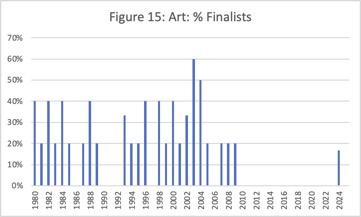
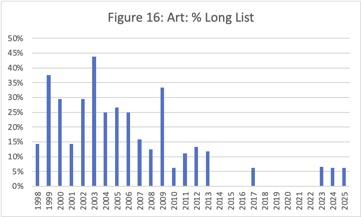
Art Books have been a mainstay of the Best Related category since its inception but have not been evenly distributed. Art Books were a substantial presence in Finalists during the Non-Fiction era, though they did not win in proportional numbers. Then in the Related Book era Art Books increased their presence significantly in all measures, and won in proportion to their presence as Finalists. In the Related Work era this presence dropped substantially, functionally disappearing from Finalists and dropping off the Long List, for the most part, after the first 4 years. This pattern gives strong evidence for nominations being affected by how the category is framed. Nominators may have been more willing to consider Art-forward Books to be in scope once the category wasn’t labeled “non-fiction.” It seems unlikely that expanding the scope to Related Work made people consider Art Books to be out of scope. It is possible that the expansion to include other content types simply pulled nominations away from Art Books but there isn’t clear evidence on this topic.
A change in priority needn’t be the sole explanation. For example, 16 out of the total of 94 works (17%) were published by Paper Tiger Books, which operated during the first two eras but went out of business around the change to Related Work. The only other Publisher represented more than a couple times in the Art data is Underwood Books with 21 works, including 17 volumes of the annual, Spectrum: The Best in Contemporary Fantastic Art. The Spectrum volumes appear on the Long List every year from the first one in 1995 through the 18th in 2012 (only missing volume 3). They were Finalists 8 of those times, more commonly toward the beginning of the run. Two years after volume 18, the original editors Cathy and Arnie Fenner handed off the Series to a different editor and Publisher. The change in editors might well explain the loss of interest in the Series, though not the disappearance of the Series in the last two years of the Fenners’ tenure. But whatever the reason, the disappearance of Paper Tiger Books and changes to the Spectrum Series at least correlate with the fall-off in Art Books in the data, whether or not they are a direct cause. Other speculative reasons for the fall-off could be that the overall shift to e-books disadvantaged works that rely on images, or that presentations of artwork moved to online-only venues due to the expense of hard-copy art publication.
69 works feature the Art of specific artists or are portfolios of a collection of specific artists, 11 feature Art associated with a specific media Property, while 16 relate to other topics with half containing illustrations accompanied by fictional narratives, typically fictionalized Science or History. Of these, the first two groups appear proportionately across the three eras, while the last group does not appear during the Related Work era. But is this due to nominators not choosing Art Books focused on “other topics” or has that type of Book become less common?
The present analysis is not in a position to answer these questions with any certainty. A survey of changes in the number of Art Books being published would be informative but would need careful study design. See also the discussion of the special Art Books Hugo category in 2019 (in the section on Overlapping Categories under Special Categories).
Subjects
Among the works focused on the Art of a specific person, there are a few repeat appearances. (There will be a more general consideration of People as Topics in the Other Tags section.) The work of the following artists was nominated more than once:
- Bob Eggleton - Finalist in 1996, Finalist and Winner in 2001
- David A. Cherry - Finalist in 1988, ineligible repeat of the same work on the Long List in 1989
- Frank R. Paul - Long List in 2010 and 2013
- John Picacio - Finalist in 2007, Long List in 2013
- Leo Dillon and Diane Dillon - Finalist in 1982, Long List in 1999
- Michael Whelan - Finalist and Winner in 1988, Finalist in 1980 and 1994
Two media Properties are the Topic of more than one work, perhaps the two most popular SFF visual Properties:
- Lord of the Rings - Long List in 2003 and 2006
- Star Wars - Long List in 2006 and 2017
Among other Topics, there are repeat appearances for works about dragons (Finalist in 2003, Long List in 1980), space travel (Finalist in 2005, Long List in 2004), and speculative zoology/biology (Finalists in 1980 and 1982, Long List in 1989).
Art works are heavily male in authorship (this is the author/editor of the work, not the subject matter). Out of the 96 works, 8 (8%) are solely non-male authored, 26 (27%) have mixed-gender authorship, and 62 (65%) are solely male authored. But while the overall trends in gender show a shift to more equality in the Related Work era, the majority of the non-male authored Art Books occur during the two earlier eras.
The gender of the artists whose work is featured (here excluding collections of multiple artists) is even more skewed. Of the 44 works featuring named artists, 2 subjects (5%) are non-male, 4 (9%) have mixed subjects, and 36 (82%) have male subjects. Once more, the non-male subjects occur during the two earlier eras. What would be more difficult to determine is the proportion of genders in published Art Books during the different eras. That is: does this represent the works available for nomination or the priorities of the nominators?
Best Art Book was held as a special category in 2019. In general, the works nominated in that category align with the types of Art Books nominated under Best Related, but in different proportions. Only 4 works focused on specific artists, all of whom also appear somewhere in the Best Related data. The majority of works focused on media Properties, though only Lord of the Rings (with two works) overlaps with the Best Related Topics. One of the four artist-Topics was female. Gender was not researched for the authors of the Best Art Book nominees. Spectrum: The Best in Contemporary Fantastic Art volume 25 shows up as a Finalist. As noted in the discussion of special Hugo categories, the nominating numbers for Best Art Book were relatively low and the idea was not pursued further. This suggests that the lower nomination numbers of Art Books in the Related Work era may be due to a general loss of interest in Art Books although, as noted earlier, several of the works nominated under Best Art Book may have had numbers sufficient to make the Long List or even Finalist if they had appeared in Best Related that year.[1] So both hypotheses—loss of interest and being pushed out by other types of works—may play a part.
Conclusions
Art Books show the most dramatic changes over the lifetime of Best Related, although those changes are as likely to have been affected by external factors within the publishing industry as by changes in nominator attitudes towards the category. The perception among supporters of Art Books that they were no longer being recognized to the same extent as previously within the Best Related category is well supported, but the disappointing results of the special category trial suggest that this was not due to other types of works “pushing out” Art Books during the nomination process. Art Books have been heavily skewed toward both male authorship and a focus on male artists and the overall shift towards gender parity in the Related Work era did not affect Art Books, though as with other Categories it’s unclear whether this is driven by publishing trends or nomination trends.
3.3.2.2 Criticism
Definition: An analytical discussion of a subject or work that generally relates it to a larger framework of ideas or experiences. This Category can have very fuzzy boundaries with Essays, Reviews, and some others.
About a quarter of the individual works are cross-categorized, most commonly with Essays, less commonly with History, Memoir, Reference, and Reviews.
Overall, 86 works (14% of the full data set) are classified as Criticism. In the 46 years in which Best Related has existed they appear as follows:
Best Non-Fiction Book
- Finalists in 6 out of 18 years (33%)
- 9% of Finalists
- 6% of Winners
- (Long List data not available)
Best Related Book
- Finalists in 6 out of 12 years (50%)
- 13% of Finalists
- 8% of Winners
- Long List in 9 years (75%)
- 15% of Long List
Best Related Work
- Finalists in 8 out of 16 years (50%)
- 14% of Finalists
- 13%Winners
- Long list in 13 years (81%)
- 16% of Long List
Figures 17 and 18 show the percentage for each year that Criticism appeared as Finalist or Long List.
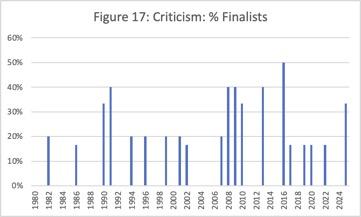
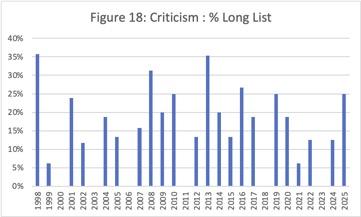
Criticism has, in general, increased slightly in frequency across the three eras. As seen in the statistics and figures, the overall increase during the Related Work era doesn’t correspond to a sharp change of behavior. The presence of Criticism, while variable in any given year, is consistent. There is a possible cluster of higher interest from 2007-2010, but there is no other common factor to those works that might suggest anything other than chance. Works of Criticism have won in all three eras, but only in the Related Work era do they win in proportion to their presence among Finalists, being slightly under-represented in the two earlier eras.
The following Topics appear multiple times in works of Criticism:
- Studies of the body of work of a specific author or literary set (18) including multiple studies of J.R.R. Tolkien (3), the Inklings (2), Joanna Russ (2), and Ken MacLeod (2)
- Science Fiction literature in general (16) including specifically French SF and YA SF
- Issues around representation (12) including disability (4), race (4), and women, motherhood, and feminism (4)
- Studies of a particular Property (11) including multiple works about Harry Potter (2) and The Hobbit (2)
- Collections of critical analysis on various topics by a specific author (8)
- Fantasy literature in general (3)
- Games and gaming culture (3)
- Movies in general (2)
- A number of other works don’t fall into any obvious group.
A fairly large number of authors have more than one work in this Category, but only 3 appear as authors of 3 or more works:
- Farah Mendlesohn (7)
- Andrew M. Butler (4)
- Elsa Sjunneson (3)
Authors of critical works are, on the whole, less skewed toward male authorship than the dataset as a whole, with 56% all-male authorship, 34% all non-male authorship, and 9% mixed-gender authorship.
By definition, in the Non-Fiction and Related Book eras, Criticism only appears in Book format. In the Related Work era, out of the 42 Criticism works, 29 (69%) are Books with other formats beginning to appear in 2014, primarily Article/Blog (19%), less commonly Video, Speech, and Dissertation. These numbers are roughly equivalent to the overall distribution of Media formats in the Related Work era. Video Criticism (the only non-textual format) always has a visual work as its subject, though visual works also appear as the subject of text-based Criticism.
Conclusions
Overall, there are no unusual or unexpected observations with respect to works of Criticism, other than the authorship being less skewed towards male authors than the overall data set. Criticism works form a significant subset of nominations and generally represent what might be thought of as traditional content.
3.3.2.3 Essays
Definition: A discussion or presentation, generally on a specific topic, usually expressing some degree of personal opinion by the author. This Category can have very fuzzy boundaries with Criticism, Reviews, and some others.
Essays frequently co-occur with other categories. Small numbers of works co-occur with Autobiography, Biography, and Humor, while more significant numbers co-occur with Criticism (12), Reviews (8), or Fiction (5).
Overall, 93 works (15% of the full data set) are classified as Essays. In the 46 years in which Best Related has existed they appear as follows:
Best Non-Fiction Book
- Finalists in 12 out of 18 years (67%)
- 17% of Finalists
- No Winners
- (Long List data not available)
Best Related Book
- Finalists in 6 out of 12 years (50%)
- 13% of Finalists
- 17% of Winners
- Long List in 11 years (92%)
- 12% of Long List
Best Related Work
- Finalists in 9 out of 16 years (56%)
- 14% of Finalists
- 19%Winners
- Long list in 15 years (94%)
- 17% of Long List
Figures 19 and 20 show the percentage for each year that Essays appeared as Finalist or Long List.
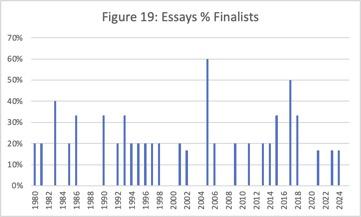
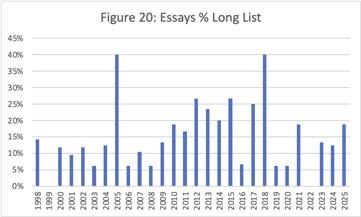
Essays are proportionately most frequent among Finalists in the Non-Fiction era especially in the later part of the era, but produced no Winners. In contrast, Essays won in greater proportion to their appearance as Finalists in the later two eras. They appear very consistently on the Long List, showing up in more than 90% of years for the two later eras. The start of the Related Work era sees a sustained increase in Essays on the Long List for nearly a decade (interrupted only by 2016)[2] followed by a falloff in more recent years.
Two significant types of Essay content are collections of the work of a particular author, usually on a variety of subjects (39), or a collection of Essays relating to a specific subject: Person (18), Property (5), or Topic (see below). Works revolving around a specific Topic may have a single author or be a collection of multiple authors, or in the Related Work era may be a single Essay on the Topic (although single Essays are rarely nominated in this Category). The following Topics occur more than once:
- Fantasy (2)
- Feminism (3)
- Futurism (2)
- Representation (6)
- Science Fiction (6)
Certain authors/editors appear multiple times in the Essay Category, with more repeats and greater frequency than in almost any other Category. The following authors have multiple works (counting for each author in the case of multi-author works).
- David Langford (6)
- Ursula K. Le Guin (5)
- Farah Mendlesohn (4)
- Harlan Ellison (3)
- John Scalzi (3)
- Lynne M. Thomas (3)
- Neil Gaiman (3)
- Edward James (3)
- Gwyneth Jones (2)
- Jim C. Hines (2)
- Joanna Russ (2)
- John Clute (2)
- Robert Silverberg (2)
- Teresa Nielsen Hayden (2)
- Sigrid Ellis (2)
- Robert J. Sawyer (2)
Overall, Essay authorship skews less male than the overall dataset, with 56% male-only, 34% non-male-only, and 10% mixed authorship.
Books make up the primary Media format for Essays in the Related Work era with 40 out of 45 works (89%). Article/Blog makes up most of the remainder, appearing first in 2018, with one Video work. The over-representation of textual formats may be unsurprising for Essays, though one might also have expected it for Criticism.
Conclusions
Very much like Criticism, the Essay Category shows no unusual or unexpected observations. They form a significant subset of nominations and generally represent what might be thought of as traditional works.
Major category:
ConventionsMonday, April 6, 2026 - 11:45
The Theory of Related-ivity:
A History and Analysis of the Best Related Work Hugo Category
by Heather Rose Jones
(This is a serialized article exploring the history of the Best Related Work Hugo category in its various names and versions. If you’ve come in at the middle, start here.)
Contents
Part 3: Historic Trends
3.3 Category
3.3.1 Introduction
Part 3: Historic Trends
3.3 Category
3.3.1 Introduction
The method for assigning content Categories to works is detailed in the Category chapter in the Categorization Process section. This includes a discussion of how Supercategories are assigned. To recap: each work may be assigned multiple Category tags, based on the nature of the content, but only a single Supercategory tag is assigned, based on the preponderance of the subject matter.
This introductory chapter will compare high-level distribution of Categories with respect to various eras (all data, Non-Fiction, Related Book, Related Work) and subsets (Long List,[1] Finalists, Winners). The comparisons will be performed both on the Supercategory level and the Category level. After that, chapters will discuss each Category individually, grouped by overall popularity. More popular categories will analyze more factors, as they are more likely to show significant patterns, while less popular Categories will be discussed more anecdotally. Each Category will include a summary of its distribution data. Content-related data other than the content Categories will be discussed in the next section (Other Tags).
Category Distribution
The purpose of this initial analysis is to determine whether there have been shifts in the nature of the subject matter being nominated either due to changes in the category scope or simply over time. (These two factors can be difficult to distinguish unless a year-by-year comparison contains enough data for meaningful analysis.)
All Data
When examining the data set as a whole, there is a rough consistency of presence for 2 Supercategories (Analysis, Associated) across the process levels (all data, Finalists, Winners) while 2 become disproportionately more popular as the selection process is applied (People, Information), and 1 is disproportionately less popular (Image). The differences between levels are not large, however. Overall, the most popular Supercategory is Analysis (which includes works such as Reviews and Criticism), followed by Information (Reference works, histories), with People, Images, and Associated following after. One might think that the lower presence of Associated works could, to some degree, be attributed to the clustering of many of its component Categories in the Related Work era, but this is not the case (as seen below).
Table 6: Supercategory Distribution for All Eras Combined

When examined at the Category level, we can identify some clear distinctions in popularity. The “most popular” 3 categories each represent 14-15% of the complete data set (Art, Criticism, Essays). There is a gap to the top of the next most popular group at 9%. We can somewhat arbitrarily identify a “more popular” group at 6-9% of the total (Autobiography/Memoir/Letters, Biography, Craft, Fiction, History, Reference). The “less popular” group each represents 1-5% of the data (Conventions, Convention Publications, Graphic, Humor, Interviews, Journalism, Reviews, Science). This leaves a “least popular” group of categories each representing <1% of the data (Experience, Music, Photography, Poetry, Role Playing Game).
Many categories appear in roughly equivalent proportions at each level (all, Finalists, Winners) and in no case is there a difference of more than three percentage points between the popularity in the full data set and at the Finalist level. Comparing equivalence at the Winner level is tricker as a single Winner represents 2% of the whole. However, the following Categories stand out as either over- or under-represented. Disproportionate Winners: Autobiography/Memoir/Letters, History, Reference. Disproportionate non-Winners: Art, Criticism, Essays.
When considered in light of criticisms of some of the shifts in the category, the comprehensive data doesn’t support the assertion that works of marginal relevance are preventing more traditional works from being recognized. The Categories that win disproportionately are all what we might think of as “traditional” content, and even those “traditional” Categories that don’t win in proportion to their nomination (Art, Criticism, Essays) are among the most common winning Categories.
Table 7: Category Distribution for All Eras Combined

Non-Fiction
Has that distribution of nominations, Finalists, and Winners changed over time or with the changing definition of the Hugo category? The first step is to do a distribution analysis for each era of Best Related. (Keep in mind that, in the Non-Fiction era, Long List data is not available.) What’s striking in this era is the near equal distribution of Finalists across most Supercategories (with the exception of Associated), while Winners are not proportionate. Informational works make up nearly half of all Winners, with History and Reference works the main contributors. Works about People are only slightly over-represented, with Autobiography/Memoir/Letters providing the majority of the effect. Works focused on Images are startlingly underrepresented among Winners. (6% represents a single Winner.)
Table 8: Supercategory Distribution for the Non-Fiction Era

When individual categories are examined, the notable mismatch between Finalists and Winners is Essays (17% of the Finalists, no Winners).
Table 9: Category Distribution for the Non-Fiction Era

Related Book
In the Related Book era and following we have three levels of data to compare and find that representation of Supercategories in the Long List and Finalists is startlingly similar. Representation among Winners is also roughly similar with the following observations. Images are no longer at a disadvantage (indeed, are over-represented as Winners) and works about People continue to be popular while Information works have lost their edge.
Table 10: Supercategory Distribution for the Related Book Era

At a Category level, there’s nothing particularly surprising except to note that the rate of People Winners is anchored by Autobiography and its associated topics.[2]
Table 11: Category Distribution for the Related Book Era

Related Work
Proportions across the different levels continue to be roughly equivalent. The only really notable observation is the disproportionately low win rate for Analysis, though it’s still the most common type of Winner. (We noted this previously in the Non-Fiction era. Detailed cross-era comparisons are found later.)
Table 12: Supercategory Distribution for the Related Work Era[3]

Teasing out observations for the individual Categories, voters seem to prefer Autobiography over Biography and seem more willing to reward works of Fiction (an odd turn for an award that began by specifying Non-Fiction).
Table 13: Category Distribution for the Related Work Era

Long Lists
Moving to the question of whether nomination (and voting) patterns have shifted over time (whether due to the category changes or not) we will first compare Supercategory proportions in the Long List (which is not available for the Non-Fiction era). The largest change is for Images, which drop from representing a quarter of the Long List to only 4%. (There is an extensive discussion of this in the chapter on Art.) Otherwise, the changes seem less meaningful (and can simply represent adjustments for the absence of Images). But one lack of change is noteworthy. The remarkably consistent rate of Associated works before and after the change to the Related Work era suggests that there was no revolution in content at a general level as a result of the category expansion. Rather, the changes are at the Category level, such as a decrease in Graphic and the addition of Experience and Music. People might be nominating different types of Media formats (as previously discussed) but “marginal” subject matter is not taking up more space than it did when only Books were allowed.
Table 14: Comparison of Long List Supercategories Across Eras

Most of the changes in the proportion of specific Categories are minor (other than Art), but we might take note of increases in Biography, Essays, History, and Reviews (all quite “traditional” content) and decreases in Reference. Journalism is a new Category and clocks in at a solid 7%, unlike most new Categories which appear less frequently.
Table 15: Comparison of Long List Categories Across Eras

Finalists
When comparing Finalists, we have data for all three eras. The previously mentioned changes in the representation of Images are even more striking. An explanation would be welcome for both the increase in representation in the Related Book era then the near disappearance of the Supercategory in the Related Work era. Beyond that, People have been variable, but are as common now as they were at the start of the award, Analysis has been steadily increasing while Information decreases, and Associated content has grown to a smaller extent. Here we do see potential support for the impression that these less traditional content types are increasing in presence. These trends echo what we saw for the less complete Long List data.
Table 16: Comparison of Finalist Supercategories Across Eras

On an individual Category level, many of the shifts are minor or inconsistent across the three eras, but the following possible trends can be identified. Art (as already noted) crashes from being one more the most popular Categories to nearly disappearing. Autobiography seems to give way to Biography.[4] Criticism, History, and Reviews have gradually increased, while Reference works dropped significantly.[5]
Table 17: Comparison of Finalist Categories Across Eras

Winners
Here we see an echo of some of the shifts among Finalists. Works focused on Images disappear after having dominated the Related Book era. People as subjects fell in popularity in the Related Book era and remained steady after that. Analysis increased significantly in the Related Book era and rose only slightly more after that. Information fell drastically in the Related Book era and then remained steady. And Associated content disappeared in the Related Book era, then returned to the same rate as under Non-Fiction. Overall, it would be hard to conclude that there are any overall content trends that are associated specifically with the change to Related Work. Either the Related Book and Related Work numbers are similar or the Non-Fiction and Related Work numbers are similar. There is nothing that clearly distinguishes Related Work Winners from the types of content that won when the award was restricted to published Books. Even the lack of Image Winners under Related Work would not be so striking if not for the high rate of Winners in the middle era. Whatever effect the broadened scope of Related Work has had on Hugo voting, it hasn’t been with respect to the nature of the subject matter being elevated by voters.
Table 18: Comparison of Winner Supercategories Across Eras

There are few surprises when shifting to a Category-level analysis of Winners. Nine Categories have never supplied a Winner. Four Categories won in only one era (none of them under Related Book), but in 2 cases had more than one Winner in that era. Three Categories had Winners in 2 eras, with 2 of them having multiple Winners in a single era, but with all possible combinations of eras represented. The remaining 6 Categories (Autobiography, Biography, Craft, Criticism, History, and Reference) had Winners in all three eras, 2 of which had only a single Winner in each era.
The distribution of Winners doesn’t correlate exactly with the overall popularity among nominators but it comes close. Within the “most popular” Category group (based on overall presence in the data) only Criticism is a 3-era Winner, the others being 2-era Winners. The 6 Categories in the “more popular” group supplied 5 three-era Winners and one winning in only a single era. On the other side, the “less popular” group of 8 Categories had 4 winning members, some with multiple Winners, while the “least popular” group supplied no Winners. Other than large presence in the dataset being no guarantee of consistent wins (notably for Art and Essays), the correlation is solid.
Table 19: Comparison of Winner Categories Across Eras[6]

Distribution Data Within Categories
In each of the chapters discussing specific Categories, the following basic data is included, regardless of the number of works involved.
- The “percentage of years appearing” statistic is not discussed in detail in the individual chapters. It’s meant to give an indication of how consistently the Category has been present on the lists.
- The number of works with that Category tag and the percentage of the whole dataset they represent.
For each era:
- In how many years of the era (number and percentage) members of this Category appeared as Finalists.
- What percentage of the Finalists in that era they represent
- What percentage of Winners in that era have this Category tag
For the Related Book and Related Work eras:
- In how many years of the era (number and percentage) members of this Category appeared in the Long List
- What percentage of the Long List in that era they represent
For the larger categories, the percentage Long List and Finalist data is also shown in graphic form.
[1]. When “all data” is specified, it includes extended nominee lists when those are available, while when “Long List” is specified it means only those works that fall in the standard set of “Finalists + next 10 works” or equivalent. Usually, the difference is not meaningful.
[2]. Remember that works may have more than one Category but only one Supercategory, so the 17% Winners for Autobiography and the 8% Winners for Biography are not necessarily additive.
[3]. In 2 years, No Award was given, which explains why the Winner percentages don’t add up.
[4]. One might speculate on the effects of demographics affecting the “big names” of early SFF. There’s a separate study to be done on which authors wrote autobiographies or Memoirs and whether this is a generational thing.
[5]. The possibility that this is related to Reference works moving online is discussed in the Reference chapter.
[6]. In both the Non-Fiction and Related Work eras, 6% represents a single Winner. In the Related Book era it is 8%.
Major category:
ConventionsSaturday, April 4, 2026 - 15:33
Lesbian Historic Motif Podcast - Episode 339 - On the Shelf for April 2026 - Transcript
(Originally aired 2026/04/04)
Welcome to On the Shelf for April 2026.
In the usual California fashion, Spring has been quickly elbowed out of the way by summer. The gardening is proceeding apace with tomatoes in the ground, the artichoke harvest well underway, strawberries trickling in, and a bushelful of Seville oranges delivered to a friend to be turned into marmalade. One delightful thing I participated in last month was a week-long “yarn store crawl,” visiting two dozen local yarn shops and adding more to my stash than I can probably knit in two years’ work. I hope your hobbies and interests are proceeding similarly well!
News of the Field
After a couple queries, I have a very special guest lined up to mark the 10th anniversary of the podcast in August. I somehow overlooked doing anything special for the 10th anniversary of the blog last year, but ten years for a podcast is quite an accomplishment and I’m glad I’ll have something lined up. (The guest is even a fan of the podcast, which was delightful to learn.)
In equally happy news, especially for those who have been following the Netflix series Bridgerton, a trailer for season 5 has confirmed what we dared to hope when the character of Michaela Stirling was introduced as a gender-flipped version of the book’s love interest. Yes, we will have a sapphic romance in Bridgerton! I’ve linked to the trailer in the show notes, in case you haven’t seen it yet.
To tie in with that news, one of the upcoming podcasts will be a condensed version of the “How to be a Regency Lesbian” chapter from my book project. (Yes, I’m going to continue teasing the book for the next couple years as it comes together.)
Publications on the Blog
Due to the length of the blog series about Anne Bonny and Mary Read, I’ve only covered two additional publications in the past month, both relating to this month’s essay. Henry Fielding’s 18th century pamphlet The Female Husband: or, the Surprising History of Mrs Mary, Alias Mr George Hamilton, which first introduced the term “female husband.” I paired that with S. Baker’s “Henry Fielding’s The Female Husband: Fact and Fiction,” since the original work seriously needs interpretive context, being as much a work of fiction as the General History of the Pyrates was.
Book Shopping!
I also picked up two new books for the Project. M. Kehoe’s collection Historical, Literary and Erotic Aspects of Lesbianism is a group of articles originally appearing in the Journal of Homosexuality. From an initial skim of the table of contents, only a couple articles are likely to fall into the Project’s timeframe.
As something of a historic curiosity, I also picked up Oscar Paul Gilbert’s Women in Men's Guise, originally published in 1932. I doubt it will have any information I’m not already aware of, and it lacks the academic apparatus that I’d expect of a current book, but it falls in an intriguing timeframe: able to incorporate the research of Magnus Hirschfeld but before the date of his suppression by Nazi Germany.
It occurs to me to note that I don’t count it as “book shopping” when I download public domain books from the internet, such as the General History or the original edition of Fielding’s The Female Husband. I’d have more regular shopping notes if I included that category.
Recent Lesbian/Sapphic Historical Fiction
This month’s new fiction listings are extensive, even after I’ve curated them. So as is often the case, I’ll be condensing the cover copy somewhat to make the length manageable. (Some authors give us nearly an entire chapter of cover copy!)
There are a couple February books I hadn’t found previously.
Stand and Deliver by Ivy Warren diverges from the standard highwaywoman plot.
Betrothed to a cruel man she despises, Countess Victoria Edmunton is determined to escape her fate. When her carriage is ambushed by highwaymen, Victoria seizes her chance to bargain with their charismatic leader. If her family believes she has been stolen away, then she may have a chance to escape her cursed marriage and claim a life of her choosing. Victoria offers jewels—and a daring plan. If he fakes her ransom, he could walk away richer than he ever dreamed, and she could disappear for good. Whisked away on horseback by the masked outlaw, Victoria makes a startling discovery…the highwayman is no man at all. But as attraction sparks into desire, the ransom plan goes awry and deadly secrets come to light. If she hopes to survive, Victoria must trust her highwaywoman with not only her heart, but with her life.
I initially assumed that Romeo & Her Sister by Jillian Blevins from Ghost Light Publications was a fictionalized biography, but it turns out it’s an audio drama. I wouldn’t normally list that genre, but since I’d already looked up all the data, here it is.
In 1845, Charlotte Cushman is the most famous American actress in the world, well-known for playing men's roles in the plays of Shakespeare. Despite her international fame, she harbors a secret, hidden in plain sight: she loves women. Celebrated in her own country, she has brought her sister Susan to London to play Juliet to her Romeo. Old resentments between the sisters surface as Charlotte struggles to balance her exploding career, her tumultuous relationship with writer Matilda Hays, and her affair with another young woman, all while keeping her personal life hidden from her fans, her sister, and her bitter rival, Edwin Forrest.
Lots of new March books!
There’s an intriguing cross-time story in To Love a Boleyn by Joey Evangelista.
Evangeline Hartwell is pulled from modern London into Henry VIII's court and is drawn into Anne Boleyn's inner circle, where survival is never certain. As Anne's position grows perilous, love becomes both refuge and liability. In a world where silence is protection and loyalty can be fatal, loving a Boleyn is never without consequence.
Arguments Against the Cultivation of Female Curiosity (Curiosity #2) by Suzanne Moss is the second book in a series.
England, 1764. Thea Morrell has everything society deems success: wealth, status, a husband and a title. But her marriage is far from what it seems.
Her only solace is found in the hushed halls of anatomy lectures, where questions of life and knowledge sustain her dangerous curiosity. Five years have passed since Martha, her lover and confidante, sailed away. Letters once filled with longing have fallen silent, leaving Thea to wonder if distance or disappointment has severed their bond. She is, after all, failing at cultivating any plant of note, and her arch rival Neville Knatchbull looks set to beat her to every goal.
When Frankie, an unruly gardener with secrets of her own, enters her orbit, Thea must decide: will she remain a prisoner of convention, or dare to cultivate a life of her own?
I confess it’s a bit of an irritation to me when historical novels ignore the realities of how noble titles worked, in order to set up an unmarried woman as a countess or the like. The second title that does that this month is The Countess and the Cartographer by Lyra Ashwood.
Imogen Ashford, the twenty-four-year-old Countess of Morthaven, has six months to satisfy the terms of her father's will: marry, or lose the estate to her guardian. She is not, by temperament, inclined to cooperate. What she needs is time. What she gets, when she commissions a survey of her crumbling Dorset estate, is Wren Calloway.
Wren is a Guild cartographer — precise, watchful, and in possession of a purpose she hasn't disclosed. Her father's survey records are somewhere on the Morthaven estate. Finding them would restore his professional reputation; failing to find them means his name stays buried alongside him. She has told the Countess she is here to document the estate. This is not entirely a lie.
What begins as a professional arrangement — uncomfortable, necessary, bounded by propriety — gradually becomes something else: a partnership built on careful honesty. The mystery deepens. And the distance between them closes.
The Egyptologist's Curse by Georgina Kenyon from SQP Nature Books is a dual timeline story, though not quite a “romance of the archives.”
It is the year 1873 and the Suez Canal is the gateway to the Pyramids. Egyptomania is the latest craze and Egypt is full of gravediggers, chancers and spies. Amelia Edwards, once a popular mystery writer, has reinvented herself as the Godmother of Egyptology. But after confessing her love to Marianne North, Amelia vanishes.
Jump to the present day and BBC podcaster, Margaret is making a series on Great Women in History, following in the footsteps of her ancestor, Amelia Edwards. Margaret travels to Egypt where Amelia had travelled over a century before, but in searching for the past, has the answer to Amelia's disappearance been hiding in one of Amelia's mystery books all along?
This next book is a bit of an oddity. It’s “historical fiction” only by virtue of being written in 1895, but only newly resurrected in print. Love's Joy and Sorrow Between Women by Emilie Knopf is translated from the German and published by Ovid Publishing Group.
A banned novel. A lost author. A love story that refused to stay buried.
When Love's Joy and Sorrow Between Women was published in Berlin in 1895, it was immediately banned under Germany’s strict obscenity laws. Its author, Emilie Knopf, was tried twice and fined for distributing it. Then the book vanished — until a single surviving copy was found in a Berlin archive.
Meet Felicita: artist, romantic, and unapologetic lover of women. Her great love is Edita, a musician from a Rhine castle, and their relationship is the beating heart of this novel. But Felicita's eye has a tendency to wander — toward a scheming French comtesse, an alluring blonde in a green velvet dress, and the quickly evolving culture of late 19th-century European society.
I’ve seen book descriptions that used a very similar set-up as framing story for a historic novel, but a little research indicated that this is the real thing.
Set in a similar era, but written today is Counterpoint by Barbara Bergmann from Backsett Books.
Counterpoint is the story of a woman at war with herself. Challenged by poverty, class, and sexism, Lucia is the main melody that plays in counterpoint to the events and characters of 19th century Britain. Resting on a scaffold of historic themes, with the impact of the Industrial Revolution over-arching, events are driven by characters that echo through history. The attitudes and mores of the British upper class are juxtaposed against the equally strong values and traditions of a rising working class. But even as the story rides through 19th century Britain and across the edicts and values of caste and rank, this is more than a rags to riches tale.
Counterpoint’s central character is viewed through her relationships with three families: the Whitfields, scions of a theatrical dynasty; the St Alyns, a cultured aristocratic family, who display a propensity to push against class; and the Rileys, dedicated socialists with weighty influence in London’s East End. But the ribbon tying these disparate characters together is Lucia and Rebecca’s love.
Forever Yours, Nell by Andrea Ead tells a story of forbidden love during World War II.
In 1940, sixteen-year-old Nell leaves home to begin her nurse training at Truro Hospital, determined to build a life she can be proud of. She knows what is expected of her. Work hard. Keep her head down. Do everything right. Then Kitty arrives.
Injured in a bombing, Kitty is bright, bold, and impossible to ignore. What begins as a quiet connection soon grows into something far more dangerous—something Nell cannot allow herself to feel.
As their bond deepens in the shadows, Nell must choose between the safety of the life she’s always known—and a love that could cost her everything… or finally show her where she truly belongs.
April brings us another wealth of titles.
The Witch and the Huntress by Luna McNamara from William Morrow follows the trend of situating ancient Greece in a mythic world.
Medea possesses both witchcraft and cunning, yet she endures a lonely and constrained life under the rule of her wicked father, Aeetes. When the hero Jason arrives, they strike a deal: If Medea helps him win her father’s Golden Fleece, Jason will marry her and take her with him back to Greece. But as the journey unfolds, Medea is forced to choose between the life she expected and the love she secretly desires—and the cost may be greater than she ever imagined.
Atalanta, raised by bears, is a capable warrior caught between the wilderness and the human world but never fully part of either. After the sudden disappearance of the woman she loves, Atalanta joins Jason’s Argonauts in an attempt to find her. But when Medea becomes part of the crew, the sorceress awakens something in Atalanta that she cannot ignore.
Jason, a skilled diplomat but a reluctant warrior, depends on his heroic companions to help him claim the Golden Fleece and retake the stolen throne of his father. Medea and Atalanta are among his most useful allies, but Jason soon finds that success may demand more than he can give.
A Whisper of Bells and Prayers by C.C. González retells The Hunchback of Notre Dame as a sapphic story.
Hidden high within the towers of Notre Dame, Mirela tolls the bells. Scarred by fire and kept under the control of her so called savior, Master Ferron, she has learned that devotion can feel like chains.
Then she hears Claire, a young nun who awakens something in Mirela she had never felt before: hope, desire and the aching need to be seen. Their secret meetings begin in whispers and candlelight, until forbidden touches turn faith into temptation.
But Ferron's eyes are always watching, and his generosity hides away a sickening obsession. When passion and devotion collide, the walls of the cathedral will tremble and the two women must decide if love is worth the fire that will follow.
If you haven’t yet gotten enough pirate stories, we have Scallywag! by K.L. Mitchell from Desert Palm Press.
Molly McCormick never set out to be a pirate. But when her family tried to marry her off to a wealthy old man to settle their debts, she resolved to strike out on her own. Taking a job aboard a handy ship disguised as a boy, she soon found herself on the other side of the world: the Caribbean. Desperate to keep her identity secret, she fell in with a lot of pirates, a decision that would change her life. From then on, she lived a life of intrigue and adventure. Forbidden islands holding magical relics. Ghost ships with undead crews. Long-forgotten colonies trapped in time. And beneath it all, a secret buried beneath the waves for centuries is about to return.
We’ve been having quite a wealth of Jane Austen-inspired take-offs, including titles from mainstream presses. Added to the Austen library is The Unruly Heart of Miss Darcy by Erin Edwards from Little, Brown Books for Young Readers.
Georgiana Darcy has only ever kissed one girl before, and the resulting blackmail almost ruined her reputation. Since then, she’s carefully calibrated her life to be as quiet as possible, focusing on books and music. She certainly isn’t planning on falling in love with another girl. But then she meets Kitty Bennet, and everything is thrown off kilter.
After a moonlit kiss shifts their newfound friendship into something more, Georgiana follows Kitty to the Bennets’ home. The visit proves ill-timed when she encounters the one man who knows her secret and threatened her with it before. Terrified of testing the limits of her family’s love and of putting Kitty in danger, Georgiana doesn’t know if there’s any chance of a happy ending.
Every etiquette guide she’s ever read makes it clear that if she wants to protect her family name, Georgiana must pretend her heart follows society’s accepted rhythm. Unless, with a little help from those who understand how it feels, she can compose the future she and Kitty both deserve.
She Tamed the Lady by Judith Lynne from Smart Cookie Books is another Regency romance (I think—the date of the setting isn’t given explicitly.)
Lady Charlotte can find fault with every man in London. But never with Delina. Charlotte knows she does everything wrong. The right husband will fix everything: a life of horses, freedom, and a home for Delina. The alternative is unthinkable. She's so close to success...if Delina isn't swept off her feet first.
Delina can't survive another Season in this half-life between friend and companion, cleaning up Charlotte's chaos. Charlotte's marriage will change everything. Why shouldn't Delina find a future for herself?
One more Season. Two clashing plans. Until Delina catches the wrong eyes—or exactly the right ones—and both women face a choice neither expected: the predictable life they've been chasing, or something far more dangerous.
Flirting with Disaster by Kerrigan Byrne from Oliver Heber Books is part of a loosely connected series but is the only title in the series with a sapphic romance.
She was told to be less. Instead, she found everything she’d been denied. Emmaline Goode has spent her life swallowing her words, dulling her edges, trying to be the woman her family needs. Then she meets the Duchesse de la Coeur.
Amélie is everything Emma has never allowed herself to want—brilliant, untouchable, and dangerously free. One look shatters Emma’s carefully controlled world. One touch ignites something she cannot bury again.
Amélie is not free to choose her own future. Bound to a ruthless past and threatened with a marriage that will destroy her, she stands on the edge of losing everything. But some love is worth setting the world on fire.
As a Lover by Hilary McCollum from Bella Books uses the classic novel The Well of Loneliness as the catalyst for a young woman’s self-discovery.
London. 1928. For centuries, the establishment has suppressed public knowledge of lesbian love. Now, a celebrated writer is set to fight back.
Award-winning author, Radclyffe Hall, hopes her new novel, The Well of Loneliness, will transform attitudes to same-sex relationships. It soon comes under attack from the right-wing press, concerned about its potential impact on readers. One such reader is Maggie Dillon, a young trainee firefighter, who has been struggling with fears that she is an abomination after kissing another woman at a party. Can The Well transform Maggie’s views about herself and help her to find love? And will Radclyffe Hall keep her book in print long enough to radically change the views of society?
At Last It's You by Marianne Marston pushes up against my arbitrary limits for considering a story historic fiction, set in 1962 on the cusp of the gay liberation movement.
One year ago, Alice Brown had everything she had ever wanted – except Lee Grant, her high school love who she let slip away a decade ago. Then her lavender marriage ends in divorce, and Alice’s world falls apart. Shunned by her neighbors, worried about her bullied son, and suffering from panic attacks, Alice feels as if she's drowning. When Lee comes back to town, Alice steels herself for more heartbreak. Instead, their relationship slowly reawakens as Lee unearths Alice’s delicate strength and Alice rediscovers Lee’s quiet defiance.
Lee has no intention of staying in the suburbs. She adores her home in Berkeley, the revolutionary bookshop she runs there, and the found family she has formed. She won’t live a life in the shadows again, not even if leaving means losing the love of her life. Yet before Lee leaves, she surprises herself by begging Alice to accompany her, and Alice surprises her by tentatively agreeing to visit.
Plunged from the staid suburbs of Connecticut to the free-wheeling Bay Area, Alice finds herself torn between her stale old life and a budding new life. But if she’s to stay in Berkeley with Lee, she must decide what she values more, societal approval — or love.
I’m holding back one other April book, The Mystery of the Bitten Peach by Cecilia Tan, to go with an interview I’m airing next month.
Other Books of Interest
I’ve put two titles in the “other books of interest” section because the possible hints about sapphic content are too vague for complete confidence.
The Keyholder by S. Kallistos has the unusual setting of the Byzantine empire, and looks like it may be something of a murder mystery.
Constantinople, 843 AD. The Iconoclasm is over. The icons have been restored, the Empress Theodora rules as regent, and the empire breathes again. But beneath the surface of triumph, the palace keeps its secrets — and its dead.
When a minor secretary is found dead in the Sacred Palace — his hands bound, his death announced as suicide — Theophano Doukena, a young widow serving as Lady of Honour, begins to ask questions no one wants answered. What she uncovers is not a single murder but a chain of silence stretching back years: a secret brotherhood guarding the empire's darkest truths, a husband whose death on the frontier was no accident, and a conspiracy that reaches higher than she ever imagined — to the throne itself.
As Theophano follows the trail from coded ledgers to hidden archives, from moonlit gardens to the corridors of power, she finds herself drawn into a dangerous alliance with the one person she should not trust: the Empress herself. What begins as investigation becomes something far more complex — a bond between two women that defies the rules of the palace and the limits of forgiveness.
But in Constantinople, knowledge is the most dangerous weapon. And when those who hold power decide that silence must be enforced at any cost, Theophano must choose: protect what she loves, or expose the truth that could bring down an empire.
When I first ran into the listing for A Lady for All Seasons by T J Alexander from Vintage it looked like it might be one of those books tagged “lesbian” only because some people tag queer books with every possible queer-related keyword, regardless of representation. But when it recently came to my attention a second time, the cover copy had been revised. There’s clearly a bunch of gender-bending going on, but I’m still not certain that there’s a sapphic storyline. I do wish book publicity would stop being so coy!
It is a truth universally acknowledged that a woman who has lost her fortune must be in need (not want) of a husband. Beautiful, cunning Verbena Montrose must marry to save herself and her odious family from abject poverty. Fortunately, what she lacks in a dowry, she makes up for in the currency of gossip.
When she hears an alarming rumor about her very dear, very queer friend Étienne that could ruin him, she comes to his aid with a proposal—for a marriage of convenience, that is. But when Verbena discovers that a mysterious and celebrated poet by the name of Flora Witcombe has been publishing verses that hint she is onto their scheme, Verbena has no choice but to pretend to be a poet herself to confront her in a local salon. And—unexpectedly—be charmed by her.
Flora, in turn, is terrified by and smitten with Verbena in equal measure. But she holds a secret of her own: he is also William Forsyth, a struggling novelist and fifth son of a minor noble family. And if circumstances don’t allow Flora to woo Verbena, perhaps William can. Faced with two suitors and a fiancé, Verbena, who has always had to be clever to survive in society, starts to realize she may need to think outside of society’s constraints to find true happiness.
What Am I Reading?
And what have I been reading in the last month? It’s been rather eclectic—though that isn’t unusual.
I tried out the fantasy Queen Demon by Martha Wells, which is the sequel to The Witch King, which I thoroughly enjoyed. But somehow this sequel didn’t grab me as solidly and I hadn’t finished it by the time the library snatched it back from me. I think part of my problem was that the book has at least two very different timelines alternating and while the timeline was indicated in the chapter titles, the audiobook didn’t always include the chapter titles in the narration. So I spent a fair amount of time being confused about when I was.
Pride and Prejudice and Pittsburgh by Rachael Lippincott was a time-travel romp with our heroine being sent back in time to seek true love. It was amusing and satisfactory, though not particularly deep. If I were critiquing plot points, I might note that while a 21st century time-traveler might be expected to recognize what’s going on with some alacrity, the early 19th century characters were implausibly willing to accept the idea of time-travel with few questions. But the time-travel is the mechanism, not the point of the story.
So I have this thing I do when I have significant dental work scheduled and I’m hopped up on nitrous gas and waiting for the dentist to be ready. I go on social media and challenge people to recommend me a book to buy when my defenses are compromised. (This is actually a performative fiction, because I don’t take just any recommendation. But it’s a way to distract from dental anxiety.) This time the recommendation was a YA science fiction story, Peasprout Chen, Future Legend of Skate and Sword by Henry Lien, which I immediately checked out from the library on my phone. It has some amusing worldbuilding involving a skating based martial arts school. I realized that I’d previously read a short story in the same universe quite some time ago. It wasn’t really my thing, and I returned it after a brief taste, but I have fun getting recommendations this way.
My second sapphic listen was Lady Eve's Last Con by Rebecca Fraimow—who has been published on this podcast. The book is a space opera caper type story, with a nice slow-build antagonists-to-lovers romance. In flavor, it's basically a jazz age thriller transferred to a future extraterrestrial setting. It made for an interesting intersection because the setting offered a queer-normative futuristic society that somehow was still mired in patriarchal social dynamics and stereotypes about silly young debutantes.
I picked up the next volume in Claudia Gray’s Jane Austen-based murder mystery series: The Rushworth Family Plot. The basic premise is that all of Austen’s characters exist in the same continuity and that the scions of the Darcy and Tillney families solve murders and have a sweet, slow-burn developing romance. On the positive side, the depiction of Jonathan Darcy as solidly neuroatypical and Juliet Tilney as the one person who truly gets him and supports him is kind and relatable. But I find the writing style to be extremely repetitive, with the author hammering away at aspects of the history and social setting that one might expect a reader of historicals to be familiar with.
And finally, based on a recommendation—though I no longer remember from whom—I read Katrine Marcal’s Who Cooked Adam Smith’s Dinner, which is both a history of the field of economics and a critique of the way economic theories are distorted by ignoring unpaid female-coded labor. Quite interesting, though the author is solidly invested in the idea that you have to repeat an idea five times to make the reader remember it.
Show Notes
Your monthly roundup of history, news, and the field of sapphic historical fiction.
In this episode we talk about:
- Exciting news about the next season of Bridgerton.
- The upcoming 10th anniversary
- Recent and upcoming publications covered on the blog
- Fielding, Henry. 1746. The Female Husband: or, the Surprising History of Mrs Mary, Alias Mr George Hamilton. Liverpool, M. Cooper.
- Baker, S. 1959. “Henry Fielding’s The Female Husband: Fact and Fiction” in PMLA, 74 pp.213-24.
- Book Shopping
- Kehoe, M. (ed). 1986. Historical, Literary and Erotic Aspects of Lesbianism. New York. ISBN 0-918393-21-3
- Gilbert, Oscar Paul (trans. by J. Lewis May). 1932. Women in Men's Guise. The Bodley Head, London.
- Recent Lesbian/Sapphic Historical Fiction
- Stand and Deliver by Ivy Warren
- Romeo & Her Sister by Jillian Blevins
- To Love a Boleyn by Joey Evangelista
- Arguments Against the Cultivation of Female Curiosity (Curiosity #2) by Suzanne Moss
- The Countess and the Cartographer by Lyra Ashwood
- The Egyptologist's Curse by Georgina Kenyon
- Love's Joy and Sorrow Between Women by Emilie Knopf
- Counterpoint by Barbara Bergmann
- Forever Yours, Nell by Andrea Ead
- The Witch and the Huntress by Luna McNamara
- A Whisper of Bells and Prayers by C.C. González
- Scallywag! by K.L. Mitchell
- The Unruly Heart of Miss Darcy by Erin Edwards
- She Tamed the Lady by Judith Lynne
- Flirting with Disaster by Kerrigan Byrne
- As a Lover by Hilary McCollum
- At Last It's You by Marianne Marston
- Other Titles of Interest
- What I’ve been consuming
- Queen Demon by Martha Wells
- Pride and Prejudice and Pittsburgh/em> by Rachael Lippincott
- Peasprout Chen, Future Legend of Skate and Sword by Henry Lien
- Lady Eve's Last Con/em> by Rebecca Fraimow
- The Rushworth Family Plot/em> by Claudia Gray
- Who Cooked Adam Smith’s Dinner by Katrine Marcal
Links to the Lesbian Historic Motif Project Online
- Website: http://alpennia.com/lhmp
- Blog: http://alpennia.com/blog
- RSS: http://alpennia.com/blog/feed/
- Twitter: @LesbianMotif
- Discord: Contact Heather for an invitation to the Alpennia/LHMP Discord server
- The Lesbian Historic Motif Project Patreon
Links to Heather Online
- Website: http://alpennia.com
- Email: Heather Rose Jones
- Mastodon: @heatherrosejones@Wandering.Shop
- Bluesky: @heatherrosejones
- Facebook: Heather Rose Jones (author page)
Major category:
LHMPFriday, April 3, 2026 - 11:00
The Theory of Related-ivity:
A History and Analysis of the Best Related Work Hugo Category
by Heather Rose Jones
(This is a serialized article exploring the history of the Best Related Work Hugo category in its various names and versions. If you’ve come in at the middle, start here.)
Contents
Part 3: Historic Trends
3.2 Media
3.2.2 Book
3.2.3 Album
3.2.4 Article/Blog
3.2.5 Dissertation
3.2.6 Ephemera
3.2.7 Event
3.2.8 Game
3.2.9 Periodical
3.2.10 Podcast
3.2.11 Social Media
3.2.12 Speech
3.2.13 Video
3.2.14 Website
Part 3: Historic Trends
3.2 Media
3.2.2 Book
Definition: This includes works published as a physical text object in bound form, even if other distribution methods are available. It could include works published only in electronic text format that are presented as a Book (as opposed to a Website or Blog), but no such examples appear. While it may include individual works that are part of a Series (such as the Spectrum Art Books), it does not include items better classified as Periodicals, even if the specific nominee is a “special issue” of the Periodical.
Though this is by far the most common format of nominated work, even during the Related Work era when other formats appear, there isn’t much to say about it as a format. We all know what a Book is, and no special pleading is needed to explain why Books have been nominated. Considerations of which Books get nominated will be discussed in the Category and Other Tags sections in great detail. There are some initial comparisons between Books and the Article/Blog format in discussion of the latter.
3.2.3 Album
Definition: An audio compilation of musical pieces, released as a single coherent work.
There have been 3 Best Related nominees that are classified as Albums, all occurring during the Related Work era. The first two appear during the initial expansion of Media types, in 2012 (Finalist) and 2014 (Long List), with the third in the 2025 Long List.
The initial two are both created by prolific and popular author Seanan McGuire and are drawn from the body of musical work that she’s been producing beginning several years before her fiction debut. She has been a prominent performer in the “filk music” community (best described as “the folk music of science fiction conventions”) for which she has won multiple awards as composer and performer. In 2010 she won the Campbell Award (now Astounding Award) for Best New Writer and has won multiple Hugo, Nebula, and Locus awards for her fiction, as well as being part of the team that twice won the Best Fancast Hugo for SF Squeecast. This level of detail on her career is presented to suggest that the nomination of two of her Albums under Best Related should probably be seen as relating to her overall name recognition and popularity, rather than necessarily indicating a general opinion that musical Albums fall naturally within the scope of the Best Related category.
There’s a broader history of nominators seeking to find ways to honor musical works and artists within the Hugo (and Hugo-adjacent) award program.[1] In theory, a musical Album could be eligible under Best Dramatic Presentation (Short Form), and in fact this was the case in 2017 when the Album Splendor and Misery by the group Clipping (featuring Daveed Diggs) was a Finalist in that category. The group finaled in the same category in 2018 for their single The Deep (inspired by the novella of that name by Rivers Solomon). In 2025, Dune, The Musical received enough nominations to final in Best Dramatic Presentation (Short Form) but was determined to be ineligible due to prior performance.[2] There may have been other similar nominations under Dramatic Presentation (especially on Long Lists) that were not identified, as a deep dive into the subject is out of scope.
The 2025 nomination in Related Work of the Album Epic by Jorge Rivera-Herrans is similar in concept to Splendor and Misery and The Deep in being a musical interpretation of a literary work, in this case The Odyssey (as contrasted to a collection of independent songs, like the McGuire Albums) and thus could easily have been considered to belong under Dramatic Presentation. As one of the eligibility requirements for Best Related is that the work not be eligible in any other category, and as certain musical Albums have been determined to be eligible as dramatic presentations, it’s a valid question whether they properly fall within the scope of the Best Related category. The question of whether certain types of Albums might fit certain specific categories better than other types further muddies the waters. The concept Albums presenting a fictional storyline more clearly fit Dramatic Presentation than a collection of individual songs does.
At various times there have been discussions proposing the creation of a Hugo award for musical works or musical performers, however it doesn’t appear that these discussions have ever gotten as far as a formal proposal in the business meeting. Enthusiasm for this project within the filk community in fandom has sometimes been dampened by the understanding that mainstream musical works with science fictional aspects would likely attract more nominator and voter support than works known primarily within a fannish sub-community.[3] Non-professional fannish musical performers should also be eligible in the Best Fan Artist category, although no search of the Long List has been done to determine if this has ever happened.
Conclusions
The overall conclusions are that the nominating community has not embraced Albums as a natural Media format for the Best Related category. Albums hold an ambiguous position and have been nominated in more than one category.
3.2.4 Article/Blog
Definition: An individual short non-fiction prose work, typically distributed electronically via the internet. (Collections of Articles would generally fall under Book.)
For every “minority” format other than this one, a point-by-point analysis is presented of the nature and context of the specific works that might contribute to understanding why nominators considered them to be in scope for Best Related, and why those specific works might have been of interest to nominators. For the Article/Blog format this makes less sense, not only because of the number of works involved, but because this format is most similar to the default of Books. So a different approach has been taken, primarily comparing Articles/Blogs to the behavior of Books in the same era.
Article/Blog only appears as a format during the Related Work era, due to the eligibility definitions for the two earlier eras. Yet we might expect the content and behavior to be similar to Books, as both focus on long-form written prose, and indeed many of the works classified as Article/Blog might be expected to be similar to items included in collection-type Books. So with that introduction, how does the Article/Blog format compare to the Book format during the Related Work era? (Comparisons of Content for Books with other eras and Media types will be in the Category and Other Tags sections.) To simplify the prose, this discussion will use “Article” rather than “Article/Blog.”
Starting with the structural data, there are 34 Article works and 179 Book works in the Related Work era. Articles overwhelmingly had a single author while Books averaged 1.33 authors with 74% having a single author. Author gender fractions were inverse in the two formats, with Articles having 0.38 male and 0.62 non-male authors, and Books having 0.61 male and 0.39 non-male authors. (This suggests a possible bias towards male authors in traditional publishing with Articles being a more accessible format for marginalized authors, assuming that nomination proportions reflect the total available pool, rather than being driven by a more complicated set of factors.)
The proportion of works in the data set that made Finalist status are also startlingly similar (38% for Articles, 34% for Books).[4] However Books were proportionately twice as likely to be Winners (3% of nominated Articles won while 6% of nominated Books won).
Out of the 22 content Categories identified in the analysis, only 16 appear for Articles or Books in the Related Work era.[5] Books appeared in all of those categories except Journalism, while Articles appeared in 8 categories. Three categories were significantly popular in both formats (Criticism, Essays, and History), while Journalism, in addition to being absent from Books, was the most common Content for Articles. This is understandable given the approach to categorizing works as Journalism, which includes temporal proximity to the subject matter. Some categories appearing in Books are understandably absent from Articles due to format, such as Art and Graphic. While other categories that are quite common for Articles in general (such as Humor, Interviews, Reviews) have not been nominated for Hugos.
When content Categories are grouped into Super-Categories (Analysis, Associated, Images, Information, and People)[6] we find that Articles are most strongly associated with Analysis (at 76%, compared to 47% for Books). Both formats are roughly equivalent for Information (18-20%), while Articles less commonly cover People and do not include the Associated or Images content at all.
A discussion of the Publishers/venues associated with Books will be considered in the Other Tags section, however we can take a look at where and how the Articles in the data are being published. It appears that 23 works (68%) were published as part of a professionally curated magazine/website that publishes a variety of content and exercises some level of editorial control. Publications associated with 2 or more nominees include Baen.com (2), Fireside Fiction Magazine (3, all editions of the #BlackSpecFictionReport), Tor.com/Reactor (6), and Uncanny Magazine (2). Two works were published on Blog aggregation sites that do not appear to exercise editorial direction over content. Finally, 10 works (29%) were published on the author’s website or on the personal website of an individual who has editorial control over the content.[7] It was surprising to see the dominance of professional magazines/websites, but in terms of visibility of the works to nominators this makes sense. An Article published on a personal website would have a harder time reaching a large enough audience to reach the nomination threshold.
Conclusions
The Article/Blog format behaves as a natural extension of the Book format, with the primary deviations in behavior between the two largely due to limitations of the shorter format of Articles and of their usual online context, their ability to address topics in a more timely fashion, and the gender of authors. That said, voters appear to prefer the longer Book format over Articles when awarding the prize.
3.2.5 Dissertation
Definition: A non-fiction research project created for an academic degree not distributed through standard publication channels.
Dissertations are an unlikely format for Hugo award nominations due to their limited visibility and restricted distribution (although many Dissertations are available electronically online, if one knows how to find them).
As noted in the introduction to this section, only one nominee falls in this Media type: The Semiospheres of Prejudice in the Fantastic Arts: The Inherited Racism of Irrealia and Their Translation by Mika Loponen, created to satisfy the requirements for a doctorate in Language Studies at the University of Helsinki, Finland. How does a work like this come to the attention of enough Hugo nominators (11 in this case) to make the Long List? As we see for other outliers, the answer appears to be in the intersection of visibility and timing. Loponen is active in Finnish SFF fandom, having been chair of Ropecon, an annual convention there. He has presented his research on topics related to fantastic fiction and roleplaying games at conventions as well as in academic settings, including a panel presenting the topic of his Dissertation at Ropecon 2020, the year it was nominated.[8] Furthermore, Worldcon had just been held in Finland in 2017 so, while the significant increase in Finnish membership specific to that year would not directly affect 2020 nominations, it’s highly likely that there was an increased interest in Worldcon and the Hugos among Finnish fans that continued in subsequent years. Given all these factors, it isn’t surprising that an academic study on fannish topics written by a visible member of Finland’s SFF community could attract 11 nominations without any more widespread familiarity among Hugo nominators. As noted in the chapter Basic Nomination Data, the number of nominations necessary to make the Long List can be relatively small.[9]
Conclusions
Given that many academic Dissertations are later published (usually in re-worked form) as Books, the only reason for separating this format out as a distinct Media type is to explore the means by which a not-yet-published Dissertation might attract sufficient attention to be nominated. In terms of format and content, this work is fully in the mainstream of Related Works.[10]
3.2.6 Ephemera
Definition: Printed matter (or electronic versions of material that historically has been printed matter) produced for a specific and transient context and not distributed through traditional publication mechanisms. Generally, this applies to convention-related publications.
Six works are classified as Ephemera, distributed fairly equally across the 3 eras: 1 in Non-Fiction, 3 in Related Book, and 2 in Related Work. Five are official publications by Worldcons. Traditionally (before the ubiquity of the web as an information source) conventions would publish periodic Progress Reports, a glossy souvenir Program Book, and usually a local restaurant guide or guide to other local attractions.
Progress Reports served both to give information about planned activities, deadlines for various actions, and contact information, but also to serve as advertisement and promotion to encourage attendance. They might include Art, Essays, and even Fiction by featured guests. The 2006 Long List nominee Ion Trails falls in this Media type, being similar to a fanzine in format and content, but created specifically in the context of promoting the 2005 Worldcon.
Program Books are always designed as a collectable souvenir as well as providing information to convention attendees. Typically, they will include articles on the featured guests as well as briefer biographies of other program participants. There will be information on activities and events. Before the advent of electronic program schedules, the Program Book usually had a full listing of programming events (supplemented by a briefer “pocket program” that could include last-minute changes as well as being easier to carry and reference). With the adoption of online apps for program information, it has become less typical for the Program Book to include programming listings. Depending on the ambitions and imagination of the convention committee, the Program Book may include additional content that elevates it from “informational” to a significant work of art, and it is in these cases that Worldcon members may nominate it under Related Work (the only category where it is in scope, as the Fanzine category requires regular publication). On 2 occasions (1990 and 2007) a Worldcon Program Book was nominated and in one case (1990) became a Finalist.
The convention Restaurant Guide seems a less likely candidate for consideration, however twice (2000 and 2018) the creativity and additional content (often including detailed reviews) has inspired nomination under Related Work, in one case becoming a Finalist (2000).
The 6th item that was nominated under Ephemera is a calendar (2013) of artwork created by World Fantasy, Chesley, and Hugo Award winning artist John Picacio. Picacio had been a Finalist for Best Professional Artist every year from 2005 to 2012 and won the category in 2012 (as well as in 2013, with many subsequent Finalist nominations).[11]
Conclusions
The nomination of convention-specific Ephemera seems to have been consistently considered in-scope for Best Related regardless of the specific era. In the Related Book era, three different types of Ephemera were nominated (Program Book, Restaurant Guide, and fanzine-like Progress Report). It’s unclear whether a non-convention item such as a calendar would have been considered in scope prior to the Related Work era, however that nomination was likely influenced by the specific popularity and visibility of the artist.[12]
3.2.7 Event
Definition: An organized, time-bound, interactive experience, such as a Convention or a specific activity held within the context of such an Event.
A total of 6 works in the data set are tagged as Events, 4 of which were Finalists and 3 of which (an overlapping set) were nominated in a single year. A significant subset of Events is closely tied to virtual experiences organized in the context of the Covid pandemic.
One work stands out as distinct: the 2019 nomination of the Mexicanx Initiative (Finalist), a project organized to support and promote the participation in Worldcon of people of Mexican origin or heritage. The Initiative was strongly associated with artist John Picacio, who was one of the founders and promoted the Event in connection with the 2018 Worldcon where he was Artist Guest of Honor.
The other 5 Event nominees are in the form of virtual Conventions or book clubs, or virtual programming associated with (but not formally part of) a Convention. Three of these were nominated in 2021 for Events held in 2020, the first year of Covid quarantines which resulted in the cancellation or onlining of many conventions: FIYAHCON (Finalist, also on the Long List in 2022), CONZealand Fringe (Finalist), and the Concellation Facebook group (Long List).
FIYAHCON is a virtual Convention first held in 2020 created to center the contributions and experiences of BIPOC[13] people to SFF. The Convention also launched and hosted a new awards program, the Ignyte Awards with a similar focus. Visibility for the Event was supported by its sponsorship by FIYAH Magazine, which first published in 2017 and has been a Finalist for the Best Semiprozine Hugo in 2019-2025, winning the category in 2021.
The idea of a fully virtual Convention was a product of necessity in 2020 and became viable largely due to rapid expansion and improvements to online meeting and presentation software spurred by business needs during Covid quarantines. Many Conventions shifted to this format either on a permanent basis, temporarily during the height of the pandemic, or shifting to hybrid formats as in-person Conventions again became viable. There is no evidence that Best Related nominators had previously considered Convention-like Events to be in scope for the category. Therefore, it seems likely that the novelty and context of fully virtual Events, combined with the multi-pronged visibility and novelty of FIYAHCON made it an obvious candidate to pioneer the idea. The Convention was on the Long List in 2022 for its second iteration.[14]
However, two other responses to Covid dynamics also made the list. The facebook Concellation group (following the popular fannish tradition of pun-based convention names) was a grassroots response to the unavailability of in-person fannish activity during the pandemic. The group functions as something of a social forum and networking space.[15] In format and function, it has some parallels to items nominated under the special Hugo categories for Websites. Concellation is not classified as a Website as it was not clear at the time of nomination that it would be an ongoing resource, however that classification could be considered valid.[16]
The ConZealand Fringe Event was a set of organized programming scheduled in conjunction with the 2020 Worldcon (ConZealand) but not officially affiliated with it. The idea of holding “fringe” Events in conjunction with Worldcons was not new—one had been held in conjunction with the Dublin Worldcon in 2019. Some reporting indicates Dublin was the first instance of a Worldcon Fringe, but it has becoming common since then.[17] The ConZealand Fringe programming was scheduled outside the hours of the convention’s official programming and—given the virtual nature of both Events and the potential worldwide audience—intended to make programming available for all time zones, as well as covering additional topics. As with FIYAHCON, visibility of the Event to Hugo nominators is likely to have been a combination of the novelty of the idea (it was the second instance of having Fringe programming in conjunction with a Worldcon) and both the visibility and value of virtual Events during the first year of Covid.
The 2025 Finalist, the Reddit Event r/Fantasy Bingo, is more similar to the Concellation Facebook group than either of those is to the virtual Conventions. The r/Fantasy Bingo Event was a communal reading challenge. It’s classified as an Event due to being time-bound to a specific period (rather than being an ongoing social forum). As with Concellation, there are valid arguments for classifying it either as an Event or a Website, but when compared to other members of those groups, it seemed to fit most naturally in Event. The group/communal nature of the work may have contributed to the level of nominator support. Reddit postings about the Bingo challenge noted that the project was eligible for the Best Related Hugo and provided members with information on how to nominate. While such reminders and pointers are common when people make “eligibility posts” around the turn of the year, the sense of group ownership of the Event may have encouraged participants to follow through.
Conclusions
Overall, Best Related nominators appear to have embraced the idea of Events being in scope for the category, but the timing and specific works indicate that innovative responses to the impact of the Covid quarantine on fannish activities were a key factor in when this type of Media reached nomination thresholds. Other socio-political contexts are likely to have contributed to interest in the specific Events that made the nomination lists. The r/Fantasy Bingo nomination suggests that while responses to Covid pushed this type of work into consideration, nominators continue to be willing to entertain it as in-scope for Best Related.[18]
3.2.8 Game
Definition: A work for which the consumer interaction and input shapes and affects the nature and outcome of the experience.
Only one work of this format appears in the data set and the nomination is most likely attributable to recommendation slates associated with the Sad Puppies campaign. See the discussion in the Games chapter of the Overlapping Categories section.
Conclusions
In general, Best Related nominators do not appear to have considered Games to be in-scope for the category, although works discussing Games as the subject matter are common. This is interesting given that there was no procedural basis for excluding Games during the Related Work era and Games are clearly a popular aspect of SFF culture, as witnessed by the creation of the Best Game or Interactive Work category. So the general absence from the nomination data during the 11 years of Related Work before Best Game was created would seem to reflect a communal understanding about the Best Related category’s scope.
3.2.9 Periodical
Definition: One or more issues of a publication issued, well, periodically. This is distinguished from Book in that the nominee is from an ongoing sequence of related material rather than being a complete and finished entity. In this Media type, it is possible that awareness of the ongoing Series contributed to the nomination of specific issues.
Only one work has been classified as a Periodical, appearing during the Related Book era. Mechademia 1: Emerging Worlds of Anime and Manga appears in 2007 in the extended list of all Best Related nominees with 2 or more nominations (it received 2) and therefore is not a Long List work. Mechademia is an academic journal (in English) covering Japanese popular culture. It has been published annually or biannually since 2006, with the debut issue being the one in the data set. As similarly extensive nomination data is not available for other years, it is unknown whether subsequent issues also received nomination at similarly low levels.
The usual Hugo categories for Periodical literature would be Semiprozine and Fanzine, however as a professional publication (by the University of Minnesota Press) Mechademia would not be eligible in either of those categories.
There are other Periodicals that cover similar material to the content of Books and Essays nominated under Best Related, such as the Journal of Irreproducible Results (science humor) or Journal of the Fantastic in the Arts (academic studies on science fiction, fantasy, and horror literature), however no other such publications appear in the nomination data for Best Related. It seems likely that individual issues of such Periodicals would have difficulty attracting a threshold of interest for nomination, even if the name recognition for the journal is high.
Conclusions
Based on the preceding and the low nomination numbers for Mechademia, it can be concluded that Hugo nominators do not consider Periodicals (either as an ongoing Series or as individual issues) to be in scope for Best Related.
3.2.10 Podcast
Definition: An audio periodical. In theory this could include isolated, single, non-musical recordings, but there weren’t any of those so the familiar term is used.
See the discussion under Overlapping Categories in the Fancast chapter for interactions between works appearing under Best Related and works appearing under Best Fancast, especially with regard to factors affecting eligibility and nominator choice of category.
Eight works classified as a Podcast appear in the data set, consisting of 4 different shows, one of which (Writing Excuses) has been nominated 5 times. Writing Excuses has been a Finalist 4 times (2011, 2012, 2013, 2014) on the Long List once (2010) and won the category in 2013. The other 3 works (Geeks Guide to the Galaxy, LeVar Burton Reads, and Imagining Tomorrow) were on the Long Lists in 2011, 2022, and 2025.
The visibility and popularity of the hosts of Writing Excuses (in particular Brandon Sanderson, and later Mary Robinette Kowal) likely account for this show breaking ground for the format being considered in scope (as well as accounting for the repeat nominations), however in the second year that Podcasts were nominated at all (before the creation of the Best Fancast category) a second show also appears in the data, indicating an acceptance of the format in general. This trend was short-circuited by the creation of Best Fancast, starting in 2012, which became the natural home for works that fit the non-professional requirement. (Writing Excuses continued to appear in Best Related due to being a professional show.) After Writing Excuses won the category in 2013, it appeared as a Finalist in the following year then dropped off the list.[19] There followed a 7-year gap before another Podcast appears in the Long List, but there have been 2 in the last 4 years indicating a continuing acceptance of professional Podcasts as being in scope.
Conclusions
The data is inconclusive as to whether nominators firmly consider Podcasts to be in scope for Best Related. The presence of the initial break-through nominee was most likely influenced by the visibility and popularity of the creators. After the creation of Best Fancast, nominations have been sparse and one might more naturally belong under Dramatic Presentation, though the other has no other natural category eligibility.
3.2.11 Social Media
Definition: A work appearing in the form of a Social Media posting that doesn’t conform to the look-and-feel of another Media type such as Article/Blog.
This is an eclectic set, defined primarily by appearing as a “micro-blogging” format, as opposed to long-form Essays, with a large audience that consumes the material directly as it is posted. Given the vast amount of this type of Social Media in circulation, one might (accurately) guess that the threshold of attention for a specific post to be considered for nomination is fairly high. None of these items were Finalists, although in one case it was due to the author withdrawing from consideration.
There are 4 items in this group, quite varied in nature, appearing in 2022, 2024, and 2 in 2025. The items are:
- An extended exchange of poetic posts labeled “Mari Lwyd Twitter Thread” by Seanan McGuire and Ursula Vernon. This interchange is based on a traditional Welsh Christmas folk practice of going door to door with a “Mari Lwyd” (a decorated horse’s skull on a pole, representing a supernatural creature) challenging householders to a battle of poetry with a forfeit of food and drink to the winner. McGuire and Vernon are both prolific, popular authors and regularly do tag-team performance art on convention panels, as well as being known for entertaining individual performances at conventions.[20] While the poetic exchange is creative and entertaining, it is unlikely that it would have been nominated in Best Related were it not for the specific authors involved.
- A tweet by a person using the handle Bigolas Dickolas urging followers to read the novella This is How You Lose the Time War (by Amal El-Mohtar and Max Gladstone) that resulted in a massive spike in sales of the book 4 years after its release. Although the tweet received enough nominations to make the Final ballot, the author declined. The incident was a nine-days-wonder on Social Media and illustrated the power of the medium to drive book sales. In this case, it was this effect rather than the substance of the original post that gave the work sufficient visibility to be considered for nomination. Even if the post+effect is a repeatable phenomenon, it’s likely that novelty was a key factor and that similar posts would not attract the same nominator attention.
- A cartoon by artist Lars D’Souza labeled “Dave McCarty Is Excoriated By A Woman In A Fabulous Hat” depicting and commemorating an altercation at the 2024 Worldcon, provoked by McCarty’s involvement in, and subsequent actions related to, the 2023 Hugo nomination and voting irregularities.[21] Although the woman depicted in the cartoon is not named, it is generally considered obvious based on circumstantial evidence that it represents author Ursula Vernon.[22] The concerns surrounding the 2023 Hugo process had high visibility and interest in Worldcon fandom,[23] creating the context in which this artwork was considered noteworthy, however it is also likely that the visibility and prominence of the (presumed) wearer of the Fabulous Hat were essential to drawing attention and interest to the work.[24]
- Postings by a person identified as “G @Book Roast” promoting a read-a-thon (Magical Readathon: Orilium). No further information could be identified for the social context of this work or its author.
Conclusions
The collection of nominees in this group point to the willingness of Best Related nominators to consider Social Media posts to fall within the scope of the category. To some extent, the difference between these works and more traditional formats is quantitative rather than qualitative.[25] However, as with other Media formats with marginal numbers, the specific works nominated had contextual reasons for the visibility and interest they received that stand apart from the content itself. This topic will be discussed in a later summary.
3.2.12 Speech
Definition: A work appearing originally as a live verbal presentation even if later appearing in the form of another Media type such as Article/Blog.
There are two works classified as Speech, one on the Long List in 2018 and one winning the category in 2020. The classification of the Media type as Speech relies on the context of original presentation as a live verbal performance. Both works have subsequently been published in text format and would have been classified differently (most likely as Article/Blog) if that had been the original format. However, in both cases, the context, audience, and emotional impact of the original presentation were likely key to their subsequent nomination.
A Hugo acceptance Speech also appeared as a Finalist in 2012 under Dramatic Presentation - Short Form. The award was for the Fanzine The Drink Tank which won the Best Fanzine category in 2011.[26] Valid arguments can be made for either Hugo category for this type of work. 2012 was very early in the Related Work era, when the possibilities for expanded Media scope were only beginning to be explored. Therefore, it’s understandable why it didn’t occur to nominators to place The Drink Tank’s Speech under Best Related. One can only speculate as to why the two Speeches discussed in this section were not similarly considered Dramatic Works by the nominators, but that category is strongly associated in people’s minds with episodic television.
Motivation for the specific works is more explainable. As mentioned in a footnote under Social Media, Ursula Vernon’s award acceptance Speeches are legendary for being a platform for humorous, entertaining essays about scientific facts that are unrelated to the nature of the award being accepted. As Vernon is (as previously noted at several points) a prolific, popular, and award-winning author, she has had numerous opportunities to make such Speeches. Her Hugo acceptance Speech at the Helsinki Worldcon for “The Tomato Thief” as Best Novelette, formally titled “An Unexpected Honor” but known colloquially as “Whalefall,” described the biological and ecological consequences of the deep sea death of whales.[27] In terms of content, the Speech aligns with entertaining and informative Science writing that has frequently been nominated for Best Related. If the material had been published as a Blog or in a collection of Essays, its nomination might be unremarkable.[28]
Jeannette Ng’s Campbell (now Astounding) Award acceptance Speech in 2020 was an impassioned and biting critique of the history and legacy of John W. Campbell for whom the Best New Writer award was named at the time.[29] Ng recounts that she had not prepared a Speech in advance, not expecting to win the award, but had been persuaded by a fellow Finalist to draft something during the ceremony. The Speech hit a nerve at a time when the fannish community was experiencing growing concern over issues of racism within the genre (both historic and contemporary). Within the next year, the sponsor of the award, Dell Magazines, changed the name of the award to the Astounding Award (named after an earlier incarnation of Analog Magazine, edited by Campbell).[30] As author John Scalzi (a previous Campbell/Astounding Award Winner) noted, as quoted in Wikipedia, “Ng wasn't an errant spark that caused an unexpected explosion; she was the agitant that caused a supersaturated solution to crystallize", and that she "could not have precipitated a change so suddenly if there wasn't already something to precipitate. This was a long time coming.” While it is possible that the same opinions, presented by Ng speaking as a Campbell Award Winner in the form of a Blog or Essay after the fact might have had the same persuasive pressure, the presentation as a live Speech in the context of the Hugo Award ceremony gave the work high visibility to the nominating community and its effectiveness in motivating the name change cemented the Speech’s noteworthiness. As a new author (the award is for authors first published within the previous 2 years) nomination of the Speech under Best Related is unlikely to be attributable to her personal visibility, but rather to the high visibility of the work’s presentation and its alignment with the zeitgeist of the nominating community. In abstract terms the content of the Speech is aligned with works in the Article/Blog format that address socio-political concerns within the SFF fannish community such as race, gender/sexuality, and disability. (See discussion of these Topics in the section Other Tags.)
Conclusions
Two works don’t lend themselves to general conclusions regarding whether Speeches are generally considered to be in scope. The content of the existing examples falls well within the Category parameters of other nominated formats, but the nominations are highly likely to have been driven by non-content aspects of the work. Would the same content have been considered if originally presented in text format? Perhaps not. Attendees at the Worldcon award ceremonies have a strong overlap with people interested in making Hugo nominations. Nor is it likely that a humorous Science Speech would have been nominated if given by someone with less name recognition. But honestly, this is always the case in all Hugo categories at all times. Popularity creates visibility creates nominator familiarity creates nominations.
3.2.13 Video
Definition: A work presented in visual format, comprising both audio and non-static visual elements.
Video works first appear in the data set in 2014, the first year of peak diversity of formats, and have appeared in a majority of years since then. A total of 13 nominations are tagged with this format (including one work appearing twice due to extended eligibility). Of these, 5 works were Finalists, but no Video works have won the category, although Video is the third most common format overall (a far third after Book and Article/Blog).
The primary distribution method for Video nominees is YouTube (8 out of 13), while other nominees have been distributed through theaters or broadcast television.
Within those 13 items, we find a significant presence of repeating creators as well as quite varied topics and approaches. Video is the most numerous format where all the nominees will be discussed individually.
The pioneer in this format is Anita Sarkeesian who was on the Long List two years in a row for episodes in her Tropes vs. Women in Video Games explorations of feminist issues in 2014 and 2015. Sarkeesian founded the Feminist Frequency website and is a spokesperson for feminist critiques of the video game industry, for which she became a target of intense misogynist harassment and threats in the context of the “Gamergate” hate campaign. This context contributed to her visibility in the community.
YouTube blogger Jenny Nicholson has 3 works on the nominee list, 2 of which were Finalists: The Last Bronycon: A Fandom Autopsy (Finalist in 2021), The Vampire Diaries Video (Long List in 2022), and The Spectacular Failure of the Star Wars Hotel (Finalist in 2025). Nicholson generally produces reviews and critiques of media works and theme parks and has a substantial YouTube following.
Lindsay Ellis appears twice among nominees, once in partnership with Angelina Meehan for The Hobbit Duology (Finalist in 2019) and once as solo creator for Into the Omegaverse: How a fanfic trope landed in federal court (Long List in 2021). Ellis is a prolific creator of video essays and reviews of media, available through YouTube among other venues.
Arwen Curry’s biographical documentary Worlds of Ursula K. Le Guin was on the Long List in 2019, but due to limited release very late in the year, it was granted an additional year of eligibility and was a Finalist in 2020.[31] The film was released in theaters, primarily independent art house venues.
Jodorovsky’s Dune directed by Frank Pavich was distributed by Sony Pictures Classics and is a documentary about an unsuccessful attempt to produce a film adaptation of the Frank Herbert novel. It made the Long List in 2015.
Discover X (雨果X访谈) by Tina Wong (王雅婷), a Finalist in 2024, is a professionally produced SFF Interview show. As noted in the Hugo Administrator’s report, the show received enough nominations to be a Finalist in both Best Related and Best Fancast, but was disqualified for the latter due to its professional status. As the show made the Finalist list in Best Related there was no need for transferring nominations between categories, and many ballots had nominated it in both categories (which would not be transferrable).
Science Fiction Fans Buma (科幻Fans布玛) by Buma (布玛), Liu Lu (刘路), and Liu Chang (刘倡) was on the Long List in 2024 and is a SFF commentary show. Like Discover X it received nominations in both Best Related and Best Fancast. The disqualification of two works in Best Fancast due to professional status brought Science Fiction Fans Buma into consideration as a Fancast Finalist, at which point it was evaluated regarding professional status and was determined to be a non-professional show. Being a Finalist in Fancast would have made the show ineligible in Best Related, even if it had sufficient nominations due to the clause in the constitution that requiring that a a work cannot appear on the ballot in more than category.[32] As it didn’t reach the Finalist threshold in Best Related, no ruling was necessary. Both Chinese-language nominees benefitted from the nominator status of Chinese fans who had joined the Worldcon held there in 2023.
The final Video nominee (Long List in 2025) is the most unusual: the NASA coverage of the 2024 Total Solar Eclipse.[33] See further discussion below.
Categorization Questions
There is potential overlap between the types of Video works nominated under Best Related and works eligible under Best Dramatic Presentation.[34] The Constitutional definition for Dramatic Presentation (with long and short forms combined) is: “Any non-interactive (theatrical feature/television program) or other production, with a complete running time of [length specification], in any medium of dramatized science fiction, fantasy or related subjects that has been publicly presented for the first time in its present dramatic form during the previous calendar year.”
The prototypical Dramatic Presentation nominee is a fictional work, while the Best Related Video nominees are all non-fictional. Non fictional works have appeared in the Dramatic Presentation categories. The 1970 Dramatic Presentation Winner News Coverage of Apollo 11 is directly comparable to the 2025 Best Related Long List nominee NASA Coverage of the 2024 Total Solar Eclipse. Other non-fiction Dramatic Presentation Finalists include Carl Sagan’s Cosmos in 1981 and The Drink Tank's Hugo Acceptance Speech in 2012. The earlier 2 of these Dramatic Presentation nominees would not have been eligible for Best Related due to the narrower category scope at the time they occurred. The 2012 Speech is comparable in format to the two Speech nominees in Best Related, but occurred very soon after the expansion to Related Work in 2010 when nominators were only beginning to explore the potential for non-text Media formats. The question of whether the solar eclipse coverage should have been reclassified under Dramatic Presentation was not explored as it did not make the threshold for Finalist.
Categorization overlap with the Fancast category has already been discussed in the Overlapping Categories section under Fancast.
Conclusions
The prototypical Video nominee in Best Related is a non-fictional, isolated work generally characterizable as a documentary or critical analysis, but works diverging from this prototype also appear and the format has raised several complex questions about categorization and eligibility. The prevalence of repeat works by the same creator suggests that the visibility/popularity of the creator may play a factor in which Video works are nominated.
3.2.14 Website
Definition: A work where interaction is with complex elements of a web interface (as contrasted with a specific static text presentation appearing as part of a Website). In general, the site will be dynamic to some degree.
There were 8 nominated works classified as a Website, representing 5 different sites, one of which was nominated in 4 different years. This last was the only work that made Finalist and also won that year. Websites begin appearing in 2014 and have appeared regularly since then (although none were nominated in the last 3 years). Many Related Work nominees were made available via the internet and thus were accessed via websites, however items are categorized as Website if the site as a whole is relevant, as opposed to a particular piece of content on it.
There is an extensive discussion of category considerations for Website nominees under the section for Overlapping Categories in the chapter on Special Categories. The following covers the nature of the Best Related nominees.
The works in this group are:
- Organization for Transformative Works (aka Archive of Our Own, AO3)—This is a repository and organization system for fan fiction and fan art, including functions for tagging, searching, and providing feedback to authors. Archive of Our Own was the first Website appearing in the data. It made the Long List in 2014, 2017, and 2018, and was a Finalist and Winner in 2019. The site has significant visibility within the fan fiction community, although there are other similar repositories. Due to nomination in multiple years, conversations developed around the question of whether the site was in scope for the Best Related category. Discussion covered issues such as whether the site was sufficiently different from year to year to have new eligibility, and to what extent the work being considered was the administrative structure as opposed to the cumulative contents.[35] In effect, the question of scope was settled by the “let the nominators decide” approach.
- The Tingled Puppies, by Chuck Tingle (Long List in 2017)—This was a satirical Website with various items poking fun at the Sad Puppies movement. (As the web site no longer exists, only a general understanding of the content could be determined.) It is classified it as a Website rather than a collection of Essays as it appears that the site itself was a work of conceptual art, however it’s possible that this classification could be challenged.
- Fanlore (Long List in 2020)—A Wiki-style encyclopedic site with crowd-sourced contributors documenting people, works, and concepts relevant to SFF fans, organizations, events, and works.
- Hugo Spreadsheet of Doom, curated by Renay (Long List in 2021)—A crowd-sourced list of works and people eligible for Hugo nomination. This resource has no official connection with the Hugo Awards but provides a central repository for suggestions and does some degree of vetting for category eligibility (at least for the length-based fiction categories). There is a new iteration of the spreadsheet every year.
- The Historical Dictionary of Science Fiction, by Jesse Sheidlower[36] (Long List in 2022)—An ongoing glossary of words appearing in or related to the field of science fiction and the fannish community. Originally the glossary was associated with the Oxford English Dictionary but is now independent.
As with some of the other less common Media formats, the works here are eclectic in nature, but could be grouped into works whose content is similar to that found in some textual nominees (Tingled Puppies, Fanlore, Historical Dictionary) and works where the organizational structure is the important aspect of the work (Archive of Our Own, Hugo Spreadsheet).
Conclusions
The diversity of content suggests that nominators consider Websites to be in scope for the category, and this is also suggested by the administrative discussions over the issue of Website eligibility which addressed questions such as content stability and how one evaluates year-related content. The community discussions around the Archive of Our Own nomination and win indicate that some aspects of the topic remain controversial.
(Segment X will cover Part 3 Historic Trends, Section 3 Category, Chapter 3.1 Introduction.)
[1]. Personal note: I have a belief that Julia Ecklar’s Campbell (Astounding) Award win in 1991 was due in no small part to her enormous popularity as a singer-songwriter within the fannish filk community.
[2]. Note, however, that this was a live stage performance, not solely an audio recording.
[3]. Personal note: This assessment is based on my own participation in the filk community and its discussions.
[4]. Within this comparison group, the only works included in the data that fell below the Long List cutoff were Books, therefore the proportion of Long List Books that made Finalist is slightly higher at 35%.
[5]. The definitions and discussions of these Categories will be in the Category section.
[6]. See the chapter on Category in the Categorization Process section for definitions.
[7]. This includes the 3 works published on File770 (sometimes as an echo of the author’s personal Blog) as the content there is curated by an individual but doesn’t feel like it falls under “professionally curated.”
[8]. The convention was held after the close of Hugo nominations, so there isn’t direct causation. This is simply an example of how his work has been visible to fans.
[9]. Within the full data set, 74 works have been ranked within the top 15 nominees with fewer than 10 nominations.
[10]. See, for example, the 2025 Winner Speculative Whiteness which also addresses issues of racial representation in SFF, among other similar nominees.
[11]. Picacio was also one of the founders and visible face of the Mexicanx Initiative to promote and support SFF work and convention participation by people with Mexican ancestry—see the discussion under Event. However, as this initiative was rolled out for the 2018 Worldcon (where he was Artist Guest of Honor) this aspect had no influence on his visibility in 2013.
[12]. The Best Professional Artist category is for the body of work in the previous year, not for a specific piece of artwork, thus avoiding the question of whether the calendar was “eligible in another category.” But see also the large category of Art Books discussed in the Category section.
[13]. Black, Indigenous, and People of Color.
[14]. As the founders of FIYAHCON themselves note (see e.g., https://www.ldlewiswrites.com/news-updates/blog-post-title-four-ax22r), the community support that made the initial instance possible was also due to heightened awareness and concern in the USA about violence against people of color due to several highly publicized police killings in 2020. This same community awareness is likely to have made Hugo nominators more inclined to support POC-related nominees. Noting this is not intended in any way to detract from the inherent virtue of the nominated works.
[15]. The facebook group has been renamed every year to include the current year number, following traditional convention naming practices, however it manifests as a single, ongoing venue.
[16]. One might best compare Concelation to the crowd-based forum site Trufen.net, which was nominated when Best Website was a special category.
[17]. The name and concept of a “Fringe Festival” derives from the Edinburgh Fringe (https://en.wikipedia.org/wiki/Edinburgh_Festival_Fringe) indicating a program of “unofficial” activities held in conjunction with a more formal event.
[18] An alternate hypothesis is that events engaging a large number of potential Hugo nominators may have a “sense of ownership” advantage during nomination. This hypothetical “ownership advantage” has certain structural parallels to nomination slates, in that the ability to coordinate significant numbers of nominations can easily place a specific work on the ballot. The E Pluribus Hugo nomination processing system was designed to dilute the ability to dominate the entire set of Finalist slots in a category, but acknowledged that it would allow for “bullet nomination” of a single work by a coordinated group.
[19]. No information was identified on whether the show decided to recuse themselves due to having won, or whether the win may have resulted in nominators spontaneously deciding not to renominate after the win. Hugo nominators have never been shy about keeping favorites on the Finalist list in categories where repeat appearance is allowed.
[20]. Ursula Vernon’s Hugo acceptance speeches are legendary. See the discussion under Speech.
[21]. A summary of many of the initial issues can be found at Locus Magazine (https://locusmag.com/2024/03/hugo-awards-tampering-expanded/).
[22]. Vernon won the Hugo for Best Novel in 2023.
[23]. See, for example, two of the 2025 Best Related Finalists dedicated to documenting and analyzing the event.
[24]. See previous comments about Vernon’s notability and popularity.
[25]. Compare, for example, with collections of cartoons, with the read-a-thon classified as an Event, and with any number of works generally containing creative writing.
[26] It’s unclear whether the “dramatic” aspect of the speech was pre-planned or spontaneous improvisation. It was not in the form of a scripted story. It’s worth noting that the Hugo presenters, immediately after the speech, commented “I think we know what one of next year’s nominees for Best Dramatic Presentation Short Form will be.” (Reference: Video of the nominee presentation from the 2012 Hugo ceremony. (See: https://www.youtube.com/watch?v=nYFLWQstRfw) This suggests that, rather than being a spontaneous expression of nominator categorization, the nomination under Dramatic Presentation was something of a self-referential in-joke.
[27]. Vernon provides a possibly fictionalized description of her motivations at her blog (https://www.goodreads.com/author_blog_posts/15577018-travel-hugos-life): “So we were at Worldcon, hence our presence in Helsinki. I was nominated [for] the Hugo for Best Novelette, for “The Tomato Thief.” (Fortunately my luggage arrived an hour before the ceremony, so I was able to wear a suit and not jeans and T-shirt to the ceremony.) I kinda won the thing, which was unexpected, and then I gave a speech about whalefall because lots of people had already given very meaningful speeches and I had nothing good to say on that front, but I figured everybody needed to know what happens to a whale corpse that falls into the deep ocean, and that is how I wound up being the Dead Whale Lady for the rest of the weekend. People complimented me on the speech a lot, which was weird because I was no longer wearing a suit AND I had put on a hat, so I don’t know how they recognized me, except possibly I have this aura that says WILL TALK ABOUT DEAD WHALES AT A MOMENT’S NOTICE.”
[28]. “Pure science” publications, as opposed to those that specifically address science-fictional aspects, have been nominated regularly. See the chapter on Science in the Category section.
[29]. For a discussion of the context and content, see the Wikipedia entry: https://en.wikipedia.org/wiki/Jeannette_Ng%27s_Campbell_Award_acceptance....
[30]. Although nominated, voted on, and awarded using the same procedures and venue as the Hugo Awards, the Campbell/Astounding Award is not a Hugo Award and thus the name change could be made quickly rather than requiring two cycles of business meeting votes.
[31]. Extended eligibility is commonly granted to films in the Dramatic Presentation categories, especially those that did not have a mainstream release in the USA. See also further discussion in the Eligibility Notes chapter under Data and Eligibility.
[32]. Here we see some of the complications regarding eligibility and category ambiguity. If the nomination numbers had gone the other way (i.e., Long List in Fancast and Finalist in Best Related), would the hypothetical eligibility in Fancast have made the show ineligible in Best Related? The WSFS Constitution stipulates that a nominee in Best Related work is restricted to work “which is not eligible in any other category.” If so, that would be a situation where Best Related nominations would be evaluated for possibly being transferred to the other category. (This can only be done if a nominator had both nominated the work in Best Related and had at least one unused nomination slot for Fancast.) The question didn’t arise for Discover X because it was ineligible for Fancast, and didn’t arise for any of the other Video works because they weren’t nominated in another category. There were no non-professional Podcasts on the nomination list in Best Related after the creation of the Best Fancast category.
[33]. It’s possible that some nominees simply listed “the solar eclipse,” which would raise the question of who to attribute authorship to.
[34]. Originally Dramatic Presentation was a single category, but starting in 2003 it was divided into Long Form and Short Form, roughly equivalent to movies versus tv episodes.
[35]. After the site won in 2019, there was renewed discourse over the second question when individual author-contributors to the site represented themselves—with varying degrees of seriousness—as “Hugo Winners.”
[36]. This appears to be unrelated to the 2014 work Historical Dictionary of Science Fiction in Literature by M. Keith Booker.
Major category:
ConventionsWednesday, April 1, 2026 - 17:04

I don't usually post more than one LHMP entry per day, but I wanted to pair this article closely with Fielding's original, so that readers have the "real version" immediately available to compare with Fielding's fiction.
Major category:
LHMPFull citation:
Baker, S. 1959. “Henry Fielding’s The Female Husband: Fact and Fiction” in PMLA, 74 pp.213-24.
Although the date of this article should serve as a warning for homophobic content, it presents an extremely thorough dissection of three topics: the evidence for Henry Fielding as author of The Female Husband, the relationship of The Female Husband to the objective facts of Mary Hamilton’s life and trial (i.e., tenuous), and the most likely sources for Fielding’s fictional additions and substitutions. I’m going to skim over much of the detailed evidence, but will use this opportunity to include the text of the primary sources that Baker quotes.
The solid historical facts about Mary Hamilton {and the broad strokes of their conflict with Fielding’s text, in brackets} are:
- She was born in Somerset. {Not the Isle of Man.}
- At some point the family moved to Scotland. {Nowhere mentioned.}
- At age 14, she left home in her brothers clothing and began a multi-year apprenticeship as a quack doctor, then set up in business on her own. {No apprenticeship mentioned. No reference to a brother. Inciting cause for cross-dressing is disappointment in love and an intent to become a Methodist preacher.}
- In the course of her work, she returned to Somerset in May 1746.
- There she lived in Wells as Dr. Charles Hamilton. {Not George Hamilton.}
- She lodged with one Mary Creed and her niece Mary Price. {Aunt, not mother.}
- In July, she married Mary Price and they lived and traveled together for two months. {Only one marriage to a woman, not three.}
- In September, having discovered Hamilton’s gender disguise, Mary Price reported her to the authorities. {Not the mother/aunt.}
Baker’s article begins with a summary of Fielding’s narrative and notes the scanty correspondences with the historic record. Fielding had no personal connection with the case, although a cousin of his was mentioned as having been consulted on the charges. Although Fielding called the case “notorious” implying that the details he related were widely known, in fact there had been only brief mentions of the case in a couple of newspapers. Fielding himself created the notoriety.
Identical notices in the Daily Advertiser (1746/11/07) and St. James’s Evening Post (1746/11/08) repeated an item in the Bath Journal (1746/11/03) mentioning the trial for “a very singular and notorious Offence” and the defendant sentenced as “an uncommon notorious Cheat” but the work “notorious in this context doesn’t mean “widely known” but something more like “notable.” And Fielding clearly didn’t expect his audience to be familiar with Hamilton’s story, given how many liberties he took.
The article continues by citing characters, motifs, and events appearing in Fielding’s works that correspond to some of the invented details in The Female Husband, including some episodes that repeat scenarios appearing in his novels. Even the insertion of the satire on Methodism echoes events in his novel Shamela. (Methodism is nowhere mentioned in the factual record and the description of Hamilton as something of a fop is at odds with Methodist practices.) This catalog of motif sources goes on for quite some time.
Moving on to the trial itself, where records of the Quarter Sessions are available, it’s clear that Fielding did not make reference to the official record for his fiction. In fact, his version barely squares with the more limited information published in newspapers.
The Quarter Session Record
The deposition of Mary Hamilton “daughter of Wm Hamilton & Mary his wife” made on 1746/09/13 is as follows. (The deposition originally was taken down in the first person, presumably as dictated, and later revised to be in the third person. I’m going to stick to the revised version. I have also converted all instances of “ye” to “the.”)
“The Examinant saith that she was Born in the County of Somerset afores[ai]d but doe not know in what parish and went from thence to the Shire of Angus in Scotland and there continued till she was about fourteen years of age, and then put on her Brothers Cloaths and travelled for England, and in Northumberland entered into the service of Doctor Edward Green, a Mountebank and Continued with him between two and three years, & then entered into the service of Doctor Finly Green & Continued with him near a twelve month and then set up for a Quack doctor herselfe, and travelled through several Counties of England, and at length came to the County of Devonshire, and from thence into Somersetshire afores[ai]d in the Month of May Last Past where she have followed the afores[ai]d business of a Quack doctor, Continueing to wear mans apparel ever since she put on her brothers, before she came out of Scotland.
“This Examinant further saith that in the Course of her travels in mans apparel she came to the City of Wells in the County afores[ai]d and went by the Name of Charles Hamilton, and quartered in the house of Mary Creed, where lived her Neice Mary Price, to whome she proposed Marriage and the s[ai]d Mary Price Consented, and then she put in the Banes of Marrige to Mr Kinston Curate of St Cuthberts in the City of Well afores[ai]d and was by the s[ai]d Mr Kingstone Married to the s[ai]d Mary Price, in the parish Church of St Cuthberts afores[ai]d, on the sixteenth day of July last past and have since travel[e]d as a husband with her in several parts of the County to the day of the date above mentioned and further this Examinant saith not.”
Signed with “the mark of Mary Hamilton” with “Mary Hamon” written in a different hand.
The record also includes Mary Price’s statement, from a month later on 1746/10/07, the date of the Quarter Sessions. (That is, Hamilton’s statement was taken at the time of her arrest, but Price’s was taken at the time of the trial.)
“Who on her Oath saith that in the Month of May last past a Person who called himself by the name of Charles Hamilton introduced himself into the Company of the Examinant and made his Addresses to her, and prevailed on this Examinant to be married to him, which she accordingly was on the Sixteenth day of July last by the Rev[eren]d Mr Kingstone Curate of the Parish of St Cuthbert in Wells in the said County—And this Examinant Further saith that after their Marriage they lay together several Nights, and that the said pretended Charles Hamilton who had married her as aforesaid entered her Body several times, which made this Examin[an]t believe, at first, that the said Hamilton was a real Man, but soon had reason to Judge that the said Hamilton was not a Man but a Woman, and which the said Hamilton acknowledged and confessed afterwards (on the Complaint of this Examin[an]t to the Justices) when brought before them that she was such to the Great Prejudice of this Examinant.”
The deposition was signed “The Mark of Mary Price” with a mark indicating her signature.
Baker also provides transcripts of the sentence (“Continued as a vagrant for Six Months to hard Labour, and to be whipped publickly…”) and the reference to the consultation with Fielding’s cousin regarding the appropriate punishment.
With respect to the trial record, Fielding has also spun the tale in a way that more strongly frames Mary Price as a naïve innocent, continuing to protest that she believed her husband to be a man even after the arrest (whereas the factual record indicates that she was the one who brought the complaint). This is further evidence that Fielding did not consult with anyone directly familiar with the case.
The newspaper mentions from the Bath Journal are given as follows.
1746/09/22
“Tuesday last a Woman, dress’d in Man’s Apparel, was committed to Shepton-Mallet Bridewell. She was detected at Glastenbury and has for some Time follow’d the Profession of a Quack Doctor, up and down the Country. There are great Numbers of People flock to see her in Bridewell, to whom she sells a great Deal of her Quackery; and appears very bold and impudent. She seems very gay, with Perriwig, Ruffles, and Breeches; and it is publickly talk’d, that she has deceived several of the Fair Sex, by marrying them. As the Circumstances in general are somewhat remarkable, we shall make a further Enquiry, and give our Readers the Particulars in our next.”
Although several details here contradict Fielding’s narrative, this may be a source for the multiplication of marriages that Fielding attributes to Hamilton.
A second notice in the Bath Journal dated September 29, mentions her alias of Charles Hamilton and adds “…we hear that she was born in Yeovil in Somersetshre.” Fielding does not seem to have used this information, but most likely did have access to the following item appearing in both the Bath Journal on November 3, and the Daily Advertiser:
“We hear from Taunton, that at a General Quarter Sessions of the Peace, for the County of Somerset, held there lately, Mary Hamilton, otherwise George, otherwise Charles Hamilton, was try’d for a very singular and notorious Offence; Mr. Gold, Council for the King, open’d to the Court, That the said Mary, etc. pretending herself a Man, had married fourteen Wives, the last of which Number was one Mary Price, who appeared in Court, and deposed, that she was married to the Prisoner, some little Time since, at the Parish Church of St. Cuthbert’s in Wells, and that they were Bedded as Man and Wife, and lived as such for about a Quarter of a Year, during which Time she, the said Price, though the Prisoner a Man, owing to the Prisoner’s using certain vile and deceitful Practices, not fit to be mentioned.
“There was a great Debate for some Time in Court about the Nature of her Crime, and what to call it, but at last it was agree, that she was an uncommon notorious Cheat, and as such was sentenced to be publickly whipp’d in the four following Towns, Taunton, Glastonbury, Wells, and Shipton-Mallet; to be imprisoned for six Months, and to find Sureties for her good Behaviour, for as long a Time as the Justices at the next Quarter-Sessions shall think fit.”
This newspaper account introduces several details that diverge from the depositions (the length of time married, the multiple marriages, the use of the name George) but that appear in Fielding’s account, making it likely that he had access to this and relied on it.
Baker concludes by speculating on Fielding’s financial motivations for publishing the hasty and sloppy account, concluding that the work was not intended as anything more than a sensational opportunity to monetize the events.
Time period:
Place:
Event / person:
Wednesday, April 1, 2026 - 16:59
This book functionally invented the term “female husband” for an assigned-female person who marries (formally or otherwise) a woman while presenting as male. It’s possible (though speculative) that the book also encouraged pop culture fascination with the phenomenon, though I suspect that the fascination would have existed even if the label had never been created.
As discussed at length in Baker 1959 (being posted simultaneously), the vast majority of Fielding’s book is total fiction, which makes it an interesting sequel to the series on the General History.
Major category:
LHMPFull citation:
Fielding, Henry. 1746. The Female Husband: or, the Surprising History of Mrs Mary, Alias Mr George Hamilton. Liverpool, M. Cooper.
In 1746, a young woman named Mary Price discovered that her recently-wed husband was assigned female at birth. She considered herself to have been defrauded and brought the matter to the attention of the law. Her husband was tried and found guilty under the vagrancy laws. England had no laws that addressed cross-dressing or gender-crossing specifically, and the legal records indicate that the system did a certain amount of head-scratching to figure out what charges to bring—though they were clear that they planned to find something.
A few months after the conviction, an anonymous pamphlet was published purporting to provide the history of the accused. Analysis has demonstrated that the author was almost certainly novelist Henry Fielding (author of The History of Tom Jones among others). Analysis also demonstrates that the vast majority of the details in The Female Husband are entirely invented (contradicted by the legal record). (Baker 1959 discusses this evidence.)
The question of Hamilton’s gender identity (as understood from a modern perspective) is tricky, especially as we must discount much of what might otherwise appear to be psychological evidence presented by Fielding, as it is entirely of his invention. I will be using female pronouns for Hamilton but refer to her primarily by surname.
Fielding situates Hamilton’s life within a mythic context, providing a quote from Ovid’s Metamorphoses on the title page that refers to a supernatural sex change. The text then opens with a brief meditation on sexual desire and its variants, framing normative desires as being dictated by “virtue and religion” while non-normative desires are the result of “excess and disorder.” The implication is that non-normative sexual desire (of which he notes “all ages and countries have afforded us too many instances”) is a result of excessive desire and a failure to apply cultural restraints to exercising it. This is relevant to constructing a landscape of how English culture understood same-sex (or trans) desires, as it contrasts with theories based on aberrant physiology, or theories positing inherent orientation. (Of course, the presence of this framing doesn’t mean this was a universal or uncontested view of sexual desire in the mid 18th century, only that it was a view expressed in popular literature.)
The biography proper begins with Hamilton’s birth and early family life, which conflicts with the known facts of her life from the trial records. Hamilton is described as having been brought up “in the strictest principles of virtue and religion” with no indication of straying until she was seduced by a neighbor woman, Mrs Johnson, who had “learnt and often practiced” sex between women within a Methodist community. Fielding’s pamphlet includes very clear anti-Methodist sentiments, suggesting that they practiced various types of sexual impropriety.
This part of the history frames Hamilton’s attachment to Johnson as initially non-sexual, but that the strength of her devotion made her susceptible to Johnson’s sexual advances. Their sexual activities are described—using the standard legal phrasing of the day—as “criminal conversation,” despite the fact that sex between women was not criminalized in England. Johnson, however, transferred her affection to a man (another fellow Methodist) and married him, to Hamilton’s great distress. (The pamphlet quotes an entirely invented “Dear John” letter supposedly sent from Johnson to Hamilton, exhorting her to repent and follow her example into marriage.)
Hamilton’s response to this was “to dress herself in mens cloaths, to embarque for Ireland, and commence Methodist teacher.” (Note that in Fielding’s fiction, the decision to live as a man happened after engaging in a sexual relationship with a woman. No direct connection between the two is made at the time, although one can be implied by Hamilton’s later relationships. The implied connection seems to be “a woman will leave a woman for a man, so a stable relationship with a woman can only be had as a man.” However nothing this specific is spelled out.)
Methodism and its discontents continues to be a motif as Hamilton shares a cabin on the ship to Dublin with another (male) Methodist preacher who “in the extasy of his enthusiasm” while praying stuck his hand under Hamilton’s shirt. It isn’t clear from the narrative whether he suspected Hamilton of being a woman, whether this was pure accident, or whether—believing Hamilton to be a man—this was intended as a male-male pass. In any event, after some commotion and further sexual advances (still unclear what sex he believes Hamilton to be), she pops him one in the nose after which he leaves her alone.
On arriving in Dublin, Hamilton has picked up a severe cold and lost her voice, postponing the start of her preaching, but not the start of her courtship of a widow staying in the same lodging house. Being unable to profess her love verbally, Hamilton “was obliged to make use of actions of endearment, such as squeezing, kissing, toying, etc.” followed shortly by a written declaration of love. The widow, alas, though generally desirous of another marriage, rejected Hamilton in rather harsh terms, soon after marrying another.
Disappointed in love(?) and with funds running low, Hamilton turned to pursuing another well-off widow who seemed much more receptive of the attentions of what she believed to be a youth. In this context, the narrator frames Hamilton as having quite mercenary motives, whereas with the previous widow she “had never any other design than of gaining the lady’s affection, and then discovering herself to her, hoping to have had the same success which Mrs Johnson had found with her.” That is, Hamilton had as an end goal a romance in which both partners knew the other to be a woman. (Though it never went far enough to test this.) But with the second widow, Hamilton is depicted as planning to carry the gender disguise through the marriage. “A device entered into her head, as strange and surprising, as it was wicked and vile; and this was actually to marry the old woman, and to deceive her, by means which decency forbids me even to mention.” Though Fielding is being deliberately—indeed, aggressively—coy, the context indicates he’s referring to consummating the marriage with an artificial penis.
The marriage was celebrated and the bride not only declared herself satisfied but boasted to her friends about her husband, despite them commenting on how her husband looked more like a woman than a man. But her curiosity was roused and one night she (we must assume) felt up her husband and discovered the anatomical lack, whereupon she flew into a rage and accused Hamilton of being a cheat and an imposter.
Hamilton, realizing that Dublin had grown too hot to remain, immediately took ship back to England where she began practicing quack medicine. [Note: this isn’t necessarily to say the practice was fraudulent, but only that it wasn’t “textbook” medicine but rather folk practice.] Hamilton soon became enamored of one of her patients who was being treated for “green sickness.” [Note: Although the term “green sickness” is now associated with a type of anemia, historically it was considered to be a disease of virgins that could best be treated by sexual activity.] Hamilton wooed the girl and they married. “The Doctor so well acted his part, that his bride had not the least suspicion of the legality of her marriage, or that she had not got a husband for life.”
Once again the marriage is initially happy until the bride once again discovers her husband’s anatomical lack. Hamilton tries to persuade her “she would have all the pleasures of marriage without the inconveniences” but she isn’t convinced. At this Hamilton makes haste to leave town even as the abandoned wife tells her parents all, who rouse the law against Hamilton.
Setting up in another town, Hamilton once more fell in love, this time with a girl named Mary Price, whom she met at a dance. Two purported love letters exchanged between the two are quoted, the one from Price written in an exaggeratedly illiterate style. They plan a swift marriage, despite interference from a jealous sister and an altercation at another dance in which Hamilton’s breast was briefly exposed during a fight. But married they were and continued happily for months, even as Hamilton’s reputation as a doctor grew. Unfortunately, someone who recognized Hamilton from the time of her previous marriage raised the alarm. Hearing of this, Mary Price’s mother quizzed her about her husband and noted inconsistencies in the story. Confronted by Mary, Hamilton considered admitting to the whole, but by this time Mary’s mother had summoned the law and Hamilton was arrested, with Mary protesting that the accusation was false and malicious.
In court, the true story came out, and a search turned up “something of too vile, wicked and scandalous a nature, which was found in the Doctor’s trunk, having been produced in evidence against her.” (Again, the implication behind Fielding’s coy language is that this is an artificial penis.) Hamilton was prosecuted under the vagrancy act “for having by false and deceitful practices endeavoured to impose on some of his Majesty’s subjects.” During the trial, Mary Price testified that she had no suspicion of her husband’s true sex and that as far as she knew her husband had “behaved to her as a husband ought to his wife.”
Hamilton was convicted and sentenced to four sessions of whipping in different towns as well as imprisonment. But rather than serving as an effective deterrent, Fielding claims that the evening after the first whipping, Hamilton “offered the gaoler money, to procure her a young girl to satisfy her most monstrous and unnatural desires.” But perhaps, he notes, the story will serve to deter others.
Fielding concludes with an assurance that, despite the shocking nature of his subject, he has written it up so carefully that “not a single word occurs through the whole, which might shock the most delicate ear, or give offence to the purest chastity.” This comment speaks to his avoidance of specific descriptions, using circumlocutions, euphemisms, and allusion for all sexual matters.
Before taking any of this narrative seriously, compare it to the verbatim court reports which are quoted in Baker 1959 and provide a much shorter and simpler story.
Time period:
Place:
Event / person:
Wednesday, April 1, 2026 - 09:30
The Theory of Related-ivity:
A History and Analysis of the Best Related Work Hugo Category
by Heather Rose Jones
(This is a serialized article exploring the history of the Best Related Work Hugo category in its various names and versions. If you’ve come in at the middle, start here.)
Contents
Part 3: Historic Trends
3.2 Media
3.2.1 Introduction
Part 3: Historic Trends
3.2 Media
3.2.1 Introduction
Categorizing work by Media has to do with the format of the work rather than its content. The basis for classifying the various Media types is given in the Categorization Process section in the Media chapter. The discussions below of individual Media types will include any trends or observations specific to each format. This introductory section examines large-scale trends. The analysis is the most straightforward and least interesting with regard to changes over the various eras, as the category names Non-Fiction Book and Related Book, as well as the eligibility definitions, strongly influenced nominations to be restricted to physical print Books.
If one accepts Convention Ephemera (souvenir program books, restaurant guides, etc.) to fall conceptually within “physical print books," then all Non-Fiction Book nominees are, in essence, Books (1 Finalist is Convention Ephemera), and all Winners in this era are Books. In the Related Book era, all nominees are, in essence, Books (1 Finalist and 1 Long List work are Ephemera) with one exception: a Periodical nominated in 2007 that did not make the Long List.[1] All Related Book Winners were Books.
Therefore, the interest in this part of the analysis comes from tracking changes in Media across the Related Work era. Two data sets are compared: Finalists and Long Lists. There is only one year (2010) during the Related Work era where additional nominees were listed (N=23).
Taking the era as a whole, the Finalist and Long List proportions are highly similar, though some rarer Media formats appear only in the Long Lists. Table 3 shows percentages ordered by popularity in the Long List data.[2] The table also includes percentages for Winners of the category.[3]
Table 3: Proportions of Media Types

So in terms of format, the Finalists appear to be closely representative of what is nominated as a whole. This distribution also suggests that for any formats outside the top five or six, observations are likely to be anecdotal only. Proportions of Winners are also roughly representative of the overall proportions of nominees, with the caveat that only Books appear more than once as a Winner.[4] On a proportional basis, we might expect there to have been at least one Video Winner and would not expect a Speech Winner, but otherwise, interest in the Media format as a whole is reflected in the voting outcome.
To examine the trends over time, the distribution by year is shown in Figures 10 and 11 and Tables 4 and 5, where the details may be easier to see due to the number of categories.
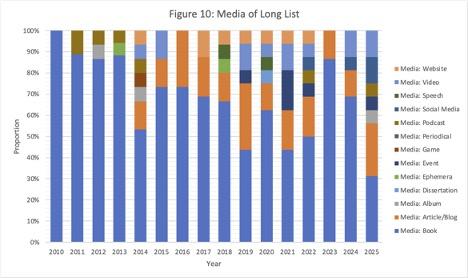

Table 4: Media Types for Long List
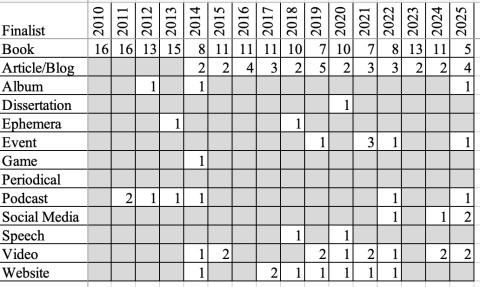
Table 5: Media Types for Finalists

We can see that it took a while for nominators to begin engaging with the potential range of Media beyond Books, with Podcasts being the first expansion. (The full data set for 2010 includes one Podcast, with all other nominees being Books.) It makes sense to do the primary analysis on the Long List and then compare the Finalists.
Within the Long Lists, Books dominate the Media formats, falling below 50% in only three years, and falling below 67% in only five years. However, there is a trend of Books increasingly being displaced by other Media formats as time progresses. The lowest presence is 33% in 2025 (the last year of analysis).
Before moving on to the more detailed analysis, it might make sense to take a slightly different, and higher-level, view. The second most prevalent Media type is the Blog/Article group—that is, textual works that are shorter than Books or that are published on the web rather than in hardcopy format. Combining the numbers into three super-sets—textual works, audio or video works, and other—the trends can be seen in Figure 12 and Figure 13. (These same graphs also work to analyze the most common versus less common formats, as the Audio/Video and Other groups are also significantly less common.)

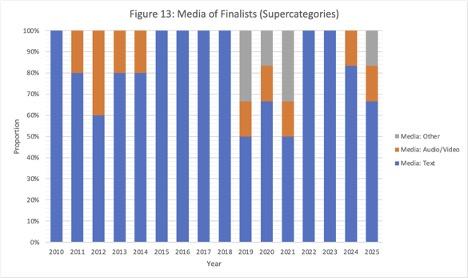
Here it’s even more clear that the expanded scope of Media formats has not dislodged textual works from dominance. Text is never less than 50% of the Long List and rarely less than 75%, though again there is a gradual downward trend across the era. The “Other” Media group takes longer to begin appearing in the Long List, but once present, it vies with Audio/Video for second place.
This dominance is even more striking among Finalists, with textual works never being less than 50% and filling all the Finalist slots in 7 years out of the 16. Audio/Video formats are a regular presence, but there is a cluster of years (2019-2021) when Other Media types are strongly represented among Finalists.
Returning to the more finely-grained analysis, there has been an overall (though erratic) increase in the number of different Media formats represented in the Long List with a similar, though naturally lower, increase for Finalists (Figure 14).

Long List diversity of format increased steadily to 2014 when 7 formats were represented (tied for maximum with 2022 and 2025). This fell significantly in the following few years (2015-2017, which include the two Puppy years), then increased again, with the anomaly being the low diversity of format in 2023 (when Worldcon was in China). While a rigorous analysis hasn’t been performed, the non-textual formats in the Long List appear to cluster toward the bottom of the nominations, so it may be that anything that disrupts normal nomination patterns is more likely to push out works in non-text formats. This is speculation.
Finalists are relatively more diverse in format than the Long List, with only two years in which only a single format was represented (Books, as one might guess).[5] There are 3 years where the 6 Finalists are drawn from 4 different formats, with Book and Video being constants, and Article/Blog, Event, and Website occurring in 2 of the years each (closely corresponding to our 6 most frequent Media formats overall).
As noted previously, diversity of Media increases gradually, but certain types begin appearing at different times. Interestingly, the Article/Blog format, though second most popular overall, doesn’t show up in the Long List until the fifth year of the era (2014), though it appears continuously from then on, and with at least 2 works each year. The earliest format expansion is Podcast, appearing in the 2nd through 5th years of the era, then sporadically later. There are several specific features of Podcast appearances that affect their appearance in Best Related and the dominance of one Podcast in this Media format. This is discussed in the Overlapping Categories section, Fancast chapter. Video and Website both appear frequently, but not continuously, starting in 2014. Unlike Podcast, Video works are not dominated by a single repeating show, although some works are part of a Series by the same creator, where only one or two episodes were nominated. Website falls somewhat between the two patterns, with one repeating work accounting for almost half the nominations for this format. The latest addition to the range of formats appearing in the Long Lists is Social Media, first appearing in 2022.
Of the 8 Media formats appearing as Finalists, 4 (Book, Article/Blog, Album, Podcast) appear in the earlier part of the Related Work era (2010-2018) and may also occur later, while 4 (Event, Speech, Video, Website) appear first in 2019-2020 and may also occur later. Looking at both Finalists and Long Lists, 2019 feels like a tipping point for expanding the diversity of formats.
Conclusions
Overall, although there are a wide variety of Media formats appearing in the data, the majority appear rarely, and text formats (long form and short form) dominate the data. Non-Book formats took a few years to be embraced by nominators, with some being adopted earlier than others. When assessing the Related Work period as a whole, Media formats appear as Finalists roughly in the same proportions that they appear in the Long List, and—within the constraints of the numbers—Winners are also roughly proportional to presence in the Long List. That said, when examined on a year-by-year basis, there is an overall trend for non-Book formats, or non-text formats in general, to become slightly more prevalent as time goes on, with non-text formats never exceeding 50% of the Long List or Finalists. And even in recent years, there have been multiple times when the Finalists were entirely text works.
The remainder of the Media section will examine each Media format and discuss any interesting features of its frequency and appearance. For rarely-occurring formats, the discussion will focus on the factors behind the specific works that appear, whereas for more common formats the analysis will review other features of the format that may have changed over time.
(Segment IX will cover Part 3 Historic Trends, Section 3.2 Media, Chapters 3.2.2-3.2.14.)
[1]. This is the only work in the entire database categorized as a Periodical. It might reasonably have been classified as a Book but see the Category discussion for details.
[2]. Note that one format (Periodical) does not occur during the Related Work era, as it has only a single instance in the entire dataset.
[3]. 7% represents a single Winner. Thus, only Book has had more than one Winner.
[4]. During two years no award was given, due to voter response to the Sad Puppy slate nominations dominating the category. For this purpose, % Winners are calculated relative to total winning works, not number of years.
[5]. “Relatively more diverse” means “number of different Media types compared to the number of nominees.”
Major category:
ConventionsMonday, March 30, 2026 - 11:30
The Theory of Related-ivity:
A History and Analysis of the Best Related Work Hugo Category
by Heather Rose Jones
(This is a serialized article exploring the history of the Best Related Work Hugo category in its various names and versions. If you’ve come in at the middle, start here.)
Contents
Part 3: Historic Trends
3.1 General Trends
3.1.3 Gender
3.1.4 Authorship
Part 3: Historic Trends
3.1.3 Gender
Gender Fractions
As the simplest way to present gender fraction data is in a bar graph, there is no convenient way to indicate the different eras in the figure. Remember that Non-Fiction is 1980-1997, Related Book is 1998-2009, and Related Work is 2010+. See Figure 8 and Figure 9 showing the overall gender fractions for each year for Finalist and Long List respectively
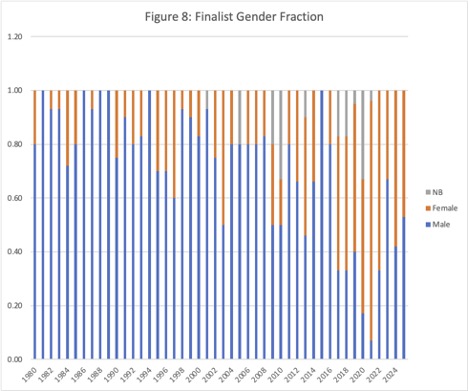
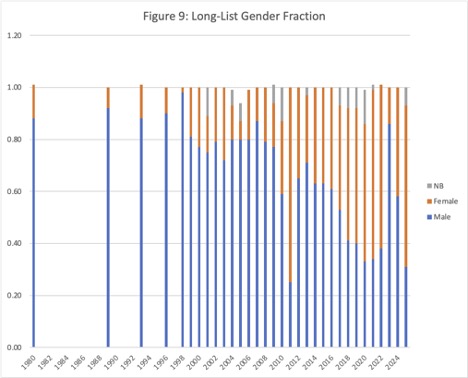
For Finalists, there is an overall shift from primarily male authorship during the Non-Fiction Book era, including 5 years with only male authors and no year when male authorship was less than 0.60, to occasional years of parity in the Related Book era (2 years with male authors at 0.50, but otherwise male authorship is nearly always 0.80 or higher), to overall parity during the Related Work era (6 years when male authors predominated, 7 years when non-male authors predominated, and 3 years nearly equal at 0.50 +/- 0.05). Outside of the Non-Fiction Book era, the only gender shut-out was in 2015 (a Puppy year) when all Finalists were male. In no year were all Finalists non-male, although 2020 came the closest with 0.50 female authors and 0.33 non-binary authors.
For the Long Lists, the overall trends are roughly similar, with a gradual increase in non-male authorship over time (with some years deviating from the trend). As might be expected, due to the larger data sets, year-to-year variability in this trend is less. The Finalist and Long List proportions are relatively similar. In 18 years, the difference between the two for male authorship is less than +/- 0.10. In 9 years, male representation is noticeably higher in the Long List than in the Finalists, while in 5 years male representation is noticeably lower in the Long List than among Finalists. The two years of greatest disparity between the two both involve lower male representation in the Long List (2011: male representation goes from 0.80 for Finalists to 0.25 in the Long List; 2015: male representation goes form 1.00 for Finalists to 0.63 in the Long List.).
If one takes the Long List as better representative of overall trends, three years stand out as breaking trend. 2011 with out-of-trend low male authorship (0.25), 2023 with out-of-trend high male authorship (0.86), and to a somewhat lesser extent 2024 with out-of-trend high male authorship (0.58).[1] With the exception of these three years, the year 2017 represents a tipping point when the Long List shifted from consistently male-dominated to consistently non-male dominated. This same year represents the point when the Finalist list shifted from being male-dominated (with occasional parity years) to primarily non-male dominated (with one exception). That is, out of the 46-year history of the category, something resembling gender parity has only been achieved within the last 9 years.
It may not be coincidental that this occurs immediately in the wake of the Sad Puppy years. That is, the campaign to promote “traditional” (i.e., male) nominees may have resulted in the opposite: a greater focus on works by women and non-binary authors.
There are three years for which more extensive nomination data is available and the gender proportion calculation was done on the complete set.[2] The resulting proportions are not significantly different from that of the Long List.
- 2007: Long List 0.87 male, all data 0.86 male (n=40)
- 2009: Long List 0.77 male, all data 0.74 male (n=25)
- 2010: Long List 0.59 male, all data 0.66 male (n=23)
The above analyses contrast male and non-male authorship,[3] but it’s worth taking a look at non-binary/gender-fluid authorship specifically. Non-binary authors first appear (in both the Finalist and Long List) in 2001 and, in the past 25 years, have appeared among Finalists in 10 years, and on the Long List in 12 years. The highest representation among Finalists is 0.33 in both 2010 and 2020. The highest representation in the long lists is 0.13 in the same two years. While this might seem like an unexpectedly high rate of representation, it’s worth noting that of the 19 works in my data set with non-binary/gender-fluid authorship, 12 involve the participation of one specific (highly-prolific) individual.
Proportion of All Male, All Non-Male, and Mixed Authorship
Another way of examining the gender data is to consider the percentage of works with all-male authorship (regardless of author number), percentage with all non-male authorship, and percentage with mixed-gender authorship. This is calculated only for the data set as a whole and for the individual eras. We see a similar pattern as for the gender fractions, with strong male dominance in the earliest era gradually giving way to something closer to parity, with mixed authorship holding fairly steady across all eras.
Table 1: Gender Proportions by Era
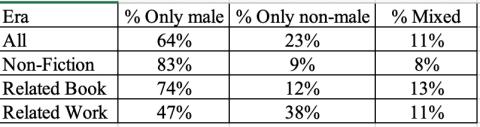
Gender of Topics
For a consideration of the gender of the subjects of Books, see the section for Other Tags in the chapter on People, which also examines repeat appearances for authors and Topics.
Overall Conclusions
The Best Related category has shifted over time from being strongly dominated by male authors, to shifting recently to a slighter balance toward other genders, though this is not consistent. This shift cannot be correlated specifically with the changes in the category name/definition, as it is gradual, but a key tipping point occurred in 2017.
Although it isn’t practical to do a cross-category survey as part of this study, there is evidence that a gender-related inflection point occurred in the fiction categories as well. James D. Nicoll surveyed gender-skewing within the fiction categories for the period up through 2019 by identifying years in which Finalists included either one or no male or female authors.[4] Low male representation is extremely rare in any of the 4 fiction categories up through 2010. There is a 3-year period from 2011-2013 when 1 or 2 of the fiction categories included only 1 male author, then another 3-year period form 2017 to 2019 (the last year in the survey) when at least 2 fiction categories included 0-1 male authors, culminating in all 4 fiction categories having only one male author in 2019. In contrast, prior to 2011 in 54 (out of 58) years at least one of the fiction categories had low female presence, and in the same period 49 (out of 58) years saw at least 2 fiction categories with low female presence. During the same couple of 3-year periods when some categories saw low male presence, no categories saw low female presence. (That is, it wasn’t just that women dominated in the specific categories with low male presence, but that they had more representation in all categories in those years.)[5]
3.1.4 Authorship
Unlike the fiction categories, it’s not uncommon for works in the Best Related category to have multiple authors. However, the way in which authorship is attributed for some of the non-Book formats isn’t always consistent. In the case of published works, the author list has sometime been revised from what is published at the Hugo website to reflect credited names in the original publication, however in the case of non-text works authorship is as attributed at the Hugo website.
Out of the 609 works in my data set, the number of listed authors is distributed as follows:
- 1 author: 448
- 2 authors: 108
- 3 authors: 27
- 4 authors: 8
- 5 authors: 4
- 6 authors: 1
- 32 authors: 1[6]
For an overall average of 1.19 authors per work, where 74% are single-author works. Because the vast majority are single-author works, a year-by-year analysis would be too granular to demonstrate any overall trends. Therefore, the data is grouped by era, then compared Finalists and full data sets (which may include more than the official Long List, but which is largely identical to Finalists for the Non-Fiction Book era).
Table 2: Number of Authors by Era
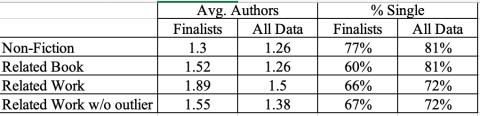
For Finalists, the average number of authors increases across the eras while the percentage of single-author works falls and then increases again. We may have a “Spiders Georg” problem here.[7] It is unusual for Best Related works created by a large team to include a full team roster.[8] If the one work that lists 32 authors is excluded, then we see only a minimal increase in average authorship between the Related Book and Related Work eras, while the percent single-author works is not substantially affected. Overall, this suggests that nominated works increasingly are involving (or at least crediting) larger teams.
When looking at the full data sets, the average number of authors is constant between the Non-Fiction and Related Book eras, then increases in the Related Work era (to a greater or lesser degree, depending on whether the outlier is excluded. This percentage of single-author works is also identical between the first two eras, then falls somewhat under Related Work. Taken all together, this suggests that the percent single-author Finalists in the Related Book era is the anomalous statistic. This appears to be due to multi-author works in the Related Book era still having a relatively small number of authors (2-3) in comparison to the Related Work era (see below).
In all subsets, Finalists have a higher average authorship and lower rate of single-author works than the full list, raising the possibility that there is a slight nomination bias in favor of multi-author works.[9]
Of the 13 works with 4-6 authors, 2 occur during the Non-Fiction era and the other 11 during the Related Work era (most of which were Finalists), with none occurring during the Related Book era. And of the 11 Related Works, 7 are a format other than a Book or Article.
This suggests that the expansion of scope to non-text formats (which may involve larger teams) in the Related Work era may be the driver for an increase in average authorship even as single-author works return to a higher level.
(Segment VIII will cover Part 3 Historic Trends, Section 3.2 Media, Chapter 3.2.1 Introduction.)
[1]. Given the specific years involved, it might be tempting to investigate whether this reflects a bias towards male authors on the basis of Chinese nominators, but the Chinese-language works show no such bias, therefore there is no basis for hypothesizing a gender bias with regard to the nomination of non-Chinese works by Chinese nominators.
[2]. Due to extensive ties at the low threshold for the Long List, some Long List data sets include up to 21 works.
[3]. See the Gender chapter in the Categorization Process section for the basis for categorization. To reiterate, as far as can be determined, all authors categorized as non-binary are assigned female at birth and are most likely to be perceived as female by an unknowledgeable observer. The question of the timing of when they shared their current identity publicly has not been investigated, therefore non-binary identity may have been retrospectively assigned for years prior to this being publicly shared.
[4] Nicoll, James D. September 10, 2019. “Gender and the Hugo Awards, by the Numbers” in Reactor Magazine (https://reactormag.com/gender-and-the-hugo-awards-by-the-numbers/) accessed 2026/02/26.
[5] A very rough back-of-the-envelope review of Finalists for the fiction categories in 2020-2025 indicates that in approximately ¾ of the category-year data sets, female-presenting authors were in the majority. So the author-gender inflection point for fiction appears to be sustained to the present.
[6]. This is not a typo. The r/Fantasy Bingo team was an extensive list. In recent years, it has become more normalized for large-team groups, especially publishing teams for Semiprozine, to list all staff individually.
[8]. For example, collections of Essays by a large number of people do not list all the contributors as “authors.”
[9]. If this is a genuine bias, there are multiple possible explanations. Multi-author teams might well be more likely to create higher quality works. Alternately, each team member might attract a different set of fans to the nomination process, increasing the likelihood of making Finalist. If this proposed “multi-author fanbase effect” is real, it may suggest that “non-traditional” works gain an advantage by involving larger creative teams than is practical for “traditional” text-based works. Plotting number of authors versus number of nominations does suggest something resembling a correlation for works with 2 or more authors, more so for works with 3 or more authors, and even more clearly when the analysis is restricted to finalists. However as the vast majority of high-nomination works have single authors, the phenomenon seems unlikely to affect nomination results significantly.
Major category:
ConventionsPages
