Blog
Monday, April 10, 2017 - 07:00
I've had several long-weekend events lately that have interfered with getting blogs up, but in this case it gave me enough slack time to get the rest of Mill's book written up. There are three more chapters in the can after this one, although some of them are rather thin and I may accelerate the posting schedule if I get more material written up to follow.
I love how Mills brings together a number of themes regarding the connections that can and cannot be made between modern understandings of gender and sexuality and historical ones. As with many sociological fields, there's too much of a temptation to believe we make regular linear progress in our understanding of gender and sexuality. That the understanding-of-the-moment is inherently "better" somehow than all previous understandings. Much harder to accept--even when it's part of the theoretical underpinnings--that all understandings are subjective and both enabled and constrained by the models and stories available to us.
A search for clear mappings and connections in history may feel validating, but it can erase the lived experience of people in the past, whose understanding of their own lives should be respected--even if that understanding includes what we consider a false belief in the sinfulness of their actions. Who are we to decide that historic person X was "really a closted homosexual" if their worldview didn't include such concepts? But I always feel deeply uncomfortable with the "strong Foucaultian" position that there are no conceptual connections between modern people's understanding of their genders and sexualities and those of people in history. And I'm especially uncomfortable with the way the Foucaultian position feels like it targets non-normative genders and sexualities exclusively. One may pay lip service to "well, after all, heterosexuality is a modern invention too" but the consequences of such an acknowledgement (and its potential to affect modern people's lives and self-images) are much smaller.
I'm comforted by seeing historians like Mills find a messier, more nuanced path through the tangle.
Major category:
LHMPFull citation:
Mills, Robert. 2015. Seeing Sodomy in the Middle Ages. The University of Chicago Press, Chicago. ISBN 978-0-226-16912-5
Publication summary:
This is an in-depth study of the visual cues and visual representations of the concept of “sodomy” in medieval manuscripts and art, using the definition of that concept at the time, not the more specific modern sense. Mills looks at how gender and sexuality interact and challenges the perception that there was no coherent framework for understanding gender and sexual dissidence in the middle ages. The topics covered include images associated with the label “sodomite”, gender transformations and sex changes (especially in Ovid), and sexual relations in closed communities (such as religious houses). The analysis includes a consideration of the relevance of modern categories to the study of medieval culture.
Chapter 3 The First Sodomite
Several chapters in this book focus, such as this one, fairly exclusively on male-related topics. I haven't summarized them in nearly as much detail as the ones relevant to women.
[The following is duplicated from the associated blog. I'm trying to standardize the organization of associated content.]
I love how Mills brings together a number of themes regarding the connections that can and cannot be made between modern understandings of gender and sexuality and historical ones. As with many sociological fields, there's too much of a temptation to believe we make regular linear progress in our understanding of gender and sexuality. That the understanding-of-the-moment is inherently "better" somehow than all previous understandings. Much harder to accept--even when it's part of the theoretical underpinnings--that all understandings are subjective and both enabled and constrained by the models and stories available to us.
A search for clear mappings and connections in history may feel validating, but it can erase the lived experience of people in the past, whose understanding of their own lives should be respected--even if that understanding includes what we consider a false belief in the sinfulness of their actions. Who are we to decide that historic person X was "really a closted homosexual" if their worldview didn't include such concepts? But I always feel deeply uncomfortable with the "strong Foucaultian" position that there are no conceptual connections between modern people's understanding of their genders and sexualities and those of people in history. And I'm especially uncomfortable with the way the Foucaultian position feels like it targets non-normative genders and sexualities exclusively. One may pay lip service to "well, after all, heterosexuality is a modern invention too" but the consequences of such an acknowledgement (and its potential to affect modern people's lives and self-images) are much smaller.
I'm comforted by seeing historians like Mills find a messier, more nuanced path through the tangle.
# # #
Another story appearing in the “moralized Ovid” manuscripts is that of Orpheus. Orpheus is relevant to the topic of the book via a version of the story in which, after losing Eurydice, he turns away from women to love boys. [As a brief summary for those not familiar with Orpheus: after his girlfriend Eurydice dies, he goes down to the underworld to plead for her return and his singing is so sweet and powerful that Hades agrees, provided he leads her out of the underworld without looking back at her. Just as they’re about to emerge into the mortal world, he looks back and she is lost to him forever. Later he takes up with maenads--rampaging wild women--who eventually tear him to pieces.]
Medieval imagery of Orpheus with his lyre (or harp) was often confused and conflated him with David (also symbolized with a harp) and with Christ. In the moralized Ovid, Orpheus’s turning away from women is equated with turning away from sin. Peculiarly enough, this means that his love of boys maps to a love of God, hence the imagery lacks some of the expected negative framing. But there are other symbolic resonances that led to viewing Orpheus as a sodomite. Music and poetry could be considered “unmanly” activities, and Orpheus’s ability to tame wild beasts was considered “against nature.”
The act of turning back (to look at Eurydice) is sometimes connected with Lot’s wife turning back to look at Sodom (leading to her conversion to a pillar of salt). Symbolically this turning/looking back is considered to represent a return to an unsaved state. The next chapter looks more at this motif of “turning”.
In the mean time, the discussion of Orpheus in the illustrated moralized texts offers a lot of examples of depictions of erotic affection between men.
Time period:
Place:
View comments (2)
Wednesday, April 5, 2017 - 07:00
When Abiel suggests to the folks back home that they will need to get out the atlas to follow along with his adventure, he isn't kidding. I had the benefit of Google Maps. I really do want to put together some maps to accompany these entries--I want to do so many things. This sort of "micro history" is so great for having an understanding of the past, and it makes it all the more of a crime that the histories of many groups of people have been suppressed, erased, or deliberately destroyed. Reading about troop movements is one thing. It's another thing to read about the emotional reactions of camp inhabitants to the reinstatement of a popular, charismatic commander who they believe is being jerked around for political reasons. That makes you understand why one commander can get his men to go all out for him, while another fails because his men have no confidence in him.
This finishes the "catch up" entries from circling back to the start of the diaries. If you've lost track, the original blog entries starting in January 1863 are here, because after this I'm going to jump ahead and pick up again in January 1865. And it's probably time to start getting these visible on the website at heatherrosejones.com as well.
The Diary and Letters of Abiel Teple LaForge 1842-1878
October - December 1863
Transcribed, edited, and annotated by Phyllis G. Jones (his great-granddaughter)
Copyright © 1993, Phyllis G. Jones, All rights reserved
[PUNCTUATION AND SPELLING ARE COPIED FROM THE ORIGINALS. EDITORIAL COMMENTS ARE IN BOLD TYPE.]
1863 Contents
- January 11, 1863
- January 26, 1863
- February 15, 1863 - The Wonderful "Care Package"
- March 2, 1863
- March 20, 1863
- April 30, 1863
- May 27, 1863
- June 26, 1863
- August 3, 1863
- August 25, 1863
- September 24, 1863 - A Night at Ford's Theater
- October 20, 1863
- October 30, 1863
- December 10, 1863 - Transporting Prisoners to Washington and Some Sightseeing
LETTER (WRITTEN ON PAPER WITH PICTURE OF FLAG WITH 34 STARS)
Head Quarters, Convalescent Camp October 20th 1863
Dear Friends,
I write to let you know I am coming off with flying colors, as you can see above. Some style about that flag ain't there? True "Union"!
I was over to Washington today, having a most splendid dinner at the "Lutz Hotel" on the european style, three bottles of wine to "finish up" with. You must not think by that that any of us were tight, for that kind of table wine does not inebriate. We returned before sundown all sober, if not honest--
We have had one or two Virginia rains, just to show us winter was at hand. I cannot help remarking how very fast this ground dries after the most protracted rain. As soon as it clears up, and the sun shows his smiling face, the earth is charmed into such good nature that it is unable to remain muddy and disagreeable if it would. So a virtue is made of a necessity and all marks of a storm are smothed away as soon as possible.
We are talking some of building barracks for four thousand more men. I hope we shall, for they do not cost as much as tents, and for a permanent camp like this are much better. A barrack can be built to accomodate 108 men for less than three hundred dollars. And "Sibley tents" for the same number would cost more than four hundred dollars. Besides, the buildings will last twice as long.
Oh! Sister, I was highly complimented by one of General Hentzelman's staff officers the other day. Major Willard, former proprietor of "Willards Hotel" was to take 374 men from this camp to Fort Monroe Virginia. [Note: I don't know from context and an initial search whether this is the famous Willard's Hotel in Washington, or something more modest named in allusion to it. "Former proprietor" and the use of scare-quotes suggest the possibility of the latter.] We were to send the men. He would meet them there with a boat at precisely 8 O.C. A.M. He is one of those fussy old fellows and was very much afraid they would not be there on time. Captain Crawford (then in charge) pledged him his word they would, and then told me he would leave the fullfilment of his word to me, and said he wanted the old major pleased once.
So I got the men nearly ready the night before, and was up at four the next morning and finished. And getting a horse, started with them early. I marched down to the dock (four miles) and had them drawn up in line and all arranged to march on board ten minutes before the boat came. As soon as she did come and rounded to at the wharf, I put the men in motion and went right aboard. I could see at once the major was satisfied. When all were aboard, he took me into the cabin and asked me what my name was. I told him Sergeant LaForge. (I am an acting sergeant now.) He put it down in his book and said he must write a letter about that. Then just as they were starting off, he came to the side of the boat, before I got on my horse, and bade me tell Captain Crawford that nothing could be more prompt than I was with the men. I galloped back to camp feeling as big as,- as,- (not ass) a hundred and thirty pounds of humanity could well feel.
I get no more pay for acting as sergeant. I merely wear the pants stripe, so that the sergeant who may be in a squad which I have charge of will not be able to rank me and object to obeying my orders.
I sent $15 dollars by express. Have you got it yet? Perry will give you a note for it Susan, and when he does, I wish you would send me copies of them all. I mean a copy of each seperate, not signed, but all the rest same as the originals. [Note: I'm always fascinated by the details of everyday finance in these lives. Small loans are constantly going back and forth, secured by nothing but pieces of paper, good will, and community reputation.]
How is Charley? Give him my love. Tell mother, if I was up there I would kiss her, and then we would set down in the corner and have a good old time smoking. My best wishes to Joseph and Perry. I would like to help them dig potatoes this fall. [Note: Interesting implication that Mrs. Potter ("mother") smokes. I'm fairly certain that this woudn't be acceptable in high society, and it makes me wonder about other differences in gendered behavior between town and country.]
I am glad Janey can give so good a report of her enjoyment on her visit. Mrs. P[otter] must leave you a place to write on every time, and if it is not filled up you will get awfully talked to when I get home. My kind regards to Mrs. S.A.Potter. Kiss Mattie for me and cut up all the other tricks you are a mind to, only remember to love your soldier brother.
A. T. LaForge
P.S. The letter you enclosed to me was from W. M. Hibbard, Company Y, 82nd New York, a discharged soldier now. He is an old friend of mine.
LETTER
Head Quarters Convalescent Camp, Virginia October 30th 1863
Dear Sister,
I have succeeded in getting a furlough for Perry Wells, and take advantage of it to send you some things to preserve for me. I wish when he returns you would send me two good pair of woolen stockings, and a long letter. Also my "French Dictionary." And if you could, I should like to have you send me a heap of love also. It is so much better to have someone say it to you, than to have it written. We are sending about a thousand men home to vote, however Perry would not have been one of them if it had not been for me. And I assure you nothing could give me more pleasure than it does to send an old friend like him home to see his friends. I have lots of work tonight, so I can write but a short letter, but it contains much love from,
Your brother
A. T. LaForge
[Note: This is another interesting facet of everyday economics. It was certainly possible to send packages by freight--as we've seen before with the food packages--but there are other references to things going missing in transit. How common might it have been to ship incidentals under the care of a traveler instead?]
LETTER
Head Quarters Convalescent Camp December 10th 1863
Dear Sister,
I this moment received yours of Dec. 7th, and as you may see by this, only waited to read its threatening contents before I hasten to answer it.
None of your surmises prove to be correct. I have not been sick, nor have I forgotten my obligations to my friends way up in Andover, but I have a story to write. Since my last to you, I have been quite an extensive traveler. [Note: It is perhaps worth rememberin in the following description that Convalescent Camp housed recovering soldiers from a vast number of different units. When Abiel escorts groups of men from the camp, in some cases it appears to be a new assignment, as in "hey, we need X number of men in location Y," but in this case it appears to be a matter of returning a large number of men to an assortment of original units. Hence dropping off a few here and a few there along the way.]
November 23rd I was ordered to take charge of a squad of 60 (sixty) men and proceed with them to the respective destinations which were given in my written instructions. So early in the morning I went over to Washington to get my transportation. The men were brought over to me in the afternoon by one of the orderlies. I started at 6 O.C. P.M. on the cars for Baltimore. I had to stay all night in Baltimore and left three men there to go to Fort McHenry. Also 5 men to go to Carlisle Barracks Pennsylvania. The rest I took on the cars with me to Philadelphia. At Philadelphia we had to change cars and all of us reached from one end of the city to the other in the street cars. [Note: Several times in this letter, Abiel uses "cars" by itself in a context that suggests "railroad cars." E.g., talking about "taking the cars" where we might expect "taking the train." But elsewhere as here he either states or implies streetcars. I haven't tried to clarify, but generally the sense can be gotten from context. Of course, the one thing he can't possibly mean is "automobiles," so there's a bit of whiplash for the modern reader.]
We arrived at New York City about eleven O.C. I took my men to the State Soldiers home on Howard Street and stayed all night. (By the way, before you read any farther you had better get my "Atlas" and follow me. [Note: I'm often tempted to do this myself!]) Next morning they gave me the big ambulance that belongs to the Home (it will hold 20 men) to take my men that were to be left at New York down to the Quartermasters on State Street. Here I took the boat and went over to Brooklyn then, taking the Street cars, went down to Fort Hamilton 7 mils distant. I stayed down at the Fort about an hour. It is a very pretty place there, I assure you.
Then went back to New York. Sent 5 of my men down to Fort Columbus, Governors Island, New York Harbor. Got transportation for the rest of us and took the boat for New London, Connecticut.
Left 14 men there at Fort Trumbull, and then took the cars on the Norwich and Worcester line for Boston. We went to the Sanitary Rooms on Beech Street, and a fine place it is, I assure you. They give each soldier a ticket to go into a first class saloon and call for whatever he wants to eat, without cost to himself.
It was Thanksgiving day and they would not do any work at the government offices, so I had to stay all day. How I wished I was up with you to dinner! I went up to the top of Bunker Hill Monument. I haven't room for description or I would try to give you some idea of the grandeur of the view from this elevated spot. It certainly was as pretty as any person has ever described it. The most distant object that can be seen is the White Mountains, distant 90 miles.
I also went to the Boston Common, which is a fine park in this heart of the city. Almost in the afternoon I went down to Fort Independence on Castle Island. I went by the Government boat. It is a mile from the city.
Next day I took the boat about sundown for Portland, Maine, and when I woke up next morning I found myself in the city. I had to take 3 men over to Fort Preble, about a mile from the city and across the Kennebeck. When I went back, I found the boat did not go back to Boston until Monday night. I felt disappointed, but of course must make the best of it.
As I had no men to bother me until I got back to New York again, I could run about as I pleased, so I went all through the town in about 6 hours. To the "jail" where a girl came to the window and called me a "pretty soldier," to the Lookout Tower from where you can see the whole city, harbor, and country around for miles, to the "Navy Yard," and finally to the Boston and Maine Depot. And, finding a train would soon leave for the former place and the fare would be $2.60, I determined to buy a ticket, as my board would cost me as much if I stayed.
So Sunday morning found me in Boston again, where I stayed all day and went up to the reservoir and "Dorchester Heights" where Washington planted the guns that drove the British fleet from the harbor. Part of it is now a park.
Monday I took the cars for New London again, and that evening [took the] New London and New York Boat for the latter place. We were were coming through the narrowest part of the "Narrows" near "Hurlgate" when we run into a schooner. The channel was so narrow she could not get out of the way without running on the rocks, and with us it was the same. Her boom ran into the steamers side making an ugly hole but well [above the?]
[the rest of this letter is written at right angles to and on top of the previous text]
water mark. We finally got loose, with very severe loss on either side. [Note: It doesn't feel like Abiel means "loss of life" so I'm assuming this is a reference to damage, or perhaps property loss?]
I stayed all day in New York. I intended to go up and see Barney, but finding it was farther up than I should have time to go, I did the next best thing. Went to Barnum's to see the big Show. And a big show it is. Every thing from an elephant to a flea, and every stage complete. [Note: I believe this would be Barnum's American Museum, as Barnum did not enter the circus business until 1870. The Museum, alas, burned down a year and a half later.]
I still had to go out to Detroit, Michigan with some official papers and one man. [Note: This is the point when we start to seriously forgive Abiel for the lateness of his letter!] I found I should not be able to stop at Andover, so I made up my mind I would go 200 miles out of my way rather than see home and not be able to stop. So I took the Hudson River cars to Albany then the New York Central to Buffalo, where I stopped a few hours. Enough to see the city. Then down to Dunkirk, and by the Ohio Shore to Cleveland, Ohio, then to Toledo.
I made another stop here of three hours, then took the cars to Detroit. I took my man and government papers out to Fort Niagara, about 2 miles from the depot. I took breakfast at the fort then came away.
It was now I commenced to enjoy myself. I had no more responsibility here, and papers were all delivered, and in the language of Shakespeare "Richard was himself again." [Note: Tracking down this quote turns up the interesting fact that it isn't originally Shakespeare at all, but was added to a performance of Richard III by English actor Colley Cibber in 1699, and evidently "stuck." See footnote 1 in this article. In a random "all history is connected somehow" fashion, Colley Cibber was the father of famous cross-dressing (and by modern standards gender-queer and possibly even trans) actress Charlotte Charke.]
I run about through the city all day and then did not see half of it. In one place was a park with three little tame deer in it. They came to me and licked my hands and ate some cake out of them. I went to the Pork packing establishment where every thing is done by steam: killing, cleaning, cutting, and packing--all but salting. [Note: Although it's amusing to think of a pork packing plant as a tourist entertainment, I keep wondering how much of this sort of thing is a normal attitude toward sight-seeing at the time, and how much reflects Abiel's deep curiosity of everything around him that stood him in good stead, career-wise.]
Finally I came by the way of Toledo to Cleveland, Ohio, where I stopped 6 hours. Went up to the Navy yard. Also to the park where the celebrated statue of Commodore Perry is. Then down to the new breakwater they are building in the lake. About 2 O.C. I started for Pittsburg by the Pittsburg and Cleveland Railroad. I did not stop at Pittsburg, but came on by the way of [the] Pennsylvania Railroad to Harrisburg. Then by the Northern Central to Baltimore. Then by the B&O Railroad to Washington, and finally over here I was [at?] last, making just thirteen days since I started.
I was rather tired, notwithstanding the old course of things. Not quite into the old course either, for Colonel McKelvy was my command when I went away and General Abercrombie when I came back. Colonel McKelvy was meanly relieved, and the general has been commanding about ten days. We began to think there was no help for it when lo! Last night Colonel McKelvy comes over from Washington with an order from the Secretary of War putting him in command again. [Note: If you recall, there were previous grumblings about command politics, such as someone pumping Abiel to try to get dirt or complaints about McKelvy.]
When he got here it was after dark, and nobody around, but how the news got through camp that he had came back to take the old place, and the camp was wild with excitement! The officers flocked around him to welcome him back. He did not want anybody to know he was in charge again, but it was known somehow, and the men could not be restrained. It was hurrah for "Mac," Glory hallelujah man, and the like. Now we are all contented again.
I hope you accept my excuse for not writing as good, do you not sister? I could not well write when traveling. I should have written before I started, but I then thought I might get a chance to see you. But such was against me. I could not.
Dear sister, don't you think I ought to feel flattered when I have the chance of taking men for a trip, that any officer of the command would have given $100 dollars for this privilege of going on such a trip? I was allowed to go because I have the name of being so sober and honest. I would not tell any but the reason. But God bless you, you are my sister and I can tell you anything my vanity may suggest.
But I must close. I don't believe you can read this. I think I must do what I should like to, which is to beg you to excuse poor writing. My nerves are not very steady. A ride of 1500 miles in the cars will make anybody shake for a while.
Give my love to Janey. Kiss mother for me and believe me ever,
Your loving brother
A.T. La Forge
Chief Orderly
P.S. I enclose a copy of my warrant promoting me to a Lance Sergeant. My pay is not increased by it; it is merely a reward of merit. Like a brevet commission. Yours, A.T. LaF.
I have not time to read this over to correct mistakes. Will you kindly overlook it? LaF.
Major category:
LaForge Civil War DiariesTuesday, April 4, 2017 - 13:54
I've discused previously how the way that Alpennian characters talk to and about each other, and even what terms the use to think about each other, provides a constant commentary on their relationships and attitudes, whether it's of status, intimacy, or affection. But in some ways, I always had an out in that I was writing in the third person. A very tight third person, to be sure, but if Barbara thought something about the princess and called her simply "Annek" in the privacy of her thoughts, that could be chalked up to shorthand.
Things are a bit different for Roz, my protagonist in Floodtide. A big difference is that I'm writing in the first person--in her own voice. So I feel much more constrained to having her refer to the people around her using the terminology that would be appropriate if she were relating her story aloud to a listener. The second big difference is that the majority of the people she's dealing with outrank her, either in terms of social class or interactional status. When she beomes Iulien Fulpi's maid, there will never be any circumstance in the story where it would be appropriate for her to address her or refer to her simply as Iulien (much less as Iuli). It will always be "Maisetra Iulien." Even Dominique the dressmaker will always be "Mefro Dominique" to Roz because Roz is apprenticed to her and it's a matter of showing proper respect.
About the only people Roz is on a first name basis with are her close friends Celeste and Liv, and her fellow household servants--at least the ones at the lower end of the ladder. Charsintek the housekeeper gets a surname in deference to her status.
That's an awful lot of maisetras and maistirs and mesner(a)s and whatnot and I may devote an entire editing pass just to look for circumlocutions to avoid being repetitive in any given passage. But one of the reasons I wanted to use Roz as a viewpoint character was to look at Alpennian society from someone at the bottom. And part of being at the bottom is that constant awareness of one's place in the hierarchy. (It's part of being at the top, too, but in a different way.) No matter what adventures they share, Roz never loses sight that it's Maisetra Iulien, not Iuli. It will be quite a challenge to make it work.
Major category:
Writing ProcessPublications:
FloodtideTuesday, April 4, 2017 - 07:57
Due to the new Live Journal terms of service, I can't log in to my LJ without agreeing to the new TOS and the new TOS only exist (officially) in Russian. There are also serious concerns about some of the content. I will probably be closing down and deleting my account there. This is to test whether the automated cross-post will show up or be blocked by the TOS requirement. This is also to test whether the RSS version will show up.
Monday, April 3, 2017 - 07:15

Mills is turning out to be a very dense book, though I'll be skimming some chapters that deal primarily with male-related topics. By the way, check out this interview of me on J. Scott Coatsworth's blog!
Major category:
LHMPFull citation:
Mills, Robert. 2015. Seeing Sodomy in the Middle Ages. The University of Chicago Press, Chicago. ISBN 978-0-226-16912-5
Publication summary:
This is an in-depth study of the visual cues and visual representations of the concept of “sodomy” in medieval manuscripts and art, using the definition of that concept at the time, not the more specific modern sense. Mills looks at how gender and sexuality interact and challenges the perception that there was no coherent framework for understanding gender and sexual dissidence in the middle ages. The topics covered include images associated with the label “sodomite”, gender transformations and sex changes (especially in Ovid), and sexual relations in closed communities (such as religious houses). The analysis includes a consideration of the relevance of modern categories to the study of medieval culture.
Chapter 2 Transgender Time
I really, really like how this chapter addresses issues of the subjectivity of human categories. It is not enough to say, "medieval people didn't have a concept of sexual orientation that corresponds to our modern one." It's also important to note that their concept of gender didn't align with ours either. For that matter, their concept of what constituted "desire" or "sexual activity" didn't align with ours. And those concepts were constantly shifting and changing across history--not in a teleological way. It isn't that we have been "evolving" slowly to some sort of true and proper understanding of sexuality and gender, but rather that the concepts are inherently unstable and responsive to the belief, attitudes, and anxieties of the time. We ourselves live in a time when those concepts have been shifting rapidly and variably in different populations and cultures. Models that are prominent today will be considered quaint and antiquated later in our lifetimes--not because they are quaint and antiquated, but because that's the nature of change.
One reason I'm glad that Mills addresses the contrasting frames of sexual orientation and transgender identity is because it's a topic that feels like an underlying current in much of the material in the LHMP. I've been hesitant to do more than acknowledge and point out its existence myself, but Mills shows how the consideration can be part of a productive analysis. In a previous essay, I took on a very personal and subjective consideration of "who owns queer history?" Mills does something of the same, though on a much more academic level, in looking at the continuing re-interpretations of motifs like Iphis and Ianthe, not only in the medieval period but up through the present.
Mills asks (rhetorically) why medievalists rarely discuss transgender frameworks of interpretation, given that medieval people had much clearer ideas about that topic than anything that might be called “sexuality.” Moral polemics focused less on sex acts themselves, than on disruptions of gender, in particular those that violated the strict binary contrast of “male = active, female = passive.” Androgynous (or intersex) persons were recognized as existing, but were required to choose a consistent binary gender identity (or celibacy).
One of the anxieties around persons categorized as “sodomites” was that they might alternate their performative gender. Not only behavior, but fashion might be targeted as gender-disruptive. Sodomitical identity could be signled by gender performance rather than by sexual activity. Or that performance might itself be a symptom of a underlying vice. Homosexuality, per se, was not required to be a sodomite.
There was, however, an association in the medieval mind between cross-gender performance and homosexual acts, for example in the trial of John/Eleanor Rykener who engaged in prostitution “as a woman”. (The implication is that he engaged in prostitution with both men and women, performing the opposite gender from his client of the moment.) In 15th century Florence, only “passive” partners in m/m sex were associated with performance of feminine gender. Similarly, f/f couples primarily came to legal attention only when one partner performed masculinity, either by cross-dressing or by employing a penis substitute for sexual activity. Literary examples of “female masculinity” included women with an assertive sex drive, or women (such as Amazons) engaged in governance, who were considered sodomitical due to the inversion of assumed gender roles.
Mills uses a transgender framework to discuss these, while acknowledging how medieval topics and attitudes don’t align with the modern use of the terminology and concepts. Modern ideas of “choice” of gender expression don’t apply in the middle ages when options were limited both in terms of modification (i.e., surgery) and expression. Not until the early modern period were there identifiable subcultures such as the 18th century “mollies.”
Use of the term “transgender” risks becoming a normalizing approach rather than a disruptive one. Mills says he considered using a meta-term such as “transgender-like” in parallel to Bennett’s “lesbian-like”, or to the way Traub italicizes her use of “lesbian” to mark a distinction from modern use, but he says he discarded that approach because of the risk that it would imply an “undeveloped” version of transgender, rather than what he intended.
Mills discusses how to approach categories such as transgender where modern concepts don’t align with historic categories, e.g., the impossibility of aligning classical pederasty with modern concepts of homosexual orientation. Per Halperin, under modern homosexuality, the significance of gender and gender roles for categorizing sexual interactions disappears in favor of the choice of sexual partner.
Mills contrasts the concepts of friendship, pederasty, and gender-variance, all of which could be linked to sodomy. He then considers that modern categories of orientation and gender aren’t as clear or stable as they’re often treated. [Note by HRJ: Although Mills doesn’t cite it as an example, the phenomenon of people who had previously identified as butch lesbians coming to understand themselves as trans men might be pertinent here. Medieval people aren’t the only ones whose understanding of their identity is shaped by the concepts that society presents to them.] Also, the historic conceptual frameworks that apply to men don’t necessarily fit women well or at all. Butler’s concept of “gender as performance” can imply that all conformance to gender binaries is dispensable and artificial. Transgender can represent a “proto-homosexuality” imagined as inversion. But it also can represent an ideal of flexibility and liberation from gender binaries.
In medieval texts, the relative priority of gender over sexuality is because sexual sins are understood as a “bad imitation” of approved forms of sex. When sex between nuns is condemned by writers such as Hildegard of Bingen, it is as “fornication” rather than narrowly as homosexuality, although there are also concerns about using “artificial means”. Is sex between nuns simply a violation of celibacy or something more? Gender distinctions mean that women cannot aspire to priestly celibacy, as such. Hildegard notes that cross-dressing is not universally sinful, as such, but could be condoned if, for example a man’s life or a woman’s chastity [note the distinction!] were in danger. “[A woman] should not take on a masculine role, either in her hair or her attire.” Female cross-dressing simply out of “boldness” is not acceptable.
The requirement is that bodily sex and gender role must align and conform to a binary. Anything else is seen as “turning away from God.” Hildegard calls homosexuality “a strange and perverse adultery” whereas Peter Damian calls it “sodomy”. The emphasis is not on specific sexual practices but on having the appropriate partner. But there are distinctions in how the categories are applied to men and women. Circumlocutions about male sodomy often focus on the implication of anal intercourse, while polemics against female sodomy focus on a women usurping a (masculine) active role.
Hildegard’s arguments aren’t entirely coherent, for example in how cross-dressing is judged by purpose rather than by the act itself. And there’s an interesting contrast between Hildegard’s prohibitions on sexual activity between women and her own passionate/romantic attachments with women, recorded in convent records and correspondence. In Hildegard’s hierarchy of sin, women who usurp a masculine gender role are distinct from, and worse than, those who simply have a female sexual partner. And the latter doesn’t distinguish active and passive roles.
Mills now digresses for a discussion of the structures of 1940s-50s butch-femme performance. The medieval gender/sex hierarchy argues against attributing the modern category of “lesbian”, which prioritizes the same-sex aspect over the gender transgression aspect. It also deflects from the medieval focus on transsexual frameworks. The category “lesbian” makes invisible the medieval priority on transgender aspects of sodomy, while the category “transgender” makes invisible the “femme partner” in sex, whom medieval attitudes considered equally culpable.
Mills emphasizes that his use of the terms “lesbian” and “transgender” about medieval examples is not a way of defining or claiming them, but of identifying gaps in the medieval logic and shedding light on how the concepts combined differently in the medieval view.
The focus of this next section is Ovid’s story of Iphis and Ianthe, and medieval interpretations and extrapolations from it. The story has enjoyed recent interpretation as depicting lesbian/same-sex desire via a cross-gender framework. How does it illuminate the medieval world view to consider it instead in a transgender framework?
In Ovid’s story, Iphis was raised by her mother as a boy to protect her from her father's vow to kill girl children. She is betrothed to Ianthe (the literal girl next door) and they fall mutually in love. Iphis laments the “impossibility” of her desire. The conflict is resolved when the goddess Isis miraculously turns Iphis into a man. Iphis dwells on the “non-natural” nature of her desire, listing various animals and claiming that they don’t experience same-sex desire. Included is a reference to the story of Pasiphaë and the bull (in which Pasiphaë concealed herself in a model of a cow in order to have sex with a bull, thereby giving birth to the Minotaur), which Iphis see as less “mad” than her own desire, because at least it involved male and female. Despite all the human pressures to encourage the marriage between Iphis and Ianthe (including the desire of the two women themselves), “nature” is assumed to triumph and make it impossible.
Like many classical stories, this one was picked up and reinterpreted many times in medieval literature, including the several variants of the story in the Yde and Olive group. But Mills looks specifically at French and English version from the 14-15th century in “Ovid moralisé” manuscripts. Like the moralized bibles, these used visual interpretations of the text to comment on and create moral lessons based on the original story. In the process, they often changed the nature of the story to better illustrate the intended moral. This is a loose group of texts, centering around a French verse translation of Ovid from ca. 1328, which had the goal of claiming Ovid as a sort of proto-Christian philosopher by extracting Christianized lessons from the pagan text. The text group also includes two 15th century secular abridgements of the 14th century verse translation that discarded the moralizing commentary but kept the revised story lines. Mills also mentions other related, but not necessarily derivative, versions of the text.
These different versions had different approaches to how the “translation” of the story and the moralizing could diverge. For example, Caxton’s text contradicts Ovid’s claim that the name “Iphis” could be used by either gender--a reason given in the original for Iphis’s mother choosing it. Caxton’s text calls the name inherently masculine, implying that the use of the name is an active gender deceit, rather than a deliberate attempt to avoid making false gender claims in use of the name. Earlier translations followed Ovid in creating a passive allowance of an assumption of (male) gender, and specifically note that it was not a “lie”. Thus Caxton introduces the common trope of transgender status as inherently deceptive.
Conversely, in contrast to Ovid’s version, Caxton’s language attributes masculinity to Iphis before the physical transformation. Ovid emphasizes a “similarity” model of attractiveness and attraction, describing characteristics that are not implied to be inherently gendered. But when the language requires specificity, Ovid’s text identifies Iphis (pre-transformation) as female. Medieval texts often alternate pronouns more by context [HRJ note: see also this protean use of pronoun gender in the medieval romance Silence], and are more likely to discuss physical characteristics as specifically masculine or feminine. Caxton portrays Iphis as masculine even before the introduction of the theme of sexual desire for Ianthe. That is, Caxton’s Iphis is male in an essential way, just not quite male enough to marry a woman. This inherent masculinity is implied to be the basis for Iphis’s desire for Ianthe, but is not sufficient to enable consummation.
Ovid’s text frames Iphis’s desire as “new” and “monstrous”, while Caxton introduces the theme of Iphis being ashamed of desiring someone she isn’t worthy of (because of this monstrosity). In the context of this story, to desire a woman is to desire “as a male”. Caxton’s Iphis contemplates changing gender “by artifice” (like Daedalus) but considers that act impossible. This interpretation echoes Hildegard of Bingen’s opinion that the error is for a woman to desire “as a man”. It cannot be revolved by “nature”--rather the change of sex is miraculous as opposed to natural.
In Ovid, the transformation is narratively signaled by performance: Iphis is described as now having a masculine stride and features, short hair, masculine vigor.
A comparison is made to another Ovidian tale, that of Tiresias who underwent several transformations of sex due to divine action. Tiresias is implied to have experienced sexual desire both as a man and a woman, but the object of Tiresias’s desire was always determined by heterosexual imperative: as a man he desired women, as a woman she desired men. Thus Tiresias’s experience was “natural”.
As another comparison, the trial of John/Eleanor Rykener focused on the transgressive nature of mutable gender performance, even though always in a heterosexual framework. That is, John had sex with women as a man, while Eleanor had sex with men as a woman. In the medieval framework, the changeability was more significant than the specific transgender performance.
Classical sources believed in the occurance of spontaneous female-to-male transformation. These occur in histories, travelers’ tales, and other anecdotes. Pliny claims that some animals can change sex, even repeatedly. The concept of hermaphroditism in part had roots in philosopy and myth, but may also have been an attempt to create a framework for understanding intersex people. There were varying opinions on whether hermaphrodites had a “divinely” double nature (i.e., that it was a natural non-binary state) or fell more in the sodomite category. Some considered a “third sex” concept, where a individual was considered to have both male and female sexual organs, but the conclusion was that one should stick to a single performative gender role.
The version of Iphis and Ianthe in Gower’s Confessio Amantis (1390) includes a framing that is ambivalent about sex between women rather than entirely negative. It describes how, when the two girls lie together in bed as “playmates”, they “use a thing [i.e., object] unknown to them” in a way that is against nature. This version of the story at least implies the possibility of sexual activity between women, as contrasted with other versions that stop at the claim that it’s totally impossible. (Mills now spends a while in meditations on queerness and interpretive theory.)
Whatever the “thing” is in Gower’s text (possibly a dildo?), it can disrupt the definitions of sex, gender, and sexuality in the moralized Ovid. Mills offers a summary of descriptions from the medieval historic record of dildos used in sex between women, such as the legal cases of Bertolina and Katherina Hetzeldorfer. But the interpretation of Gower’s reference as a dildo is far from certain. It could simply be a reference to the female organ (clitoris). Similar language is used by Chaucer’s Wife of Bath, which she refers to the genitalia of both sexes as “small things”.
Mills now goes into a discussion of the “discovery” of the clitoris in 16th century medical treatises, and the popular theory at that time of a causal connection between an enlarged clitoris and sexual activity between women. But this 16th century “discovery” is not entirely accurate. William of Saliceto (13th c. Italy) clearly described the clitoris and echoes the claim s that women use it for sexual activity with other women.
In the “moralized Ovid” the general mapping of the story to Christian concepts goes as follows:
- Ligdus (Iphis’s father) = God
- Telethusa (Iphis’s mother) = the intercessory church
- Change of sex = divine grace for sinners
Thus we have the mapping:
- female Iphis = sinner
- male Iphis = virtuous Christian
But this equation in the verse Ovid Moralisé is preceded by a portrayal of Iphis as using an “artificial member” on the advice of a procuress to accomplish sex with Ianthe “against law and against nature.” This dildo is identified in French as a “chose” (the word also used by Chaucer’s Wife of Bath), which allows her to pay her “marital debt” by deceit. As in the tale of the Wife of Bath, male privilege is treated as a mobile and transferable object that can be appropriated. F/f eroticism is visible, but mediated by an object, rather than treated as an impossibility.
Mills presents a discussion of penitential manuals that mention “diabolical instruments” (machina) used between women for sex. This theme dates back as far as Hincmar of Rheims (9th c) and Burchard of Worms (10th c).
The verse Ovid Moralisé follows this obsession with dildos. Rather than the original “miraculous” transformation, we get artificial devices used for “deceptive” homosexual activity. Here we have a clearer parallel to the story of Pasiphaë with her artificial cow. The motif of the transferable penis touches back on the original tradition of the goddess Isis, where she creates an artificial penis for Osiris when reconstructing his dismembered body. But note that this tradition may not have been available to the medieval translators who inserted dildos in the story of Iphis.
When the moralized Ovid was abridged to remove the moralizing text, the earliest version removed the “instrument” scene, but other versions kept it and spun it differently. In 15th c. Bruges, where one version was published, there are records of multiple trials and executions of women for sodomy (although the specific acts are not indicated, so we don’t know if “instruments” were involved). The translator uses similar language to these trials in condemning Iphis’s dildo, though the specific word "sodomy" is not used. Similarly, this version retains a non-Ovidian ending where Iphis flees into exile, similar to the typical non-capital punishment for women convicted of sodomy in 15th c. Flanders.
Caxton’s version of the story eliminates the spiritual interpretation of the moralized texts entirely in favor of a misogynistic condemnation of a woman performing “as a man” in bed. His version depicts cross-dressed desire as leading to love, and then to marriage and sex, but when Iphis’s underlying gender is discovered, the result is shame and exile.
The moralized Ovid added illustrations early in the manuscript tradition, which provide additional interpretative information. One version prioritizes illustating the miraculous sex-change, but another features depictions of homoerotic potential. The oldest surviving illustrated version (from the first quarter of the 14th century: Rouen O.4) has the most extensive set of images. There are three illustrations of the Iphis story, plus two illustrations for the moral context.
- 1. The birth of Iphis
- 2. Iphis (as a girl) and her mother pray to Isis (while the accompanying text references the sex change)
- 3. A male Iphis with Ianthe is paired with a matching image of a penitent sinner
In the Paris Bibliotheque Arsenal 5069 ms, dated a few years later, there are some images that correspond to the Rouen manuscript, but most are different:
- 1. The birth of Iphis
- 2. Two women (Iphis and Ianthe) embrace. The poses suggest that Iphis is acting assertively, perhaps even agressively. There is a parallel image of a cleric forcing his attentions on a woman.
One theme of these texts is that they position female same-sex desire in “ancient time” while excluding the possibility from the present and future.In a consideration of the “chronology” of gender inversion tropes, the Ovid Moralisé situates Iphis’s sex change in a vanished past. Mills compares this with current scholarship that considers the concept of “sexual inversion” to be an obsolete model (i.e., situated in the past).
Another example of sex-change imagery from this period is Christine de Pizan’s (1403) “Book of Fortune’s Transformation.” The narrative voice of the poem represents a female author who, after the death of her husband, is transformed by “Fortune” into “a natural man”. The poem tells the story of how this happened. It includes a discussion of the story of Iphis. The narrator describes having been born female but feeling gender dysphoria and having always identified with their father, who wanted a son. There is a list of “miracles” of gender transformation from Ovid, but the focus in citing Iphis is on the mother’s regret for raising Iphis as a boy and so creating the context for same-sex desire. The poem presents Fortune as a “second mother” who re-births the narrator as a man, in grief for the husband’s death. The work creates no context for homoeroticism and focuses only on gender identity.
The driving force for the gender change of Christine’s narrator is not sexual, there is no mention of a penis (after transformation) or of desire. As the transformation is miraculous and independent of desire, there are no allusions to potential mechanics of sex between female bodies. This text erases the motif of “femme desire”, unlike in some other versions of Iphis and Ianthe, such as Caxton’s, in which Ianthe too is a desiring participant.
Another parallel is the collection of variants of the Yde and Olive tale. In these, Olive takes a strongly desiring role toward the cross-dressed Yde, desiring sexual consummation and continuing faithful to Yde even after Yde’s physiological sex is revealed. Olive’s father, on the other hand, when contemplating the possibility that he daughter is in a same-sex relationship refers to it as “buggery” and calls for penalties assigned to sodomites.
Mills finishes the chapter with a discussion of modern fictional interpretations of the Iphis and Ianthe story in a contemporary setting with a gender-fluid Iphis.
Event / person:
Friday, March 31, 2017 - 08:07
Someone (and apologies for not having taken note of who) about a year ago posted a list of early utopian fiction by female authors and I went of and hunted down several of the titles listed. one of those was Mizora: A Mss. Found Among the Private Papers of the Princess Vera Zarovitch (1890), which purports itself to be a memoir "written by herself" but is copyrighted by Mary E. Bradley. (And despite the fiction that it was written by a Russian, the social and political concerns and assumptions are unmistakably American.)
The work begins with a framing story strikingly similar to that of Margaret Cavendish's The Blazing World: a woman comes by misadventure to be in a boat that drifts into a vast whirlpool in the Arctic regions that turns out to be a portal to "hollow earth," and spends the initial part of her time there recording a detailed (and somewhat tedious) account of the people and society she finds there. In the case of Mizora, the protagonist has come under the wrath of the Russian government for her progressive politics, is sent to Siberia, escapes on a whaling ship, lives for a while with an Innuit community, then borrows a boat from them to explore a strange expanse of mist and falls through the ocean to Mizora.
Mizora is a female utopia, that is, it is a utopia inhabited only by women. The protagonist is intensely curious about this aspect but doesn't inquire about it until perhaps the last third of the story due to her reticence about asking personal questions of her hosts. In the mean time, she is taught the language, introduced to the people and institutions, and gives a detailed account of how the society she finds has achieved a life of plenty and productive leisure through the miracles of chemistry and electricity. Food is largely synthesized (domestic animals have been eliminated), all machinery is run by electricity, compressed air, hydrogen fuel produced by electrolysis, and other clean methods. (How the electricity is produced is left somewhat as a mystery, but there are a few references to a natural power source generated by electromagnetic fields generated across the interior poles of the earth, so we may take this as the handwavium.)
Solving the problems of economic need through science has been augmented (as well as enabled) by eliminating violence, ignorance, and class. Education is free to all at all levels (and at any time of life) and is considered the greatest good. People are encouraged and supported in finding their true vocation, whether it be inventing new labor-saving devices (roombas! they invented roombas! I swear -- I'll include the excerpt below), devising new means of enabling education (big-screen live video conferencing!), or devising cuisines to use their chemically syntheized foodstuffs. (The protagonist is at first taken aback that her host's cook is treated as a social equal until she is given to understand that cooking is simply what that woman excels at and so she cooks for others with no implications of social inferiority.)
One curious omission in the cultural tour is the question of how the society reproduces itself. Families are maternal lineages and presumably the advanced medical science that--along with the benefits of "clean living" has greatly extended the Mizorans lifespans--takes care of the generative aspect. One side note: an early episode in the book (before the portal incident) involves the protagonist having an intensely romantic friendship with a young Polish woman whose death devastates her and precipitates her political activism. And the protagonist's emotional attachment to, and physical admiration of, one of the Mizoran women led me to hope that the book would touch on the same-sex romantic and erotic potentials of a single-sex society. Alas, after those initial teasers, we learn that Mizorans consider the mother-daughter bond the only significant emotional attachment possible (though cohort friendships also are noted) and there is no indication at all of any sort of pairings or other non-relative bonding as a basis for households and families.
It is when our protagonist finally gets up the nerve to ask, "Where are the men?" that we start learning some of the darker history of Mizora--though it isn't always clear what the author considers to be "dark". It seems that at some time deep in the mists of history (and yet still vividly in memory of those whose historical interests have led them to pay attention), Mizora had a society that was functionally identical to the world outside. A demographic and political crisis precipitated by ongoing wars led the women to seize power. The implication is that men were eliminated purely by virtue of the discovery of (never directly described) parthenogenic reproduction. Women stopped reproducing heterosexually, all children were daughters, and eventually all the men died out.
In the recitation of this process, the reader also learns some disturbing things about Mizoran philosophy (though it isn't entirely clear how the author intends us to take them), such as that the uniform pale skins and blonde hair of the Mizorans are due to eugenic selection. Mizorans determined "scientifically" that white, blonde, blue-eyed people are inherently superior, and therefore the process by which women are authorized to reproduce has deliberately selected for those characteristics. Similarly, in the early parts of the process of transforming Mizoran society, unfortunate personality and intellectual flaws were removed from the society by means of prohibiting their bearers from reproducing. Thus as the tale continues, what at first seemed like an intellectual and scientific paradise reveals itself as a humanitarian horror show. To be sure, no one was directly executed for social transgressions, but Mizoran society has evolved into a smug sense of the superiority of their engineered uniformity.
The protagonist seems to come to an echo of the disquiet that the modern (progressive) reader may be feeling, though she expresses it as a longing to return to her home to see her husband and son, and to bring Mizoran enlightenment to the outside world. To this end, she persuades her Mizoran "special friend" to accompany her. Alas, on their return, her husband and son have died. While the Mizoran is treated as a curiosity, no one takes her advice on social and scientific improvement seriously and she rapidly succumbs to the coarse food and environment and dies while trying vainly to travel back to the portal to Mizora.
The author has some interesting views on social improvement via a faith in the ability of education to eliminate negative social traits. But the fascination of this book is in the naive and startlingly prescient imagining of "better living through chemistry and electricity". I'll include the one description that made me laugh out loud.
[Mizora, chapter 6]
My first visit happened to be on scrubbing day, and I was greatly amused to see a little machine, with brushes and sponges attached, going over the floor at a swift rate, scouring and sponging dry as it went. Two vessels, one containing soap suds and the other clear water, were connected by small feed pipes with the brushes. As soon as the drying sponge became saturated, it was lifted by an ingenious yet simple contrivance into a vessel and pressed dry, and was again dropped to the floor.
I inquired how it was turned to reverse its progress so as to clean the whole floor, and was told to watch when it struck the wall. I did so, and saw that the jar not only reversed the machine, but caused it to spring to the right about two feet, which was its width, and again begin work on a new line, to be again reversed in the same manner when it struck the opposite wall. Carpeted floors were swept by a similar contrivance.
Major category:
ReviewsWednesday, March 29, 2017 - 07:00
In this period we see Abiel settling into what will be the pattern of his duties for much of the next year: escorting groups of men from one location to another, centered around the headquarters near Washington. He suffers from some physical complaints that may or may not be related to the dysentery that took him out of action. But all in all, he's living quite a pleasant life for a wartime soldier, including regular stops in Washington for cultural entertainments. At some point I really do intend to do a separate post summing up all the plays and other performances he sees, and the books he mentions. A bit harder would be drawing up a bibliography if random literary references. Abiel helps me out in often putting such references in quotation marks (other times I can identify them by the sudden shift in register, though he can be quite poetic on his own at times). But even with the aid of Google Books, there are some passages that I'm quite certain are quotes but where I can't track down the source or inspiration. In some cases, he may have paraphrased them enough to make the original hard to find. In other cases, it may simply be that even with vast store of data on the web doesn't contain the relevant text. But when I can track them down, it reminds me what a miraculous time we live in for research!
The Diary and Letters of Abiel Teple LaForge 1842-1878
July - September 1863
Transcribed, edited, and annotated by Phyllis G. Jones (his great-granddaughter)
Copyright © 1993, Phyllis G. Jones, All rights reserved
[PUNCTUATION AND SPELLING ARE COPIED FROM THE ORIGINALS. EDITORIAL COMMENTS ARE IN BOLD TYPE.]
1863 Contents
- January 11, 1863
- January 26, 1863
- February 15, 1863 - The Wonderful "Care Package"
- March 2, 1863
- March 20, 1863
- April 30, 1863
- May 27, 1863
- June 26, 1863
- August 3, 1863
- August 25, 1863
- September 24, 1863 - A Night at Ford's Theater
- October 20, 1863
- October 30, 1863
- December 10, 1863 - Transporting Prisoners to Washington and Some Sightseeing
[Battle at Gettysburg began July 1, 1863. Vicksburg and Port Hudson fell the same week.]
LETTER
Head Quarters - Convalescent Camp
August 3rd 1863
Dear Sister,
I must tell you before anything else that this letter will be poorly written, for I was sick all yesterday and last night, and feel weak and nervous but in good spirits. Perhaps my being unwell will save me from getting a scolding for not sooner answering your letter, which I should have done long ago if I had been a good boy, as you have often advised me to be.
I am glad you appear to be enjoying yourself so well. I really believe you have the secret of true enjoyment which is a contented mind, taking the world as it comes and being pleased with whatever providence sees fit to grant you. Any person who is possessed of such a mind will do well and be truly rich in any situation. But I don't want to go into a lecture on this point.
There been a great change in our situation since my last to you. Then the Rebs were making successful headway into Pennsylvania. Johnston showed every symptom of being able to raise the siege of obstinate Vicksburg. Port Hudson showed herself a "hard nut to crack." Now, how different! Lee has been beaten and his army driven South again with heavy loss. Vicksburg with thirty thousand and Port Hudson with seven thousand men have surrendered to our brave troops, and at last the "Mississippi" is open.
Morgan, the great thief and raider, with his four thousand cavalry has been captured. Bragg, with the boasted army of Tennessee, has been obliged to abandon the stronghold of the west Chattanooga and has started like all the rest for the South. To ruralize I suppose. [Note: A bit more of Abiel's wry humor, I think.] All this taken into consideration, I think that [at] no time since the war commenced has the cause of freedom looked so hopeful. All honor to the brave soldiers in the field! At this rate, the war will be over before my time is out.
Things go on here pretty much the same as usual. It is so confounded hot that one does not feel like doing anything. I was over to Washington every day but one last week. Tuesday I went over in command of one company of the Invalid Corps 87 men. [Note: the numeral is in quotes and I'm not certain whether this is a count of men or a company unit designation.] Wednesday, in command of two Companies Invalid Corps 157 men. [Same note as for the previous.] Thursday, Colonel Baker, Chief Detective of the U.S.Army, sent for me to ask what my opinion was in regard to certain matters and things, in regard to the manner in which this camp was organized and conducted. They evidently wanted to get some evidence against Colonel McKelvy, but they chose the wrong person for that. But I gave them some information which I rather think they did not want. [Note: It's clear throughout many entries that Abiel had a high opinion on Colonel McKelvy and that the sentiment was returned.]
You say Perry's family is nearly all unwell. How strange! They were so well when I was up there that I thought they were not going to be sick anymore. But it appears the hope was delusive. Is Perry so unwell that he cannot write to me? He has not informed [me] whether he received the $45.00 I sent him yet. I wish you will let me know in your next if he has.
Janey, you must have to make Mattie send her likeness to me before long, for I begin to want to see her again. She don't know what to make of pretty niece eh! Well, you must tell her it don't mean nees but a relationship. [Note: I'm trying to remember how old Mattie is--I believe fairly young.]
I wish you had some of our ripe peaches, apples, watermelons, mushmelons, plums, which are now becoming abundant. Oh you can't imagine how their blackberries have been here! A thousand men were out gathering them some days but they seemed inexhaustible. They were ripe July 15th, but there is still a abundance of them yet. There was also an abundance of huckleberries, but they are all gone now. We have been feasting since fruit has got ripe, I assure you. I have often wished I could exchange some of it to you for some of your pickles and milk. But that of course cannot be done. [Note: Passages like this always remind me of the rhythm of seasonal produce in older days. I'm imagining the soldiers gorging themselves on ripe fruit for as long as it's available, not having a way to preserve it as the folks back home would have.]
I am up now at 5 A.M. nearly every day. About as early as you get up, is it not? At five P.M., walk half a mile and take a bath. Doing pretty well ain't it? I expect to go down to Annapolis, Maryland this week some time with some men. I am not sure yet, however. I received a letter from John Clemence, informing me of the death of his mother, of whose kindness to your brother I have told you so much. God rest her spirit, for she was a good Christian.
James Liverman, Perry Wells, and Jerome Remington were here now. You see I have some old acquaintances, even in convalescent camp. The enclosed letter was written by Eliza Bubier to her brother, who refused to obey an order of Colonel McKelvy on the ground that it conflicted with his oath of Parole. He said he would write to his sister and abise of decision. [Note: I'm not entirely certain how to render "abise of" but the sense as seen below would seem to align with "abide by her".] She returned this patriotic reply, which I send for your perusal. Her name should be remembered long. An editor saw it and printed [it].
Give my love to all, and do not neglect waiting so long as I [did]
Your loving brother
A. T. LaForge
Chief Orderly
[ENCLOSED NEWSPAPER CLIPPING - The original text is left as transcribed]
CONVALESCENT CAMP NEAR THE CITY. We read almost daily of Camp Convalescent. The limited knowledge which the community generally have acquired of this necessary government appendage consequent upon the war, bears not the slightest analogy, as respects its extent and operations, to the reality of this very eligibly located and indispensable institution.
It is located across the Potomac, In Virginia, only a short distance from Fort Albany, and about three miles from Arlington, the estate of the Confederate general, Lee.
Being required to make a business call there a day or two since, we availed ourselves of a letter of introduction to Col. McKelvy, the very efficient and polite commander, to acquaint ourselves somewhat, superficially, with the extent, operations, and system inaugurated by those charged with the various supervisory functions.
Some idea of its extent may be inferred from the fact that there are now, comfortably and without any crowding, over eight thousand soldiers accommodated there, recuperating from wounds and diseases contracted in the arduous service of their country. Many more could find equally comfortable accommodations. Many towns and cities, possessing every form and attibute of a finished place, do not possess as large a population as is now temporarily located at Camp Convalescent. A post office is established, under the control of Captain Thomas H. Marston, where all the mail matter received and sent off receives due and proper attention.
About one hundred hospitals, each capable of accommodating about one hundred and twenty patients, are admirably and judiciously arranged; walks and shady groves surround the encampment, serving as a resort during the heat of the day for the very large number of convalescents seeking reinvigorating air.
The cooking appendages certainly present a perfect model of judicious arrangement and economy of operation. Though it may appear incredible, yet it is so, that the entire cooking for all the inmates can be done at one time with comparatively a small outlay of labor and fuel. The arrangements for roasting meats, baking bread, and all other requisities for the men, are as admirable as it is capable for the ingenuity of man to invent. The bread, of which we partook, will vie with any made in the city.
Two mammoth dining saloons, each capable of accommodating seventeen hundred, are an attractive feature of the whole arrangement.
The admirable order, system, and scrupulous cleanliness, everywhere marked, speak well for Col. McKelvy and those acting under him.
The knowledge on the part of the thousands of brave ones encountering the vicissitudes of the war campaign, that their Government is so provident for them in the event of wounds or sickness, must serve as a strong incentive to persevere in the path of duty.
ENCLOSED NEWSPAPER CLIPPING
LOCAL INTELLIGENCE
A TRUE FEMALE PATRIOT.- A convalescent paroled soldier, at Camp Convalescent, took exception to the orders emanating from the proper authority, requiring him to assist in some necessary work, on the ground that it would conflict with his oath of parole. He wrote to his sister, residing North, relating his grievances, and received from her the following response, which does credit both to her head and heart:
JUNE 2, 1863
MY DEAR BROTHER WILL: Your letter of the 26th of May was received by me to-night. I am most truly sorry that you are so unpleasantly situated, but while I grieve that you are in trouble, I must say that I think your refusal to obey orders puts you in a false position. If ordered to do that which you conscientiously think you ought not to do, it seems to me the proper way would be to obey the order under protest. But I certainly think you are mistaken in the construction you put upon your oath of parole. The officers of Government surely know the extent and linmitations of that oath better than one unversed in the law of nations can do, and you ought to be very clear on the point before you take such a stand, subversive as it must be of all discipline and efficiency in the army. You well know that your sister Eliza would be the last person to advise you to violate your conscience, but in this case I think that you are making a point where none is involved. All this I say with the kindest feelings of sympathy for your trouble, on the supposition that it is only the supposed violation of your oath which causes you to resist the orders. There are certain recognised principles of law which regulate this whole matter, and those in authority are supposed to be thoroughly conversant with those principles. If they violate them the blame rests on their shoulders, not on yours. It would be exceedingly impolitic for the Government to inaugurate such a course if it were really forbidden by the law of parole, and I cannot believe they would do so. I trust the next letter will tell me that all trouble is over, and that you are cheerfully embracing every opportunity to show your devotion to your country and her cause. Building fortifications is not pleasant work, I can well believe; yet it is necessary work, and if I could serve my country best by digging, I would dig with all my heart.
Your affectionate sister, ________ __________
[Note: An interesting conundrum. When a captured soldier gave his parole, he was released on the understanding that he would refrain from fighting. It seems a reasonable question whether digging fortifications would violate that parole, given that it was an activity that active duty soldiers performed regularly. From one standpoint, his sister's argument "your officers know the law better than you do; obey them" isn't entirely tenable. On the other hand, her suggestion that, having made his objection, he was absolved from the responsibility if he really was in violation of parole, is a useful face-saver all around.]
LETTER
Head Quarters Convalescent Camp August 25th 1863
Dear Sister,
I hope this letter will find you better than Sally Ann's of the 18th--which I just received--left you. It seems so strange to hear of your being sick who have always been so well that I can hardly believe it. Poor girl, you have over-worked yourself in your benevolent desire to aid others in distress. It is part of your kind nature, and I cannot scold for well I know how pleasant it is to have your thoughtful presence in a sick-room. How very light have you made moments when I have been sick that would otherwise have seemed as ages! And can I then deny to others the same blessing which I myself have enjoyed? fails.. I fear not. And I must say I very much doubt my ability to do so, even supposing I had the will. For I well remember to your other qualifications you add that of obstinacy, and that I may say very strongly developed, judging from the manner in which you have often resisted me in certain things which I will not mention. For fear you will make a mistake, I will state "it was not in eating pickles" when I was up there. [Note: I have no idea whether "not in eating pickles" is simply a private joke between them or has some conventional meaning.]
"O golly," you must not be sick because I am not up there to take care of you. I wish I was. I believe it would do you good to see me. Don't you think so? I would like to have it in my power to see if it would not. I would not be slow in trying the experiment. I guess you must kiss "Josey" a few times see if that won't do you good.
Then another reason why you should not be sick is because one sick person in a family is quite enough, and I have been sick nearly a month. My face is so thin that the boys make fun of me, but "good gracious," if you could see me eat now you would not think it could stay thin long. And I am determined it shan't be so long, for I have good backing in my appetite, which is good enough to eat dead things. I did not go to bed at all (only nights) during the whole time. The diarrhea was my disease. [Note: As Abiel isn't referring to this as dysentary, it isn't clear whether he's downplaying the severity or if it's a more ordinary complaint. One has to wonder about sanitary issues in the camp.]
I went down to Fortress Monroe last week. There was a small squad of men to go down, and as the doctor thought it would do me good, down I went with them, and it did do me good. I came back by the way of Baltimore and stayed part of a day at old McKims. Five or six of the old detailed men were there. That girl I used to flirt with is married, which is a great load off my mind. For you see it leaves me free to make proposals for my dear, good, kind-hearted, Janey. She is the best girl I have met in my travels anywhere. I could just kiss you now if I had a chance with a good will, and mother too, if she were present and was going to tell. [Note: As I discussed in a previous entry when I finally looked up that various relationships and dates, Janey (Joseph Potter's sister) is significantly older than Abiel, and one must believe that even as direct a flirtatious comment as this was probably intended entirely in fun. Though I sometimes wonder if Janey thought it quite as entertaining as Abiel did.]
I received a letter from father the other day. He is doing well--has taken up a quarter section of land with 120 acres of prairie [and] 40 acres of wood land. He has not money to enter it, although he is getting large wages, but cannot get his pay until his employer gets back from down the river, where he has been running lumber. It will cost him $12.00 to enter his land and I enclose an order for Perry to send him that amount in "Green backs." I would send him a hundred if I could only get him past so he could not move away by so doing. [Note: The first Homestead Act was established in 1862 and the Wikipedia entry suggests that a quarter section (160 acres) was the standard allotment. Abiel's father would need to file an application, improve the land, and reside on it for five years to receive permanent title. The $12 is presumably the application fee. I get the impression, across a number of references, that Abiel's father was not a particularly successful farmer and spent a lot of energy pursuing the "next sure thing" and being supported in various ways by his children.]
We have just had a most refreshing shower. It has been dreadful dusty before, and the change is so agreeable that I think if you could enjoy it, it would do you more good than all the doctor medicine in the world.
Sincerely hoping this will find you better than Sally's left you,
I remain,
your loving but anxious brother,
A. T. La Forge
Chief Orderly
P.S. Janey, if Susan is still sick, please write immediately, for I am most anxious to hear. If better, write also immediately, for I want to feel easy. Kiss all for me. Yours A.T. LaF--
Chief Orderly
LETTER
Headquarter Convalescent Camp, September 24th 1863
Dear Sister,
I believe we are laboring under the same misunderstanding. You think it is my turn to write, and I rather think it is yours, for you must have got my letter after I did yours. But of course [you? I?] don't know that. Such being the case, I think I will end the matter by taking the initiatory, for I want to hear from you, as you was quite unwell the last you wrote.
Your letter came just in time to prevent my taking a very gloomy journey. I was just starting for Fortress Monroe and feeling badly enough, as I had received Sally Ann's but a short time before informing me of your serious illness. (I don't think I ever appreciated all your kindness before. At least, I never knew you was so good, or had so many virtues. I assure you, sister Sally's letter made you almost a saint in my eyes.) And naturally [I] felt very much depressed. When your letter came--and I don't know--but I felt a good deal better. At any rate, I got ready to start off with a quiet [quite] better will than I had before. In fact, I rather think the men would have found me a poor commander if I had not heard from you before I started.
It was the third time I had been to "Old Point" with men. I had 260 convalescents and a sergeant with ten guards. I started from Alexandria on the steamer "Black Diamond." I being in command of the boat, of course, felt quite important, but believe I did nothing to be ashamed of--which is saying a good deal, for a person as vain as myself. Don't you think so?
I had to stop at Point Lookout, which is about half way. And when we arrived at 3 O.C. A.M. to take 38 of my men belonging to the 2nd and 12th New Hamshire Regiments ashore, I had to go about 1/3 of a mile to their camp, wake up the adjutant, and get a receipt for them (always when we deliver men anywhere, we have to get a receipt for them, like the one enclosed), and return to the boat.
Day was breaking when I went back, and you don't know how well I felt. The little birds were just beginning to sing. A stiff breeze was blowing in from the sea, causing the "waves to murmur gentle music on the sandy beach." I never saw so beautiful an awakening of nature or one that brought to my mind so forcibly the boundless love of God. [Note: the quotation marks suggest that Abiel has taken this phrase from somewhere, as he often sets off lyrics and such in this way. A quick Google search doesn't turn up any exact match, and it's hard to tell whether slight paraphrases point to some common source or simply to a natural similarity of expression. One item in Google Books quoted in "Honey from the Rock: Spiritual Refreshment from the Rock of Ages" edited by Ivor Powell has a similar phrase: "the gentle murmurs of waves falling upon a sandy beach" as an example of music found in nature. Although the various passages in this modern collection aren't attributed to sources, it may be that Powell is adapting some much earlier text that Abiel was also familiar with.]
Point Lookout is situated at the mouth of the Potomac [and] is in the district of Saint Mary's in Maryland, and before the war, was quite a noted "watering place", the conveniences being excellent for sea bathing. I believe none but Southrens [i.e., Southerners] came here. It is now used for a camp of rebel prisoners of war.
I got to the Fortress about 2-1/2 P.M. I had the alternative of getting rid of 222 men before 5 O.C. or staying there all night. The last I very much disliked to do, so I got rid of the men, got my transportation back, had my guards on board and everything ready to return just in time, when I remembered having left my overcoat and haversack at the provost marshall's. My overcoat cost $12--I could not leave that! So off I jumped, expecting to be left. Run up to the Provost, got my things, run back hard as I could tear, got on the boat, and it was fifteen long minutes before we started. I declare, I was almost mad!
We came back by the way of Baltimore--had a beautiful sail up the Chesapeake. I went to bed, but could not sleep it was so warm. My guard slept in the "forward cabin" while I slept in the "aft cabin". I had my meals on the boat (supper and breakfast) 50 cents per meal. Arrived in Baltimore about 7 A.M., went around through the city until 3:50 O.C. P.M., then came on to Washington where we arrived in time for me to go to Ford's theater and see the play of the "Naiad Queen". [Note: presumably the same play mentioned in this source in 1859, featuring John Wilkes Booth.] The scenery is most magnificent but the plot of the play is not much. The hero, a robber, spends all his money and, to get rid of his trouble, jumps into the Rhine to drown himself. Instead of drowning, he finds himself in beautiful castles under the water, surrounded by beautiful "nymphs". He falls in love with their mistress the "Naiad." She gives him lots of money to return to earth and ornament his palaces for their nuptials. He fulfills the first part of the agreement, but instead of going back to the Queen, he marries a being more of earth, earthy. Then the Queen is mad. She gets her female soldiers. They come out in beautiful uniform and train on the stage. When they get ready to make war on the faithless lover, she repents and gives his earthly true love to him, and "blessing them ascends to heaven." The gorgeousness of scenery makes up for the want of a good plot and is a beautiful play. I got back to camp safe next day and received the congratulations of Colonel McKelvy for doing my duty so well, which made me feel better than all the rest.
Tell William, when he gets another pair of new boots, to come down again, as there is plenty of new things to see and it wants new boots to see them, eh? How is Miss 'Melia? Is she the same kind-hearted, handsome, lively, piece as ever? Don't let her know I have written to ask you. It is getting so cold here now that a fire is comfortable.
Major category:
LaForge Civil War DiariesTuesday, March 28, 2017 - 13:40
In writing the first draft of Floodtide, I sometimes feel like I'm back in the same process as for Daughter of Mystery. I have a general idea of what's going to happen (though not always a clear notion of what order all the events will come in) and I'm just laying down text to see what happens. If I stop to think too much about structure, I get this sneaking suspicion that it's all a horrible mess. So I try to avoid thinking about it at this point.
I'm fairly good at reminding myself that this is the "making clay" part of the process. Throwing the pot comes later. But it sometimes feels like not enough is happening in this middle part of the story. After the initial excitement when Roz was dismissed from her first job and struggled to avoid falling into a hole she'd never climb out of, most of her experiences have been about meeting and getting to know the other key characters, and about the slowly expanding scope of her awareness of events in Rotenek.
I--as the author--know about all sorts of exciting things that are going on, but they aren't the sort of things a half-time apprentice seamstress cum lady's maid would pay any attention to. She worries about how to balance her two entirely different sets of duties (and being grateful for the opportunities they both offer). She deals with the aftermath of a crush that went horribly wrong. (Any romantic disaster that ends with thinking you're going to get your neck wrung by Baroness Saveze's armin can be concluded to be a disaster.) She's only just figured out that she apologized to the wrong person for the wrong thing after it all fell to pieces. She's intrigued and a little frightened at helping her friend Celeste experiment with charms and amulets. And she's about to be dragged into all manner of potential scrapes by the young woman she attends (the impetuous but impishly charming Iulien Fulpi) because the company of a lady's maid can make almost any adventure sufficiently respectable.
I don't know if that's enough to have happening at this point--I'll figure that out later. When I throw the pot.
Major category:
Writing ProcessPublications:
FloodtideMonday, March 27, 2017 - 07:00
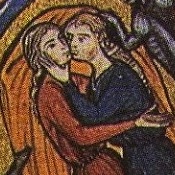
There's one part of me that just wants to squee on the theme of the title of this blog. But what I love about Mills' work here is that he puts the brakes on the emotional reaction that's inspired by wanting to "own" this piece of history, and he walks the reader step by step through what these images do and don't mean. The biggest part of that is that they mean a lot more than simply "here is a picture of two women or two men making love." Because sex never exists in a social vacuum. One of the conundrums of medieval evidence for sex between women is that the actual simple act of genital contact was generally not considered of significance. But a great many associated behaviors and conditions could make that act either more or less transgressive than we might expect. So, for example, a woman who makes sexual advances to another woman might be viewed as acting "against nature" not necessarily because of the object of her desire, but due to having taken an assertive role in sex at all. That is, she might be seen as no less but no more transgressive than a woman who takes the sexual initiative with a man.
From the point of view of an author trying to create motivations and reactions for a historic character, it's vitally important to understand those differences. If a woman's confessor asks her "have you had sex in an unusual way" rather than "have you had sex with another woman", the difference in how she perceives her behavior will be significant. Among the few testimonies we have from pre-modern women accused of sodomy, several of them claimed that they didn't think what they were doing was a sin. That it couldn't be unnatural because they'd heard of other women doing it. Studies like this current book help flesh out that sort of difference of approach.
Major category:
LHMPFull citation:
Mills, Robert. 2015. Seeing Sodomy in the Middle Ages. The University of Chicago Press, Chicago. ISBN 978-0-226-16912-5
Publication summary:
This is an in-depth study of the visual cues and visual representations of the concept of “sodomy” in medieval manuscripts and art, using the definition of that concept at the time, not the more specific modern sense. Mills looks at how gender and sexuality interact and challenges the perception that there was no coherent framework for understanding gender and sexual dissidence in the middle ages. The topics covered include images associated with the label “sodomite”, gender transformations and sex changes (especially in Ovid), and sexual relations in closed communities (such as religious houses). The analysis includes a consideration of the relevance of modern categories to the study of medieval culture.
Chapter 1 Translating Sodom
[The following is duplicated from the associated blog. I'm trying to standardize the organization of associated content.]
There's one part of me that just wants to squee on the theme of the title of this blog. But what I love about Mills' work here is that he puts the brakes on the emotional reaction that's inspired by wanting to "own" this piece of history, and he walks the reader step by step through what these images do and don't mean. The biggest part of that is that they mean a lot more than simply "here is a picture of two women or two men making love." Because sex never exists in a social vacuum. One of the conundrums of medieval evidence for sex between women is that the actual simple act of genital contact was generally not considered of significance. But a great many associated behaviors and conditions could make that act either more or less transgressive than we might expect. So, for example, a woman who makes sexual advances to another woman might be viewed as acting "against nature" not necessarily because of the object of her desire, but due to having taken an assertive role in sex at all. That is, she might be seen as no less but no more transgressive than a woman who takes the sexual initiative with a man.
From the point of view of an author trying to create motivations and reactions for a historic character, it's vitally important to understand those differences. If a woman's confessor asks her "have you had sex in an unusual way" rather than "have you had sex with another woman", the difference in how she perceives her behavior will be significant. Among the few testimonies we have from pre-modern women accused of sodomy, several of them claimed that they didn't think what they were doing was a sin. That it couldn't be unnatural because they'd heard of other women doing it. Studies like this current book help flesh out that sort of difference of approach.
# # #
In Paris, ca. 1200, there was an increased focus on anti-sodomy literature. One writer considered it equivalent to murder because both “interfere with the multiplication of men.” Sodomy also relates to gender categories because non-procreative sex blurs distinctions and suggest androgyny. Androgynous people, according to this position, must pick a binary identity based on the nature of who they find arousing within an imposed heterosexual framework. The focus in this anti-sodomy literature is not generally on gender ambiguity, but specifically on preserving “active” male sexuality. Not only are “passive” partners despised, but the “active” partner who uses them becomes corrupted thereby. Sodomy is generally linked to luxury and effeminacy.
Anti-sodomy authors are generally associated with the cathedral schools (and naturally are churchmen) and are obsessed with the idea that “unnatural crimes” are being treated too leniently by the authorities. To address this, penitential manuals included detailed interrogation scripts that focused on details of the status and nature of the partners of the person confessing. Notably, these interrogation scripts not only omit details of the sex acts that are under scrutiny, but the confessor is instructed not to discuss them, to avoid giving people ideas. They are directed to speak only of acts “against nature” or of sex performed “in an unusual way.”
“Against nature” could include masturbation, incest, or other “seed wasting” activities. The details were often obscured as being “too terrible to name.” Sodomy was also othered and exoticised with references to unspeakable sins being practiced openly in other parts of the world. [Note: this comes back later in the chapter as a connection between sodomy and heresy or non-Christian practices.] Although “unspeakable” in text, the medieval understanding of the specific nature of these activities can be seen in how they are depicted in art, and specifically in the Bibles Moralisées. This chapter focuses on those works and images.
This genre of manuscript first appears in Paris in the 1220s-1230s. These were not “popular” books but were a restricted genre produced for royal and noble patrons. [Note: I’ll include a catalog summarizing the full manuscript references and descriptions of the relevant images at the end of this entry. For now, I’ll be using the shorthand manuscript references that Mills uses.]
The Bibles Moralisées follow a conventional layout (and there is a clear continuity of content and visual imagery across multiple examples, which makes some of the shifts and re-interpretations more obvious). A series of eight images is presented in roundels of similar artistic frames, two columns of four each, and are bracketed by two narrow columns of text at the right and left margins. The text is broken up into a total of eight boxes, aligned with and corresponding to the roundels. It is clear from the text layout that the images are primary and the text has been added, often badly fitting into the available space. This stands in sharp contrast to the usual text-centered approach to Biblical commentary. In general, within a set of four roundels, the upper left image will directly represent a biblical scene, with the images to its right and below extrapolating and commenting on it in some way, and the lower right image providing commentary and interpretation for the contemporary context. This layout allows for--in fact encourages--multiple viewing paths and ways of constructing context for the images. [I'll include a brief description of each manuscript image when it becomes relevant to the discussion, as in the following.]
Vienna MS 2554, the earliest example of the genre, created in the 1220s in Paris - Context is Adam and Eve in the garden, with subsequent images of the temptation of Eve and the marriage of Christ and the Church. The roundel of interest shows two embracing couples, one male and one female, being tormented by devils. Both couples are lying on bedding and are oriented diagonally on the page. The women are kissing and one woman is holding the other’s face in a conventionalized “chin chuck” gesture [see note]. One member of the male couple has a tonsure indicating a monk and the other wears a style of round cap that elsewhere is associated with Jews or heretics.
Note: The "chin-chuck gesture" is a conventional artistic trope that is always associated with erotic love. It involves one person holding the other's chin, with their thumb on one side and the other fingers (sometimes curled into a loose fist, sometimes straight) on the other. Due to its symbolic significance, I'll be noting for each image whether it is or is not present.
If sodomy is not to be named, why is it being depicted in detail for a royal audience? And for people who are closely associated with the authors of the anti-sodomy polemics? Mills compares this to the myth of Victorian repression, i.e., that a surge of interest in sodomy spawned both the textual response and the interest in depicting the acts. Stepping back for a moment from the focus on homosexuality in particular, Mills views the set of images in Vienna 2554 as a “translation” of acceptable sexuality, i.e., as portraying various types of “imitation” of the central approved/moral behavior, which is considered “moral” because it is “natural.”
In the set of Eden images, the primary image is of an upright Adam and Eve invited into Eden by God (interpreted in the text as a marriage). This theme is reflected to the right by the temptation, with a female-torsoed serpent taking the central position from God, and Eve taking over the active role, in offering the apple to Adam. Below the primary image, the “marriage” of Adam and Eve is reflected in a scene of Christ marrying Ecclesia (the church). And then in the fourth position, we have the above described pairs of female and male lovers. Mills discusses how these illustrate a variety of parallels, contrasts, and reversals of meaning. The “sodomites” represent chaos, contrast, and corruption in the same way that the temptation is contrasted to the “marriage” of Adam and Eve by God in the first panel. The images do not “speak” directly of specific sexual acts (the image only shows embracing, kissing, and caressing) but rather of this symbolic violation of order and hierarchy. In the same way, Eve “unnaturally” takes the lead in the scene of the temptation, overturning “natural” gender hierarchies.
These reflections and contrasts continue in the lower four roundels. In the primary position, we see God confronting Adam and Eve, with Adam blaming Eve for his temptation. Then to the right, the expulsion from Eden, below the primary image a scene of sinners excusing themselves to God at judgment day, and in the fourth position, Christ leading sinners to hell.
Although this layout of images carries over across multiple examples of the genre, the depiction of transgressive sexual desire is not always illustrated by female and male pairs. Other representations include a tonsured man embracing a woman. But there is an entire sequence of images (some clearly related by direct transmission or imitation) that involve a female and a male couple.
Vienna 1179 (produced in Paris, the Vienna label has to do with its current ownership) 1220s - Image occurs in the context of Adam and Eve and the Fall. In the “sodomites” image, there is a female and a male couple, oriented diagonally. Pillows are visible behind them, but not necessarily full bed-clothes. The women are embracing and one women holds the other’s face in a chin-chuck gesture. Their faces are close to each other, but not actively kissing. Mills interprets the scene as showing the chin-holder’s legs inserted between the other woman’s and the other woman’s skirt as being somewhat hiked up. [I’m not sure I see that clearly.] The male couple are embracing and kissing. The man reclining on his back has his tunic open in front with his underclothes showing.
Paris Bibliotheque nationale de France MS français 9561, mid 14th cntury - This book contains a similar image of a female couple and a male couple, embracing and kissing, lying diagonally across the page and being tormented by devils. The layout is strongly connected to the previous examples, though somewhat simpler in execution. But rather than being presented in the context of the expulsion from Eden, it is located in the story of Lot and Sodom.
In Paris 9561, the accompanying text focuses on the disruption of “natural” order due to bodily desire, and not on the specifically same-sex aspect. Although the image is homoerotic, the textual message is broader and more diffuse. The presence of devils ties in with the textual claims that unnatural lust (or simply lust in general) is due to demonic possession. Demons are often depicted as violent sodomists (in the sense of anal intercourse). While texts can conceal the presence and specificity of same-sex acts, art must over-particularize them, converting a general focus on “unnatural lust” into a narrow indictment of homosexuality.
Mills next looks at images that accompany text that specifically identifies “sodomites” (regardless of the nature of the images). How is the concept of “sodomite” translated into the specificity of visual representation? The Bibles Moralisées had the purpose of moralizing about contemporary times, using Biblical motifs, often modified from their original context. One example is how the serpent in Eden is embodied as female (thus tempting Eve in a same-sex context) where the Biblical text doesn’t specify gender. Other textual interpretations of this scene suggest the sexual implication is not homoerotic but narcissistic, though these are often conflated.
The “translation” of one scene to another context is seen in the Vienna 2554 illustration for Judges 20:47. This is an episode that thematically parallels the Lot/Sodom story but rather than the demanding neighbors being residents of Sodom, they are members of the Benjaminite tribe. The image used to illustrate the episode focuses on the host’s unfortunate concubine who is handed over for sexual abuse and murder (in substitution for the guests that had been demanded). There is no reference to same-sex erotics in the art except for an isolated image within a crowd scene of two men embracing with a chin-chuck gesture. But the text accompanying the scene specifically identifies the attackers as “sodomites”, rather than Benjaminites. Some scholars have viewed this “bad translation” between the image and text as simply due to ignorance and error. Mills sees it instead as a sophisticated manipulation of the imagery in service of a teleological moral truth in which Biblical textuality is subservient to that lesson.
There are other examples of parallel imagery that comes, not from the original Biblical text, but from visual connections. For example, in a depiction of the story of Cain and Abel, Cain is shown kissing Abel before taking him off to kill him, and this is paired with an image of Judas kissing Christ.
Later editions of the Bible Moralisée genre sometimes attempted to restore a more accurate text, but this could result in visual incoherence, which point out the hazards in interpreting the visual parallels in these later texts, as in the following.
Bibliotheque Nationale de France MS Fr 166, early 15th century - A depiction of the story of Ruth and Naomi has shifted the depiction from earlier versions. The earlier examples set up a parallel between how Ruth stayed with Naomi (representing those who are faithful to the church) while Orpha separates from her (representing those who leave the church). But in this 15th century text, a depiction of Ruth and Orpha embracing before parting from each other is juxtaposed with an image of a lustful couple embracing (as an example of turning away from chastity to embrace sensual temptation), creating a false visual equation of Ruth with sin.
Another example of the drift and change of visual symbolism is how the earlier images of female same-sex couples used as a negative symbol in parallel with the male couples, are replaced within the same visual composition by a heterosexual couple. There is a parallel erasure of the feminine characteristics of the serpent, removing the homoerotic potential from Eve’s temptation. For example, Paris 166 does not include any lustful images of female couples.
Illustrations associated with the term “sodomites” and the story of Lot shifted by the 14th century from a relatively narrow range of behaviors in the Bibles Moralisées (specifically, violence and inhospitality) to a focus on non-procreative sexual acts, including but not exclusively between male couples. The earliest pictorial connection between this story and sexual transgressions is in Toledo MS 1 (1230s, created in Paris).
Toledo tesoro de Catedral MS 1, 1230s, created in Paris - In the context of the story of Lot and Sodom, a scene of two same-sex couples embracing, one female, one male. The male couple consists of a cowled monk embracing a youth of indeterminate gender (beardless and wearing a long garment). The female couple both have long hair and long garments, and one holds the other’s head but without a chin-chuck gesture.
Bodley MS 270b (the first volume of the three-part Oxford/Paris/London Bible) ca. 1230, created in Paris - In the context of the Lot/Sodom story, depiction of two embracing couples. The couple on the left: a bearded man wearing a round cap sits in a chair and embraces a monk (with tonsure and cowl). The couple on the right: both figures wear long garments and are bare-headed and beardless. The one on the left has long hair (clearly signifying female gender). The hair length of the one on the right is not visible, however the overall artistic similarity and lack of unmistakably masculine signifiers suggests interpretation as a woman. They are embracing and the long-haired figure is holding the other’s head in her hands, though there is no chin-chuck gesture.
British Library Additional MS 18719, ca. 1260, probably London or Westminster origin - The art in this book is much more simple that the earlier works, line drawings rather than fully colored paintings, and more primitive in style. The nature and positioning of the figures indicates that it’s clearly copied from Bodley MS 270b or from a common source. On the left two men embrace, standing beside a chair. One is bearded and wears a round cap, the other is a monk with tonsure and cowl. On the right, reclining toward a slope formed by a hell-mouth, are two embracing figures. Both wear long garments, and are bare-headed and beardless, though the length of the hair is not visible for either. The left-hand figure is holding the other’s head in her(?) hands but there is no chin-chuck gesture.
Paris Bibliotheque Nationale de France, MS français 166, ca. 1402, produced in Paris - The physical arrangement of the characters is the same as for the preceding works, but the artistic style is elaborate and sophisticated. On the left is an embracing pair consisting of a monk and a youth. On the right a heterosexual couple embraces and kisses. They are wearing high-fashion garments that are clearly differentiated by gender.
In the preceding sequence, we see how the ambiguity of feminine representation, and a reanalysis of an androgynous ideal of beauty allows for the reframing of a female same-sex couple as heterosexual, thus erasing the representation of female homoerotic possibility.
I’ll skip over a section focused solely on male depictions that discusses the association of sodomy with Saracens and heretics.
The question remains, why did this particular genre of illustration arise in this particular time and place? The original center of production of Bibles Moralisées was Paris, which had a reputation for the prevalence of sodomy, though this was a reputation shared by urban centers in general. And the imagery in these bibles is urban rather than rural. Whether or not urban centers were hotbeds of male homoerotic activity, they did provide a fertile intellectual and moral context for anti-sodomy rhetoric. The temporal context was also one where the fuzzy idea of sodomy as anything “against nature” was being particularized as a specific set of gender and sexual transgressions. The depictions in these bibles often focus on aspects of the social context, e.g., same-sex pairings, age differences, active/passive contrasts, clerical with secular figures, Christian with non-Christian, rather than focusing on the physical act of genital sex. The physical interactions that are depicted are embraces, kisses, chin-chuck gestures, and the displacement of clothing.
From another angle, why are these moralizing illustrations confined only to the Bibles Moralisées? Several factors may be relevant. These works were typically commissioned by or for royalty and their readership was tightly restricted, moreover it was restricted to a set of people who had close clerical oversight in their lives. So perhaps there was less “danger” in allowing this set of readers a more explicit understanding of what activities were forbidden (rather than worrying about “giving them ideas”). Female patronage for several of the earliest examples may have influenced the prominence of female same-sex couples in the depictions of sodomy. In turn, this very restricted readership may explain why these images were not generalized as part of the artistic vocabulary of medieval art.
In reference to this last observation, Mills notes several isolated examples of male same-sex embraces or sexualized interactions in other manuscripts, but in those cases they are not tied to specific passages in the text.
Another correlation with the era when these works evolved was the rise of capital punishment for homosexuality in the laws of Castile and France (in the 13th century) as well as increased legal concern with heresy.
Catalog of images
It seems pointless to discuss an analysis of visual imagery without having those images available. I tried to see if I could find online sources to link to, but have only succeeded at this point in the case of Vienna 2554. Ethics (as well as legality) prevents me from taking images directly from the book, so instead I have provided simplified re-drawings of the human figures in the relevant illustrations. (One of the major elements I've omitted are the tormenting devils, but other background details have been left out as well.) I make no claims for artistic merit here, and some of the subtleties of gesture, clothing, and hairstyles are not well reproduced.
Vienna 2554 (Österreichische Nationalbibliothek, cod. 2554, fol. 2r), the earliest example of the genre, 1220s - Context is Adam and Eve in the garden, with subsequent images of the temptation of Eve and the marriage of Christ and the Church. The roundel of interest shows two embracing couples, one male and one female, being tormented by devils. Both couples are lying on bedding and are oriented diagonally on the page. The women are kissing and one woman is holding the other’s face in a conventionalized “chin chuck” gesture [see note]. One member of the male couple has a tonsure indicating a monk and the other wears a style of round cap that elsewhere is associated with Jews or heretics.

Vienna 1179 (Österreichische Nationalbibliothek, cod. 1179, fol. 4r) (produced in Paris, the Vienna label has to do with its current ownership) 1220s - Image occurs in the context of Adam and Eve and the Fall. In the “sodomites” image, there is a female and a male couple, oriented diagonally. Pillows are visible behind them, but not necessarily full bed-clothes. The women are embracing and one women holds the other’s face in a chin-chck gesture. Their faces are close to each other, but not actively kissing. Mills interprets the scene as showing the chin-holder’s legs inserted between the other woman’s and the other woman’s skirt as being somewhat hiked up. [I’m not sure I see that clearly.] The male couple are embracing and kissing. The man reclining on his back has his tunic open in front with his underclothes showing.

Paris Bibliothèque nationale de France, MS français 9561, fol. 8v, mid 14th cntury - This book contains a similar image of a female couple and a male couple, embracing and kissing, lying diagonally across the page and being tormented by devils. But rather than being presented in the context of the expulsion from Eden, it is located in the story of Lot and Sodom.

Toledo tesoro de Catedral MS 1, vol. 1, fol. 14r, 1230s, created in Paris - In the context of the story of Lot and Sodom, a scene of two same-sex couples embracing, one female, one male. The male couple consists of a cowled monk embracing a youth of indeterminate gender (beardless and wearing a long garment). The female couple both have long hair and long garments, and one holds the other’s head but without a chin-chuck gesture.

Bodleian Library, MS Bodley 270b, fol. 14r (the first volume of the three-part Oxford/Paris/London Bible) ca. 1230, created in Paris - In the context of the Lot/Sodom story, depiction of two embracing couples. The couple on the left: a bearded man wearing a round cap sits in a chair and embraces a monk (with tonsure and cowl). The couple on the right: both figures wear long garments and are bare-headed and beardless. The one on the left has long hair (clearly signifying female gender). The hair length of the one on the right is not visible, however the overall artistic similarity and lack of unmistakably masculine signifiers suggests interpretation as a woman. They are embracing and the long-haired figure is holding the other’s head in her hands, though there is no chin-chuck gesture.

British Library Additional MS 18719, fol. 7v, ca. 1260, probably London or Westminster origin - The art in this book is much more simply that the earlier works, line drawings rather than fully colored paintings, and more primative in style. The nature and positioning of the figures indicates that it’s clearly copied from Bodley MS 270b or from a common source. On the left two men embrace, standing beside a chair. One is bearded and wears a round cap, the other is a monk with tonsure and cowl. On the right, reclining toward a slope formed by a hell-mouth, are two embracing figures. Both wear long garments, and are bare-headed and beardless, though the length of the hair is not visible for either. The left-hand figure is holding the other’s head in her(?) hands but there is no chin-chuck gesture.
Paris Bibliothèque nationale de France, MS français 166, fol. 7r, ca. 1402, produced in Paris - The physical arrangement of the characters is the same as for the preceding works, but the artistic style is elaborate and sophisticated. On the left is an embracing pair consisting of a monk and a youth. On the right a heterosexual couple embraces and kisses. They are wearing high-fashion garments that are clearly differentiated by gender.

Time period:
Place:
Event / person:
Saturday, March 25, 2017 - 10:44
It's the last Saturday of the month, so it must be Lesbian Historic Motif Podcast time! This month I'm talking about romantic relations between women in poetry and stories of the courtly love era in Europe. I also talk about how female same-sex desire is erased in academic discussion by setting up entirely different goalposts than are placed for heterosexual desire.
[Note: references to the Lesbian Talk Show version of the podcast are now obsolete and links have been removed.] Check out the podcast here, but better yet, subscribe to it on iTunes, Podbean, or Stitcher under the umbrella podcase The Lesbian Talk Show. And if you have the time, all the Lesbian Talk Show podcasters would love it if you'd rate it, which helps other people find the show. There's also a new facebook discussion group: The Lesbian Talk Show Chat Group. If you're a facebook person, we'd love to have folks drop by to talk about the episodes, meet the podcasters, and make suggestions for future shows. The Lesbian Talk Show is a magazine format collective, with book clips, reviews, media fan-girling, tips on the life of an author, and all sorts of other topics.
Now with transcript!
* * *
Lesbian Historic Motif Podcast - Episode 8 - Medieval Love Poetry - transcript
(Originally aired 2017/03/25 - listen here)
* * *
(Transcript commissioned from Jen Zink @Loopdilou who is available for professional podcast transcription work. I am working on adding transcripts of the existing interview shows.)
Today I’d like to talk about two related themes in medieval literature: love poetry, and relationships in romances. Now, keep in mind that when we use the word “romance” to talk about genres of medieval literature, it doesn’t mean stories centering around a specific love relationship, as it does modern use, but rather stories of heroic adventure and courtly deeds, that have love as one of several themes. Medieval romances usually included fantastic elements and otherworldly settings. So we can’t interpret them as representing actual historic behaviors and cultures. But they do give us a glimpse into the beliefs and attitudes of the people who created and listened to the stories.
The romance genre arose in the same context as the idea of “courtly love” as expressed in the songs of the troubadours. The courtly love movement was, in part, a reaction to the stark reality among the upper classes that marriage was a business transaction with nothing of individual attraction or affection. In fact, when the rules of courtly love were written down, they stated baldly that love was impossible between married couples because there could be no love where there was coercion. Instead, one was expected to perform a fiction of romantic desire for a person one could not possess. A fiction of adultery, as it were, where extravagant language and pledges of undying devotion were understood as representing sexual desire without ever being allowed to fulfill it.
As a result, the language used in acting out courtly love can be highly ambiguous in terms of how it related to behavior. Was it all play-acting or was it a way of expressing frustrated desires that might otherwise work out in less socially acceptable ways? When the language of courtly love appears in poetry or prose to express interactions between men and women, few scholars deny that it was intended to represent actual sexual desire, even if in a formal and stylized manner.
But when we find the language of courtly love used between women, there is often a greater hesitancy among scholars to attribute it to actual romantic or erotic attraction between women, as opposed to being mere literary convention. I’m going to look at three works that were written around the 12th and 13th centuries in western Europe in which the language of romantic love is used between women.
L’Escoufle
The first is a 13th century French romance titled L’Escoufle or, the kite -- referring to the bird, not to the child’s toy. The story centers around a young woman’s adventures after a man persuades her to elope with him and then abandons her--pretty much for the majority of the remainder of the story. The “kite” of the story comes in shortly after Aelis (our heroine) rides off with Guillaume. The bird swoops in and steals Guillaume’s fancy silk purse and Guillaume chases after it, abandoning Aelis to her own devices in a strange land.
But Aelis is a resourceful young woman and gradually betters her situation by a series of alliances and personal relationships with other women. What is most interesting to us at the moment is that these relationships are described with language and using situations that would be unambiguously sexual if a man were involved.
When she finds herself alone, Aelis promptly takes up with another young woman named Ysabel. And shortly after being taken in by Ysabel and her mother, “Fair Aelis began thinking that the two of them could well spend the night in one bed together.”
Now, spending the night in bed together is no big deal. It was something that travelers often did even when they were complete strangers. The implication is primarily one of friendship and probably of social protection, since Ysabel is an established member of the local community while Aelis is a stranger and alone. But as the two start up an embroidery business together, their relationship becomes more physically ambiguous. Aelis “moves closer to her, she kisses her, embraces and hugs her” and Ysabel “tells her that she will accomplish completely her wish, whatever it is.”
This is language that, in mixed-sex contexts could indicate either sexual or non-sexual interactions, but the language continuing to describe their relationship is framed strongly in the conventions of romance. Ysabel provides Aelis with “so much solace, so much pleasure” and Aelis “enjoys herself in so many ways.”
These same-sex romantic descriptions are balanced by how the story focuses on their combined search for Aelis’s missing boyfriend, Guillaume.
In this quest, Aelis encounters two further intimate friendships with women in the story, using the same ambiguously suggestive language about sharing a bed and, in the second case sharing a friendship so close that, “they are all one body/heart and soul; they no longer remember Guillaume … No other woman was ever treated in the way the noble countess did [Aelis]; She kisses her, then let the other young women kiss her. Then she takes her to relax in her bedroom, holding her with her naked hand.”
Other medieval romances include episodes of desire between women, but more commonly it is excused by having one of the women be in disguise as a man at the time, such as in the story of Yde and Olive, or the romance of Tristan de Nanteuil. In L’Escoufle there is no such plausible deniability. These are women who know each other to be a woman. One can only try to explain away the interactions as using conventional formulaic language that used the forms of romantic love without intending the substance. Or...one can believe that they may have intended the substance.
Bieiris de Romans
This same argument has been used in regard to the lyrics of the 13th century troubariz --or female troubadour -- Bieiris de Romans. The bare facts are that Bieiris, a woman, wrote a love song addressed to a woman named Maria, using the conventional language of courtly love poetry. Where scholars come into disagreement is the question of what it means. (The show notes mention two articles that discuss this question from different points of view.) Before considering that question, let’s take a look at the lyrics themselves. I wish I could recite the original in Provencal, but I’ve never studied the language and would only make a hash of the pronunciation.
Lady Maria, in you merit and distinction, joy and intelligence and perfect beauty, hospitality and honor and distinction, your noble speech and pleasing company, your sweet face and merry disposition, the sweet look and the loving expression that exist in you without pretension cause me to turn toward you with a pure heart.
Thus I pray you, if it please you that true love and celebration and sweet humility should bring me such relief with you, if it please you, lovely woman, then give me that which most hope and joy promises, for in you lie my desire and my heart and from you stems all my happiness, and because of you I'm often sighing.
And because merit and beauty raise you high above all others (for none surpasses you), I pray you, please, by this which does you honor, don't grant your love to a deceitful suitor.
Lovely woman, whom joy and noble speech uplift, and merit, to you my stanzas go, for in you are gaiety and happiness, and all good things one could ask of a woman.
Within the genre of troubadour song, the romantic and erotic desire that is expressed is often something of a literary game, composed in the framework of the “courtly love” genre where unconsummated desire for an unobtainable beloved was a default trope). But when the sentiments are expressed between a man and a woman, no one questions the sincere underlying emotions. For this work, modern commentary has attracted unique skepticism with some scholars dismissing it as a mere literary exercise, or as an expression of platonic friendship in the language of romantic love (charges which are not used to question the heterosexuality of other authors), or as being the pen-name of a male author (which leaves open the question of why a male author would represent love between women).
When one is determined to avoid interpretations of lesbian desire in literary works, it's easy enough to point to the formulaic nature of many genres. Even the language of personal correspondence can be composed of stock phrases and meaningless formulas. (After all, think about how many letters you’ve written that begin “Dear So-and-so” and ask yourself how many of the people are genuinely "dear" to you?)
It is impossible to argue that all written compositions should be taken at absolute literal face value. But at the same time, it’s important to consider whether we interpret literalness versus literary style differently based on pre-existing assumptions. No one would argue that the formulaicness of troubadour love poetry means that there’s no such thing as romantic love and sexual desire between men and women. But when a woman writes in the genre of love poetry or writes love correspondence to another woman, you will often encounter circular arguments of the following format:
- There is no evidence for lesbian expression in medieval European literature
- Therefore, even though we would interpret this same language as romantic or erotic if addressed from a male author to a female subject
- Because it is addressed between two women it must be purely formulaic,
- And because this language is purely formulaic, it can’t be counted as evidence for expressions of lesbian love,
- And therefore we have no evidence for lesbian expression.
You see how it ties up so neatly?
The Tegernsee Manuscript
Bieris was writing a work for public performance, and therefore it’s reasonable to analyze it within the conventions of that type of public performance. But similar arguments fall short when considering private poetry that was never meant for any eyes but the one it was written for.
It is reasonable to assume that this was the case for a poem found in a 12th century manuscript that was preserved at Tegernsee Abbey in southern Germany. Again, we know little of the context in which this was written except that it is clearly addressed from one woman to another. The writer laments the absence of her beloved and longs for her return from a journey. Given the context in which the poem was preserved, it is possible that the women were nuns. There are a number of biblical allusions in the poem that would suggest that possibility.
This translation is by Ann Matter, whose article on expressions of love between medieval religious women is cited in the show notes. Again, I’d love to be able to present the original so that you could hear the poetry of the sounds, as well as the meaning, but I’ll take pity on my listeners. The women’s names are abbreviated as G and A, so we don’t even have that much identity for them, although I’m tempted to go by the most popular German women’s names of that era and think of them as Gertrude and Anna.
To G., her singular rose,
From A. -- the bonds of precious love.
What is my strength, that I should bear it,
That I should have patience in your absence?
Is my strength the strength of stones,
That I should await your return?
I, who grieve ceaselessly day and night
Like someone who has lost a hand or a foot?
Everything pleasant and delightful
Without you seems like mud underfoot.
I shed tears as I used to smile,
And my heart is never glad.
When I recall the kisses you gave me,
And how with tender words you caressed my little breasts,
I want to die
Because I cannot see you.
What can I, so wretched, do?
Where can I, so miserable, turn?
If only my body could be entrusted to the earth
Until your longed-for return;
Or if passage could be granted me as it was to Habakkuk,
So that I might come there just once
To gaze on my beloved’s face--
Then I should not care if it were the hour of death itself.
For no one has been born in to the world
So lovely and full of grace,
Or who so honestly
And with such deep affection loves me.
I shall therefore not cease to grieve
Until I deserved to see you again.
Well has a wise man said that it is a great sorrow for a man to be without that
Without which he cannot live.
As long as the world stands
You shall never be removed from the core of my being.
What more can I say?
Come home, sweet love!
Prolong your trip no longer;
Know that I can bear your absence no longer.
Farewell.
Remember me.
Given the ways in which women’s writing--and writing that centers women--has been erased from the historic record, it is a treasure to find literature of this sort. I won’t fault scholars for being careful and skeptical about interpreting such material at literal face value, but I will always fault people for placing an extra burden of proof on representations of same-sex love that is not placed on heterosexual expressions.
And in the context of the Lesbian Historic Motif Project, the importance of works like this is not whether there was an actual woman named Bieris who loved a woman named Maria, or whether there was a real Gertrude--or whatever her name was--who kissed and caressed Anna’s breasts with tender words. The importance is that people in the 12th and 13th century could imagine such things, and had language to express them. That some woman reading about how Aelis and Ysabel kissed and embraced each other in bed, or listening to the voice of Bieris longing to be given “that which most hope and joy promises”, might have thought to herself, “This is what it means--this feeling I have for the woman I cherish. This is real and others have felt it too.”
Show Notes
This episode looks at examples of courtly love--both in poetry and in prose--expressed between two women, or by two female characters.
In this episode we talk about:
- The context and conventions of the “courtly love” genre
- The problems of relating the sentiments expressed in courtly love literature to everyday lives and experiences
- Scholarly blind spots when interpreting same-sex expressions of courtly love
- Love, desire, and friendship between women in the 13th century French story L’Escoufle
- The 13th century troubariz (female troubador) Bieiris de Romans and the love poem she wrote to a woman named Maria
- A passionate poem of love and longing written by one anonymous 12th century German woman to another
Books mentioned
- The full text of Na Maria by Bieris de Romans can be found in: Bogin, Meg. 1976. The Women Troubadours. Paddington Press, Ltd., New York. ISBN 0-8467-0113-8
- The full text of the Tegernsee MS poem can be found in: Matter, E. Ann. 1989. “My Sister, My Spouse: Woman-Identified Women in Medieval Christianity” in Weaving the Visions: New Patterns in Feminist Spirituality, eds. Judith Plaskow & Carol P. Christ. Harper & Row, San Francisco.
This topic is discussed in one or more entries of the Lesbian Historic Motif Project here:
Links to the Lesbian Historic Motif Project Online
- Website: http://alpennia.com/lhmp
- Blog: http://alpennia.com/blog
- RSS: http://alpennia.com/blog/feed/
- Twitter: @LesbianMotif
- Discord: Contact Heather for an invitation to the Alpennia/LHMP Discord server
- The Lesbian Historic Motif Project Patreon
Links to Heather Online
- Website: http://alpennia.com
- Email: Heather Rose Jones
- Twitter: @heatherosejones
- Facebook: Heather Rose Jones (author page)
Major category:
LHMPPages
