Blog
Thursday, September 26, 2019 - 07:00

I can’t be anything other than delighted to find romance authors with established reputations and readerships venturing out into the field of f/f historic romance. Courtney Milan has tackled not only same-sex romance but a later-life discovery of love, as well as tossing our two protagonists into a “burn down the patriarchy!” (literally) adventure. I admire the enthusiasm and cheerful fury of the non-romance plot, but certain aspects of this historic setting fell a bit flat for me.
I mean: servants. Where are the servants? I don’t care how eccentric a rich elderly woman is, she doesn’t flit off to London for an unspecified period of time without at least one lady’s maid. And even the impoverished property manager whose plight she comes to address would be expected to have at least a part-time maid-of-all-work to do the heavy labor. Erasing the servants may be a convenient way of allowing your protagonists privacy to explore their new-found attraction, but it inevitably gives a novel a very modern feel for me.
The story is far more focused on the logistics of Mrs. Martin’s crusade of retribution against her Awful Nephew than on the romance itself. The women seem to get together on the basis of little more than bonding over “isn’t it awful that the world thinks old single women are of no value?” Their romantic attraction never really clicked for me. The revenge plot is a delightful wish-fulfillment story but the very over-the-top nature of the actions made it harder for me to sympathize with the women (or at least with Martin). Deliberately setting fire to buildings in the heart of mid 19th century London is not a harmless prank but the act of a psychopath.
So...mixed feelings on this one. It’s solidly written and the plot is well structured. I’m cheered by the existence of the book and its reception, but it didn’t really hit the spot for me either as a historic novel or as a romance.
Major category:
Reviews View comments (0)
Wednesday, September 25, 2019 - 07:00
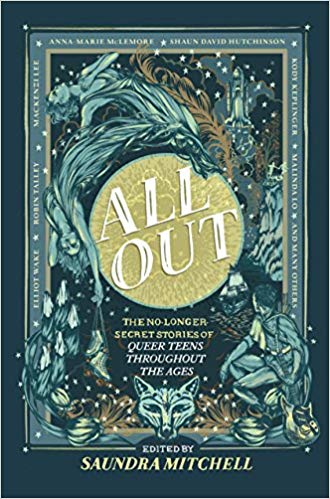
I had much more to say about this collection right after I read it, but unfortunately that was about a year ago. The stories cover historic eras from the 14th century up through the 1990s, with almost half falling in the 20th century, more than half set in the USA, and none set outside Europe + North America. Based on my own experience of soliciting queer historical fiction (and collections my work has been included in) these statistics aren’t at all surprising but are worth noting. The themes and flavors of the stories are all over the map, including fantastic fairy-tale type settings, slice-of-life memoir, adventure, and a good sprinkling of romance, some of it erotic though to the best of my recollection, none explicit. The writing quality and historic grounding are similarly varied. There are some well-known names among the authors that are enough to make the collection as a whole worth reading, but chances are that for any given reader, only a handful of the stories will hit your sweet spot. Definitely a worthwhile endeavor but maybe a bit too unfocused to find a clear audience.
Major category:
ReviewsTuesday, September 24, 2019 - 07:43

Quite some time ago, I pulled out the passages I wanted to use for the teaser series and set them up in a separate file. That way I didn't need to hunt around for something every week and there was no risk of messing with the master file by accident. But that means that for the last few months I've been setting up the teasers while looking at snippets of text in isolation. This past Saturday, I did the review of the final page proofs, which is as close as I've come so far to reading the final novel straight through. (Not quite the same, since I had to keep my awareness on things like formatting and punctuation, rather than reading immersively.) So it's all fresh in my mind at the moment in that way where I simultaneously know how much more there is to go and yet feeling like the story is rushing straight to the finish. I hope other readers feel the same way!
Celeste--like Margerit--takes a fairly mechanistic approach to charms and mysteries. It's inevitable, I think, when you have that rare talent for being able to visualize the process of magic. But in Floodtide, rather than contrasting with a more spiritually-oriented relationship to mysteries, Celeste is contrasted with Roz's matter of fact acceptance of charms as just "something you do because you don't want to think about what might happen if you didn't do them." That makes it a little more pointed on the occasions when Celeste experiences undeniable encounters with the more numinous side of magic. Like when she comes back from participating in the tutela of Saint Mauriz and shares with Roz that the saint spoke to her during the ceremony. Or--on a more practical side--when an essential component for her experiments in charms against river fever turns out not to be used up after all.
* * *
“It’s Liv,” I stammered, not sure how to start. “They’ve got fever and I said I’d do what I can.”
Celeste was right behind her and I added quickly, “Just what you can give me to take. Anything that doesn’t need a charm-wife. I didn’t promise her anything except that I’d come.”
“What have you done, Rozild!” Mefro Dominique said, but not like it was a question.
“Come on up,” Celeste said.
I took off my muddy shoes to go upstairs, where her erteskir was packed tightly between the bolts of fabric and work baskets, and watched as she sorted through all the compartments and drawers of her chest of charm-work.
“This will help for heat in the blood,” she said, putting a candle wrapped in a strip of cloth into a basket. You remember how we used it trying to build the fever charm? Tie it around the neck then light the candle.” She gave me two sealed packets. “These herbs will help even without charms. Tell them to make a tea with it. And—”
Celeste gave a gasp and lifted a small stoppered bottle out of the very bottom of the chest.
“It was all gone. I used it all up. I swear to God I looked and looked.”
It was some of the water from Saint Rota’s well. One bottle overlooked when she’d been sharing the blessing charm around at the beginning of the flood. Celeste closed her eyes and held it tight, moving her lips like she was praying silently.
“Roz, it’s a sign. I’m meant to try one more time.”
I wanted to protest. But I remembered Liv crying. And if Saint Mauriz had told her to go, who was I to say no?
Major category:
TeasersPublications:
FloodtideMonday, September 23, 2019 - 07:00

This turned out to be a good choice to follow directly after Laqueur, as they cover much the same ground but from different angles. (Although I've tried to plan out the order of the publications I'm covering in this "basic theory" group so that I'm following thematic threads, I don't always know how that will play out until I start reading.)
Both authors point to the contrasting ideas of sexual difference in the classical authors that formed the underpinnings of later theory, and to how those ideas were transmitted and interpreted in new contexts. But where Laqueur seems to reach for a relatively tidy notion that the "one-sex" model was dominant in classical and medieval times, Cadden puts a lot more weight on how diverse and contradictory the material was and how those contrasts formed part of the ongoing development of sexual theory.
Both Laqueur and Cadden are clearly distinguishing between ideas about sex/sexual difference--that is, the physiology of male and female--and ideas about gender (masculine and feminine) that relate to idealized prototypes of behavior/roles/social attributes which are associated with, but not identical to, the sexes. I'll come back to this later in the coverage of Cadden when it becomes a focus of one of the chapters. This distinction of sex and gender in earlier historic eras is similar--but not identical--to current gender theory. Earlier concepts of gender were focused on an inherent association of certain behaviors, personalities, and attributes with a gender concept (man or woman), as contrasted with modern theory which focuses more on an individual subjective "sense of self". But the idea that sex and gender were distinct and not always aligned is common throughout (western) history.
Major category:
LHMPLHMP #271a Cadden 1993 Meanings of Sex Difference in the Middle Ages: Medicine, Science, and Culture
Full citation:
Cadden, Joan. 1993. Meanings of Sex Difference in the Middle Ages: Medicine, Science, and Culture. Cambridge: Cambridge University Press. ISBN 0-521-48378-6
Introduction
[The following is duplicated from the associated blog. I'm trying to standardize the organization of associated content.]
This turned out to be a good choice to follow directly after Laqueur, as they cover much the same ground but from different angles. (Although I've tried to plan out the order of the publications I'm covering in this "basic theory" group so that I'm following thematic threads, I don't always know how that will play out until I start reading.)
Both authors point to the contrasting ideas of sexual difference in the classical authors that formed the underpinnings of later theory, and to how those ideas were transmitted and interpreted in new contexts. But where Laqueur seems to reach for a relatively tidy notion that the "one-sex" model was dominant in classical and medieval times, Cadden puts a lot more weight on how diverse and contradictory the material was and how those contrasts formed part of the ongoing development of sexual theory.
Both Laqueur and Cadden are clearly distinguishing between ideas about sex/sexual difference--that is, the physiology of male and female--and ideas about gender (masculine and feminine) that relate to idealized prototypes of behavior/roles/social attributes which are associated with, but not identical to, the sexes. I'll come back to this later in the coverage of Cadden when it becomes a focus of one of the chapters. This distinction of sex and gender in earlier historic eras is similar--but not identical--to current gender theory. Earlier concepts of gender were focused on an inherent association of certain behaviors, personalities, and attributes with a gender concept (man or woman), as contrasted with modern theory which focuses more on an individual subjective "sense of self". But the idea that sex and gender were distinct and not always aligned is common throughout (western) history.
# # #
While covering much of the same timeframe, Cadden takes a broader and more diverse view than Laqueur, while acknowledging the reality of his two models (the one-sex and two-sex models). In all eras, the “facts” about sex and sexuality are filtered through cultural prejudices. Medieval ideas about sex difference were part of the culture’s assumptions about gender. Medieval society was not a single culture, and the era covered several overall shifts in thinking, so there isn’t a single unified “medieval idea” of sex difference that can be pointed to.
Cadden differs from Laqueur, who considered pre-18th century ideas as deriving from a unified “one-sex” concept in which male and female existed on a single scale. Though much of the medieval evidence fits this one-sex model, other views were present throughout. [Note: Laqueur acknowledges this even though he considers one model to have predominated at any given time.] Even when systems of thought (e.g., theology and medicine) agreed on a principle relating to sexuality, they might come to it from different rationales.
It isn’t possible to make an overall judgement of whether medieval thought on sex difference was “good” or “bad” for women. Some concepts, such as the importance of female orgasm to conception, had both positive and negative consequences. In the later middle ages (12-14th century), European culture became more inflexible and intolerant in general, which affected attitudes toward women and sex. Cadden’s book looks at the diversity and eclecticism of medieval thought regarding sexual difference during this period.
Most sources were in Latin and therefore reflect the learned class dominated by men, but these sources also sometimes include “popular” thought, collected into encyclopedic works. This can include material collected from female professionals. The diversity of sources, authors, and genres makes interpretation more complex as it isn't easy to determine whether contrasting opinions reflected different traditions of thought or were simply accepted in their inherent contradiction. Topics include the physical and functional differences between female and male, details of reproduction, and behavioral differences between the sexes. The texts rarely addressed the idea of sex difference directly, but the underlying concepts inform other topics. Masculine and feminine (i.e., gender) were viewed as attributes separate from male and female (i.e., sex).
Cadden points out that Foucault’s History of Sexuality boils down to a history of male sexuality and doesn’t touch on sex difference much at all.
The structure of the work is laid out: Part I (chapters 1-3) traces the evolution of medieval medical and natural philosophy about sex difference. Part II (chapters 4-6) looks at the collection of learned ideas with regard to specific topics. From this, no overall unified picture emerges, rather a cluster of related ideas that didn’t always align or agree.
Time period:
Place:
Sunday, September 22, 2019 - 07:00

Wise’s collection of fantastic (most often futuristic or steam-punkish) short stories is best read in individual bites so that the effect and implications of each piece has time to settle. Many of them focus on the use of language--either as a theme of the story or simply in its presentation. Pain, damage, and disability are strong through-lines. And queerness is an assumed given in most of the pieces. These are not comfortable stories; they’re often angry and many feature characters who can’t easily be framed as likeable. It’s a powerful collection--almost overwhelming in its entirety (hence my reading suggestion).
Major category:
ReviewsSaturday, September 21, 2019 - 07:00
Lesbian Historic Motif Podcast - Episode 124 (previously 38c) - Book Appreciation with Olivia Waite
(Originally aired 2019/09/21 - listen here)
Transcript pending
Show Notes
In the Book Appreciation segments, our featured author will talk about one or more favorite books with queer female characters in a historic setting.
In this episode we talk about:
- Books mentioned
Links to the Lesbian Historic Motif Project Online
- Website: http://alpennia.com/lhmp
- Blog: http://alpennia.com/blog
- RSS: http://alpennia.com/blog/feed/
- Twitter: @LesbianMotif
- Discord: Contact Heather for an invitation to the Alpennia/LHMP Discord server
- The Lesbian Historic Motif Project Patreon
Links to Heather Online
- Website: http://alpennia.com
- Email: Heather Rose Jones
- Twitter: @heatherosejones
- Facebook: Heather Rose Jones (author page)
Links to Olivia Waite Online
- Website: oliviawaite.com
- Twitter: @O_Waite
- Instagram: o_wow_waite
Major category:
LHMPFriday, September 20, 2019 - 07:00

I needed something fun and fluffy and light and a quick read. Burgis’s YA magical Regency novel Kat, Incorrigible perfectly hit the spot. Having recently been on a panel discussion about Regency fantasy at Worldcon, I’ve been thinking about the role that magic plays in this sub-genre. It can either be an analog of social rank and privilege, or a forbidden underlayer, or in rarer cases, a subverting force that acts openly across the formal structures of society. But that’s a discussion for a different time and place. In the world of Kat, Incorrigible, magic is of the “forbidden underlayer” kind unless one gains access to the strictly controlled and regulated version that operates as a kind of secret society among the upper crust. We also get the common theme of magic being a secretive “women’s practice” kept hidden from husbands and other male figures which it is presumed to be used to influence and protect against.
But all that operates in the background of Kat’s life. She’s more concerned with the ordinary non-magical problems of an unsympathetic step-mother and how to save her older sister from an unwanted marriage to a wealthy but possibly unsavory man. Kat is at the refreshingly delightful age where questions of romance and desire are among the nonsensical concerns of adults. Her attempts to harness her newly awakened magical powers to solve her family’s problems lie in the realm of action hero. It will be equally delightful to see her non-nonsense, all-speed-ahead, near-bullying approach to problem solving once she becomes older and the tangles she addresses touch her more personally.
Major category:
ReviewsThursday, September 19, 2019 - 07:00

Everyone and their cousin is using the relationships and themes of Sherlock Holmes as inspiration for characters in decidedly non-English non-Edwardian non-mimetic settings these days. Some of them are doing it very well--sometimes so well that the Holmesian framework is almost unnecessary as an underpinning for the story. (I’m thinking of more than this one novel in this context, but this is the one I’m reviewing at the moment.) This story retains the mystery framework, the enigmatic and cerebral investigator who plays everything very close to their chest, and the traumatized narrator in a healing-related profession who plays an essential supporting role. But “Watson” is a brain-ship whose deep-space trauma has restricted them to the spaceport profession of creating psychologically active teas to treat people undergoing space travel, and “Sherlock” has a dark history that may or may not be related to the investigation that takes them out into the dangerous parts of space. I enjoyed this contribution to the loosely-connected Xuya story-verse, though it was a bit more relaxed and comfortable than some of my favorite brain-stretching encounters. I’m not entirely sure that it needs to be a Sherlock Holmes story, but that makes a good hook for those who might not otherwise give the story a try.
Major category:
ReviewsWednesday, September 18, 2019 - 07:00
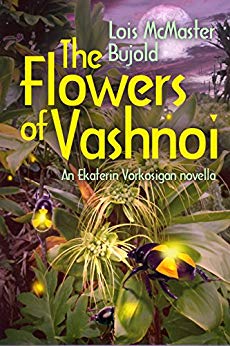
This is a pleasant (well, maybe wrong word, see futher...) side-story in the Vorkosigan universe focusing on collaborations between Ekaterin and bioengineer Enrique looking for genetically engineered mitigations for the toxic waste site that forms part of Miles’ inheritance. It’s also about the persistance of ingrained prejudices and the ways in which ignorance (on all sides) enables unprivileged people to fall through the cracks in an otherwise progressive society. Although I liked that these issues were highlighted, I’m less enamored of how often the solutions to individual social problems in the Vor universe are for some wealthy privileged person to throw money and influence at the central characters of the narrative. My main beef with the fictional universe is that the positive outcomes rely on the personal goodwill and honor of people who could just as easily be awful and abusive (and whose peers often are). It's not that I expect my fiction to be universally fluffy and progressive, but I've often felt that the Vorkosigan series isn't sufficiently self-aware of how it valorizes a "benevolent dictator" approach to society. There should be more occasions when the system fails badly in horrific ways and can't be tidied up by the personal goodwill of someone with power and privilege.
Major category:
ReviewsTuesday, September 17, 2019 - 08:02
Disasters aren't always sudden and extreme -- sometimes they creep up on you slowly, like the water rising along the steps of the plaiz one at a time. Sometimes disasters consist of tedious waiting as the news dribbles in from those who are harder hit. Sometimes disasters are mere inconveniences to be avoided until they ebb away again. Floodtide in Rotenek has always shown different faces to different people. In the previous Alpennia books, we've mostly seen the "inconvenience" side. Floodtide as a holiday excuse to leave the city.
Knowing the shape of what was to come after the events of Mother of Souls, it was important to me to show the other side. The people who had no where to go. Who had to carry on with their lives, no matter whether the river only left a mess or carried away lives and livelihoods. The people who watch the aristocracy and monied classes hurry out of town in their fine carriages and resent that ability to escape.
Even the upper crust of Rotenek can't always pick up and leave with no warning and no preparation. An unexpected floodtide can democratize disaster. But for a little while yet, the two cities continue their separate ways...
* * *
At Tiporsel House, they talked about floodtide like it was a holiday. The maisetra was always down at her school, making a place for the families of her students who’d been flooded out. Mesner and Maisetra Pertinek left town to go visiting. They wanted to take Maisetra Iulien with them, “to be safe from fever” she told me after she’d refused to go.
“I can’t think that the fever would be worse than sitting around in a parlor listening to all the Pertinek cousins reminiscing about things I don’t know anything about,” she said. “I wish Cousin Margerit would let me go down to Urmai. I want to do something.”
There was plenty to do in the flooded parts of the city, but that wasn’t work for a proper young lady. There wasn’t anything for a proper young lady to do with no parties or visiting. That meant no one asked why I was still giving half-days to Mefro Dominique, when anyone with sense would know we couldn’t be dressmaking right now. I came home bone-tired every afternoon and it was all I could do to keep awake after supper until I saw her tucked into bed. For now I kept going back and forth between worlds—the one where floodtide was a holiday and the one where it was a disaster.
* * *
We're now two months out from the Floodtide release date. I've just plunged into the whirlwind of setting up publicity, arranging for review copies, and making sure the book gets the best launch possible. Just as a reminder, here's some key information about pre-orders, availability, and whatnot.
Pre-orders: Currently you can pre-order the hard copy at Amazon (possibly other online retailers but I haven't checked them all), but pre-orders of both the hard copy and the ebook won't be available from the publisher (Bella Books) until one month before release, i.e., mid-October. If you like buying hard copies from a bookstore, now is the time to check with them and ask if they've ordered it.
Ebooks: Bella Books has a policy of restricting ebook sales to their own site for the first month after release. (I have no control over this.) But if you buy from Bella and especially if you set up an account with them, you get access to all formats (epub, mobi, pdf) in DRM-free format with the ability to re-download anything you've bought in the past if something happens to the file. Otherwise, ebooks should be available through other venues in mid December.
Review copies: Bella is now using NetGalley for review copies. I haven't learned all the details yet, so I don't know whether reviewers have to be individually authorized or simply have accounts in good standing with the right book preferences. NetGalley should have the book a month in advance, so around mid-October. If you're on the list of reviewers I'm putting together, I'll be sending out a notification when I've confirmed it's available there. Bella does not provide hard-copy ARCs (Advance Reading Copies).
Release Party: It looks like I'll be doing a virtual release party in November, given that Chessiecon (my usual November convention) has been cancelled this year, and given that I don't know of any local bookstores that will be stocking the book. So expect to see me doing some serious online blow-out activities, including a few giveaways. So keep an eye out and join the celebrations!
Major category:
TeasersPublications:
FloodtidePages
