Blog
Saturday, September 2, 2017 - 18:00
Lesbian Historic Motif Podcast - Episode 17 (previously 14a) - On the Shelf
(Originally aired 2017/09/02 - listen here)
Welcome to On the Shelf for September 2017.
Recording this is a bit of a surreal experience because I’m recording it in mid July and it won’t air until the beginning of September. You see, I’m going to be spending three weeks in August traveling to Europe for the Worldcon - the World Science Fiction Convention - in Helsinki Finland, and then traveling around visiting friends. Some of whom I’ve known online for over a decade but have never met in person yet. And while I’d love to burble a bit about the convention and my trip in this update, I’m looking at the calendar and suspecting that I’ll be too wiped out to record anything in the few days between when I get back and when this episode will have to air. So you’ll just have to imagine me telling you all about my travels through Europe.
The Lesbian Historic Motif Project blog spent the month of August finishing up the last five chapters of Sherry Velasco’s Lesbians in Early Modern Spain. This book is an example of the rich trove of historic data that can be made available by someone willing to sift through records outside the well-worn tracks that most general histories of sexuality touch on. There are summaries and excerpts from the very extensive trial records that provide details of the everyday lives of lesbians in 16th through 18th century Spain, including an indication of how their relationships were viewed by their friends and neighbors, and under what circumstances they might be accepted or at least tolerated. There’s a discussion of three individuals who become something of gender-outlaw celebrities in 16th and 17th century Spain, including the part that race and class played in how they were treated. As touched on in discussions of Catalina de Erauso, upper class women in early modern Spain basically had two options: marriage or the convent. And not all women in convents were there because they had a religious vocation. Velasco looks at how these women-only institutions dealt with the inevitable “special friendships” that developed between nuns and to what extent they were concerned with preventing sexual relationships specifically. For a culture seen as being conservative and strait-laced, drama and fiction in Spain was chock full of women disguised as men and the inevitable romantic entanglements that caused. But there were also works that explored romantic relationships between women that didn’t rely on mistaken gender identity.
While the publication list forthcoming for August is still being finalized, my plan is to do a couple of tie-ins with the last history episode and cover books about the concept of Boston Marriage and the queer history of Boston in general.
This month’s author guest will be Genevieve Fortin whose historic novel about Canadian immigrants to New England in the early 20th century was released just a couple months ago.
The Ask Sappho segment this month comes from a question on the Lesbian Talk Show Chat Group on facebook. (As of the time of recording, I hadn’t received permission to mention the requester specifically, but if you’re out there, I hope you’re listening!) This was a request for lesbian historical novels set at the time of the American Civil War.
Since there isn’t already a specific Goodreads list set up on this topic that could be pointed to, I thought I’d throw something together. Of course, now I will make it into a Goodreads list. This is largely taken from sifting through Goodreads lists of lesbian historical fiction to find the books with the desired setting. To narrow things down, I’m specifically focusing on books and stories that have the war as a background, not simply ones from the same general time period. I’ve tried to summarize reviews of the books that I haven’t read myself. And most of these, I haven’t read myself.
But I hope I’ll be forgiven for starting off with an anthology-sister. The short story “Emma” by Priscilla Scott Rhoades in the anthology Through the Hourglass edited by Sacchi Green and Patty G. Henderson is a sweet love story set on the cusp of the American Civil War involving a girl who disguises herself as a boy to run away from home and who takes a job as a handyman at a school for the deaf. Complications from a budding romance with one of the students motivate her to enlist in the army. I really liked the voice in this one (it’s told in something of a diary style) and the historic context was quite believable.
Firefly by Whitney Hamilton follows the intersection of two southern women during and after the war, one a widow struggling to keep her farm going, the other a woman who served in the Confederate army in male disguise. Reviews on this book are passionate in several directions. Many readers were drawn in by the story, but several were concerned that it painted a too-rosy picture of social and political issues underlying the war particularly with regard to race.
Promising Hearts by Radclyffe also hinges on a character who participated in the war in disguise (this ends up being a very strong trend in this set of books). This time the woman is a surgeon who comes out of the war wounded in body and spirit and heads West where she encounters an archetypal madam with a heart of gold. Reviews were impressed with the intensity of the story but some felt the short length was a bit too packed with details to do justice to the characters.
House of Clouds by K. I. Thompson has the set-up for an enemies to lovers romance with a staunch Union loyalist and actress turning spy until she’s confronted with the need to betray the woman she loves--the daughter of a Confederate officer. Reviewers seem to agree that it’s more of a strong historical novel--full of nuanced and accurate details--that has a romance sub-plot, but is not primarily a romance story.
Words Heard in Silence by T. Novan and Taylor Rickard blends the two popular motifs of a woman serving in the army in male disguise and throwing two people from different sides of the conflict into close connection. Charlie Redmond--the soldier in disguise--commands a troop quartered at the Virginia farm of widow Rebecca Gaines. Their growing attraction threatens Charlie’s secret. Most reviews were enthusiastically positive, though with few details. Some felt the book’s origins as an episodic serial could have been cleaned up a bit more.
The War Between the Hearts by Nann Dunne braids together three of the popular themes in this group: gender disguise, spying, and romance between two women on opposite sides of the conflict. Sarah is a spy for the Confederate side, in male disguise and Faith the beloved enemy who betrays her and threatens any hope of a future. There weren’t a lot of reviews to judge by, but there seems to be agreement that this should be approached as a historic novel with a romance plot rather than as a category romance novel. This book has a sequel The Clash Between the Minds which follows the characters after the war as they struggle with the violence of the reconstruction era and face suspicion about their relationship now that gender disguise has been abandoned.
Miserere by Caren J. Werlinger isn’t precisely a Civil War novel. Teenage Connemara in the 1960s starts having visions of her Civil War era ancestor, an Irish indentured servant whose legacy involves a mystery and a curse for her to solve. Reviews are generally positive, but the focus of the story is split between the two eras, so it may not answer the original request for Civil War stories.
Divided Nation, United Hearts by Yolanda Wallace once more brings together the themes of a woman serving in the military in male disguise and sparks between two women on opposite sides of the war. Reviews were very mixed on this book with some loving it wholeheartedly and others feeling the pacing was off and the romance thread rushed and weak.
Beguiled and Her Beguiling Bride by Paisley Smith are a series that starts with the requisite Union woman in disguise as a soldier ending up wounded in the hands of the mistress of a southern plantation. The second volume continues into the Reconstruction era when the two must make hard choices to keep their land. Unlike most of the books in this list, these fall solidly in the category of erotica, and some reviewers who were expecting something more in the line of historical fiction felt a little short-changed. Comments suggest that these are both more novella length than full novels.
Sabre by Rhavensfyre is another very short erotic piece, following the familiar themes of a soldier in male disguise and the woman who discovers her secret. Reviewers seemed to feel that it should have been longer and the comments weren’t detailed enough for further evaluation.
For those who feel the whole motif of women cross-dressing as men to become soldiers and spies in wartime is a bit over the top in terms of believability, the Lesbian Historic Motif Project reviewed an article on the narratives of real-life crossdressing women in the 17th through early 20th centuries that includes figures from the Civil War era like Ellen Craft, a black woman used a combination of gender-disguise and the fact that her skin was fairly light to play the role of a white southern slave owner in order to enable her darker-skinned husband, William to escape slavery. And Cuban-born Texan Loreta Janeta Velazquez who accompanied her lover in battle in disguise, after his death continued serving the Confederacy as a spy. Although these women were not lesbians, their lives demonstrate that the motifs used in these novels are within the realm of historical accuracy.
You can find links to all of these publications in the show notes.
Show Notes
Your monthly update on what the Lesbian Historic Motif Project has been doing.
In this episode we talk about:
- Why I’m recording this more than a month before it airs, and how you’re all missing out on hearing about my trip to Europe, which will have just finished then.
- Recent and upcoming publications covered on the blog
- Velasco, Sherry. 2011. Lesbians in Early Modern Spain. Vanderbilt University Press, Nashville. ISBN 978-0-8265-1750-0 (We’ve spent this month going through the chapters on legal records, celebrity gender benders, women’s romantic relationships in convents, homoerotic motifs on stage and in novels, and the visual stereotype of lesbians in early modern Spain)
- Books on Boston Marriage and the queer history of Boston
- Announcing this month’s author guest, Genevieve Fortin
- New and forthcoming fiction
- The new/forthcoming boos segment hasn’t been added yet.
- Ask Sappho: An anonymous poster on the facebook group asks: What are some lesbian novels set during the American Civil War?
- Through the Hourglass edited by Sacchi Green and Patty G. Henderson
- Firefly by Whitney Hamilton
- Promising Hearts by Radclyffe
- House of Clouds by K. I. Thompson
- Words Heard in Silence by T. Novan and Taylor Rickard (Note: In later books in this series, it beomes clear that the character of Charlie Nolan is a trans man, not a woman using gender disguise. But in this first book, my understanding is that is not yet how the character understands his identity.)
- The War Between the Hearts by Nann Dunne
- Miserere by Caren J. Werlinger
- Divided Nation, United Hearts by Yolanda Wallace
- Beguiled & Her Beguiling Bride by Paisley Smith
- Sabre by Rhavensfyre
- And this article gives examples of real-life women who fought and spied in the Civil War in male disguise, just like many of the characters in these novels.
Links to the Lesbian Historic Motif Project Online
- RSS: http://alpennia.com/blog/feed/
- Twitter: @LesbianMotif
- Discord: Contact Heather for an invitation to the Alpennia/LHMP Discord server
- The Lesbian Historic Motif Project Patreon
Links to Heather Online
- Website: http://alpennia.com
- Email: Heather Rose Jones
- Twitter: @heatherosejones
- Facebook: Heather Rose Jones (author page)
Major category:
LHMP View comments (0)
Saturday, September 2, 2017 - 14:00

I've titled the first-week-of-the-month round-up podcast "On the Shelf" as a bit of a pun. On the one hand, it's referring to what books I have "on the shelf" to be covered in the blog, or talked about with our guest author. But it was also a term in the 19th century for a woman who was still unmarried at an age when society considered her too old to be an eligible bride. And, of course, a certain number of the women who were "on the shelf" were avoiding marriage to a man very deliberately.
In addition to a review of what the blog is covering, and an announcement of this month's author guest, the Ask Sappho segment takes a reader request for lesbian historical novels set during the US Civil War. (Due to a cut-and-paste error, the show notes repeat last month's question about the legal status of lesbianism through the ages.) Doing thematic book lists is a fun little project. What time period, culture, or historic topic would you like to see a list built around? I can't guarantee that I can find books on every possible topic!
Major category:
LHMPMonday, August 28, 2017 - 07:00

Can you know a lesbian when you see one? What characteristics did people in early modern Spain think a lesbian would have? And what did that say about how they conceived of sexual orientation? The concluding chapter to Velasco's book covers an assortment of loosely-connected topics having to do with visual signifiers. It's interesting how old the trope of the "masculine-looking ugly lesbian" is. One aspect in this regard that I don't recall seeing addressed is the extent to which "feminine beauty" as a concept is actively and deliberately created rather than being a natural and spontaneous state. Is the mythical "ugly lesbian" simply the resting bitch face of sexuality? The trope also points out that the understanding of sexuality was still very much focused on an active/passive definition. Only the "active" desiring woman risked evoking the "ugly, masculine-looking" accusation.
As we come to the end of Velasco's book, I'd like to step back and once again marvel at how much material the author found to address her topic, and what that implies for many other historic cultures that have not yet had the benefit of a knowledgeable and interested researcher. I'll reitereate one of the main lessons I've gained from this project: the assumption that information is scarce and skimpy regarding the history of women's same-sex desires derives from a history of the field that often focused on types of data that were more relevant to men, and interpretations of the data that assumed "heterosexual unless clearly proven otherwise." Historians don't find things that they aren't looking for. Once you start looking, there is a greater wealth of data than we've been led to believe.
Major category:
LHMPFull citation:
Velasco, Sherry. 2011. Lesbians in Early Modern Spain. Vanderbilt University Press, Nashville. ISBN 978-0-8265-1750-0
Publication summary:
A study of the evidence and social context for women who loved women in early modern Spain, covering generally the 16-17th centuries and including some material from colonial Spanish America.
Chapter 7: Looking Like a Lesbian
[The following is duplicated from the associated blog. I'm trying to standardize the organization of associated content.]
Can you know a lesbian when you see one? What characteristics did people in early modern Spain think a lesbian would have? And what did that say about how they conceived of sexual orientation? The concluding chapter to Velasco's book covers an assortment of loosely-connected topics having to do with visual signifiers. It's interesting how old the trope of the "masculine-looking ugly lesbian" is. One aspect in this regard that I don't recall seeing addressed is the extent to which "feminine beauty" as a concept is actively and deliberately created rather than being a natural and spontaneous state. Is the mythical "ugly lesbian" simply the resting bitch face of sexuality? The trope also points out that the understanding of sexuality was still very much focused on an active/passive definition. Only the "active" desiring woman risked evoking the "ugly, masculine-looking" accusation.
As we come to the end of Velasco's book, I'd like to step back and once again marvel at how much material the author found to address her topic, and what that implies for many other historic cultures that have not yet had the benefit of a knowledgeable and interested researcher. I'll reitereate one of the main lessons I've gained from this project: the assumption that information is scarce and skimpy regarding the history of women's same-sex desires derives from a history of the field that often focused on types of data that were more relevant to men, and interpretations of the data that assumed "heterosexual unless clearly proven otherwise." Historians don't find things that they aren't looking for. Once you start looking, there is a greater wealth of data than we've been led to believe.
# # #
This chapter looks at the role of imagination, spectacle, and accusation in shaping understandings of female same-sex relations. These understandings, in turn, could create or enable same-sex erotic possibilities for their consumers. There is a contrast between writers who denied the possibility of desire between women and the regular use of female homoerotic imagery in popular culture. Spectacles involving female homoeroticism were meant to warn and punish, but could also inform and educate. Accusations against specific women assumed general knowledge of homoerotic possibilities and expectations regarding types of homoerotic activity.
Probable intersex cases tested the understanding and judgement of same-sex activity. Beliefs about the possibility of spontaneous physical sex change problematized investigations into potential transgressive relations when physical sex was ambiguous or did not match gender performance. Medical opinions presumed that people had an innate sexual orientation, though they differed on the underlying cause.
When same-sex relationships were performed in public (for example, when the specifics of relationships came out in public arguments or lawsuits) the evidence suggests that individual fear of punishment for sexual transgression was not an absolute deterrent for entering those relationships. [Note: when has it ever been?] Within all this, what was the public expectation for being able to identify lesbians from their appearance? How could you know you were looking at one?
Catalina de Erauso was depicted in a portrait from life by Francisco Pacheco, and that portrait was further publicized by engravings based on it. Her features were interpreted differently depending on how people perceived her gender. Physiognomy--the pseudo-science of identifying innate characteristics based on facial features and physiology--was not only applied to Catalina during her lifetime, but was taken up by psychologists and sexologists in the early 20th century to “diagnose” her in terms of supposed psychological and medical abnormality.
Simple economics meant that homoerotic scenes of women in art were typically designed to cater to the male gaze for the purposes of titillation. One exception was depictions of lesbian erotics in genre scenes of witchcraft that often drew on male anxiety about powerful and dangerous women, conflating lesbian sexuality with anti-male magical activity. (That is, the scenes may still have been created for the male gaze, but not likely for titillation.)
In religious art, images of close emotional bonds betwen women were often depicted using physical gestures to indicate spiritual connections and conferral of authority. This appears in art showing Saint Teresa and her rival spiritual heirs in a sort of religious propaganda art staking claims to her legacy using imagery of closeness and inseparability.
Velasco includes a discussion of visual art associated with Nicholas Chorier’s pornographic Satyra Sotadica showing a frontispiece with a group of upper class Spanish women shopping in a “dildo market” with wares hung up on display as in a butcher’s shop. This seems to be included on the basis that Chorier’s work was alleged to be a translation of a dialogue by the 16th century Spanish poet and humanist Luisa Sigea. Sigea did write dialogues between women expressing passionate friendship. [Note: Velasco seems at first to treat the connection to Sigea as solidly evidenced but then appears to agree with other sources that the connection with Sigea is entirely fictitious and was, in part, intended to imply a genuine female authorship for Chorier’s female-voice dialogue.]
Beliefs in gender essentialism with regard to sexuality led to an emphasis in descriptions of women with same-sex desires as being masculine in appearance (or at least unfeminine). Contemporaries of María de Zayas suggest she may have been viewed as “manly” in appearance as well as in literary talent. Other writers compared her poetic talent to Sappho, possibly intending implications about her sexuality. Zayas herself excluded Sappho from her list of dedicatory “foremothers” possibly suggesting that she herself was anxious about what people would read into the comparison. There is some evidence that Zayas lived with a fellow female poet, Ana Caro, but the nature of their relationshp must be entirely speculative.
The Mexican poet Sor Juana Inés de la Cruz (later 17th century) wrote poems to multiple women (including her patroness) that used amorous language and imagery, such as, “I love you with so much passion...My love for you was so strong I could see you in my soul and talk to you all day long...Let my love be ever doomed if guilty in its intent, for loving you is a crime of which I will never repent.” And in another work, “I aspire that your love and my good wine will draw you hither, and to tumble you to bed I can conspire.” Historians writing of Sor Juana and other examples of suggestive evidence between nuns often dismiss the possibility of same-sex desire out of hand on a presumption that they would have needed to learn about homoerotic love before being able to experience it, and that they were “too young” to understand the implication of such desires. [Some things never change.]
Event / person:
Saturday, August 26, 2017 - 10:00
I'm not going to lie: I'm feeling a bit anxious about the reception of this week's podcast. The topic of how erotic desire has been handled with respect to the history of lesbians has the potential for hurtful erasure on every side. Some scholars have approached the history of sexuality from a position that erotic desire and erotic activity are how you define the presence of lesbianism. Even aside from the way in which an eagerness to "claim women for the L team" tends to erase bisexual identity, using sexual activity and sexual desire between women as the sine qua non of lesbian identity erases those for whom romantic attachment, rather than sex, is the key factor. (Although it does encompass aromantic women who enjoy erotic attraction to women.)
In this episode, I look at the patterns of history, not through the question of "how did specific women experience homoerotic and homoromantic attraction?" but through the lens of cultural archetypes. What were some of the prominent cultural archetypes that combined romantic bonds between women with an absence of the expectation of sexual activity? I'll be very curious to hear what people think.
* * *
Lesbian Historic Motif Podcast - Episode 16 (formerly 13d) - Beguines, Boston Marriages, and Bed Death: Archetypes of Asexual Lesbianism - transcript
(Originally aired 2017/08/26 - listen here)
One of the things that history and literature provide for us is archetypes that can help us understand ourselves and that give us a framework for connecting to society. Archetypes can also be pernicious stereotypes that act to lock us into specific ways of viewing ourselves or other people, but today I’m going to talk about the positive things archetypes can offer.
An archetype isn’t a factual description of a set of people, or even of any specific person. Rather it’s a symbolic image. In Platonic philosophy, an archetype is the hypothetical idea of something that actual life never reaches. In Jungian psychology the term is used for a collectively-held unconscious pattern of images or thoughts that is believed to be present in every individual consciousness. More generally, the word “archetype” may be used to refer to a recurring symbol or motif.
In literature, the knight in shining armor is an archetype, as is the wise old mentor, or the femme fatale. In pop culture we might see certain iconic characters are representing archetypes, such as how June Cleaver in the tv show Leave it to Beaver became the unobtainable ideal of a ‘50s American suburban wife and mother.
So when I talk about lesbian archetypes, I’m not talking about individual experiences, or even about statistical realities, but of cultural models that are communicated to us and then internalized in our understanding of the world. No archetype will hold true for everyone. Different archetypes will speak to different people. Having archetypes that speak to the truths of your life can be the difference between feeling isolated and broken, and feeling that you’re a thread in the larger fabric of history and society.
What do I mean by archetypes of lesbianism? A good example to start with is the butch-femme couple. This archetype has deep roots, but most people are familiar with it from the mid 20th century. The archetype consists not simply of the individual gender presentations of butch and femme, but also of the framework in which butch and femme are expected to be attracted to each other and to form a particular type of couple based on the interaction of those roles. To some extent, the butch-femme archetype may extend to cover particular types of social activities. Either ones that were popular at the time the archetype flourished, or ones that were part of the venues where lesbians found each other during that era.
Obviously, there are more ways of being lesbian than being butch or being femme--there were even at the time the archetype hit its stride. And there’s no rule that says that butches have to be attracted only to femmes and vice versa. But none of those exceptions mean that the archetype of the butch-femme couple doesn’t exist or that it doesn’t affect how people think about the world and their place in it, if that archetype has resonance for them.
Today I want to talk about historic archetypes of lesbianism that incorporate asexuality, that is, women who are romantically attracted to women, but have a lower experience of erotic desire or response than what is considered typical or expected.
This is a complicated topic to talk about, because much of lesbian activism starting from the mid 20th century on has been focused strongly on the right to claim a sexual existence and to overcome social and political forces that denigrate sexual desire between women. Similarly, much of the historic research into lesbian-like women in the past has focused strongly on the question of “Did they or didn’t they?” Where the key question is about sex, rather than romance or domestic arrangements or any of the other elements that can make up an interpersonal relationship.
In Lillian Faderman’s study Surpassing the Love of Men, she dances around the idea that there is a qualitative difference among historic women who had deeply passionate and romantic attachments to each other based solely on whether they engaged in activities that they would have considered to be sexual. In historic research, there is a constant difficulty in figuring out what a particular society even considers to be sexual activity, versus physical activities that might express affection, such as hugging and kissing, but were not necessarily considered sex.
The point here is not to consider whether actual women engaging in relationships that fit these archetypes did or did not have sex, but rather whether there was a widely known, socially recognized type of relationship that included strong emotional and romantic bonds between women but did not include sexual activity. Whether women in romantic relationships that did not involve sex would have seen themselves reflected in these archetypes.
In discussing archetypes of asexual lesbianism, I’m going to try to avoid assigning modern interpretations to past relationships. Since I’m talking about ideas and ideals, I don’t need to know what people were actually doing, I need to know what they thought about what they were doing, and what other people thought about them, and how they were represented in the culture of the time. As for the other word in the phrase--lesbianism--I’m going to lean towards the idea of Adrienne Rich’s “lesbian continuum” which focuses on a wide variety of expressions of dedicated emotional connection between women. But in general I’m going to look at archetypes where at least the ideal goal was for women to share a household, independent of heterosexual marriage, based on a deep and lasting emotional bond and a desire to support each other both economically and psychologically.
One thing I need to acknowledge is that these archetypes can derive, in part, from social models that are themselves problematic--such as the model that has prevailed in various times and places that the genders have different innate sex drives, or the model that people of different classes experience sexual desire differently. All archetypes involve problematic aspects. For example, the archetype of the butch-femme couple (just to pick one I’ve already mentioned) incorporates models of gender performance that correlate with heterosexual gender archetypes of the same era, as well as relying on the model that love and desire are driven by an “atraction of opposites”.
So, for example, archetypes of asexual lesbianism often reflect the social model that women have an inherently lower sex drive than men. Some of the specific archetypes I’ll be talking about are strongly class based, where people accepted that working-class women might have sex drives, but “ladies” weren’t expected to be interested in that sort of thing. Conversely, some of the archetypes evolve out of a model where the only activities considered to be sexual are those that resemble heterosexual penetrative sex. So a woman might consider a relationship to be non-sexual that we wouldn’t classify that way today. When it comes down to it, it’s nearly impossible to find an archetype of any sort that doesn’t rely on problematic elements, simply because they arise out of popular culture and popular culture tends to be inherently problematic.
So enough about theory, let’s look at some of the specific archetypes I’d like to talk about in their historic context.
Religious Contexts
There’s always been an uneasy connection between the all-woman environments of Catholic convents and the potential for their residents to form intense emotional relationships with each other. (In fact, I have a podcast episode planned at some point to talk about the motif of lesbian desire in convents.) Within the cloister, the concern was not simply that nuns were expected to life a chaste life, but also that they were supposed to reserve their emotional intensity for Jesus and God.
Nevertheless, it was extremely common for cloistered women to pair off in “special friendships”. We know some of the ways these relationships were expressed from the descriptions of what their superiors were concerned about. They would hang out together, holding hands, talking together late at night when they should be sleeping, addressing each other with endearments. In letters and poetry addressed from one nun to another, we find sentiments like “I love you more than any, you alone are my love and longing.”
It is clear that these special friendships in convents were tolerated -- perhaps in part due to the number of women who were being warehoused in convents to protect their reputation, regardless of any true religious vocation. Sometimes these convent friendships were even celebrated. In part, the tolerance relied on retaining an adherence to the principles of chastity and celibacy. Certainly they were an archetype in the sense of being an accepted model of a particular social arrangement.
But not all women who dedicated their chastity to God lived under the strict rules of convents. One interesting group is the Beguines, who flourished in the 13th through 16th centuries, especially in northern Europe. Although these women lived together in semi-monastic communities and promised not to marry during their time of residence, they didn’t take lifelong vows as nuns and were free to leave if they chose.
Free of the stricter rules of convents, beguines often lived together in group homes called beguinages, usually in an urban area, where they would work within the community as teachers or doing charitable works. They weren’t required to renounce their property, as nuns were, and well-off beguines might have servants and separate households. But the key relevant characteristics for the present discussion is that they renounced marriage to men, they lived in women-only and women-centered households, and -- necessarily given attitudes toward sex outside of marriage and the association of holiness and chastity -- they were expected to live celibate lives.
But that doesn’t mean lives devoid of close emotional attachments. A collection of correspondence between Beguines in 13th century Flanders expresses these attachments in very romantic terms, including using the term “minne” (as in Minnesinger) which refers specifically to romantic rather than platonic love. The letters hint of romantic jealousies and the fear that the emotion is not returned to the same extent.
One letter begins, “Greet Sara also in my behalf, whether I am anything to her or nothing. Could I be fully all that in my love I wish to be for her, I would gladly do so; and I shall do so fully, however she may treat me.” And in the same letter the writer addresses another woman named Emma, “both of you [that is, Sara and Emma] turn too little to Love, who has so fearfully subdued me in the commotion of unappeased love. My heart, soul, and senses have not a moment’s rest, day or night; the flame burns constantly in the very marrow of my soul.”
So there’s the first archetype: women living in an all-female establishment that excluded the expectation of heterosexual marriage, who formed a strong and exclusive emotional bond with another woman, expressed in terms of romantic love, but where the relationship was assumed not to involve sexual expression, although it might include physical affection.
Romantic Friendship
Listeners may be familiar with the Romanic Friendship phenomenon of the Victorian age, which I’ll talk more in a little bit in the context of Boston Marriages, but the roots of passionate or romantic friendship begin earlier in the Renaissance.
The neo-platonic ideal of an intense friendship of equals that was popular in the Renaissance more or less excluded the possibility of such friendship existing between men and women, as there was no possibility that they could be on an equal social, legal, and economic standing at that time. Never mind the inescapable presumption that relations between men and women would lead to illicit sex.
Neo-platonic friendships between men were taken for granted, those between women were acknowledged as a possibility by some authors. This ideal was expressed succinctly by Agnolo Firenzuola in the mid 16th century in his dialogue entitled “On the Beauty of Women”. He recounts the story in Plato’s symposium that gave rise to the name and concept of Platonic love--that is, of two souls who seek each other out because they were originally joined--and he provides several examples of notable female friendships that illustrate it. Women who “love each other’s beauty, some in purity and holiness, as the elegant Laudomia Fortegurra loves the most illustrious Margaret of Austria, some lasciviously, as in ancient times Sappho from Lesbos”. That is, Firenzuola is setting up a model of platonic love between women that specifically excludes lascivious behavior. And how did such women express their love? Alessandro Piccolomini says of the same pair of women, that when they first met, “suddenly with the most ardent flames of Love each burned for the other, and the most manifest sign of this was that they went to visit each other many times.”
Such love, especially among women of the upper classes, didn’t necessarily come with the ability to choose a female partner to the exclusion of heterosexual marriage. And a conventional marriage to a man may have been one of the mitigating factors that enable society to recognize and praise such relationships. But even so, these intense friendships might be granted the symbolism and trappings of marriage by public acclaim.
In 16th century England, the close friendship between Mary Barber and Ann Chitting of Suffolk was honored by Mary’s son when he arranged for Ann to be buried together with his mother (and, of course, alongside his father) with an inscription noting that the women would be united in heaven’s embrace as they had “lived and loved like two most virtuous wights”. Burial together was normally reserved for spouses, so this was an important sign of the acceptance of the women’s relationship.
But women’s passionate friendships did sometimes lead to them resisting marriage--or to being depicted as doing so. In 1573 the French poet Pontus de Tyard wrote a poem translated as “Elegy for a Lady enamoured of another Lady” in the voice of a woman who feels romantic love for another woman--a love that, by its nature, is assumed to be “honorable”, that is, non-erotic. She envisions the possibility that:
Would by miracle through the centuries us wed
And that, unique example in French history,
Our love would serve as eternal memory
Proof that love of woman by woman may arise
And from all manly lovers seize the prize
Although, alas, the object of her affection in the poem doesn’t return the same level of commitment. An anonymous Scottish poem of 1586 expresses a similar desire by a woman to live in a committed romantic relationship, invoking Hymen, the god of marriage.
Your peerless virtue does provoke
and loving kindness so does move
my mind to friendship reciproc
that truth shall try so far above
the ancient heroes love
as shall be thought prodigious
and plain experience shall prove
more holy and religious
The poet compares their love to that of any number of classical pairs, such as Achilles and Patrocles or Penelope and Ulysses, but in the end she recognizes the practical barriers from what she desires:
As we are, though to our woe
Nature and fortune do conjure
and Hymen also be our foe
yet love of virtue does procure
friendship and amity so sure
with so great fervency and force
so constantly which shall endure
that none but death shall us divorce
and though adversity us vex,
yet by our friendship shall be seen
there is more constancy in our sex
than ever among men has been
no trouble, torment, grief or pain
nor earthly thing shall us dissever
such constancy shall us maintain
in perfect amity forever
Such bonds were sufficient to cause men jealousy, as expressed in Edmund Waller’s poem of 1645 titled “On the Friendship Betwixt Two Ladies” in which the poet falls back on the expectation that at least such friendships are not sexual and therefore need not provoke outrage.
Women seeking artistic inspiration for this type of chaste same-sex relationship could find it in pastoral scenes of classical figures, especially depicting the goddess Diana and her followers who explicitly rejected relations with men and were often portrayed or described as forming paired friendships. This archetype of a platonic marriage-like state between women is depicted as asexual because the understanding of the times defined sex in ways that required the presence of masculinity -- either an actual man, or a masculine-acting woman, as in the case of cross-dressing plots on the stage, or marriage involving a “female husband” in real life. Therefore bonds between two feminine women--even ones with an exclusive romantic bond--were imagined as inherently asexual.
Fictional depictions of romantic relationships within all-female social groups in the 17th and early 18th century suggest that women were perhaps more skeptical about the idea that “kisses and embraces” were qualitatively different from sexual activity, as we see in works ilke Margaret Cavendish’s The Convent of Pleasure and Mary Delarivier Manley’s The New Atalantis where there’s a bit of a wink-wink nudge-nudge aspect to claims that the kisses and embraces between female romantic couples don’t involve sin or irregularity.
But here I go back to the concept of an archetype. The archetype of the romantic but chaste female couple clearly existed -- it had to exist for Cavendish and Manley to poke fun at it. And that archetype continued to hold sway as fictional depictions of women’s same-sex love diverged in the 17th and 18th centuries into two genres: the pornographic, as exemplified by Nicholas Chorier’s The Academy of Women--which describes two women’s erotic journey from lesbian sex to pan-sexual orgies--and the platonic, as exemplified by Sarah Scott’s A Description of Millennium Hall, in which a thinly-veiled version of the author and her bluestocking friends create a woman-focused charitable foundation, based on female couples who eschewed conventional marriage to support each other in lifelong partnerships.
In the 18th century, such partnerships were more often an unrealized ideal, described in women’s letters to each other during separations from each other. But one particular couple might be considered the perfect embodiment of that idea of passionate friendship.
Eleanor Butler and Sarah Ponsonby were two upper-class Anglo-Irish women who fell in love and determined to spend their lives together as a couple. It took several attempts and a move across the Irish Sea to Wales before their families accepted this as the status quo. The made their home in the town of Llangollen--becoming known to the ages as “the ladies of Llangollen” and were publicly celebrated throughout the British Isles as the epitome of a chaste and romantic friendship between women. Their home became something of a pilgrimage site for the litterati, being visited by many notables of the day and inspiring a minor industry of poetry about them by such famous names as William Wordsworth. Despite people using the language of marriage to refer to them (for example, writing to one of the women and referring to her partner as “your better half”) their public image was of platonic, non-sexual partnership. Men praised them for their virtuous purity; women envied their steadfast marriage resistance. Whatever the realities of their day-to-day lives may have been (and there were those who suspected their relationship was less chaste than the official image suggested) they became living icons of the archetype of Romantic Friendship.
Social changes in the mid to late 19th century gave more women an opportunity to achieve the ideals of Romantic Friendship in everyday life. In America, the prevalence and normalcy of women living together in committed romantic couples is signaled by the existence of a specific label for the phenomenon: Boston Marriages. I haven’t been able to find a source that pins down the earliest use of the term, but some suggest it was inspired by Henry James’s 1885 novel The Bostonians which depicts such a relationship, although the story ends with an unhappy disruption of the Boston Marriage by a male rival.
Unlike the Romantic Friendships of the 18th and earlier 19th century, Boston Marriages fell in an era when women were increasingly able to achieve professional and economic independence. The possibility of this independence brought with it a growing impatience with the lack of support that such women typically found in heterosexual marriages. Women intellectuals had long relied on close friendships with other women for sympathetic moral support in their endeavors, and circumstances now allowed for economic support as well. It was now possible and practical to reject marriage to a man in favor of forming a household and lifelong relationship with a female partner. Although individual rural exceptions can be found, this option was most available to urban middle and upper class intellectual and professional women--another possible reason for associating the phenomenon with an intellectual urban center like Boston.
As with earlier archetypes, the public face of the Boston Marriage as being non-sexual is neither erased nor is contradicted by the personal lives of individual women in these relationships. It is clear that the image is shaped in part by the official position of the Victorian age that “nice women don’t like sex”. If these well-born intellectual women were to be accepted publicly as respectable ladies, it was necessary to allow society to believe that Boston Marriages did not involve sexual desire. Personal correspondence and memoirs indicate that the women involved in them had a wide variety of attitudes towards erotic activities, and that some found the archetype constricting, while others embraced it.
One specific example of the Boston Marriage model is that of the late 19th century New England writer Sarah Orne Jewett and her 30-year domestic partnership with Annie Fields. Another pair that fit the archetype closely are Mary Woolley--named president of the women’s college of Mount Holyoke in 1901 and her partner of 55 years, Jeannette Marks.
Political Lesbians
The intersection of the gay liberation and women’s liberation movements in the ‘60s and ‘70s brought in a new archetype: women whose partnerships were driven by political principles of rejecting compulsory heterosexuality and dedicating themselves to women-centered lives as a philosophical path, rather than inspired by erotic desire. The gay liberation movement established a social space -- however tenuous -- in which identification as a lesbian was an acceptable choice. And the women’s movement offered support and encouragement for those women who chose to opt out entirely of supporting patriarchal structures like heterosexual marriage in their own personal lives. Labeled “political lesbians” by the old guard, there was something of an uneasy partnership with women whose lesbianism was based on sexual desire.
In an era when marriages and partnerships of all types had fewer expectations of permanence, it’s unclear how many same-sex partnerships entered into by political lesbians survived the first flush of idealism. And as the ‘60s and ‘70s were also an era that embraced greater sexual openness, identifying as a political lesbian didn’t necessarily mean being unwilling to explore lesbian sexuality. Still, the creation of the archetype of political lesbian offered a new model for women who desired the emotional structures of a same-sex relationship without necessarily being interested in the erotic ones.
Coming to the last item in our alliterative trio, beginning with beguines and Boston marriages, we arrive at the questionably named “bed death”. That is, the supposed phenomenon in which lesbian couples lose interest in regular sexual activity more commonly and more rapidly than heterosexual couples or gay male couples.
Archetypes aren’t always framed in ways that make people eager to identify with them, even when they serve a purpose of saying “this is a thing that happens to people.” The term “lesbian bed death” was coined in 1983 by a sociologist studying the dynamics of long-term couples and-- somewhat daringly for the time--including lesbians among the data set. Her conclusions were that lesbians had less sex than other types of couples and that the frequency of their sexual encounters declined the longer the relationships lasted. The study has been criticized from a number of angles, in particular the question of whether “sex” was being defined in terms that excluded common erotic activities enjoyed by female couples. (This, of course, is a theme mentioned at the beginning of this episode -- that the archetype of a non-sexual relationship often depends on how one defines sex.)
Regardless of the validity of the data or the conclusions, the phrase established a new archetype at the intersection of lesbianism and asexuality: that of the established couple that--presumably by mutual agreement, if they are continuing happily as a couple--gradually drop sexual activity as a core aspect of their relationship.
And here I’d like to re-emphasize the difference between an archetype and a sociological truth. It doesn’t matter whether the way sex was defined in the study led to flawed conclusions. It doesn’t matter that the conclusions may be contradicted in the lives of specific individuals. None of that contradicts the establishment of a new archetype that people can use in evaluating their relationship with the world.
To be sure, in the context of current society, with it’s emphasis on sexual desire, the label Lesbian Bed Death frames the question in overtly negative terms. In the same way, the archetype of Romantic Friendship existed in a context that emphasized the virtues of chastity. Neither emphasis embraces the full variety of the human condition.
The overall point of this podcast is not to set a relative value on the presence or absence of sex within a romantic relationship, or to try to pin down the sex lives of particular historic individuals, but rather to point out that the historic record holds a wide variety of archetypes of asexual lesbianism just as it holds a wide variety of archetypes of sexual lesbian relationships. There are models that speak to each of us, if we only know where to look for them.
Show Notes
This show takes a tour through a variety of social models in European history that recognized committed romantic partnerships between women that did not focus on sexual desire.
In this episode we talk about:
- Emotional partnerships between women dedicated to religious chastity
- The rise of Neo-Platonic friendship as a model for women’s relationships
- The divergence between models of erotic and platonic female partnerships
- The rise of the Romantic Friendship over the 17th to 19th centuries and how economic changes made it an achievable ideal
- The origin of the term Boston Marriage
- The concept of “political lesbianism”
- The myth of “lesbian bed death” and how it can speak to some couples
This topic is discussed in one or more entries of the Lesbian Historic Motif Project here:
Links to the Lesbian Historic Motif Project Online
- Website: http://alpennia.com/lhmp
- Blog: http://alpennia.com/blog
- RSS: http://alpennia.com/blog/feed/
- Twitter: @LesbianMotif
- Discord: Contact Heather for an invitation to the Alpennia/LHMP Discord server
- The Lesbian Historic Motif Project Patreon
Links to Heather Online
- Website: http://alpennia.com
- Email: Heather Rose Jones
- Twitter: @heatherosejones
- Facebook: Heather Rose Jones (author page)
Major category:
LHMPThursday, August 24, 2017 - 01:24
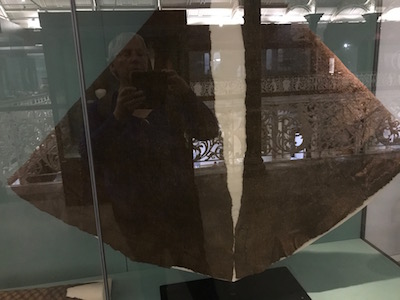
I've found that museums are generally happy to let you photograph objects...but that doesn't mean you'll get good images. Today's blog title is, of course, a little pun. Having reviewed the various substations of the National Museum of Ireland online, I determined that the Archaeology Museum was the only one likely to have things I was interested in. They had a lovely large wing of Viking-era materials, although pretty much all the textile finds were kept in rooms that were dark enough you could barely read the information cards, much less see any details. Ah well, that's what publications are for. A great deal of Celtic and prehistoric material as well. I'm fairly familiar with the Celtic era finds, though there's something to be said for standing in the same room as the Tara brooch, the Ardagh chalice, and any number of other similarly exquisite pieces. And the sheer massive volume of gold objects is impressive. I was focusing my picture-taking on the Viking-era material for *ahem* future research purposes. I stuck to just the one museum in part because my right knee has been getting very grumpy, though it settles down a bit with use. I've probably timed the end of my trip just right because I could use about a week of not much walking and few stairs. Bodies. What can you do?
Liz was in town again for her gym workout, so we met up for dinner and then a long chat about books and life and whatnot in a coffee shop afterward. I've been extremely happy with the outcome of my "visiting people" tourist plan. And now I have another day to kill but not much inclination to do a lot of walking. I can stash my suitcase at a kept-luggage office here at Trinity College until I head out to the airport hotel when I figure it's time to do that. Since this is my Thursday blog, the Friday blog will cover a very very long day of travel. I may fall back on my theoretical schedule of doing a review and tell you about the play we went to Tuesday evening. I can write that up while sitting around in airports. See you on the other side of the ocean!
Major category:
TravelWednesday, August 23, 2017 - 01:28

Tuesday was the whirlwind walking tour of Dublin day. I started off with the campus tour of Trinity College Dublin (where I'm staying), which gave background on the main buildings and history of the college. The repeating theme of the tour was, "And this building was designed in [date] by [name] and then the college built it and never paid him for his designs." (Ok, so maybe it only happened for two or three of the main buildings.) The tour ended up in the Old Library which houses the several early medieval gospel books, including the Book of Kells. There's a vast an fascinating set of displays on the history, production, purpose, etc. of these early books before you get to the small room where the Kells and Durrow gospels are displayed (also one other I didn't note the name of?). Even though people were let into the room in small groups, there was no traffic control and you could easily spend half an hour there without getting close enough to see them unless you were willing to be very pushy. So I saw the books (what can I say, I'm pushy). Impressive, but other than being able to see the three-dimensionality of some of the inks and paints, you get a much better idea of the artistry from any half-decent facsimile.
The tour then leads to the "Long Room" which houses the library's older books (as well as a display of the so-called Brian Boru harp). See picture above. They have a peculiar shelving system, based on a combination of date of acquisition and shelving books in decreasing size as you go up the cases. Which, I suppose, makes sense because I'd hate to be teetering on top of a tall ladder reaching over my head to lift down a folio-sized book.
I met Liz Bourke at noon at the Campanille and after luch at her favorite soup place, we set out on a meandering tour through the most interesting Georgian and (much fewer) medieval parts of Dublin. I highly recommend Liz as a tour guide! Very knowledgeable. We hit most of the better known churches (including her favorite, Saint Audoen's, which is the oldest continuously-used church in Dublin -- see picture), Dublin castle, the old parliament building (now a bank), then a walk up the river past the Guinness plant to see Kilmainham Hospital (now an art gallery) and its formal gardens. Then back to central Dublin for a fish & chips dinner and dawdling over cider at a pub until it was time for the play: Carl Capek's "R.U.R." at the Peacock Stage (part of the Abbey Theatre complex) about which I will have more to say in a review.
Today (Wednesday...it is Wednesday, right? the days are merging together) is scheduled for the archaeology museum and recovering a bit from yesterday's walking. I've been talked into see the Viking-centered Dublinia Museum tomorrow, about which I'd had questions as it advertising made it sound a bit school-group oriented.
Major category:
TravelTuesday, August 22, 2017 - 01:17
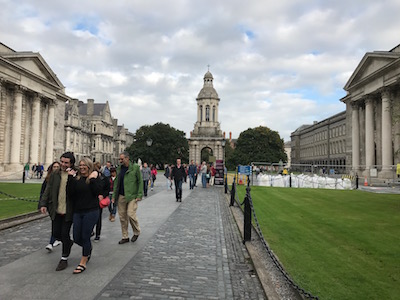
Back in '99 when I was taking enough trains around Europe that it was worth it to have a rail pass, I was regularly gobsmacked at how (at least on the Continent) they ran to-the-minute per the published schedule. Yesterday, pretty much every train I was on was delayed...which was a good thing because otherwise I would have missed a couple of connections. In one case, I ran up and over an overpass (carrying a heavy suitcase) to a train already standing at the correct platform, barely glanced at the monitor and only confirmed it was the correct train when I was on board (and had managed to catch my breath). Which brings up another observation: the British rail system must be hell on people with physical disabilities. I can't count the number of occasions where I couldn't see any obvious option for getting from point A to point B that didn't involve stairs. (Even on the spiral ramp up to the pedestrian bridge to the Durham station, the ramp had periodic steps. Not quite enough to daunt the roll-away, but certainly enough to preclude wheelchair use.) I'm still spry enough that I can break out the backpack straps on my suitcase and hike up to my 3rd floor walk-up room here at Trinity College (see picture) but I can feel the bones aching on occasion and it makes me ponder.
But on the up side, I saw lots of lovely train-side scenery yesterday, cutting accross the Pennines and then traveling along the northern edge of Wales, across the Menai Strait, and on to Holyhead where I took the ferry to Dublin. I took a bunch of "atmosphere" notes on the trip for when I return some day to my 10th century historic romance that involves Dublin and Vikings.
If you ever plan to visit Dublin in the summer and want easy access to everything downtown (and you have good knees) I can highly recommend taking advantage of the Trinity College on-campus accommodations. (I found them through Hotels.com) It's a dorm style room (there are a few with en suite facilities, which I got) and comes with a complimentary continental breakfast at The Buttery (full breakfast available if you pay more). And now I'm going to walk out of my room, across the quad, and take a campus tour that ends up putting me in front of the Book of Kells. But more on that in tomorrow's post.
Major category:
TravelMonday, August 21, 2017 - 07:00
In the research I read though for this project, I regularly come across references to pieces of historic literature that come tantalizingly close to being positive queer stories. A few of them have been added to my "to write" list where I want to tweak them ever so slightly to overcome the deficiencies of the past. Aragón's play Añasco el de Talavera is one of those tantalizing near-misses, with its open homoerotic desire and the "mannish" woman who has the power to order people's lives within the story. It doesn't tempt me quite enough to add it to the list, but I'd love to read through a full translation of it some day.
Major category:
LHMPFull citation:
Velasco, Sherry. 2011. Lesbians in Early Modern Spain. Vanderbilt University Press, Nashville. ISBN 978-0-8265-1750-0
Publication summary:
A study of the evidence and social context for women who loved women in early modern Spain, covering generally the 16-17th centuries and including some material from colonial Spanish America.
Chapter 6: Lesbian Desire on Center Stage
[The following is duplicated from the associated blog. I'm trying to standardize the organization of associated content.]
In the research I read though for this project, I regularly come across references to pieces of historic literature that come tantalizingly close to being positive queer stories. A few of them have been added to my "to write" list where I want to tweak them ever so slightly to overcome the deficiencies of the past. Aragón's play Añasco el de Talavera is one of those tantalizing near-misses, with its open homoerotic desire and the "mannish" woman who has the power to order people's lives within the story. It doesn't tempt me quite enough to add it to the list, but I'd love to read through a full translation of it some day.
# # #
Female same-sex flirtation is a regular feature in popular Spanish drama of the early modern era. Erotic attraction to cross-dressed actrresses was cited in moral warnings. Velasco discusses the “meaning” of same-sex flirtation in cross-dressing scenarios, based on the several layers of “real” versus “apparent” gender, and considering different audiences. If female attraction to cross-dressed actresses isn’t quite all-out lesbian desire, it at least acknowledges its possibility. In-play dialogues about the attractiveness of the cross-dressed characters is coded in ambiguously androgynous terms.
Another context for dramatic ambiguity is the use of female actors for roles where a male character takes on a female disguise (within the story), as in the legend of Achilles. While this may have avoided having an actual male actor cross-dress as a woman on stage, it created the potential for female same-sex desire within the layered “woman playing a man playing a woman” scenario.
Moralists of the 17th century warned parents that their innocent daughters would be corrupted by consuming plays and novels. The expressions of concern are not specifically focused on homoeroticism, but the general idea is that young girls will “get ideas” from popular culture.
There is an extensive discussion of Cubillo de Aragón’s play Añasco el de Talavera (ca. 1637) which depicts lesbian desire without the mechanism of male disguise. The “manly woman” Dionisia’s desire for her female friend Leonor is an open topic of discussion within the play. Dionisia complains about the restrictiveness of female gender roles and has a serious case of “not like other girls”. She specifically expresses the desire to be touched (implied: sexually) by Leonor and say she loves her. Leonor demurs about the concept, but Dionisia presents her argument in terms of platonic love, and argues for the supremacy of (same-sex) platonic love over heterosexual desire. The dialogue acknowledges that women may “sin” together, i.e., that activity counting as forbidden sex is possible between women.
Leonor, alas, is irredeemably heterosexual, and the play ends up shoehorning Dionisia into a heterosexual resolution. But the resolution implies that Dionisia is still controling the situation driven by desire for Leonor. Dionisia marries the man who is mutually in love with Leonor (thus interfering with their competing relationship) and leaves Leonor to marry the man who has been vainly attempting to woo Dionisia.
Velasco considers the effect of homoerotic art and literature on female viewers. For example, homoerotic scenes of Diana and her nymphs may have been intended for male voyeurism, but had female viewers as well. Literary depictions of Diana were viewed as potentially corrupting and parents of daughters were specifically warned against Jorge de Montemayer’s 1559 work Las siete libros de la Diana (known more typically as La Diana). The same-sex love depicted in this work has traditionally been dismissed as neo-Platonic friendship, but it is expressed in terms of physical affection and verbal flirtation.
Two characters, Ysmenia and Selvagia, enjoy a passionate interlude, then Ysmenia falsely convinces Selvagia that she is a man in disguise and that Selvagia has been tricked into a heterosexual liaison. Selvagia remains steadfast in her love for Ysmenia, despite this apparent trick. Enter Ysmenia’s Convenient Twin Cousin (male) who takes advantage of the situation to take over Ysmenia’s affair with Selvagia. The story can be compared with other pastoral romances, most of which involve some type of gender disguise. But La Diana is unusual in showing Selvagia’s love beginning when she believes that love to be homoerotic. The steadfastness of Selvagia’s love regardless of the (believed) gender of the object supports the image of same-sex love being equivalent to heterosexual love.
In other similar works, there is more often uneasiness expressed about apparent or real same-sex desire, which is resolved by either the reality or a fantasy of a magical sex-change to permit a heterosexual resolution. These may include sexual interludes that could be interpreted as lesbian and involving an artificial penis. There is often a phallocentric assumption that only a penis can provide a woman with pleasure and that real female same-sex relations must remain unfulfilled.
In the romance Tirant lo Blanc there is an episode of a woman engaging in sex play with another woman supposedly for the voyeuristic benefit of an observing man. Later, the sex play continues in the dark and the man substitutes in (unknown to his partner). The woman in this interaction is shown protesting that the supposed same-sex act is against nature, but she does not deny its possibility. The in-story implication is that sex between women is permited as long as it’s really a performance for the male gaze or for the reader. But the fact that both La Diana and Tirant lo Blanc were popular among female audiences suggests other possibilities. Heterosexual resolutions kept the text “safe” while allowing transgression between the covers (of the book).
The rest of the chapter takes a close examination of the novels of María de Zayas, which interrogate heterosexual relations and support the concept of female community and marriage resistance (although in the form of the convent). The themes send conflicting messages about heteronormativity and female same-sex love.
“Love for the Sake of Conquest” uses a male-to-female disguise plot to assert the superiority of love between women, though the arguments are put in the mouth of the male character (disguised as a woman) who it turns out is making those arguments purely for the sake of getting the other protagonist in bed. This creates a context for articulating the attractions of same-sex love and desire without the transgression of enacting it. After the male character reveals his identity and succeeds in initiating a sexual relationship, he loses interest and moves on, while the female protagonist is then murdered by her father for her (heterosexual) sexual transgression, whereas her apparent attraction to another woman was considered odd but not equivalent to fornication.
In “Aminta Deceived and Honor’s Revenge” a woman expresses romantic attraction to another woman without the artifice of a disguies plot, and her attention is found flattering. But it turns out the first woman was acting out of ulterior motives in order to further her relationship with a man and to deceive the supposed female object of her affection.
The third story considered, “Marriage Abroad: Portent of Doom”, includes a rather hostile depiction of male homoerotic relations, raising the question of whether this indicates that Zayas judged male and female relations entirely differently, or whether it’s evidence that she didn’t intend her female couples to be read as having physical relations.
Overall, although Zayas' novels include themes of the superiority of love between women, the actual plots undermine this message, showing deception and falsehood. Only in the framing story for the novels does the messge of that superiority prevail in truth.
Place:
Event / person:
Sunday, August 20, 2017 - 02:57

Just a quick note this time. Yesterday we did a little more wandering around Durham. Checked out the stalls in the Old Market Hall looking for gifts, but didn't see anything that really grabbed me. Went off to look at Sara & Joel's new house that they're gradually getting fixed up for moving in and had serious Old House Envy. (18th century beams! 0.5 meter thick back wall (now an interior wall of the house)! Cute postage-stamp back garden with sheds!) Had lunch and a pint in the pub right around the corner from the new (old) house.
Spent the afternoon resting up for the jaunt to York today, plus doing a bunch of exporting, formatting, and annotating of my files from the Great Welsh Name Database which I'm handing over to Sara for use in the DMNES project (Dictionary of Medieval Names from European Sources). This is, to some extent, an acknowledgement that I'm unlikely to do more work on the database in the near future. But I've always meant to ask if she wanted the data to use and this was a chance to talk about how the current files are structured and what some of the analytic data was trying to do.
Major category:
TravelSaturday, August 19, 2017 - 00:00
Author Catherine Lundoff returns to the podcast to share some of her favorite lesbian historical fiction. I hope this series of segments will help people find new (or old) titles that may strike their fancy.
Now with transcript!
* * *
Lesbian Historic Motif Podcast - Episode 15 (formerly 31c) - Book Appreciation with Catherine Lundoff - transcript
(Originally aired 2017/08/17 - listen here)
(Transcript commissioned from Jen Zink @Loopdilouwho is available for professional podcast transcription work. I am working on adding transcripts of the existing interview shows.)
* * *
Heather Rose Jones: Last week, we had Catherine Lundoff on to talk about her own writing. This week she comes back to participate in our historic book appreciation feature, where she squees about her favorite books with queer female characters in historic settings.
Catherine Lundoff: Well, there’s a number of different things I like. I can think of a number of books that are by lesbian, bi, trans women, but they have male protagonists. I was thinking of, in particular, Melissa Scott’s and Lisa Barnett’s Armor of Light, which is an alternate history about Christopher Marlowe and Sir Phillip Sydney and Christopher Marlowe doesn’t get assassinated in Deptford and wacky hijinks ensue. It’s a great book, I keep hoping that Melissa will do a sequel to it. But in terms of books with queer characters, one of the ones that I would like to recommend that I think isn’t as well known for the les-fic readership in particular, is a trilogy called Tomoe Gozen.
H: Oh, yes!
C: I’m probably mispronouncing it but that’s another Jessica Amanda Salmonson work and it’s based on the life of a woman who was a… She was a Japanese historical figure who was an actual fighter, she fought with a naginata and it’s kind of a scythe-like spear. It has a sort of curved blade on the end of it. She was, at various times in her life, both a nun and a fighter who was involved in all of these different political things that were going on in the time period. In the course of the three books, she is revealed to be bisexual by contemporary standards. Again, I can’t remember if she’s a lesbian or not, I’m thinking that she’s bi, because I think she does have one romance with a man. They’re very, very rich books. They’re very interesting. They’ve been out of print for a while, which is unfortunate, but they may be available in ebooks. A lot of things are coming back in ebook. That’s probably one of my favorites of the historical end of things that I can think of off the bat. I, of course, enjoy your books as well because Ruritanian romances are just fun. They’re just great books. Presumably, the people listening to this are already reading your books, I hope.
H: Yah, I’m trying to avoid having the book squee part of the podcast be just an appreciation of my books, because that looks bad.
C: I can see that. I can see that. Emma Donoghue, you know, has got to be one of my favorite authors. Slammerkin, I think I cried all the way through the last third of Slammerkin and I am not somebody who weeps much.
H: Can you tell a little about what the book’s about?
C: Slammerkin is about a young British woman, who was a real person, who worked as a prostitute in London and ended up, through a variety of circumstances, going to work for this prosperous rural family. Somewhere along the line, things went hideously awry and she ended up being accused of murdering her mistress and hanging for it. ‘Slammerkin’ is a slang term from the time period, I believe it’s mid-seventeenth century, for a prostitute. It’s a very intense book because it’s written entirely from her perspective. Donoghue’s very sympathetic towards all the different things that this woman would have had to mesh together to make it work. To go from a reasonably prosperous career as a prostitute in London to being a servant in the country and where that went wrong. It’s a very interesting book, it’s a very intense read. I find that with most of Donoghue’s stuff; she does a lot of really great historical books. She’s also got a collection of lesbian fairytales called Kissing the Witch that’s well worth tracking down. Donoghue is definitely somebody I would recommend. Sarah Waters…
H: Yes! There’s always Sarah Waters.
C: There’s always Sarah Waters. I was just recommending, on a Gothics panel that I was on at WisCon, I was recommending Affinity, which is her novel about the séance and spiritualist movements in Victorian England. It’s about a woman who is queer but is from a noble background and has to pass herself off as continually ill and always going to these séances. She gets sucked into the criminal underworld that also accompanied séances and so forth. It’s beautifully written, it’s beautifully written. It’s well worth tracking down. Fingersmith gets a lot more play of her novels of the time period, but I think Affinity is also very, very good. I think, between the two of them, they’re just amazing, amazing authors. I’m so glad I discovered them when I did.
H: Well, thank you so much for sharing some of your favorite queer female historical fiction with us!
Show Notes
In the Book Appreciation segments, our featured authors (or your host) will talk about one or more favorite books with queer female characters in a historic setting.
In this episode Catherine Lundoff recommends some favorite queer historical novels:
- Tomoe Gozen by Jessica Amanda Salmonson
- Slammerkin by Emma Donoghue
- Kissing the Witch (collection) by Emma Donoghue
- Affinity by Sarah Waters
- Fingersmith by Sarah Waters
- Also a nod to The Armor of Light by Melissa Scott and Lisa Barnett (queer authors, but queer male protagonists)
Links to the Lesbian Historic Motif Project Online
- Website: http://alpennia.com/lhmp
- Blog: http://alpennia.com/blog
- RSS: http://alpennia.com/blog/feed/
- Twitter: @LesbianMotif
- Discord: Contact Heather for an invitation to the Alpennia/LHMP Discord server
- The Lesbian Historic Motif Project Patreon
Links to Heather Online
- Website: http://alpennia.com
- Email: Heather Rose Jones
- Twitter: @heatherosejones
- Facebook: Heather Rose Jones (author page)
Links to Catherine Lundoff Online
- Website: Queen of Swords Press, Catherine’s newsletter, and the History of LGBTQ Speculative Fiction column “Out of the Past”
- Twitter: @clundoff
- Twitter - Queen of Swords Press: @qospress
- Twitter - Emily L. Byrne (pen name for erotica): @emilylbyrne
- Facebook: Catherine Lundoff
- Facebook: Queen of Swords Press
- Facebook: Emily L. Byrne
Major category:
LHMPPages
