Blog
Saturday, May 13, 2017 - 07:00

It's hard enough in ordinary times to keep up with all the books one might want to acquire. Paying attention in the aftermath of The Unfortunate Election was a special challenge. That must be why I was oblivious to the collection A Certain Persuasion: Modern LGBTQ+ fiction inspired by Jane Austen's novels, edited by Julie Bozza, when it first came around. I have remedied that oversight, as I have a great fondness not only for Austen's fiction but for creative re-tellings and extrapolations of her stories.
Thirteen stories from eleven authors, exploring the world of Jane Austen and celebrating her influence on ours. Being cousins-by-marriage doesn't deter William Elliot from pursuing Richard Musgrove in Lyme; nor does it prevent Elinor Dashwood falling in love with Ada Ferrars. Surprises are in store for Emma Woodhouse while visiting Harriet Smith; for William Price mentoring a seaman on board the Thrush; and for Adam Otelian befriending his children's governess, Miss Hay. Margaret Dashwood seeks an alternative to the happy marriages chosen by her sisters; and Susan Price ponders just such a possibility with Mrs Lynd. One Fitzwilliam Darcy is plagued by constant reports of convictions for 'unnatural' crimes; while another must work out how to secure the Pemberley inheritance for her family. Meanwhile, a modern-day Darcy meets the enigmatic Lint on the edge of Pemberley Cliff; while another struggles to live up to wearing Colin Firth's breeches on a celebrity dance show. Cooper is confronted by his lost love at a book club meeting in Melbourne while reading Persuasion; and Ashley finds more than he'd bargained for at the Jane Austen museum in Bath. A Pemberley-sized anthology...
Austen wasn't a direct source of inspiration for the Alpennia series--except second-hand through the Regency fiction of Georgette Heyer. And even that inspiration applied primarily to Daughter of Mystery with its themes of disguise and mysterious parentage, first young love and finding one's way though the tangle of polite society. In some ways, Mother of Souls may hearken back to more Austenesque themes of the hardships women face alone in the world and especially their economic struggles.
The Great November Book Release Re-Boot is intended to re-shine a light on books release in November 2016 that may have suffered an unfair handicap at the gate.
Major category:
Promotion View comments (0)
Friday, May 12, 2017 - 19:23

Not-a-session: Manuscripts to Materials
- Sponsor: Research Group on Manuscript Evidence;
- Societas Magica
- Organizer: David Porreca, Univ. of Waterloo
- Presider: Jason Roberts, Univ. of Texas–Austin
Practical Magic: Making Magical Artifacts and Using Them
- Frank Klaassen, Univ. of Saskatchewan
- Responses: Claire Fanger, Rice Univ.; David Porreca; Marla Segol, Univ. at Buffalo
The session begins with an interactive display of the physical paraphernalia of magic and divination, created by various members of the society based on the descriptions in historic manuscripts. This is a roundtable discussion on the process of researching, reconstructing, and practicing with the various artifacts.
In many cases, no actual objects of these types survive. Working on three aspects of texts and imagination: the process of producing artifacts based on very limited textual instructions (requiring extrapolation); consider the ways that magic tools leverage the imagination of the practitioner; and then how to use the tools to encourage the observer to enter into the medieval world imaginatively.
Among the modern technology used for this process are 3D printers and computer simulations of divination techniques. The participants tried out various of the interactive techniques such as ciromancy (divination by wax tripped into water), or the key-and-psalter divination (for identifying criminals).
What did they learn? Presenting this reserach to a non-academic audience requires very condensed textual information. Some outcomes of the interactive practice were expected, such as the physics of the key-and-psalter divination. Some were open-ended, such as giving artists descriptions for the creation of amulet figurines, who then extended the limited information with other religious and philosophical imagery to create the actual objects. Or the need for an interpretive key for the molymdomancy (molten lead divination). Some results were unexpected. Such as the personal attachment students felt to the molybdomancy lumps they’d created.
What can the audience take away with them? Encouragement to actually try out the magical practices you’re studying academically, as you’ll learn things not otherwise available. Use the artifacts in teaching for greater meaningful understanding and connection with the historic context. (The 3D printer vector files will be made available for general use.) An audience member notes that the 3D printing method side-steps the practice aspect of the personal physical creation of objects, which was an essential part of their original use.
They’re looking for a context for a larger, more extensive exhibit, collaborating with a museum. Encouragement of additional examples developed by other researchers.
The panel now offers their responses/discussion. (Sorry I’m not keeping track of the speakers individually.)
Another technique explored was scapulomancy (sheep shoulder blades) using actual bones. Someone just during the exhibit noted they should include a wishbone divination. (They include modern equivalents to some techniques, like Ouija boards.) The interpretative guides for the ciromancy/molybdomancy are reminiscent of interpretation guides for dreams, etc. Abstract divinations require an “answer key”. Some of the more complex 3D print jobs required up to 36 hours and required constant babysitting!
They ask for volunteers from the audience for the Homeric divination (from Greek magical papyrus). One selects the text, the other interprets. Other audience members tell their experiences interacting with the same divination prior to the roundtable. People asked meaningful questions and received what they perceived to be meaningful answers. A discussion of the significance of the public performance of these rituals, where the fact of witnessing adds more significance than something done privately would.
Major category:
ConventionsFriday, May 12, 2017 - 13:36
There always seem to be a number of “emergent themes” each year at Kalamazoo. This year, Islamic topics are one of them, along with disability studies and themes of anger and despair. I’ve been keeping an eye peeled for books on Islamic mystical and magical traditions in order to do deep research for some topics that will appear the next Alpennia book I write (i.e., the one after Floodtide). Just as I studied medieval Christian folk-religious and magical practices to give deep roots to the magic in the previous books, I want to have a depth of historic understanding behind the early 19th century practices that I invent for Zobaida. The sessions on history are of less relevance for my novel, obviously, but this one intersected my interest in women’s history.
Session 310: Medieval Arabic Scholarship II: Medieval Arab(ic) Feminisms
- Organizer: Maha Baddar, Pima Community College; Sally Abed, Univ. of Utah
- Presider: Norma H. Richardson, Central Michigan Univ.
Female Agency within the Confines of the Medieval Harem - Maha Baddar
Will focus on Abassid era. Brief definition of who/what the harem was. Explains the dual meaning referring both to the sense within its original culture, and the use by western culture for a mythic interpreted representation. Baddar discusses this dual meaning within Lakoffian conceptual metaphor theory. The patriarchal frame of understanding of “harem” informs the reception of the term/concept even when the women who participate in the system resist those structures. Scholarship of the harem has largely drawn from externally imposed udnerstandings (both western and masculine).
The harem system was not monolithic, expressing itself in various cultures according to the traditions of those cultures, with greater or lesser agency for the women within it. The depiction of the figure of Shaharazade is a good illustration of the differing functions/understandings of the role of the harem, with western depictions focusing on themes of sexuality and decadence.
Culturally-internal descriptions of harem dynamics in the Abassid period show the importance of learning and scholarship for the women’s relative status and value. Intelligence and political acumen was a surer path to power within the court and the harem than purely physical attributes. But evidence for the harem (people)’s intellectual pursuits is hampered by the (male) historians’ practice of omitting reference (or at least details) as part of the cultural framework around the harem (institution).
Examples are given of women of the harem making legal appeals on behalf of others to the caliph, especially those with close familial connections to the caliph. But these types of agency often depended on those personal connections and power could be lost or gained as the political power shifted between ruling men. These influences and shifts are sometimes documented via men’s reactions to them and attempts to interfere with them. It is also clear from these interactions that the theoretical structure of the harem being forbidden to access by all but selected men, was often a social fiction.
Artistic depictions of harems by westerners tended to emphasize physical restriction and sensual service, while Abassid depictions show the women having physical freedom to ride horses and practice archery, as well as emphasizing the women’s intellectual interactions and “service” for the men they were associated with.
The Other Woman in the Arabian Nights: A Different Interpretation - Sally Abed
Paper focuses on Sheherazade’s sister, Dunyazad, who plays a liminal position in the narrative of the 1001 Nights, hiding under the bed as her sister tells her tales. She is part of the framing story to the tales involving the king who marries a new woman every day and kills her the next morning.
Dunyazad’s part, as pre-planned before the marriage--is to prompt her sister for a story every night in order to set up the indefinite postponement of Sheherazade’s execution. Dunyazad then concludes the night’s storytelling by thanking her sister for the story, to which S. response, “That’s nothing to what I would tell you tomorrow.” This prompts the king’s desire to hear more and spare S’s life.
The two of them together create a new framework that de-sexualizes the interaction between S. and the king and shifts it to a verbal storytelling framework. D’s concealment under the bed does not have a precedent in historic culture, although there are related precedents for a special relationship between sisters.
D’s “art of interrumption” creates boundaries and limits to the structure and relationships of the story. As the story goes on, the king begins echoing D’s exclamations of delight and surprise at the story and decides to postpone the execution in longer and longer increments, specifically requesting particular story continuations or completions.
Thus the ongoing conversation is framed as being between S & D, with the king an increasingly active bystander/overhearer. Eventually the king becomes more interactive and even takes on storytelling activities himself.
Later copies of the overall story, as focus shifts to the internal tales, begin to erase Dunyazad’s presence and agency, sometimes becoming merely “someone” that S. talks to.
European translations of the tales presented the contents as “accurate” depictions of middle eastern culture, even above their own personal experiences and observations there. This erases the 1001 Nights as a literary creation, making it a mere “traveler’s tale” type of story. It also erases the agency (within the story) of S & D as creators of that literary tradition. (Examples are given of women who provided the transmission of other women’s scientific and technical achievements. This parallels the interactions of S & D in the literary field.)
(There is a series of images of western art showing the storytelling scene, emphasizing luxurious excess in contrast to the lack of focus on such things in the story itself. There is also focus on the sexualization of Sheherazade, via dress and physical performance.)
Alkhansaa and the Tradition of Pre-Islamic and Early Islamic Female Poets in the Arabian Peninsula - Doaa Omran, Univ. of New Mexico
Evidence for around 17 female poets for the era roughtly 5-7th centuries CE. Contemporary male poets considered Alkhansaa among the best, if not the best poet. Her life spanned the pre-Islamic and Islamic eras. Tradition holds that she met with the Prophet and his wife A’ishah.
She used imagery of the eyes being the body. Famous for mourning poems for her brother. Bio: an orphan, married three times but no poems about her husbands. Lost four sons in battle, and again no poems for them.
She uses body parts as a landscape for the world in which she must survive without her brother. Especially the eyes and tears. It isn’t an isolated grief but one constantly connected with details of his life that provide the context/motivation for mourning. There is imagery connecting the eyes with darkness and with natural water phenomena such as rain.
The poem evokes the tradition of professional mourners, but crosses over to a more personal connection. The poet’s body exists primarily as a sensory organ, with focus on eyes, ears, and heart. But her work itself does not focus on herself as a woman or a sexual being.
Some of her contemporaries tried to minimize her talents as limited in scope. When one man said, “You are the best poet among those with [female body parts],” she responded, “I”m also the best among those with testicles.”
Female Intellectual Spaces in al-Andalus - Jessica Zeitler, Pima Community College
(Unfortunately this paper was not presented.)
Major category:
ConventionsFriday, May 12, 2017 - 11:47
Session 233: Dress and Textiles II: Real and Unreal
- Sponsor: DISTAFF (Discussion, Interpretation, and Study of Textile Arts, Fabrics, and Fashion)
- Organizer: Robin Netherton, DISTAFF
- Presider: Gale R. Owen-Crocker, Univ. of Manchester
A Change of Face, or, A Man in an Otter Suit
M. A. Nordtorp-Madson, Univ. of St. Thomas, Minnesota
[Speaker was unfortunately not able to attend.]
The Real Unreal: Chrétien de Troyes’s Fashioning of Erec and Enide
Monica L. Wright, Univ. of Louisiana–Lafayette
Chrétien de Troyes shows his familiarity with contemporary fashion in the extensive and detailed descriptions of clothing in his romances. But not all clothing in the stories is meant to be realistic. In some cases the specifics are symbolic and “unreal”.
Structurally, there are two sequences, beginning and ending with a gift of clothing that is described in detail. The first begins with a gift of armor from Enide’s father to Erec. Erec’s clothing is rich and describes actual garments, though he does not wear armor, which lack is symbolically important. Enide, in contrast, has beome impoverished, which is refelcted in the simplicity of her initial garments: a linen mantle over a threadbare linen chemise, but lacking the expected bliaut which would be an expected part of court wear. The sequence ends with a gift of clothing from the queen to Enide, who previously has remained in her poor clothing. The description of Enide’s clothing gift is long and detailed, again reflecting actual contemporary fashions.
The second sequence is when the two venture out on adventures in the midst of conflict between them. Enide is instructed to wear her finest clothes--those the queen gave her--which will attract the attention of Erec’s adversaries in this section.. The central part of this sequence includes a number of gifts of clothing that Erec hands out to resolve problems along the way. This sequence concludes with the couple reunited and invested to rule the realm of Enide’s late father. There is a long description of Erec’s coronation mantle with its elaborate embroidered decorations. Although these might seem improbable in theme, they are similar in detail and them in existing royal mantles from the general era.
Some details of the mantle, however, are deliberately fantastic, such as the work being attributed to fairies, and the description of the strange and colorful legendary beasts that provided the fur lining. Or are they so strange? In other manuscripts, some furs are described as coming from the orient, and Write notes some furred creatures native to Asia such as the Giant Malabar Squirrel and a type of monkey whose multi-colored fur is consistent with the description in Erec.
(Summary tying the clothing descriptions and dynamics in with the contemporary social and political landscape.)
“Monstrous Men of Fashion”: Striped Costume in a Danish Church Wall Painting
John Block Friedman, Center for Medieval and Renaissance Studies, The Ohio State Univ.
During 15th c “ungodly creatures” began to be depicted in Dnaish church paintings. This paper concerns such depictions of “monsters” derived from Pliney’s writings, but shown wearing fashionable “Landsknechte” style clothing in the early 16th century in a church at Raaby. There is an anecdotal story of how such works might have been commissioned. Figures at Raaby include:
- dog-headed man
- one-eyed man with long ears
- sciopode (with umbrella-like foot over his head) & prominent erection
- horned man with long nose
Possiby connected with these are similar figures in churches near Aarhus, wearing similarly fashionable clothing of other styles.
Whey are the monsters clothed at all? And in familiar garments? The contrast between humans and monsters suggests that monsters should be depicted naked or in the styles of foreign lands.
Two features make the Raaby onsters unusual. The carefully depicted garments are a turning point in the depiction of monsters. But they also reflect an antagonistic reaction to the landsknechte mercenaries via a hostile association of them with monsters. The mercenaries were specifically exempted from sumtuary laws and encourated to use clothing display as a cohesive strategy. And their low pay encouraged rapacious behavior in the wake of battles, hence their bad reputation.
The visual significance of the Landsknechte clothing style resulted in plentiful visual documentation, but early depictions are often hostile.
[There is a general discussion of fashionable changes in the doublet in the 14-16th century, especially with regard to social critique of them.]
The Raaby sciopode is not wearing landsknechte styles but rather a more academic robe. Thus contrasting the intellectual and bestial qualities.
Vivid striping on the figures’ hose and codpieces draws attention to a novel aspect of the style, where the lower limbs are increasingly displayed. By the early 16th century, German art often associated striped clothing with outrageous figures and tormenters, as in crucifixion, flagellation, and St. Sebastian scenes. We’re now looking at alterpieces and other paintings from Germany and Austria.
Thus the dressing of the Danish monsters creates an association between unhuman monsters and the violent and rapacious behavior associated with landsknechtes, as well as with violent sexuality.
Tall Hats, Scrolling Brims, and the Byzantine Scholar in Late Medieval European Painting
Joyce Kubiski, Western Michigan Univ.
In the 15th century a particular hat style begins appearing in European art from the east moving to the west. It seems to be a fantastical item used to reprsent Jews and other foreigners. But garments of this sort were not entirely inventions, but relied in origin on an actual association with a foreign garment, though often fantastically elaborated later.
This “hat with a scrolling brim” has a round crown with a knob on top, and a bifurcated upturned brim.
It may date to contacts with Byzantine diplomats traveling to western European capitals looking for assistance. Western representations of Byzantine dress are more common than Byzantine ones due to later destruction of art during political and religious upheavals. Everyday dress is particularly difficult to research for this reason.
Although this hat style had clear symbolic meaning in western art, it isn’t clear what it may have symbolized in its original cultures of origin. It was used to symbolize a “benign” foreigner, or ancient Greek philosophers and the like. Later it morphed into a more general sign of “otherness”, not necessarily benign, and might be applied to foreigners from other places than the east.
Italian artist Pisanello (early 15th c) created portraits of the Byzantine emperor John VIII Palaeologus, and this is the earliest appearance in western art of the hat with the scrolling brim (HwtSB). This item has a tall rounded crown with a knob and a brim in two parts, the front one elongaged and pointed, turned up, though not rolled as the later depictions show. Pisanello’s portrait was designated the only “official” image of the emperor and thus became strongly associated as an icon. Possibly for this reason, although the emperor clearly had other garments and caps, descriptions of him usually include this hat.
Official depictions of the emperor in Byzantine art never show him in this hat style, though textual descriptions indicate less formal everyday wear than the official Byzantine portrait styles.
Other sketches by Pisanello of the emperor show a number of other hat styles and clothing. Five different hat designs are show, not including the iconic style eveually used for the official portrait. Some of these other hats show up in images of the Byzantine court included on a set of bronze doors commissioned for Saint Peter’s at the same time. This is a design much closer to the iconic HwtSB, with a high rounded crown, with a tall brim turned up and split at the sides, with the edges scrolled in various directions.
Possible Byzantine visual evidence includes a 14th c image of a saint wearing a stiff tall hat with a split brim, and a Serbian version of the Alexander romance where Alexander and his court wear a tall-crowned, tall-brimmed hat, split at the sides and scrolling.
The later medieval European depictions are modified significantly from these early images but have a clear structural connection, as well as a strong symbolic association, first with Byzantine and Greek individuals, later with eastern foreigners, and then with foreigners in general. The connection via Pisanello’s art supports a conclusion that this is a real garment with actual Byzantine associations, despite its later abstraction as an artistic signifier.
Major category:
ConventionsFriday, May 12, 2017 - 08:16
Session 175: Dress and Textiles I: Details from Documents
- Sponsor: DISTAFF (Discussion, Interpretation, and Study of Textile Arts, Fabrics, and Fashion)
- Organizer: Robin Netherton, DISTAFF
- Presider: Gale R. Owen-Crocker, Univ. of Manchester
Saints Subverting Early Medieval Fashion - Sarah-Grace Heller, Ohio State Univ
Hagiography offers a rare glimpse of early medieval everyday life, those skewed by the purpose of the documents. Information on attitudes towards fashion is even harder to find in this ear and actual garments are rare and fragmentary. History of costume surveys therefore give this era skimpy coverage. This paper looks for evidence for anything resembling a “fashion system” in this era, defined by atributes like constant and systematic change, priviledging of the “new”, a focus on consumption and appearance, conspicuous consumption, and criticism of these features.
Hagiography often featured a rejection of luxury and comfort, including luxurious clothing. But sometimes these tropes are subverted. This paper compares a set of saints’ lives with respect to this question.
S. Radegund (6th c Thuringian princess) had early life disrupted by war and becoming a political captive and pawn. Eventually offered marriage by the king when she would have preferred life as a nun. She subverts the rich treasures of clothing she is offered by wearing a hair shirt under the rich royal robes she wears.
Advice to avoid surplus or luxurious clothing dates back to the gospels. Radegund would regularly divest herself of her rich royal garments while in the middle of public display, leaving them on the altar as an offering.
Description of a multi-layered “foreign” outfit involved: a “’stapio’ [style?], including her chemises, sleeves, caps, fibulas, all ornamented with gold and precious stones.” ... “A new veil of coars linen ornamented with gold and gems in the barbarian fashion.” Here we have references to novelty and consumption. Radegund is descxribed as rejecting these things when they are praised as attractive. The context makes it clear that these donated items are not her only garments but that she regularly receives new ones.
Sainte Bathilde, similarly, is described as taking off her girdle (belt) and giving it to the hold brothers for alms. Some of Bathilde’s garments that were donated survive and show aspects of luxurious cut, such as extravagantly long sleeves. [Reconstructed examples are brought out and Robin Netherton models them.] Such extravagance suggests aspects of a fashion system.
Comparison of the concepts of “fashion” and “treasure”. The latter is “specially valued wealth...scarce, desirable, and stored...mobile, it can be given and negotiated.” Fashion, in contrast, is not necessarily stored up and accumulated, but it is the turnover and newness that is valued.
Quotation from Jerome about how a girl should interact with clothing: homespun, not imported silk and luxury fabrics, clothing that protects and covers, not that exposes the limbs.
Hemp and Hemp Cloth in the Medieval Rus Lands - Heidi Sherman, Univ. of Wisconsin–Green Bay
[This speaker scratched, alas.]
“Luflych Greuez” and “Wedes Enker-Grene”: Clothing and Its Social Implications in Sir Gawain and the Green Knight - Kara Larson Maloney, Binghamton Univ.
Paper will focus on Gawain because she ran out of time before getting to the Green Knight. 14th c. text in a single manuscript, combining pretty much every trope of medieval romance. There isn’t any specific political critique identifiable, but a general critique of courtly society and chivalry, especially as elevated in romance literature.
Gawain’s quest involves failing almost every test he is set on his quest. But this paper focuses on the passages where he dresses and puts on his armor (all 47 verses of it). The description is detailed and the clothes and armor are rich and overly ornamented. This is part of a tradition of the public performance of knightly splendor and virtue.
The poem was written during the reign of Richard II who was criticized for foppishness and ineffectualness. This period shows a transition in heraldry between designs simply being adopted and arms being inherited as part of a noble lineage.
When Gawain reaches Hautdesert (a way station on his quest) he is re-clothed. They attendants remove his armor and divest him of his gear, after which he is presented with rich clothing, where he choses embroidered silk lined with fur. He is then wrapped hi in an ermine-lined mantle and say by the fire. This is seen as taking away his volition in dressing himself.
This aspect is continued when Lady Bertilak approaches Gawain in bed, when he is naked, and points out his vulnerability. Gawain asks to be allowed to dress and this is refused. All this emphasizes how the garments of his identity as a knight and a virile man have gradually been taken away from him. The lady presses on him her green girdle, which later is seen as proof of Gawain’s weakness.
Gawain reclaims his status by re-donning his own clothing and armor and does not again remove anything until he faces the Green Knight to receive his blow.
Gawain can be seen as the artificial veneer of performative chivalry, while the Green Knight represents the substance, competent both in court and battle. When the Green Knight originally appeared at Arthur’s court, it was in courtly clothing, not armor. He doesn’t need the artificial signifier of armor to represent his masculinity. When Gawain returns to Arthur’s court wearing the green girdle as a symbol of his failure, the court mistakenly adopts it as a symbol of victory, thus reminding Gawain at every turn of his chivalric weakness. Interestingly, King Arthur’s clothing is not described, despite his importance in the court.
“At Hir Mariage”: Wedding Clothes in Sixteenth-Century England and Scotland - Melanie Schuessler Bond, Eastern Michigan Univ.
Accounts of wedding clothing not only depict the specific styles but give evidence on the social and economic contracts embodied in the marriages. Weddings were a unique opportunity for a family to display and establish status. Although women were often advised to avoid ostentatious dress, sumptuary legislation did not try to limit women’s clothing.
[We get a brief survey of the basics of women’s fashion at this time in England and Scotland.]
In additionu to the wedding clothes, a bride might enter the marriage with a trousseau: a set of new clothing meant to launch her into her new life. We now get some examples of outfits of important women at marriage which I’ll try to keep up with.
Margaret Hamilton (neice to the Regent of Scotland) March 1544
- gown of Lille worsted wool trimmed with fine tawny velvet
- kirtle of violent camlet
- purple velvet sleeves ..
- (I think there was a hood?)
Elizabeth Hamilton (niece to the Regent of Scotland) March 1548
- gown of figured red damask with border of velvet
- kirtle of satin with border of velvet
- partlet
- hood
Lady Jean Lyle
- gown of tawny velvet
- kirtle of tawny satin
- partlet
- hood
Margaret Hamilton’s 2nd marriage April 1552
- gown of fine tawny velvet with a train
- kirtle of purple velvet
- hoods and partlets of fine black velvet lined with black satin garnishing for the hoods
- other gowns
- something?
Dorothy Petre (gentry, England Spet 1555)
- I’m not going to be able to keep up with the typing. Long list of garments with details of the fabric and trimmings. Includes a farthingale which we haven’t seen mentioned in Scotland.
Thomasine Petre (her sister) Feb 1560
- A similarly long list of garments for the wedding clothes. An extensive list of garments in her trousseau with details of fabric and decoration. Details show her family’s wealth as it is comparable to those of noble families.
Katherine Herries (ward to the Regent of Scotland) Feb 1551
- Much longer list of garments than those for the Regent’s nieces.
Jane Herries (ditto) April 1552
- Similarly long list of garments with details of fabric and decoration. Lists of accesories. Mention of gold garnishing for the hood and chains.
Barbara Hamilton (daughte rof the Regent of Scotland) Feb 1549
- Only recipient of garments of cloth of gold and silver. An item described as a “royal robe.” Richest garments for any woman associated with the Regent.
Mary I (Queen of England) July 1555
- Lavish ensemble, probably the only woman in this list who chose her own wedding garments.
- French-style gown of rich brocade, deecorated with pearls and diamonds
- kirtle of white satin tissue embroidered, with sleeves of tissue
- partlet to match the gown
- scarlet stockings
- black velvet shoes
[We get a slide showing symbolic representations of all these wedding outfits arranged by social status.]
Wedding clothes were an important point of conspicuous display, and wealthy friends and patrons of the family might be tapped to help pay for the outfit.
Major category:
ConventionsFriday, May 12, 2017 - 07:00

What: featuring Mother of Souls again? But of course, because it's my birthday. And if you can't jump the queue and take a second turn on your birthday, when can you?
(I had a lovely essay written here and then did one of those accidental "swipe sideways" things on my trackpad that disappeared it. So let's do something different.)
One review noted of Mother of Souls that it's the book where I say, "So, we're all established and comfy, yes? Good, because now I'm going to start breaking things." That's not entirely wrong. The Alpennia series starts off, as yet a different reviewer notes, as "a tropetastic Heyeresque romance" with innocent young love and a fairly simple (hah!) mysterious-parentage and defying-social-expectations plot. Pretty much everything my characters thought they knew about the world in that book will eventually be exploded. And Mother of Souls starts challenging not only the characters, but the reader expectations of what sort of series I'm writing.
For one thing, it isn't a romance--not in the genre sensenot even as marginally as the first two books were. I think that shakes up a number of readers, even more than the amount of non-romantic plot in the previous books did. Not that the characters may not eventually find a lasting love, but life isn't that simple. And sometimes you have lessons to learn along the way first.
Reading Daughter of Mystery, some readers--along with Margerit Sovitre--got the impression that magic in the world of Alpennia was purely a matter of "Christian miracles are real". But Margerit's confidence in her understanding of mystic forces is rapidly being eroded. The world isn't that simple. And what happens to Margerit's faith in God and in the intercession of the saints when she accepts that magic can exist outside of them?
Barbara has built her whole self-image on being supremely competent in her sphere of activity: her skill with a blade, her ability to untangle the social and political currents in Rotenek's ballrooms and council halls, and her ability to direct and protect the lives of those she cares for and watches over for their own benefit and good. Even it, as Jeanne so succinctly puts it, she comes across as a bit of a bully. Just because Barbara thinks she is responsible for someone's life doesn't mean that person accepts her authority, and it's no suprise that Antuniet Chazillen sees no reason why she must answer for her plans to Baroness Saveze. Antuniet, as usual, is tripped up by her single-minded obliviousness. But Barbara is the one who pays the greatest price for her pride and self-confidence. That price will challenge everything she loves and holds dear.
And Serafina--poor Serafina! She's been given so many wonderful things in life: a happy and loving family, an acceptance and delight in her mystic visions, marriage to a scholar who values her abilities...only to have them erode away until all that's left is the need to master her confusing skills and maybe, just maybe, someday find a place where she feels she belongs, the way she did in her childhood home. But what if she will never find those things? What if she needs to look for new goals? Ones she hadn't previously thought to want?
Luzie enjoyed the acclaim of being a prodigy in a musical family in her youth, but she equally delighted in finding happiness as an ordinary middle-class wife and mother settled in Rotenek. And now that widowhood has become a habit, she is glad her musical talents can support her sons in the path her late husband planned for them. But she knows she can do more than compose little exercises and occasional pieces for her students, even if her friend the great composer Fizeir thinks that's what her talents are suited to. Daring to tackle a project as daunting as an opera would have been impossible if not for the encouragement and unexpected collaboration from one of her boarding-house tenants: a foreign thaumaturgy student named Serafina Talarico. Neither of them expect that Luzie's opera will be the key to the greatest magical ritual Alpennia has known for centuries.
Yes, I start breaking things. But not my characters. They will bend; they will rage; they will fight. And--as Jeanne so poetically puts it--they will come through the fire and they will be transformed. The fiercest fires are yet to come.
Mother of Souls is a story of dreams and ambitions, of finding new alliances and risking fatal fractures, of the conflict between personal triumphs and daring everything for a greater good. You should read it. It's a great book.
The Great November Book Release Reboot is a series I'm posting throughout the month of May to shine a light on books that were releasted in November 2016, and which therefore may not have gotten the attention and promtion they deserved due to the US electio results.
Major category:
PromotionThursday, May 11, 2017 - 17:48
All the participants have connections to the University of York. The session is organized to commemorate the 50th anniversary of the program there.
Thursday 7:30: Reflecting on Gender and Medieval Studies
· Sponsor: Centre for Medieval Studies, Univ. of York
· Organizer: Craig Taylor, Univ. of York
· Presider: Craig Taylor
From Women to Men, and Back Again
Katherine J. Lewis, Univ. of Huddersfield
Paper title refers to her field of study which began with women’s history and then moved to concepts of kingship. Legend of St. Katherine contrasting concepts of kingship’s relationship to concepts of masculinity. Is kingship related to power over others, or does self-mastery make one greater? Thus the “frail” woman S. Kathering stands higher than King Maxentius who challenged her. This highlights the performative nature of gender, rather than biological determinism, as women saints, especially, can perform “masculine” virtues and rise above their biological origins.
Katherine’s life was often included in general textual collections, alongside romances, which may reflect its use as an example to women of a desirable but transgressive life. But what its reception might be by male readers? What appeal would it have to men in modeling the performance of piety? S. Katherine is depicted by Caxton as a model of kingship, her father’s heir and ruling her household as such. This is more a model of masculine rule than a model for a woman’s stewardship over a household. Caxton’s text explicitly offers her as an example to men of such governance.
We get a summary of the contents of a particular manuscript collection that includes a Life of S. Katherine. Including an inserted indenture for one James Fytt, written on a blank page, recording his agreement with the Guild of S. Margaret regarding a bequest. There is a suggestion that he may have commissioned the manuscript. The Life of S. Katherine in this text also includes a detailed description of how she rules her household after her father’s death.
This is an example of an urban household, depicted similarly to that of the man who we presume was the manuscript’s original owner. The characteristics are not simply the sort of extreme piety and asceticim we often see in lives of female saints, but a very practical and worldly concern for the welfare (including spiritual welfare) of those who depended on her. She gives charity, but retains sufficient good to run the house. She does not withdraw, but concerns herself with the behavior of those under her authority. Self-mastery is a significant component of the virtues she represents.
Katherine’s ability to rule is associated with her ability to perform these “masculine” virtues, and in turn she becomes a model of those virtues for men. She is considered not to have “transgressed” her gender but to have “transcended” it. Even so, her biography provides a model to women that such a transcendence is possible and available.
From Romances to Bromances: Studies in Masculinity at York and Beyond
Rachel E. Moss, Corpus Christi College, Univ. of Oxford
Paper is looking at the field of masculinity studies and its future. Begins with the (modern) Brock Turner rape incident to raise the issue of elitism and masculine privilege at prominent universities. This is a reminder that the issues in medieval studies are still active today, and the role of academics of addressing issues of sexism (among other isms) in academia and research.
The problem of “how can we believe a ‘good guy’ might be a rapist” she raises the probability that Geoffrey Chaucer was a rapist, and resistance to that consideration from those who admire his writing. Moss chose to study masculinity in the middle ages, not to side-step consideration of women, but to focus on it. The study of patriarchy, not simply as a socio-political system but as an on-going social system, which informs her current study of homosociality. It is a system that, by privileging male-male social relationships, supported and maintained patriarchal systems. One of her topics is the function (and necessity) of rape as a tool of that maintenance.
Homosocial bonds such as those in institutions such as sports clubs and fraternities, as well as close friendships of (straight) men christened “bromances”, are an essential element of rape culture, wherein men invite their male comrades to participate vicariously in their sexual assaults as a bonding function. The male witnesses are more important than the female “conquests”.
What does this have to do with medieval studies? Privileged medieval men participated in a culture where the threat of violence against women was an essential component of their social bonds with each other. For example, Chaucer’s The Reeve’s Tale, in which two clerks punish a greedy miller by a combination of raping his daughter, and tricking the miller’s wife into having sex with one of them by deception. The two clerks treat this as an appropriate social victory against the miller. The story is played for broad comedy, which requires a male gaze to accomplish.
Those some scholars try to find nuance in the story, it is inescapable that the clerks (and Chaucer the author, and the presumed reader) consider it appropriate and natural to punish a man by sexually assaulting “his” women. The clerks overtly consider that it will make a good story to tell later, one must assume to their male peers. This type of storytelling and audience appreciation are a performance primarily intended as in-group bonding. These performances establish the boundaries of appropriate masculine behavior. The fate of the miller’s wife and daughter after the end of the story is considered irrelevant. It isn’t part of the story.
How do we recognize how the reflex to defend this type of historic content as a type of rape culture while still teaching historic content in its own context? Recognize that the canon is not neutral and that the selection of what it taught not only reinforces sexist understandings of history, but also is a “story we tell each other” that reinforces sexism in the academy by promoting this sort of homosocial bonding among academics and thus excluding marginalized participants.
From Romance to Administrative History: New Perspectives on Queenship in Late Medieval England
Lisa Benz, Univ. of York
She will discuss how she came to work on the topic of her thesis on queenship, having begun with an interest in Arthurian romance. What did it mean to be a queen in practice? Textual sources include ceremonies, didactic literature, histories, biographies. Model images of queens in these sources were influential in creating an ideal of queenship.
“Mirrors for princes” and similar texts were prevalent in the 14th century, but few touched on the subject of queenship. A few 15th c. texts address the question, but most do not. Christine de Pizan addresses queenship in her woman-centered texts, but not in her general works.
Vitae and chronicles retrospectively portray queens as paragons of virtue, to set them up as models for behavior. The “spin” put on their lives was more important than the factual details of their lives, and stock tropes might be assigned to them for this purpose.
Queens in romances supply a different model: often the calumniated queen or the guilty queen. Queens may depict sovreignty, but it is typically resolved by her marriage to a man. The calumniated queen (myserious pregnancy) typically shifts to a focus on the adventures of her resulting son, including his redemption of his mother. The guilty queen typically takes a lover and conspires to kill the king, requiring punishment for the resolution.
Chronicles of actual queens often depict the same event in different ways depending on the particular chronicler’s didactic purpose. Hagiographies similarly cannot be consider factual as their religious purpose was more important than their descriptive one. And romances can’t be considered factual at all.
These texts show the competing ideas and expectations, but the actual historic women had more complex lives. In the early 20th century, historians of queenship moved away from the simple biographical narratives and began addressing the evidence of non-narrative sources, such as accounts and administrative records. Economic and structural studies of the queen’s household (especially as it became distinct form the king’s household) provide a less biased look. But there was still a preference for focusing on queens with “good stories” Studies of Iberian queens have been particularly rich in data for looking at these contrasting approaches to the research.
Much summing up that I can’t keep up with. Plus some specific examples of types of evidence from administrative documents.
Major category:
ConventionsThursday, May 11, 2017 - 13:32
Session 97: Would You Write More, or What? The Quest to Publish Historically-Based Creative Writing in the Contemporary Literary Marketplace (A Roundtable)
· Organizer: Curtis VanDonkelaar, Michigan State Univ.
· Presider: Curtis VanDonkelaar
A roundtable discussion with Grace Tiffany, Western Michigan Univ.; Amanda Sikarskie, Univ. of Michigan–Dearborn; Merrie Haskell, Library, Univ. of Michigan Library; and Edward L. Risden, St. Norbert College.
Genre fiction has embraced historically-based writing for quite some time, but there now seems to be more openness in “literary” venues as well. The Presider (VanDonkelaar) considers this possibly related to pop culture phenomena like Lord of the Rings and Game of Thrones. Introduces the panel:
Grace Tiffany - author of six novels set in the middle ages or English Renaissance Talks about how you integrate your creative work with professional scholarship. Interest grew from reading Renaissance literature (Shakespeare, etc.). Led to interest in creating her own stories. Can explore ideas that arose in the context of scholarship from a different angle. Argues it’s not just pop culture or genre fiction, but people like Hilary Mantel (Wolf Hall).
Amanda Sikarskie - The “odd person out” as an art historian who is now in the middle of writing a novel. [The link is to her non-fiction publications.] Tells a story about the passage in a historic source that inspired her fictionalization of the event concerning a family of silk weavers. She recommends novel writing as a distraction from looming academic deadlines.
Merrie Haskell - Now she claims the “odd person out” title as a non-academic, although she’s working on a degree to become an academic librarian (currently a para-professional). So for her the writing focus drives her other professional interests, rather than the other way around. Many of her books are aimed at the young adult market.
Edward L. Risden, writing fiction as Edward S. Louis - He’s the first presenter who notes negative reactions from his academic colleagues for his fiction writing. This moves into a discussion among the presenters about this point. Tiffany notes that she has consistently written both fiction and academic work at the same time and her institution supports “creative” work as well as research (and she already has tenure).
General discussion about the mechanics of self-publishing, comparing non-fiction and fiction aspects. (This is from Sikarskie who has self-published non-fiction as well as having her research published by others.) Comparison of the economics of publishing for academic presses versus other models.
Question: Do you bring aspects of your fiction writing into your teaching process? Risden: Yes, in terms of process, projects, ideas. Presenting historic material in narrative/experiential format. Tiffany: Yes, especially when interacting with Shakespeare. Have students create their own new interpretations, dialogues, to demonstrate understanding of the characters and material. Having students fill in the “gap” in Beowulf, extrapolating from the existing material creatively.
The presider is now repeating the canard that “major publishers” don’t understand the internet and are behind the curve on using new technologies. Tiffany is challenging this, especially the theory that one needs to have separate literary identities for different types of work. Haskell offers the middle ground that pen names are useful for separate branding, and this works for academic/non-academic divides as well. Further discussion of the dynamics and practicalities of pen names. Tiffany notes that her case is peculiar since her fiction is essentially unknown so there isn’t a set of readers moving from that to her academic work and bouncing off.
Sikarskie provides practical and useful information about why self-publishing is not as great an idea for fiction as many people think. She also notes that she was advised to leave her self-published non-fiction work off her academic resume. Conversation moves on to the problem of trying to make a living as an author. [Very little of the specifics of this part of the conversation will be new to any of my usual audience.]
Major category:
ConventionsThursday, May 11, 2017 - 11:43
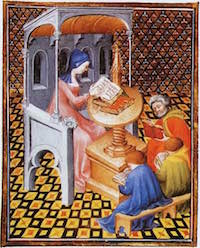
Yes, it's that time again! I'm blogging the sessions I attend at the annual medieval studies congress at Western Michigan University in Kalamazoo. (There will also be reports on book purchases.)
Session 49: When Medievalists Fictionalize the Middle Ages
- Organizer: Rebecca Barnhouse, Youngstown State Univ.
- Presider: Sharan Newman, Independent Scholar
The Mean Streets of Medieval York: The Murder Mystery as Cultural Lens
Candace Robb, Independent Scholar
The pros and cons of writing about a real place and real people, but adding in fictitious events (like murders). Her focus is on the city of York itself (which she fell in love with). Not finding enough fiction set in that place, she decided to remedy it. Some tweaking of specific historic details to get the setting she wanted. The rich cultural context of the 14th century provides a lot of potential for interactions.
The pitfall of fictional invention is that lots of people know details about medieval York and will know when you make something up. The pitfall of using the real characters is they don’t always do what you need them to do. But conversely, real historic events and relationships sometimes provide a perfect context or inspiration for the genre plot you need.
Another pitfall is the historically accurate repetition of the same personal names over and over and over again. What do you do when there are two very important John Montagues in your historic setting? (Handout is passed out with detailed family tree of both historic and fictional persons in the series.)
What happens when later information turns up a historic mistake in an earlier volume in a series? Do you revise? Do you shrug and move on? Do you ret-con? (Star Trek’s handling of Klingons is offered as an example.) What happens when someone else uses your fictionalizations as a “historic” source for their own fictions?
The Fantasy Space of Medieval History: The Case of Chaucer, Gower, and Bruce Holsinger’s A Burnable Book
Debra E. Best, California State Univ.–Dominguez Hills
What is the perfect mix of history in fiction? When do facts slow down the action? ABB is reviewed as an excellent portrait of medieval England, but how well does it create a fantasy space within that history? And how does this process interact with the story-internal process of the role of fiction in creating historic reality. It is a murder mystery involving a (fictitious) prophetic book, wrapped in an embroidery, combined with the words of a dying woman and several other clues.
The story centers around objects and events that are not merely fictitious with respect to the modern novel, but some turn out to be fictious creations within the context of the story itself.
Holsinger’s background as a historian drove some of his creative process, writing the book’s core prophecy originally in Middle English, based on historic prophetic examplars, and then modernizing it for the text, but similarly his characters turn out to have created the (story-internal fictitious) prophecy by modeling it on earlier (historic) writers. Thus the process of creating a fantasy of the past is echoed both within the story and in the existence of the story.
The author’s background also shows in a comfort with both the vocabulary of Middle English and the choice of non-historic vocabulary that fits the esthetic. Also: many Easter egg allusions to medieval English literature.
Worldbuilding in Rebecca Barnhouse’s The Coming of the Dragon and Peaceweaver
Patricia H. Ward, College of Charleston
The conflict between presenting a strictly “accurate” historic story, and bringing in modern sensibilites about morality, diversity, etc. in an anachronistic fashion. How do you remain faithful in depicting a historic society (even a fictionalized one, as in Beowulf here)? How do you present the facts while avoiding didacticism?
Potentially problematic topics include valorization of literacy, gender relations, slavery and class differences in general, depiction of Christianity/non-Christian practices. (The paper primarily consists of discussion and summaries of how these types of topics are handled in the books.)
Armored Knights and Winged Faeries: The English Middle Ages and the Medieval Fantasy Novel
Emily Lavin Leverett, Methodist Univ.
Addressing questions about the nature and purpose of accuracy in medieval fantasy. Is it an inherently conservative genre, or can it be used to subvert and expand the historic narrative? This paper particularly addresses the handling of gender in urban (medieval-inspired) fantasy. This work follows the trope of the fantasy-medieval heroine who rises about gender restrictions and disenfranchisement. But even the focus on “rising above” helps establish the default assumption of patriarchy and oppression.
The protagonist here begins as a 21st century American urban woman (possibly two women?) on the verge of entering an academic career. I.e., struggling within an opressive patriarchal society. [I’m not getting a clear notion of what happens in the story, but it sounds like it’s a portal-type fantasy where the modern character(s) enter an alternate medieval-inspired story but where the fantasy story is designed to eliminate some of problematic defaults in order to create an adventure story that doesn’t revolve around tired struggles. Or possibly even the modern setting is an alternate version of our world? Unclear.]
Major category:
ConventionsThursday, May 11, 2017 - 07:00
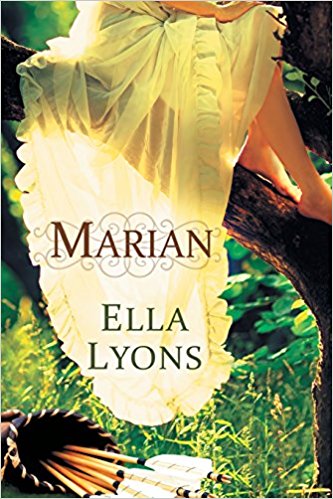
Reviewer Shira Glassman at the Lesbrary says: "One way to describe Marian by Ella Lyons is that it’s a kiddie version of Heather Rose Jones’s Daughter of Mystery — both are costume dramas featuring a traditionally feminine lesbian with a nurturing personality and a lesbian swordfighter living in a world where it’s not customary for women to participate in combat, both feature father figures who a main character is both attached to and in opposition to, and both feature court intrigue — just to name a few similarities. So if you like the Alpennia books, rejoice because now there’s a young adult novel with a similar flavor."
When Marian Banner moves to the glittering city of Nottingham with her father, Sir Erik the Fortunate, her entire life changes. She is no longer allowed to run about the countryside in trousers and braids, climbing fences and shooting turkeys, but is thrust into a life of dresses and jewels and dancing lessons, none of which Marian is particularly pleased about. Her dark mood changes when she meets a tiny whip of a girl called Robin Hood. Robin is fierce and brave, and wants more than anything to become a knight, regardless of her gender. Together they explore the city, becoming fast friends along the way.
As time passes, their friendship into something bigger and scarier and far more wonderful. But then Marian’s father is killed in service to the king and she catches the king’s eye.
Can Robin save her one more? Or will Marian discover how to save herself?
So maybe just for today I should change it up and suggest that if you like Ella Lyons' Marian, then you should also check out Daughter of Mystery!
Major category:
PromotionPages
