Blog
Monday, July 18, 2022 - 07:54

This chapter is the article that forms the philosophical heart of the book, with subsequent chapters elaborating on the motif in specific contexts. I've interspersed some commentary within the summary, and will include more general retrospective commentary in the last post for this publication.
Major category:
LHMP View comments (0)
Full citation:
Castle, Terry. 1993. The Apparitional Lesbian. Columbia University Press, New York. iSBN 0-231-07653-3
Chapter 3 – The Apparitional Lesbian
This chapter opens with the example of Daniel Defoe’s ghost story “The Apparition of Mrs. Veal,” viewed as a lesbian love story but one in which one party is dead – a literal ghost – thus making the relationship impossible and unreal. The second example – Dennis Diderot’s La Religieuse – involves eroticized persecution of a young woman in a convent. The erotic element is introduced in the midst of physical hazing by the authorities accusing the young woman of “unnatural desires” – something she does not understand until transferred to a different convent where her superior engages in erotic activity with her, becoming obsessed with her. The superior is described in increasingly ghost-like terms as the story progresses, moving in shadows and becoming increasingly mentally deranged, until she dies.
Castle sees a parallel of this process across the scope of lesbian literature. The lesbian figure is “de-realized”, made into a shadowy figure either symbolically or literally. Lesbian passions are introduced only to be obscured and disembodied. The specter of genuine, real-life lesbian love between two real women is neutralized and removed from the stage, either by madness, death, or a heterosexual reclamation. In Gautier’s Mademoiselle de Maupin, the “ghost” is the masculine identity of the cross-dressing title character – an identity that is made unstable by her female lover’s desire to consummate their love.
Various poems of the French decadent movement are used to demonstrate motives of insubstantiality and the lesbian as doomed and wandering spirit. This motif of ghostly symbolism intruding into lesbian relationships is traced through a number of early 20th century novels.
[Note: it occurs to me to speculate on how much of Castle’s identification of “ghost” themes in lesbian literature is driven by her earlier specialty in ghost motifs in literature in general.]
Turning the “ghost” motif around, Castle notes that an important feature of ghosts is that they do exist, perhaps insubstantially, but they are visible, they have presence. And they can be difficult to banish.
Sometimes the motif of the ghost reflects the lesbian character’s perception that she has no substantial reality in her lover’s life - no ability to influence the outcome of their lives. This appears in Hall’s The Well of Loneliness.
In lesbian “pulp” fiction, the repeating motif of “shadows”, “twilight”, “darkness” marks not only the secretive closeted society the characters moved in, but also carries the negative connotations of secrecy and darkness. A life that exists only in shadows can be nullified by the application of light.
But after the brief excursion into the pulps, Castle considers it necessary to return to “more ambitious and self-conscious literary works” and moves on to the later 20th century.
Having completed a literary tour, Castle returns to the “why” of lesbian ghosting. Patriarchal authority relies on the denial and suppression of love between women. Beginning in the 18th century, cultural upheavals placed traditional social structures under assault, which encouraged anxiety about female independence and the potential for women to be free of men for social, legal, economic, and emotional needs. But the denial of lesbian reality that this generated only served to reinforce the concept of lesbianism in social awareness. (Castle cites Freud on the power of repression to reinforce a concept.)
Event / person:
Monday, July 18, 2022 - 07:49
Chapter 2 is a personal reminiscence that has no relevant content for the Project. I was tempted to combine it with Chapter 3, like I sometimes do for chapters with minimal commentary, but since it's the only such chapter in this book, I flipped a coin and gave it its own entry.
Major category:
LHMPFull citation:
Castle, Terry. 1993. The Apparitional Lesbian. Columbia University Press, New York. iSBN 0-231-07653-3
Chapter 2 – First Ed
This chapter is a reminiscent of when Castle, as a child, encountered and crushed on a butch woman, and how she later recognized the experience as part of her recognition of her sexuality.
Saturday, July 16, 2022 - 07:00
Lesbian Historic Motif Podcast - Episode 234 – Our F/Favorite Tropes Part 1: Only One Bed - transcript
(Originally aired 2022/07/16 - listen here)
“…and there was only one bed!”
Historic romance is full of beloved tropes—scenarios that evoke a certain dynamic or conflict or anxiety that gets us right in the feels. Some readers have specific favorites, other readers enjoy the whole box of chocolates. But have you ever stopped to think about how those tropes might play out differently in a historic context when your romantic couple involves two women?
I’ve been wanting to do a series of shows that ask that question. The podcast won’t be all-tropes-all-the-time for the duration, but expect that maybe half the shows will focus on this topic for the foreseeable future. Originally, I wanted to bring guests on to talk about their favorite tropes and how they apply to sapphic historical romance, but honestly, I’m really really bad about the process of hunting up guests for the show. So I decided I’d just charge ahead. If there’s some trope you’d love to dissect and explore in this context, I’d love for you to reach out to me, and there are a couple topics that people have expressed interest in that I may bring in as guests.
What Is a Trope?
But first off, what is a trope, anyway? The word comes from the Greek “tropos” meaning “a turning, a change”. The literary sense comes by way of classical rhetoric, where tropes referred to types of figurative speech used to explore and communicate ideas – things like metaphor and analogy. But in literary analysis, it has come to refer to a recurring literary device or motif—a conventional story element that is used regularly enough that it carries a whole context of meaning, and connects the story to other works that employ the same trope. The trope could be a character type, like the knight in shining armor; it could be a situation, like the moment when the detective reveals the murderer; it could be a mini-script, like “experienced mentor trains novice to be an expert.”
In the context of romance novels—and we’re looking more specifically at historic romance novels here—popular tropes can be any of these types. Especially popular as “named” tropes are ones that describe attributes of the romantic couple, the context in which they meet, the barriers keeping them apart, or the mechanism by which they connect romantically.
To brainstorm for this series, I went online and searched out popular historic romance tropes and came up with a list of about 50 topics to draw from, though I’ll be focusing primarily on tropes where the gender of the romantic couple changes the social understanding of how the trope works. In some cases, the trope dynamic is shifted due to the same-sex nature of the couple, and we might find parallels in how male couples and female couples both differ from mixed-gender couples. For example, all the tropes relating to marriage—marriage of convenience, fake marriage, political marriage—have similar considerations when considering pre-21st century same-sex romances. But in other cases, gender itself is a significant factor in how the trope applies differently. For example, if you’re writing a trope involving titled aristocracy, you need to pay attention to gendered rules about who can and can’t inherit titles in the specific setting you’re using. While my historic research focuses on female couples, I’ll try to include discussion of how the tropes play out for male same-sex couples if it seems relevant.
As usual, my examples and discussion are going to lean heavily on western culture. But if you’re brainstorming a historic romance in some other cultural context, there’s even more need to challenge the assumptions and conclusions embedded in popular tropes.
Only One Bed
I thought it would be fun to start this series with a deep dive into the trope “only one bed.” Let’s take a look at the social context and assumptions that make this situation noteworthy in male-female romances.
A major context is the dual role in western culture of the bed as a location for both sleep and sex. This is a fairly universal connection across time. Accompanying this is the cultural assumption that when a man and woman are in the same bed, the potential for sexual activity is so overwhelming that one can assume it will happen or has happened. One can trace this assumption in accusations of illicit sex that rest entirely on sharing a bed, and in moral treatises that frown on unmarried men and women sharing a bed even when poverty or crowded conditions result in a distinct lack of privacy. (Cultural concepts of privacy around sex are also worth exploring.)
The expectation that mixed-gender bed-sharing equals sex is a special case of the long-standing western cultural assumptions that male-female interactions always inherently have sexual potential, and that when a man and woman are alone without the presence of a reliable chaperone, one is allowed to assume that sex has occurred. These attitudes contribute to the periodic emphasis on separate social spheres for women and men, or the belief that platonic friendship is impossible between women and men. These assumptions have nuances and variations depending on the exact culture, era, and the social class of the people involved, but they underlie a long tradition of cultural rules and expectations.
The set-up for the One Bed trope, therefore, is that a man and woman who do not have an existing licit sexual relationship find themselves in circumstances where they both need to sleep and there is only one bed available. Because this is a romance novel, there may well be a certain amount of pre-existing Unresolved Sexual Tension. The sexual potential of the situation will create anxiety and hyper-awareness regardless of whether they find a means to avoid sleeping in the same bed, or whether they agree to share the bed but intend to refrain from sexual contact. Sometimes proximity overcomes these precautions, resulting in a shifting of gears in the relationship. Sometimes it leads to an acknowledgment of mutual desire while still postponing consummation. In other cases, the rest of society assumes that sex has occurred (even if it hasn’t) and this forces certain resulting actions by the couple. In all cases, it’s a turning point in the plot.
Two Women, One Bed
Now let’s re-examine the historic cultural assumptions when it’s two women in bed together. Is there a cultural assumption that all female-female interactions have sexual potential? That would be a “no.” Is there a cultural assumption that putting the two women in the same bed changes this answer to “yes”? Generally, no, there isn’t. Although we’ll get into some of the ambiguities and edge cases in a little bit. So if two women who do not have an existing sexual relationship find themselves in need of sleep and with only one bed available, are they going to be anxious about the sexual possibilities, or about the assumptions people will make about them the following day? Highly unlikely. You could write this scenario and have them go their separate ways the next morning without any meaningful change in their relationship or circumstances.
OK, so no “only one bed” trope for female couples, case closed, moving on…
Uh, not so fast!
Let’s back up a bit and talk about three topics. Firstly, what was the range of cultural attitudes toward women sharing a bed? What were the contexts in which it might routinely happen? What meanings were attached to it?
Secondly, were there contexts where people did make sexual assumptions if two women shared a bed—or at least, did they allow for sexual possibilities?
Thirdly, how can bed-sharing be re-fashioned into a different type of trope when female couples are involved? One with a different framework, different anxieties, and different opportunities?
Bed-Sharing
Even in the present day, cultural attitudes toward bed-sharing can vary widely, and they varied even more widely in the past. Ideas about privacy, whether in the bed itself or in the room where the bed is located, have been similarly variable. Expectations depended not only on the time and place, but very much on class or income, and on individual circumstances. This isn’t going to be an exhaustive survey across the scope of history, but rather anecdotal examples from various sources.
The question of whether you have a specific room designated as a sleeping room has always depended mostly on class and wealth. A poor family might live in a single room where all activities took place, including cooking, working, sleeping, and everything else. But with sufficient income and space, there was usually a priority on having a separate room designated as a bedroom. In households that included servants or other dependents, those of lower status might sleep in dormitory-like arrangements, sometimes in a room that was used for other purposes during the day. As early as classical Rome up through the 17th century or so, someone’s personal servants (of the same gender) might sleep in their bedroom or in an adjoining chamber, to be available at a moment’s notice—or, in the case of female servants, to provide some level of security against unauthorized or unwanted sexual encounters.
A trusted servant might even sleep in the same bed as her mistress, especially if she fell on the fuzzy line between servant and waiting woman or companion. In 16th and 17th century English records, we find it would be expected to share your bed with someone—a sibling, an unrelated dependent, a close friend, a visiting guest, or if you were traveling, perhaps even a random stranger. And this was probably the case in the medieval era as well.
But getting back to logistics, by the 18th century, it was becoming more common for servants to sleep in an entirely different part of the house. Another feature that changed ideas of privacy relating to the bedroom was a shift to the use of hallways to access rooms individually, rather than having each room simply open off the neighboring rooms. This feature began being included in house design in the 18th century but many buildings retained the older layout.
There’s another entire discussion to be had about what level of personal privacy people expected when engaging in sex, whether socially licensed or not. When we’re considering historic romance novels, we suspect that reader expectations will also be important!
The bedroom (and by extension the bed) both was and was not a “private” space. Servants and other inhabitants of the house might pass through, if that were the only means to get somewhere. But at the same time, the bedroom, when contrasted with the hall or the parlor (depending on era) was a place where one might expect solitude, or the company only of invited friends. It was a place where one expected to have some control over access, and might include a side-chamber referred to as a “closet” (not in the clothes-storage sense) that could be locked. The French salons of the 17th century and later were typically held in the hostess’s bed chamber, marking the close and intimate nature of the gathering, but also the public aspect of the space.
There was another aspect to privacy in bed, though privacy itself wasn’t the driving motivation. In the drafty environment of pre-modern houses, those lovely curtained four-poster beds served a very useful purpose of providing some insulation while sleeping. The curtains, of course, could also provide a certain amount of privacy from people moving through the room or the inhabitants of other beds in the same room. (Medieval records often list multiple beds located in the same chamber and it was common in many eras to have a movable truckle-bed for a servant as well as the main bed.) Another bed design that could afford privacy as well as insulation was the box bed – in essence a very large cupboard built into the side of the room with a bed inside. These can be found throughout Europe from the later medieval period to as late as the 19th century, and featured in some early North American house styles as well. The box bed was largely associated with rural houses, rather than homes of the well-to-do. And curtained beds were also correlated with wealth and status, both in their presence and in the richness of their appearance.
So, enough about the physical infrastructure, let’s get back to the question of who you might be sharing your bed with and why.
You might share your bed because you were poor and there were too many people packed into too small a space. This, alas, does not allow for the sort of privacy one might hope for in a romance novel. Groups of siblings, students, servants, or residents in charitable institutions might be expected to share beds as a general practice in a dormitory-like environment. Medieval inns typically lumped unrelated travelers together in the same room, and even the same bed, and this continued on in the early modern period for those who couldn’t afford to claim a private room when traveling.
But apart from necessity, sharing a bed was a sign of friendship, intimacy, and trust. In the early modern period, when you referred to someone as your “bed-fellow” it wasn’t a sly way of saying “sexual partner” but a marker of that close degree of trust and friendship. Bed was a place for private conversation and sharing secrets, for deepening or renewing personal bonds. The simple act of sharing a bed was a sign of affection, and it was a place where physical displays of affection were welcomed. This was, of course, true of the marriage bed as well. But outside of that situation, none of this is necessarily meant as a euphemism for erotic activity. But we’ll get back to that. Let’s look at some anecdotal examples.
In Spenser’s 16th century heroic poem The Faerie Queen, the woman warrior Britomart and the maiden Amoret, whom she has just rescued, share a bed while traveling where they share the stories of their past adventures and commiserate with each other.
Among the English aristocracy of a similar era, the social politics of whom among one’s ladies in waiting and relations one slept beside was deeply entangled in the creation and strengthening of political alliances. In 1603 Lady Anne Clifford writes in regard to her cousin Frances Bourchier, “[she] got the key of my chamber and lay with me which was the first time I loved her so very well.” A different letter describing the same event mentions a third party, “I lay all night with my cousin Frances Bourchier and Mrs. Mary Cary, which was the first beginning of the greatness between us.” Clifford wrote two years later to her mother about not sleeping with Lady Arabella Stuart “which she very much desires” and which her mother had urged. These are not secret diary entries detailing sexual liaisons, but letters to relatives and friends discussing the social politics of the household openly.
Among the “lady’s companions” of 18th century England, we find some references to sharing a bed, such as Elizabeth Steele, companion of professional courtesan Sophia Baddeley. (The two may also have been lovers, but the point is that the two relationships were not automatically assumed to coincide.) But the question of whether a companion might also be a bed-fellow probably depended on the specific relationship between the two women and the financial logistics.
In 18th and 19th century rural America, women’s same-sex friendships might be disrupted by marriage or other family commitments, with the women reconnecting through extended visits when it was typically expected for them to share a bed. There they would discuss their experiences while apart, share concerns and hopes, and express their affection with kisses and embraces. One woman, writing to her friend in the 1830s about an upcoming visit, promises, “I would turn your good husband out of bed and snuggle into you and we would have a long talk like old times in Pine St.” There was little self-consciousness and no expectation of guilt or secrecy. There was no social assumption that these arrangements involved what the participants would consider sexual activity. Which isn’t to say that it didn’t happen, only that it wasn’t part of the assumed script.
So we have extensive evidence throughout western history that there was no automatic assumption of sexual activity if two women spent the night in the same bed. This situation held well into the beginning of the 20th century until Freudian suspicions took hold.
We might pause for a moment to compare the situation for men. Many of the same social dynamics held for men sharing a bed the same as women. It could be ordinary necessity, or a sign of close friendship, depending on the specific social context. But there was generally a higher level of awareness of the potential for sexual encounters between men who shared a bed. It was more often a subject of ribald humor, or a potential accusation against one’s enemies. And with the shift in gendered stereotypes of erotic desire around the 19th century, men came in for greater scrutiny when expressing physical affection, not only because the social stigma against male homosexuality was greater than that against female homosexuality, but because the prevailing definitions of sexual activity were focused around the presence of a penis in the act. So while the social assumptions and anxieties about two men in bed were different from those for a mixed-gender couple, there could also be distinct differences from attitudes towards women sharing a bed.
Suspicious Circumstances
But does that mean that people assumed nothing ever happened between two women in that bed? Or that nobody ever worried that it might? Well, no, not exactly.
Religious institutions seem to have been the most consistently anxious about the consequences of same-sex bed-sharing. Concerns about same-sex relations in convents date back at least to the time of Saint Augustine in the 5th century. Those concerns covered even trivial actions like hand-holding and terms of endearment, showing that some of the anxiety was for the formation of “particular friendships”, not specifically the possibility of sex. Nuns were not supposed to have emotional attachments to anyone but God—even though the records show that this expectation was regularly violated. But co-sleeping was a special concern in convents, and most religious regulations specified that two women should not have private sleeping arrangements together. This might involve single-person cells or communal dormitories.
In the secular world, around the 16th century, we begin to see anecdotes that connect bed-sharing by women with sexual relationships. Brantôme, in his salacious descriptions of lesbian sex at the late 16th century French court describes how “two very fair and honourable damsels of a noble house, cousins of one another, which having been used to lie together in one bed for the space of three years” ended up as a result becoming sexual partners.
During the sodomy trial of Inés de Santa Cruz and Catalina Ledesma in early 17th century Spain, we learn that the two women had been quite open about a long-term co-habitation—“eating at the same table and sleeping in the same bed.” And that might not have triggered anyone’s suspicions if it hadn’t been for a maid overhearing them in the bedroom making suspicious noises and sharing love talk and sexual commentary.
English dramas of the 17th century were rife with sexual humor and innuendo, and we find repeated sly references to the sexual possibilities of women sharing a bed in works like Jasper Mayne’s The Amorous Warre and Henry Burnell’s Landgartha.
The early 19th century slander lawsuit of Marianne Woods and Jane Pirie provides a bit of convoluted backwards evidence for a recognition of the erotic possibilities of bed-sharing. Woods and Pirie, who ran a girls boarding school, had been accused of having a sexual relationship by one of the students, with one part of the accusation resting on the fact that they regularly shared a bed. The judges in the case were faced with a dilemma. The woman Woods and Pirie accused of slander was a powerful member of the aristocracy and it would be awkward to bring in a guilty verdict. But if the judgment concluded that the accusations about sexual misconduct were true, it would rattle the official position that proper British women Didn’t Do That Sort of Thing. In order to maintain this position, it was necessary to argue that the close, physically affectionate relationship between the two teachers—a relationship that included sharing a bed, and which they did not deny—must be entirely innocent of any sexual suggestion. If, they protested, young women who were intimate friends and shared a bed could be considered sexually suspect on that basis, then what woman would ever be innocent?
A similar struggle to avoid the public legal acknowledgement that two women sharing a bed might be “up to something” occurred in the Victorian-era Codrington divorce trial, when Admiral Codrington alleged that the conflict in his marriage (which eventually led to his wife Helen’s adultery) had started with Helen’s close friendship with feminist activist Emily Faithful, including a preference for sharing a bed with Emily rather than her husband. The evidence in the trial gave this something of a wink-wink spin, but the suspicion of sexual activity between the two women was never stated explicitly in the trial evidence.
So, while pre-20th century western culture did not make a knee-jerk assumption that two women in bed together automatically meant hanky-panky was going on, there were still rumblings of unease on occasion. Sex might not be probable, it might be officially excluded as a possibility, but it was imaginable.
And this sets aside the question of what these cultures defined as “sexual activity,” given that cuddling, kissing, and affectionate language were within the range of unexceptionable activity. We’ll come back to this point in a bit.
While society in general might prefer to disbelieve, there are any number of solid examples of female friends sharing a bed openly, without question by other members of the household, where we also know that they were engaging in a sexual relationship. Ann Lister’s diaries from the early 19th century are full of visits to and from other women where it was expected that the visitor would share their hostess’s bed openly, and Lister records the sexual activity that followed.
19th century American actress Charlotte Cushman’s first serious love was Rosalie Sully, the daughter of a family friend. Cushman’s later diary entries indicate an intense emotional and physical relationship, and based on Cushman’s later life we can conclude it was sexual. Cushman’s diary notes the occasions on which they “slept together” with delight, though this was probably not meant as a euphemism for sex specifically. Through it all, Rosalie’s family was entirely supportive of her relationship with Cushman.
The family of a Russian woman, described in a late 19th century case study, similarly supported a close female friendship that included sharing a bed during visits, being unaware that the two were continuing a sexual relationship they had begun at boarding school together.
All of this brings us to the point of re-imagining the “only one bed” trope in the context of lesbian historical romance.
Re-making the Trope
What are the parts of the trope that don’t apply? Most importantly, there will be no social taboo on two women sharing a bed that would make them hesitant or anxious based on sexual expectations. There may be other reasons why your female characters might be hesitant or apologetic about needing to share a bed, depending on the specific cultural context, but we don’t assume it will be a sexual anxiety. Maybe one woman worries that she’ll be seen as a poor hostess if she can’t provide her guest with her own bedroom. Maybe one or both feel that they aren’t close enough friends yet to make sharing a bed a natural event. Perhaps they’re of sufficiently different social classes that they wouldn’t be sharing a bed as friends and we aren’t in an era when one slept in the same bed with a servant. Maybe the sleeping arrangements of multiple people have been rearranged and there’s the potential for social jealousy over the choice of bed-fellow.
Of course, if one or both of the characters is already aware of feeling erotic desire for the other, they might consider the prospect overly tempting and be nervous about that, but it’s a different dynamic than it would be with a mixed-gender pair.
Two women also don’t need to worry about their reputations being ruined if people know they slept in the same bed. There will be no need to keep it a secret, and no reason to reorganize their lives as a result of it. No public shame, no private guilt, no shotgun marriage. In short, the two primary reasons for a one-bed trope that apply to mixed-gender couples—negotiation around a taboo, and being forced into marriage for the sake of honor—do not apply.
Of course, if your characters need to share a bed and one thing leads to another and they do initiate an erotic relationship as a result, that can serve as the same sort of turning point in the romance that it would for a mixed-gender couple, but the stakes are lower and the potential for social trauma is less.
Now let’s look at the positive side.
Historic attitudes toward bed-sharing by women mean that Only One Bed is an excellent context for getting your characters to take the next step in their physical relationship. There they are, in close proximity, with a social expectation that bed is a place for sharing secrets, deepening personal connections, and drawing closer. There is no taboo—and perhaps even a positive expectation—regarding physical contact. A touch, a goodnight kiss, a casual accidental juxtaposition of bodies, these are not fraught with anxiety or expectation. Almost certainly, one or both of the women has shared beds previously with women that they were close to but not romantically interested in, and there will be a range of behavior that will seem natural to them and not weighted with meaning. Until the moment when it is.
So if you want to create a context where your characters can find themselves making out without having planned to, Only One Bed offers a wealth of possibilities. And if you want to toss in a bit of angst, they can worry about whether the other person is on the same page about what’s happening, whether they classify the activities they’re engaging in the same way, how they both understand the experience to change the nature of their relationship—or not.
What if we do want to add a bit of sexual anxiety into the mix as they discuss sleeping arrangements? Does one of your characters have a reputation (warranted or not) as a lover of women? How does the other character feel about that? What does she expect might happen? Is she worried what other people might think?
Is one of the characters sexually experienced with women and finding herself overthinking the whole situation? What happens if she finds herself the target of displays of affection and isn’t sure how her bed-fellow intends them? How do you begin that discussion? What are the concepts and language they have available to talk about it?
Let’s suppose something does happen. How far can it go before your characters need to recognize that this is more than the sort of affection that any two women might exchange in bed?
When the night is over, have they changed how they feel about each other? Typical social expectations would be that women who share a bed will become closer as a result. Do their feelings match what the people around them expect them to feel? If other people don’t see anything odd or unusual about them having shared a bed, do they take the same attitude or are they unexpectedly bashful or nervous about it?
The answers to these questions will depend on the details of the social context, as well as the personal histories and personalities of your characters. But the key take-away is that the One Bed trope should have significantly different dynamics in your sapphic romance than it would for a mixed-gender couple. And you can use those dynamics to your advantage.
Show Notes
In this episode we talk about:
- Introducing the trope series
- What is a trope?
- The logical structure of the Only One Bed trope
- The history of attitudes toward female bed-sharing
- Bed-sharing and sex between women
- Remaking the trope for f/f romances
- This topic is discussed in one or more entries of the Lesbian Historic Motif Project here: bed-sharing
Links to the Lesbian Historic Motif Project Online
- Website: http://alpennia.com/lhmp
- Blog: http://alpennia.com/blog
- RSS: http://alpennia.com/blog/feed/
- Twitter: @LesbianMotif
- Discord: Contact Heather for an invitation to the Alpennia/LHMP Discord server
- The Lesbian Historic Motif Project Patreon
Links to Heather Online
- Website: http://alpennia.com
- Email: Heather Rose Jones
- Twitter: @heatherosejones
- Facebook: Heather Rose Jones (author page)
Major category:
LHMPMonday, July 11, 2022 - 08:11
There's a phenomenon where the majority of books you read keep citing a specific earlier work, and you build it up in your mind to being something larger and more significant than it turns out to be. Of course, academic citations aren't necessarily a mark of significance; sometimes they're an acknowledgment of origins, of idea-lineages, of honoring those who first mapped out the territory. But it can still, sometimes, feel like a let-down when you finally get around to reading some highly-cited work and it doesn't live up to the image you've created in your head.
The core essence of Terry Castle's The Apparitional Lesbian is the idea that lesbian invisibility in popular culture is neither a reflection of the absense of lesbians nor an accidental coincidence, but rather is a systematic (if uncoordinated) process of framing lesbianism and lesbian characters as unreal, illusory, or not of this world.
While I follow the general argument presented here, I do have one bone to pick with what I feel is an unexamined bias. Castle's work started off as a study of ghost stories in post-Enlightenment literature. As she started seeing more and more lesbian characters and themes in those stories, she developed the idea of the "apparitional lesbian" -- the lesbian who moves through popular culture only as a ghostly motif. But this seems to be a "hammer problem" as in, "if the only tool you have is a hammer, every problem starts looking like a nail." If your focal field of study is ghost literature, and you keep seeing lesbians in that literature, does that mean that all lesbians in literature are ghostly? Or does it mean that you'd find lesbian characters and themes in other types of literature as well, if that were your field of study? And if you're looking for "ghostly lesbians" to explore a theory, how hard are you working to view those characters through a ghost-lens?
So, as I read this book, I kept asking myself, "Is this a genuine universal cultural theme, or is it an artifact of one academic's preoccupations?" I'd be interested in hearing the thoughts of others who have read the book.
Major category:
LHMPFull citation:
Castle, Terry. 1993. The Apparitional Lesbian. Columbia University Press, New York. iSBN 0-231-07653-3
Chapter 1 - A Polemical Introduction: or, the Ghost of Greta Garbo
[The following is duplicated from the associated blog. I'm trying to standardize the organization of associated content.]
There's a phenomenon where the majority of books you read keep citing a specific earlier work, and you build it up in your mind to being something larger and more significant than it turns out to be. Of course, academic citations aren't necessarily a mark of significance; sometimes they're an acknowledgment of origins, of idea-lineages, of honoring those who first mapped out the territory. But it can still, sometimes, feel like a let-down when you finally get around to reading some highly-cited work and it doesn't live up to the image you've created in your head.
The core essence of Terry Castle's The Apparitional Lesbian is the idea that lesbian invisibility in popular culture is neither a reflection of the absense of lesbians nor an accidental coincidence, but rather is a systematic (if uncoordinated) process of framing lesbianism and lesbian characters as unreal, illusory, or not of this world.
While I follow the general argument presented here, I do have one bone to pick with what I feel is an unexamined bias. Castle's work started off as a study of ghost stories in post-Enlightenment literature. As she started seeing more and more lesbian characters and themes in those stories, she developed the idea of the "apparitional lesbian" -- the lesbian who moves through popular culture only as a ghostly motif. But this seems to be a "hammer problem" as in, "if the only tool you have is a hammer, every problem starts looking like a nail." If your focal field of study is ghost literature, and you keep seeing lesbians in that literature, does that mean that all lesbians in literature are ghostly? Or does it mean that you'd find lesbian characters and themes in other types of literature as well, if that were your field of study? And if you're looking for "ghostly lesbians" to explore a theory, how hard are you working to view those characters through a ghost-lens?
So, as I read this book, I kept asking myself, "Is this a genuine universal cultural theme, or is it an artifact of one academic's preoccupations?" I'd be interested in hearing the thoughts of others who have read the book.
# # #
As an iconic example of the phenomenon Castle is studying, she contemplates the Greta Garbo film Queen Christina, and how Hollywood took a notoriously lesbian figure from history, portrayed her using a lesbian actress, and turned the story into a heterosexual love story. Lesbianism becomes an illusory “ghost” in cultural performances, even when the “fact “of lesbianism is undeniable. The lesbian is made difficult to see – absent even when central –a figure that’s easy to refuse to recognize in the moment, and easy to deny after the fact, as in all the obituaries of Garbo that avoided mentioning her love for women at all. The lesbian in popular culture is always somewhere else – never here and now, never central and familiar (in contrast to the figure of the male homosexual). It is this effect that Castle tackles and unmasks.
The book emerged out of Castle’s previous interest in the place of ghosts in post-Enlightenment culture, combined with a realization that lesbianism had been the “ghost” in her own work. The “disappearing” of lesbians reflects the threat that the idea of lesbianism is seen to pose to patriarchal society. This takes the form of denying or simply remaining silent with respect to lesbian aspects of historic figures (often in the name of protecting their reputations), silencing, censoring, or dismissing lesbian themed works, or simply ignoring the existence of lesbians - as happened in many legal systems – not because that existence was unimportant but because it was too dangerous to be given existence by recognition.
Castle reviews examples of lesbian literary figures framed as ghostly and supernatural evil. If ghostly, the lesbian can then be exorcised and disappeared from the “reality” of the literary work entirely. Real life lesbians similarly “ghost” themselves, disappearing into isolation and secrecy, or into marriages of convenience.
Castle lays out the outline of the book’s contents: two autobiographical essays about her own “emergence”, three historical and biographical, and three literary criticism. The organization is chronological in terms of writing, but this reflects the development of her thinking, from recognition to theorizing to exploration. The remainder of the introduction lays out who “the lesbian” at the center of her focus is not and is.
- She is not a recent invention – pushing back at Foucault and the sexologists, who argue for the recency of lesbianism and its isolation from history.
- She is not asexual – pushing back against the view not only that all love between women reflected a Victorian platonic friendship model, but also against the idea that Victorian romantic friends had no erotic desires. The belief in women’s inherent non-eroticism is what prompted some to allege that Anne Lister’s diary must have been a hoax (when first published in the 1980s) because it flew in the face of the comfortable myth of the asexual lesbian. In this, Castle scrutinizes the idea that lesbian relations are simply part of a continuum of female homosocial bonding, arguing for a clear distinction recognizing an embodied eroticism as definitional. [As usual, I push back on any framing that denies the possible existence of the “asexual lesbian” as a real and valid category.]
- The lesbian is not a gay man. Castle points out that in treating male and female homosexuality as a unified concept, the lesbian experience is “ghosted” under the more iconic figure of the gay man. Similarly, the shift to the umbrella term “queer” can silently make specifically lesbian experiences invisible. (Note: along with other marginalized queer identities.) As example, she notes how one of the prominent (in the 1980s) proponents of queer theory in academia focuses almost exclusively on male experiences even when presenting her work as general.
- She is not a nonsense. Here, Castle grapples with the tendency of deconstructionists to challenge the meaningfulness of concepts like “lesbians” in ways that erase the concept entirely on the basis that it cannot be clearly defined.
Castle attempts to define “the lesbian” in terms of presence, but the result is inherently a jumble of the particular, a listing of prominent cultural figures (mostly of the 20th century).
Monday, July 4, 2022 - 07:00
All in all, this was the least satisfying of the four chapters of this book that I summarized in detail, from the viewpoint of providing a survey of the field. While the other three chapters were written by scholars with extensive work in the topic they took up, Thomas (based on some cursory googling) seems to be more a specialist in Victorian English culture, with queer history being only one of a number of specialized topics she has written on within that field. This probably accounts for the relatively narrow focus of the chapter, which makes it far less useful as an introduction to lesbian literature in the 19th century than the overall program of the Cambridge Companion would seem to call for. It omits the substantial body of sentimental homoerotic poetry, the rise of "school stories" with strong homoerotic themes, and -- as I note in the body of the summary -- a large part of the decadent movement that engaged strongly with lesbian imagery. If you are looking for a guide to 19th century lesbian literature, I would advise going farther afield. (Terry Castle's anthology has good coverage for this era, along with other sources.)
Major category:
LHMPFull citation:
Thomas, Kate. 2015. “Lesbian Postmortem at the Fin de Siècle” in The Cambridge Companion to Lesbian Literature, edited by Jodie Medd. Cambridge University Press, Cambridge. ISBN 978-1-107-66343-5
Thomas, Kate. Lesbian Postmortem at the Fin de Siècle.
[The following is duplicated from the associated blog. I'm trying to standardize the organization of associated content.]
All in all, this was the least satisfying of the four chapters of this book that I summarized in detail, from the viewpoint of providing a survey of the field. While the other three chapters were written by scholars with extensive work in the topic they took up, Thomas (based on some cursory googling) seems to be more a specialist in Victorian English culture, with queer history being only one of a number of specialized topics she has written on within that field. This probably accounts for the relatively narrow focus of the chapter, which makes it far less useful as an introduction to lesbian literature in the 19th century than the overall program of the Cambridge Companion would seem to call for. It omits the substantial body of sentimental homoerotic poetry, the rise of "school stories" with strong homoerotic themes, and -- as I note in the body of the summary -- a large part of the decadent movement that engaged strongly with lesbian imagery. If you are looking for a guide to 19th century lesbian literature, I would advise going farther afield. (Terry Castle's anthology has good coverage for this era, along with other sources.)
# # #
This chapter begins with a tour through the complex inter-connectedness of lesbian writers in the late 19th century. As a community they were not only aware of each others’ works and themes, but promoted each other, wrote about and to each other, and often loved each other, whether requited or not.
The chapter's discussion focuses (perhaps oddly) on the gothic fascination with death that is so often associated with Victorian sensibility in general. There is a discussion of how lesbian identity in literature of the era is most often elusive "apparitional” to use the term Terry Castle applies – tying this analysis back to the fascination with death.
Overall, this chapter focuses on a narrow range of writers, and on a narrow range of subject matter, and on a thematic exploration of that filtered selection, rather than being a study guide to the full range of “lesbian literature” at the turn of the 20th century.
Since the previous chapter focused on the “long 18th century” and this one picks up only at the very end of the 19th, there is a gap in coverage that, for example, excludes the majority of the French decadent movement, the Parisian Sapphic revival, and any of the Victorian writers who were not fascinated by themes of death.
(Note: I have not added tags for specific literary works or authors as the article is more of a catalog than an analysis.)
Time period:
Saturday, July 2, 2022 - 07:00
Lesbian Historic Motif Podcast - Episode 233 - On the Shelf for July 2022 - Transcript
(Originally aired 2022/07/02 - listen here)
Welcome to On the Shelf for July 2022.
How was your Pride Month? Did you do anything special to commemorate it? You know: riot in the streets? Demand the right to be your own special brand of queer? Read a banned book…or maybe write one that will risk banning? Events like Pride hold a fascinating place in the long stretch of history. It’s so easy to lose track of the origins and slide into a simple feel-good celebration. But when we look around at the forces marshalled to push us back into those closets, it can be important to remember the place of rage. We are still making history today and must continue to make it if we want to get to a place where Pride can be mere celebration.
But making history isn’t the only creative act. I’m always on the lookout for people who are creating content that might be of interest to my audience, and when I saw a post on twitter for a new podcast titled “Swords & Sapphics” I figured it was worth a shout-out. As it turns out, the content isn’t quite as historically oriented as the “swords” in the title might imply but very solidly sapphic. It’s a conversational show looking at issues of representation, queer media, body image and related topics, especially as depicted in TV, film, and books. I have a link to their website in the show notes, so check them out if it sounds interesting.
Publications on the Blog
In June, the Lesbian Historic Motif Project blog looked at a fascinating academic study of lesbian historic fiction: Linda Garber’s Novel Approaches to Lesbian History. Then we tackled The Cambridge Companion to Lesbian Literature, which finished up in the beginning of July. Next up on the blog is a book that gets cited regularly by other authors: Terry Castle’s The Apparitional Lesbian: Female Homosexuality and Modern Culture. That should take care of all of July, though I haven’t yet decided how many posts I’m going to split it up into. I’m having some interesting thoughts about Castle’s central thesis about the connections between lesbian representation and ghosts, so you’ll probably hear more about that in my commentary in the blog. After that, well, it feels like there’s been a lot of literary analysis and I’ll be looking in my to-do list for something a bit more based in everyday life.
Book Shopping!
Several books that I ordered a while ago came in this month. One isn’t remotely relevant to the Project but relates to my interest in the history of magic: Medieval Marvels and Fictions in the Latin West and Islamic World by Michelle Karnes. It provides a cross-cultural look at stories of magical objects and events.
I picked up George E. Haggerty’s Unnatural Affections: Women and Fiction in the Later 18th Century from a citation in my recent reading expecting it to be a bit more focused on homoerotic topics than it appears to be. So it may go a bit far down on the to-do list.
The last item touches on a subject I’ve been wanting more academic interest in, though this one is fairly limited in time-frame. Anne E. Linton tackles the topic of intersexuality in: Unmaking Sex: The Gender Outlaws of Nineteenth-Century France. There are many different historic intersections between lesbian possibilities and intersex possibilities but I’ve found it rare to have the intersex side addressed directly. This is a topic I should tackle in a future podcast to discuss the overlap in topic in more detail, and explain why it can be difficult to make clear distinctions when discussing specific individuals.
Recent Lesbian Historical Fiction
This month’s new and recent releases aren’t quite as numerous as last month’s list – though we could always dream of last month’s numbers becoming the norm! I found one May release that had escaped my notice previously.
Penny's Forest by Tatiana Dee from TDY Books braids together a number of cross-time stories, which the author promises us will all come together in the end.
Viola Windermere's plans for a relaxing holiday at her aunt Penny's home in England fall apart when she accidentally travels to 1673 while exploring Penny's wooded property. There she meets and falls in love with a Romani woman named Hazel, who lives in the forest with her young daughter and a mysterious woman called Old Bridget, believed by some to be a witch. Penny Windermere encounters a small occult group living in her house after she transports back in time to 1934. She manages to return to her own time, but the thought of Marion draws her back. Martha Jenkins travels back to 1611 and, against her better judgement, returns again and again with drastic consequences. Jane Ainsworth is the single mother of a small boy in 1593. His sudden disappearance years later is the thread that weaves these stories together.
There’s one more June book: Becoming the Pannell Witch: A Prequel (The Pannell Witch #1) by Melissa Manners from Melissa Manners Publishing. As you can guess from the title, there’s a second part of the story, which will be coming out in October. It appears that these characters are based rather loosely on events surrounding an actual 16th century witch trial in England. The transcript has a link to the (very brief) Wikipedia page about the historic <a href="https://www.alpennia.com/%3Ca%20href%3D"https://en.wikipedia.org/wiki/Mary_Pannal" rel="nofollow">https://en.wikipedia.org/wiki/Mary_Pannal ">Mary Pannal</a>.
Yorkshire, 1556. From the moment Mary meets Elizabeth, she’s smitten. For the first time, her life has a purpose, and when she delves into the world of herbal medicine, she is amazed to see that she can even save lives. But Mary is accused of witchcraft and her world falls apart. Can her relationship with Elizabeth survive?
I found four July releases. First up is The Only Game in Town by Geonn Cannon from Supposed Crimes. It looks like this can be summed up as “What if ‘A League of Their Own’ but more overtly queer?”
When the men are called to fight, women are called to play. 1916. Marcy Neal is a shortstop with a barnstorming baseball team called the Lady Yankees when the US joins the Great War. Every able-bodied man is expected to serve, athletes included. A canceled season would be a financial disaster for team owners and morally devastating for the American public, so a plan is devised. The season will go on as planned... with women players. Marcy jumps at the opportunity to play professionally. With only a few weeks before the first pitch, she gathers the best players she knows. Rosalind O'Brien, the fastest woman in Illinois. Iona "Moxie" Moccia, a catcher who knows the game better than anyone on a Cracker Jack card. And Caroline Rainy, the best pitcher to ever take the mound. Rainy is also Marcy's lifelong friend, first love, and current heartbreak, but she's willing to put her feelings aside for the greater good. The war has given them the chance of a lifetime to prove women can play the game as well as any man, and Marcy has no intention of stopping before the World's Series.
The author, Jill Dearman describes Jazzed from Vine Leaves Press as A gender-swapped take on the infamous “Leopold and Loeb” case: part historical fiction, part true crime. Juxtaposing the thrilling scientific breakthroughs in quantum physics and artistic explosion of the Harlem Renaissance with the pseudoscience of eugenics and anti-immigration fervor that also defined the era.
Academic geniuses, Wilhelmina “Will” Reinhardt and Dorothy “Dolly” Raab, become roommates at Barnard in the early 1920s, a time when college for women was a rarity. Socially awkward Will, grieving her mother’s death, is fascinated by Dolly, a beautiful, charming rebel with an insatiable taste for adrenaline. Both musicians come alive at Harlem jazz clubs and Prohibition-era speakeasies. Dazzled by the world they are discovering together, their romance ignites. But while Will is obsessed with Dolly, Dolly is obsessed with crime. The power dynamics keep shifting as Will agrees to commit petty crimes with Dolly in exchange for sexual favors. When the University and their rich families unite to split them up, passions escalate. To strike back at those who deny them the right to be together, they plot another crime: murder.
Another story with a 20th century setting is Worth a Fortune by Sam Ledel from Bold Strokes Books.
In the aftermath of the Second World War, Harriet Browning has thrived as the heiress to a lumber fortune, living lavishly among New York’s elite. Her father’s death reveals unexpected financial woes, and Harriet is left to face a sudden, harsh reality. Ava Clark threw herself into the war effort when her brothers enlisted. Suddenly, the war is over, and she’s without a cause and a job. An ad for a personal secretary from Harriet—the woman she loved more than a decade before—surprises Ava and proves impossible to resist. Harriet only wanted an assistant for a few months—someone to help sort out the mess her parents left. She never bargained for the woman who got away to show up at her front door.
I don’t usually include re-issues in the book listings, but I wanted to take note that Rhiannon Grant has self-published an edition of her Neolithic sapphic story Between Boat and Shore, which had been orphaned when the original publisher, Manifold Press, closed. This is a very unusual and well-written novel combining a slowly developing love story, a bit of a murder mystery, and a fascinating and deeply researched imagining of Neolithic society in the north of the British Isles. I’m really happy to see this book available again.
What Am I Reading?
So what have I been consuming? I hadn’t realized until I drew up the list that it’s been all audiobooks for me this month, and not much in the way of sapphic content. Though part of the reason for that is that when I get in a mood for audiobooks, there’s often little overlap between the lesbian historicals on my to-be-read list and the books available in audio. I get a better success rate for the sapphic historical fantasy coming out from the major publishers. But a lot of the more intriguing purely historic titles are either self-published or from small enough presses that they haven’t been up to investing in audiobooks. I know there’s been more of a push to get audiobooks out from the lesbian presses. My own first novel, Daughter of Mystery, will be coming out in audio in August (according to the current published schedule). The industry grapevine seems to consider publication in audio alongside print to be an essential strategy, not just a nice to have. So I can hope that things might change.
I listened to another title in Seanan McGuire’s Wayward Children novella series, about the lives of children who slip into other worlds and what happens when they come back. This one was Across the Green Grass Fields, featuring a world that’s a horse-mad girl’s dream…or nightmare.
Another book that I listened to because it’s a Hugo finalist is Becky Chambers The Galaxy and the Ground Within, a novel in an existing series that stands alone fairly well (which is a good thing because it’s the first book I’ve read from that series). The basic premise is: an odd assortment of spacefaring aliens are stranded together at a planetary truck stop and get to know each other better. I have a number of complicated thoughts about what the book is doing and hope I can make time to explore them in a review. (I’m about half a year behind in writing reviews, so I often catch up by writing very short ones.)
Katherine Addison’s Witness for the Dead is also a continuation of a series, though in this case I’ve read the previous volume, The Goblin Emperor, and feel the sequels wouldn’t stand on their own as well. It’s basically a fantasy police procedural, told from the viewpoint of someone whose profession is taking the testimony of dead souls.
The final item in my media-consumed list is the only one with sapphic content, but wow, what content. The Netflix series First Kill (based on a short story by SFF author V.E. Schwab) can be summed up as “cross Buffy the Vampire Slayer with Romeo and Juliet and make them both lesbians.” You have two warring families – the vampires and the monster hunters – and two high school girls trapped between them as they fall in love. The first season ends on something of a cliffhanger with respect to the romance, but given the tone of the series, I have high hopes for a happily ever after ending.
Future Episodes
Looking ahead to the other podcasts coming up this month, we’ll have another fiction show at the end of the month. Rebecca Fraimow’s “A Farce to Suit the New Girl” is set among the birth of Yiddish theater in turn of the century Russia. And we’ll have an interview with Rebecca in the August On the Shelf show.
For the essay episode, I’ve decided to start my series on how favorite historic romance tropes play out with female couples. My original idea was to try to pull in guests to talk about their favorite tropes, and that’s still a possibility for some episodes. But my organizational skills fail a lot around coordinating with other people to do things, and I decided it was better to plunge into the topic on my own rather than leaving it to wither for lack of my social and organizational skills. So this month’s episode will start with a brief overview of what sorts of tropes we’re going to tackle and why they play out differently in sapphic historic romances.
Show Notes
Your monthly roundup of history, news, and the field of sapphic historical fiction.
In this episode we talk about:
- Podcast of interest: Swords & Sapphics
- Recent and upcoming publications covered on the blog
- Garber, Linda. 2022. Novel Approaches to Lesbian History. Palgrave, Cham. ISBN 978-3-030-85416-4
- Medd, Jodie (ed). 2015. The Cambridge Companion to Lesbian Literature. Cambridge University Press, Cambridge. ISBN 978-1-107-66343-5
- Castle, Terry. 1993. The Apparitional Lesbian: Female Homosexuality and Modern Culture. Columbia University Press, New York. ISBN 0-231-07653-3
- New and forthcoming fiction
- What I’ve been consuming
- Across the Green Grass Fields by Seanan McGuire
- The Galaxy and the Ground Within by Becky Chambers
- Witness for the Dead by Katherine Addison
- First Kill Netflix tv series
Links to the Lesbian Historic Motif Project Online
- Website: http://alpennia.com/lhmp
- Blog: http://alpennia.com/blog
- RSS: http://alpennia.com/blog/feed/
- Twitter: @LesbianMotif
- Discord: Contact Heather for an invitation to the Alpennia/LHMP Discord server
- The Lesbian Historic Motif Project Patreon
Links to Heather Online
- Website: http://alpennia.com
- Email: Heather Rose Jones
- Twitter: @heatherosejones
- Facebook: Heather Rose Jones (author page)
Major category:
LHMPWednesday, June 29, 2022 - 11:19
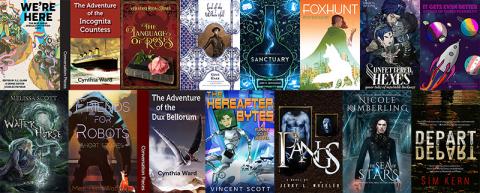
The 2022 Pride Bundle Bundle - Curated by Catherine Lundoff and Melissa Scott
It's time for another queer-themed bundle to celebrate Pride! This year, we have five books in the main bundle, and another ten in the bonus, for a total of fifteen if you spring for the bonus. Once again, winnowing it down to a manageable number was ready hard — there are so many writers out there who are creating intelligent, nuanced and queer SF/F.
Because this is for Pride, we looked for books that depicted queerness in all its aspects. You'll find profoundly hopeful work as well as darker themes, but what you won't find is stories in which being queer means you're evil, nor any in which it's purely a doomed and tragic fate. We've included newer writers and new work, reintroduced some older ones, and are offering a mix of novels, novellas, and short story collections; we have science fiction, fantasy, dark fantasy, solarpunk, cyberpunk, ghost stories, and more. These are stories that celebrate the multitudes within our queer community, all written by authors at the top of their game. You'll find a wide range of diverse characters, an equally wide range of styles, and stories that will hook you from first to last.
We can't claim that this is anything like a definitive LGBTQIA+ collection. There is too much wonderful queer writing out there for anyone to be able claim that. Instead, we're offering a collection that celebrates queerness, and shows off the work of some of the best writers working today.
StoryBundle has always allowed its patrons to donate part of their payment to a related charity, and once again we're supporting Rainbow Railroad, an NGO helping LGBT+ people escape state-sponsored persecution and violence worldwide. Especially at this moment, their work is desperately needed, and if you choose, you can pass part of the bundle's price to them — a gift that can save a life. – Catherine Lundoff and Melissa Scott
* * *
For StoryBundle, you decide what price you want to pay. For $5 (or more, if you're feeling generous), you'll get the basic bundle of five books in any ebook format—WORLDWIDE.
- Lord of the White Hell by Ginn Hale
- We're Here edited by C.L. Clark & series editor Charles Payseur
- The Adventure of the Incognita Countess by Cynthia Ward
- Sanctuary by Andi C. Buchanan
- The Language of Roses by Heather Rose Jones
If you pay at least the bonus price of just $20, you get all five of the regular books, plus TEN more books for a total of 15!
- Unfettered Hexes edited by dave ring
- The Adventure of the Dux Bellorum by Cynthia Ward
- It Gets Even Better edited by Isabela Oliveira and Jed Sabin
- The Hereafter Bytes by Vincent Scott
- Water Horse by Melissa Scott
- Friends For Robots by Merc Fenn Wolfmoor
- The Sea of Stars by Nicole Kimberling
- Foxhunt by Rem Wigmore
- Pangs by Jerry L. Wheeler
- Depart, Depart! by Sim Kern
This bundle is available only for a limited time via http://www.storybundle.com. It allows easy reading on computers, smartphones, and tablets as well as Kindle and other ereaders via file transfer, email, and other methods. You get multiple DRM-free formats (.epub, .mobi) for all books!
It's also super easy to give the gift of reading with StoryBundle, thanks to our gift cards – which allow you to send someone a code that they can redeem for any future StoryBundle bundle – and timed delivery, which allows you to control exactly when your recipient will get the gift of StoryBundle.
Why StoryBundle? Here are just a few benefits StoryBundle provides.
- Get quality reads: We've chosen works from excellent authors to bundle together in one convenient package.
- Pay what you want (minimum $5): You decide how much these fantastic books are worth. If you can only spare a little, that's fine! You'll still get access to a batch of exceptional titles.
- Support authors who support DRM-free books: StoryBundle is a platform for authors to get exposure for their works, both for the titles featured in the bundle and for the rest of their catalog. Supporting authors who let you read their books on any device you want—restriction free—will show everyone there's nothing wrong with ditching DRM.
- Give to worthy causes: Bundle buyers have a chance to donate a portion of their proceeds to Rainbow Railroad!
- Receive extra books: If you beat the bonus price, you'll get the bonus books!
StoryBundle was created to give a platform for independent authors to showcase their work, and a source of quality titles for thirsty readers. StoryBundle works with authors to create bundles of ebooks that can be purchased by readers at their desired price. Before starting StoryBundle, Founder Jason Chen covered technology and software as an editor for Gizmodo.com and Lifehacker.com.
For more information, visit our website at storybundle.com, tweet us at @storybundle and like us on Facebook. For press inquiries, please email press@storybundle.com.
Major category:
PromotionMonday, June 27, 2022 - 07:00
As with the previous post, this chapter is written by a prolific and deeply knowledgeable scholar on the era in question. One of the benefits of a survey like the Cambridge Companion that is both a high-level overview and focuses specifically on lesbian history is that it can be easier to see some of the large-scale patterns. If the 17th century was an era when female homoeroticism was becoming more visible in general, the 18th century was an era when knowledge about female homoeroticism was becoming more organized into motifs, tropes, and categories. In some ways, that categorization only serves to emphasize the diversity of experiences that fall generally into the concept of "female homoeroticism". I've started poking at the idea that one of the problems with trying to identify "lesbianism in history" is that we need to acknowledge that there were many different "lesbianisms", each with their own history and cyclicity. On some points, they intersected and overlapped, on others they could be distinctly different. The awkwardness we often experience in trying to develop a unified historical model of lesbianism stems, in part, from trying to embrace all those lesbianisms as a single whole. But even if you look at much more recent lesbian history -- say, from the mid-20th century onward -- the experiences, concepts, and communities that are, in theory, covered by that label have been diverse, distinct, and sometimes in philosophical conflict. I shall continue poking at this idea and will probably turn it into a podcast at some point.
Major category:
LHMPFull citation:
Gonda, Caroline. 2015. “Writing Lesbian Desires in the Long Eighteenth Century” in The Cambridge Companion to Lesbian Literature, edited by Jodie Medd. Cambridge University Press, Cambridge. ISBN 978-1-107-66343-5
Gonda, Caroline. Writing Lesbian Desires in the Long Eighteenth Century.
[The following is duplicated from the associated blog. I'm trying to standardize the organization of associated content.]
As with the previous post, this chapter is written by a prolific and deeply knowledgeable scholar on the era in question. One of the benefits of a survey like the Cambridge Companion that is both a high-level overview and focuses specifically on lesbian history is that it can be easier to see some of the large-scale patterns. If the 17th century was an era when female homoeroticism was becoming more visible in general, the 18th century was an era when knowledge about female homoeroticism was becoming more organized into motifs, tropes, and categories. In some ways, that categorization only serves to emphasize the diversity of experiences that fall generally into the concept of "female homoeroticism". I've started poking at the idea that one of the problems with trying to identify "lesbianism in history" is that we need to acknowledge that there were many different "lesbianisms", each with their own history and cyclicity. On some points, they intersected and overlapped, on others they could be distinctly different. The awkwardness we often experience in trying to develop a unified historical model of lesbianism stems, in part, from trying to embrace all those lesbianisms as a single whole. But even if you look at much more recent lesbian history -- say, from the mid-20th century onward -- the experiences, concepts, and communities that are, in theory, covered by that label have been diverse, distinct, and sometimes in philosophical conflict. I shall continue poking at this idea and will probably turn it into a podcast at some point.
# # #
Female same-sex desire appears in a wide variety of genres in the “long 18th century” from private letters and journals, to professional literature, to novels, to satire, to porn, to poetry. And reference to lesbianism served a number of purposes that are not always obvious to the modern reader. The most visibly sexual representation tends to be hostile, while positive depictions tend to idealize “chaste female friendship”.
That polarization can obscure the relationship of literary representation to real women’s everyday lives. In a gender segregated society with very different concepts of privacy, opportunities for erotic encounters were many, and could easily go unremarked. Hostility tended to arise when women’s activity is challenged male privilege and expectations.
In contrast, official models of female-female desire tended to be associated with an unnatural state: whether physical, such as the “enlarged clitoris” theory, still prevalent early in the century, or behavioral, such as the increasing image of lesbians as “masculine”, later in the century.
Toward the end of the century, shifts in the acceptability of gender play in masquerades and theatricals parallel an increasing “gender panic” about appropriate roles and behavior. (Some see this crisis gradually developing from as early as the late 17th century.)
Across the 18th century the discourse around female homoeroticism moved from viewing it as having no significance to being significant enough to be threatening. The figure of the “female husband” appears regularly at the intersection of those views. Writing about these symbolic representations of female-female desire and gender transgression sometimes tells us more about the concept of lesbianism in the 18th-century than trying to find real-life lesbians. Real women had a reason to obscure their desires, while public discourse focused overtly on the meaning and consequences of those desires.
The figure of Sappho as a lesbian icon comes to the fore. Language evoking Sappho establishes itself in the general vocabulary of female-female desire, most commonly as “sapphist”, “sapphic”, “sapphism” but also in ambiguous uses of “lesbian” in reference to the poet and her loves.
Public and private discussion of specific women’s sapphic desires took up a full range of presentations from the celebrated “friendship” of Ponsonby and Butler to the whispered accusations against Anne Damer, to the autobiographical records of Anne Lister.
One common theme seen in these commentaries is an attempt to force female couples into a “butch-femme” mould even when the couple themselves emphasized their similarities. However we also see couples that do embrace a gender polarity, as in the writings of Lister.
Outside of overtly satirical or hostile literature, treatments of female homoeroticism in literature are often oblique or coded. This coding may be hostile, as in the depiction of “masculine” women in novels such as Belinda, or may act to blur or conceal erotic elements in favor of sentimental attachment, as in Millenium Hall.
The chapter catalogs a number of iconic and lesser known works with homoerotic themes, and again makes a good shopping list for interested readers.
(Note: I have not added tags for specific literary works or authors as the article is more of a catalog than an analysis.)
Time period:
Monday, June 20, 2022 - 07:00
Lanser is one of the most significant voices in the study of lesbian themes in the Renaissance and early modern period, so it's not at all surprising that she does an excellent job at surveying the literature of the period. I'm a smidge less convinced by her framing discussion, suggesting that the significance of Queen Elizabeth I of England's extended reign as a woman, and as an unmarried woman at that, created a special context for disrupting concepts of gender and increasing discourse around female homoeroticism. Co-occurrence is not causation, and one could cite many other female rulers in other eras and locations that did not co-occur with a similar shift in the discourse. But it is certainly true that in later 16th centiury England there was a special awareness of the value and potential of women, and prominant themes of praising women's virtues in human terms rather than purely feminine terms. Along with Valerie Traub, who is cited extensively in the discussion, this is an era well covered by the scholarship in analyses that do no attempt to view gender and sexuality only in reference to modern frameworks, but that explore them in their own context.
Major category:
LHMPFull citation:
Lanser, Susan S. 2015. “’Bedfellows in Royaltie’: Early/Modern Sapphic Representations” in The Cambridge Companion to Lesbian Literature, edited by Jodie Medd. Cambridge University Press, Cambridge. ISBN 978-1-107-66343-5
Lanser, Susan. ’Bedfellows in Royaltie’: Early/Modern Sapphic Representations.
[The following is duplicated from the associated blog. I'm trying to standardize the organization of associated content.]
Lanser is one of the most significant voices in the study of lesbian themes in the Renaissance and early modern period, so it's not at all surprising that she does an excellent job at surveying the literature of the period. I'm a smidge less convinced by her framing discussion, suggesting that the significance of Queen Elizabeth I of England's extended reign as a woman, and as an unmarried woman at that, created a special context for disrupting concepts of gender and increasing discourse around female homoeroticism. Co-occurrence is not causation, and one could cite many other female rulers in other eras and locations that did not co-occur with a similar shift in the discourse. But it is certainly true that in later 16th centiury England there was a special awareness of the value and potential of women, and prominant themes of praising women's virtues in human terms rather than purely feminine terms. Along with Valerie Traub, who is cited extensively in the discussion, this is an era well covered by the scholarship in analyses that do no attempt to view gender and sexuality only in reference to modern frameworks, but that explore them in their own context.
# # #
Lanser connects female rule over England in the wake of Henry VIII’s death with the rising debate regarding women’s nature and women’s place in society in the later 16th and 17th centuries. That is, that the undeniable fact of Elizabeth’s lengthy reign forced society to grapple with the concept of the equality of the sexes, while Elizabeth’s relationships with her female courtiers helped sanction the validity of female friendship bonds.
As documented by Valerie Traub, this era saw a significant increase in textual representations of lesbianism or its equivalent. This shift was not confined to England, either in terms of literary motifs or in terms of the growing prominence of female rulers and intellectuals. If Women could have power, independence, and value, they were capable of desiring and being desired by other women.
Male voices begin protesting that women can’t sexually satisfy each other. None of this implies a “golden age” of lesbian expression – only that lesbian possibilities were more openly recognized and expressed for good or ill. That potential becomes a site of conflict and anxiety in a variety of literature.
Lanser explores some selected text in more detail, especially drama and poetry. This chapter provides an excellent shopping list of texts for interested readers to explore in more depth.
(Note: I have not added tags for specific literary works or authors as the article is more of a catalog than an analysis.)
Time period:
Saturday, June 18, 2022 - 07:00
Lesbian Historic Motif Podcast - Episode 232 - Yuri Manga and Anime: Interview with Erica Friedman – transcript pending
(Originally aired 2022/06/18 - listen here)
Transcript is pending
Show Notes
In this episode we talk about:
- What is Yuri?
- Roots in Japanese girls’ culture of the 1920s
- Common tropes
- How is Yuri related to overtly queer culture?
- Different “flavors” of Yuri for different readerships
- Isekai “light novels”
- Differences and similarities between Yuri and Yaoi or “BL” (boys’ love) media
- How US attitudes towards sexual content have affected the reception of romantic/erotic themes in manga/anime
- The “girl prince” trope in The Rose of Versailles (see Erica’s YouTube discussion)
- How Erica approaches Japanese media as a non-Japanese consumer
- What By Your Side covers
- Publications Mentioned – Note: Links may be to the yuricon.com online store which is Erica Friedman’s website and benefits her financially.
- By Your Side :The First 100 Years of Yuri Anime and Manga by Erica Friedman
- Hana Monogatari (Flower Stories) by Yoshiya Nobuko “Two Maidens in the Attic”
- Revolutionary Girl Utena by Chiho Saito
- Boyish 2 (Butch x Butch Yuri Anthology)
- If We Leave on the Dot by Ayu Inui
- Sailor Moon (Hulu, Netflix) – especially season 3
- The Rose of Versailles by Riyoko Ikeda (5 vol. of manga, 2 seasons of anime)
- “Yellow Rose” by Yoshiya Nobuko from Hana Monogatari, translated by Dr. Sara Frederick
- Dear Brother by Riyoko Ikeda
- Maria Watches Over Us by Konno Oyuki
- I’m in Love With the Villainess by inori - Isekai “light novel” and manga
- Sexiled: My Sexist Party Leader Kicked Me Out, So I Teamed Up With a Mythical Sorceress! by Ameco Kaeruda - Isekai “light novel”
- JK Haru is a Sex Worker in Another World by K? Hiratori? - Isekai “light novel”
- RESISTANCE: The LGBT Fight Against Fascism in WWII by Avery Cassell (Author), Diane Kanzler (Editor), Diego Gomez (Illustrator)
- No Straight Lines: Four Decades of Queer Comics Justin Hall (Editor)
Edited to add additional titles identified by listeners:
-
Puella Magi Madoka Magica (link is to Wikipedia)
Links to the Lesbian Historic Motif Project Online
- Website: http://alpennia.com/lhmp
- Blog: http://alpennia.com/blog
- RSS: http://alpennia.com/blog/feed/
- Twitter: @LesbianMotif
- Discord: Contact Heather for an invitation to the Alpennia/LHMP Discord server
- The Lesbian Historic Motif Project Patreon
Links to Heather Online
- Website: http://alpennia.com
- Email: Heather Rose Jones
- Twitter: @heatherosejones
- Facebook: Heather Rose Jones (author page)
Links to Erica Friedman Online
- Website: http://yuricon.com
- Blog: http://okazu.yuricon.com
- Twitter: @OkazuYuri
- Discord: https://discord.gg/4NPHGH7Vc4
- Facebook: https://www.facebook.com/YuriconALC
- YouTube Channel: https://www.youtube.com/user/yuristudio
- Patreon: https://www.patreon.com/Okazu
Major category:
LHMPPages
