Blog
Wednesday, August 23, 2017 - 01:28

Tuesday was the whirlwind walking tour of Dublin day. I started off with the campus tour of Trinity College Dublin (where I'm staying), which gave background on the main buildings and history of the college. The repeating theme of the tour was, "And this building was designed in [date] by [name] and then the college built it and never paid him for his designs." (Ok, so maybe it only happened for two or three of the main buildings.) The tour ended up in the Old Library which houses the several early medieval gospel books, including the Book of Kells. There's a vast an fascinating set of displays on the history, production, purpose, etc. of these early books before you get to the small room where the Kells and Durrow gospels are displayed (also one other I didn't note the name of?). Even though people were let into the room in small groups, there was no traffic control and you could easily spend half an hour there without getting close enough to see them unless you were willing to be very pushy. So I saw the books (what can I say, I'm pushy). Impressive, but other than being able to see the three-dimensionality of some of the inks and paints, you get a much better idea of the artistry from any half-decent facsimile.
The tour then leads to the "Long Room" which houses the library's older books (as well as a display of the so-called Brian Boru harp). See picture above. They have a peculiar shelving system, based on a combination of date of acquisition and shelving books in decreasing size as you go up the cases. Which, I suppose, makes sense because I'd hate to be teetering on top of a tall ladder reaching over my head to lift down a folio-sized book.
I met Liz Bourke at noon at the Campanille and after luch at her favorite soup place, we set out on a meandering tour through the most interesting Georgian and (much fewer) medieval parts of Dublin. I highly recommend Liz as a tour guide! Very knowledgeable. We hit most of the better known churches (including her favorite, Saint Audoen's, which is the oldest continuously-used church in Dublin -- see picture), Dublin castle, the old parliament building (now a bank), then a walk up the river past the Guinness plant to see Kilmainham Hospital (now an art gallery) and its formal gardens. Then back to central Dublin for a fish & chips dinner and dawdling over cider at a pub until it was time for the play: Carl Capek's "R.U.R." at the Peacock Stage (part of the Abbey Theatre complex) about which I will have more to say in a review.
Today (Wednesday...it is Wednesday, right? the days are merging together) is scheduled for the archaeology museum and recovering a bit from yesterday's walking. I've been talked into see the Viking-centered Dublinia Museum tomorrow, about which I'd had questions as it advertising made it sound a bit school-group oriented.
Major category:
Travel View comments (2)
Tuesday, August 22, 2017 - 01:17
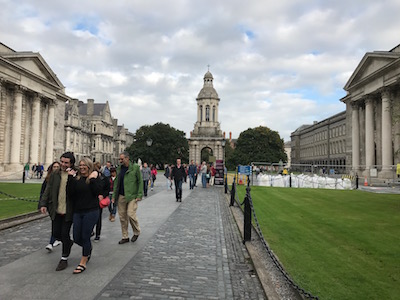
Back in '99 when I was taking enough trains around Europe that it was worth it to have a rail pass, I was regularly gobsmacked at how (at least on the Continent) they ran to-the-minute per the published schedule. Yesterday, pretty much every train I was on was delayed...which was a good thing because otherwise I would have missed a couple of connections. In one case, I ran up and over an overpass (carrying a heavy suitcase) to a train already standing at the correct platform, barely glanced at the monitor and only confirmed it was the correct train when I was on board (and had managed to catch my breath). Which brings up another observation: the British rail system must be hell on people with physical disabilities. I can't count the number of occasions where I couldn't see any obvious option for getting from point A to point B that didn't involve stairs. (Even on the spiral ramp up to the pedestrian bridge to the Durham station, the ramp had periodic steps. Not quite enough to daunt the roll-away, but certainly enough to preclude wheelchair use.) I'm still spry enough that I can break out the backpack straps on my suitcase and hike up to my 3rd floor walk-up room here at Trinity College (see picture) but I can feel the bones aching on occasion and it makes me ponder.
But on the up side, I saw lots of lovely train-side scenery yesterday, cutting accross the Pennines and then traveling along the northern edge of Wales, across the Menai Strait, and on to Holyhead where I took the ferry to Dublin. I took a bunch of "atmosphere" notes on the trip for when I return some day to my 10th century historic romance that involves Dublin and Vikings.
If you ever plan to visit Dublin in the summer and want easy access to everything downtown (and you have good knees) I can highly recommend taking advantage of the Trinity College on-campus accommodations. (I found them through Hotels.com) It's a dorm style room (there are a few with en suite facilities, which I got) and comes with a complimentary continental breakfast at The Buttery (full breakfast available if you pay more). And now I'm going to walk out of my room, across the quad, and take a campus tour that ends up putting me in front of the Book of Kells. But more on that in tomorrow's post.
Major category:
TravelMonday, August 21, 2017 - 07:00

In the research I read though for this project, I regularly come across references to pieces of historic literature that come tantalizingly close to being positive queer stories. A few of them have been added to my "to write" list where I want to tweak them ever so slightly to overcome the deficiencies of the past. Aragón's play Añasco el de Talavera is one of those tantalizing near-misses, with its open homoerotic desire and the "mannish" woman who has the power to order people's lives within the story. It doesn't tempt me quite enough to add it to the list, but I'd love to read through a full translation of it some day.
Major category:
LHMPFull citation:
Velasco, Sherry. 2011. Lesbians in Early Modern Spain. Vanderbilt University Press, Nashville. ISBN 978-0-8265-1750-0
Publication summary:
A study of the evidence and social context for women who loved women in early modern Spain, covering generally the 16-17th centuries and including some material from colonial Spanish America.
Chapter 6: Lesbian Desire on Center Stage
[The following is duplicated from the associated blog. I'm trying to standardize the organization of associated content.]
In the research I read though for this project, I regularly come across references to pieces of historic literature that come tantalizingly close to being positive queer stories. A few of them have been added to my "to write" list where I want to tweak them ever so slightly to overcome the deficiencies of the past. Aragón's play Añasco el de Talavera is one of those tantalizing near-misses, with its open homoerotic desire and the "mannish" woman who has the power to order people's lives within the story. It doesn't tempt me quite enough to add it to the list, but I'd love to read through a full translation of it some day.
# # #
Female same-sex flirtation is a regular feature in popular Spanish drama of the early modern era. Erotic attraction to cross-dressed actrresses was cited in moral warnings. Velasco discusses the “meaning” of same-sex flirtation in cross-dressing scenarios, based on the several layers of “real” versus “apparent” gender, and considering different audiences. If female attraction to cross-dressed actresses isn’t quite all-out lesbian desire, it at least acknowledges its possibility. In-play dialogues about the attractiveness of the cross-dressed characters is coded in ambiguously androgynous terms.
Another context for dramatic ambiguity is the use of female actors for roles where a male character takes on a female disguise (within the story), as in the legend of Achilles. While this may have avoided having an actual male actor cross-dress as a woman on stage, it created the potential for female same-sex desire within the layered “woman playing a man playing a woman” scenario.
Moralists of the 17th century warned parents that their innocent daughters would be corrupted by consuming plays and novels. The expressions of concern are not specifically focused on homoeroticism, but the general idea is that young girls will “get ideas” from popular culture.
There is an extensive discussion of Cubillo de Aragón’s play Añasco el de Talavera (ca. 1637) which depicts lesbian desire without the mechanism of male disguise. The “manly woman” Dionisia’s desire for her female friend Leonor is an open topic of discussion within the play. Dionisia complains about the restrictiveness of female gender roles and has a serious case of “not like other girls”. She specifically expresses the desire to be touched (implied: sexually) by Leonor and say she loves her. Leonor demurs about the concept, but Dionisia presents her argument in terms of platonic love, and argues for the supremacy of (same-sex) platonic love over heterosexual desire. The dialogue acknowledges that women may “sin” together, i.e., that activity counting as forbidden sex is possible between women.
Leonor, alas, is irredeemably heterosexual, and the play ends up shoehorning Dionisia into a heterosexual resolution. But the resolution implies that Dionisia is still controling the situation driven by desire for Leonor. Dionisia marries the man who is mutually in love with Leonor (thus interfering with their competing relationship) and leaves Leonor to marry the man who has been vainly attempting to woo Dionisia.
Velasco considers the effect of homoerotic art and literature on female viewers. For example, homoerotic scenes of Diana and her nymphs may have been intended for male voyeurism, but had female viewers as well. Literary depictions of Diana were viewed as potentially corrupting and parents of daughters were specifically warned against Jorge de Montemayer’s 1559 work Las siete libros de la Diana (known more typically as La Diana). The same-sex love depicted in this work has traditionally been dismissed as neo-Platonic friendship, but it is expressed in terms of physical affection and verbal flirtation.
Two characters, Ysmenia and Selvagia, enjoy a passionate interlude, then Ysmenia falsely convinces Selvagia that she is a man in disguise and that Selvagia has been tricked into a heterosexual liaison. Selvagia remains steadfast in her love for Ysmenia, despite this apparent trick. Enter Ysmenia’s Convenient Twin Cousin (male) who takes advantage of the situation to take over Ysmenia’s affair with Selvagia. The story can be compared with other pastoral romances, most of which involve some type of gender disguise. But La Diana is unusual in showing Selvagia’s love beginning when she believes that love to be homoerotic. The steadfastness of Selvagia’s love regardless of the (believed) gender of the object supports the image of same-sex love being equivalent to heterosexual love.
In other similar works, there is more often uneasiness expressed about apparent or real same-sex desire, which is resolved by either the reality or a fantasy of a magical sex-change to permit a heterosexual resolution. These may include sexual interludes that could be interpreted as lesbian and involving an artificial penis. There is often a phallocentric assumption that only a penis can provide a woman with pleasure and that real female same-sex relations must remain unfulfilled.
In the romance Tirant lo Blanc there is an episode of a woman engaging in sex play with another woman supposedly for the voyeuristic benefit of an observing man. Later, the sex play continues in the dark and the man substitutes in (unknown to his partner). The woman in this interaction is shown protesting that the supposed same-sex act is against nature, but she does not deny its possibility. The in-story implication is that sex between women is permited as long as it’s really a performance for the male gaze or for the reader. But the fact that both La Diana and Tirant lo Blanc were popular among female audiences suggests other possibilities. Heterosexual resolutions kept the text “safe” while allowing transgression between the covers (of the book).
The rest of the chapter takes a close examination of the novels of María de Zayas, which interrogate heterosexual relations and support the concept of female community and marriage resistance (although in the form of the convent). The themes send conflicting messages about heteronormativity and female same-sex love.
“Love for the Sake of Conquest” uses a male-to-female disguise plot to assert the superiority of love between women, though the arguments are put in the mouth of the male character (disguised as a woman) who it turns out is making those arguments purely for the sake of getting the other protagonist in bed. This creates a context for articulating the attractions of same-sex love and desire without the transgression of enacting it. After the male character reveals his identity and succeeds in initiating a sexual relationship, he loses interest and moves on, while the female protagonist is then murdered by her father for her (heterosexual) sexual transgression, whereas her apparent attraction to another woman was considered odd but not equivalent to fornication.
In “Aminta Deceived and Honor’s Revenge” a woman expresses romantic attraction to another woman without the artifice of a disguies plot, and her attention is found flattering. But it turns out the first woman was acting out of ulterior motives in order to further her relationship with a man and to deceive the supposed female object of her affection.
The third story considered, “Marriage Abroad: Portent of Doom”, includes a rather hostile depiction of male homoerotic relations, raising the question of whether this indicates that Zayas judged male and female relations entirely differently, or whether it’s evidence that she didn’t intend her female couples to be read as having physical relations.
Overall, although Zayas' novels include themes of the superiority of love between women, the actual plots undermine this message, showing deception and falsehood. Only in the framing story for the novels does the messge of that superiority prevail in truth.
Place:
Event / person:
Sunday, August 20, 2017 - 02:57

Just a quick note this time. Yesterday we did a little more wandering around Durham. Checked out the stalls in the Old Market Hall looking for gifts, but didn't see anything that really grabbed me. Went off to look at Sara & Joel's new house that they're gradually getting fixed up for moving in and had serious Old House Envy. (18th century beams! 0.5 meter thick back wall (now an interior wall of the house)! Cute postage-stamp back garden with sheds!) Had lunch and a pint in the pub right around the corner from the new (old) house.
Spent the afternoon resting up for the jaunt to York today, plus doing a bunch of exporting, formatting, and annotating of my files from the Great Welsh Name Database which I'm handing over to Sara for use in the DMNES project (Dictionary of Medieval Names from European Sources). This is, to some extent, an acknowledgement that I'm unlikely to do more work on the database in the near future. But I've always meant to ask if she wanted the data to use and this was a chance to talk about how the current files are structured and what some of the analytic data was trying to do.
Major category:
TravelSaturday, August 19, 2017 - 00:00
Author Catherine Lundoff returns to the podcast to share some of her favorite lesbian historical fiction. I hope this series of segments will help people find new (or old) titles that may strike their fancy.
Now with transcript!
* * *
Lesbian Historic Motif Podcast - Episode 15 (formerly 31c) - Book Appreciation with Catherine Lundoff - transcript
(Originally aired 2017/08/17 - listen here)
(Transcript commissioned from Jen Zink @Loopdilouwho is available for professional podcast transcription work. I am working on adding transcripts of the existing interview shows.)
* * *
Heather Rose Jones: Last week, we had Catherine Lundoff on to talk about her own writing. This week she comes back to participate in our historic book appreciation feature, where she squees about her favorite books with queer female characters in historic settings.
Catherine Lundoff: Well, there’s a number of different things I like. I can think of a number of books that are by lesbian, bi, trans women, but they have male protagonists. I was thinking of, in particular, Melissa Scott’s and Lisa Barnett’s Armor of Light, which is an alternate history about Christopher Marlowe and Sir Phillip Sydney and Christopher Marlowe doesn’t get assassinated in Deptford and wacky hijinks ensue. It’s a great book, I keep hoping that Melissa will do a sequel to it. But in terms of books with queer characters, one of the ones that I would like to recommend that I think isn’t as well known for the les-fic readership in particular, is a trilogy called Tomoe Gozen.
H: Oh, yes!
C: I’m probably mispronouncing it but that’s another Jessica Amanda Salmonson work and it’s based on the life of a woman who was a… She was a Japanese historical figure who was an actual fighter, she fought with a naginata and it’s kind of a scythe-like spear. It has a sort of curved blade on the end of it. She was, at various times in her life, both a nun and a fighter who was involved in all of these different political things that were going on in the time period. In the course of the three books, she is revealed to be bisexual by contemporary standards. Again, I can’t remember if she’s a lesbian or not, I’m thinking that she’s bi, because I think she does have one romance with a man. They’re very, very rich books. They’re very interesting. They’ve been out of print for a while, which is unfortunate, but they may be available in ebooks. A lot of things are coming back in ebook. That’s probably one of my favorites of the historical end of things that I can think of off the bat. I, of course, enjoy your books as well because Ruritanian romances are just fun. They’re just great books. Presumably, the people listening to this are already reading your books, I hope.
H: Yah, I’m trying to avoid having the book squee part of the podcast be just an appreciation of my books, because that looks bad.
C: I can see that. I can see that. Emma Donoghue, you know, has got to be one of my favorite authors. Slammerkin, I think I cried all the way through the last third of Slammerkin and I am not somebody who weeps much.
H: Can you tell a little about what the book’s about?
C: Slammerkin is about a young British woman, who was a real person, who worked as a prostitute in London and ended up, through a variety of circumstances, going to work for this prosperous rural family. Somewhere along the line, things went hideously awry and she ended up being accused of murdering her mistress and hanging for it. ‘Slammerkin’ is a slang term from the time period, I believe it’s mid-seventeenth century, for a prostitute. It’s a very intense book because it’s written entirely from her perspective. Donoghue’s very sympathetic towards all the different things that this woman would have had to mesh together to make it work. To go from a reasonably prosperous career as a prostitute in London to being a servant in the country and where that went wrong. It’s a very interesting book, it’s a very intense read. I find that with most of Donoghue’s stuff; she does a lot of really great historical books. She’s also got a collection of lesbian fairytales called Kissing the Witch that’s well worth tracking down. Donoghue is definitely somebody I would recommend. Sarah Waters…
H: Yes! There’s always Sarah Waters.
C: There’s always Sarah Waters. I was just recommending, on a Gothics panel that I was on at WisCon, I was recommending Affinity, which is her novel about the séance and spiritualist movements in Victorian England. It’s about a woman who is queer but is from a noble background and has to pass herself off as continually ill and always going to these séances. She gets sucked into the criminal underworld that also accompanied séances and so forth. It’s beautifully written, it’s beautifully written. It’s well worth tracking down. Fingersmith gets a lot more play of her novels of the time period, but I think Affinity is also very, very good. I think, between the two of them, they’re just amazing, amazing authors. I’m so glad I discovered them when I did.
H: Well, thank you so much for sharing some of your favorite queer female historical fiction with us!
Show Notes
In the Book Appreciation segments, our featured authors (or your host) will talk about one or more favorite books with queer female characters in a historic setting.
In this episode Catherine Lundoff recommends some favorite queer historical novels:
- Tomoe Gozen by Jessica Amanda Salmonson
- Slammerkin by Emma Donoghue
- Kissing the Witch (collection) by Emma Donoghue
- Affinity by Sarah Waters
- Fingersmith by Sarah Waters
- Also a nod to The Armor of Light by Melissa Scott and Lisa Barnett (queer authors, but queer male protagonists)
Links to the Lesbian Historic Motif Project Online
- Website: http://alpennia.com/lhmp
- Blog: http://alpennia.com/blog
- RSS: http://alpennia.com/blog/feed/
- Twitter: @LesbianMotif
- Discord: Contact Heather for an invitation to the Alpennia/LHMP Discord server
- The Lesbian Historic Motif Project Patreon
Links to Heather Online
- Website: http://alpennia.com
- Email: Heather Rose Jones
- Twitter: @heatherosejones
- Facebook: Heather Rose Jones (author page)
Links to Catherine Lundoff Online
- Website: Queen of Swords Press, Catherine’s newsletter, and the History of LGBTQ Speculative Fiction column “Out of the Past”
- Twitter: @clundoff
- Twitter - Queen of Swords Press: @qospress
- Twitter - Emily L. Byrne (pen name for erotica): @emilylbyrne
- Facebook: Catherine Lundoff
- Facebook: Queen of Swords Press
- Facebook: Emily L. Byrne
Major category:
LHMPFriday, August 18, 2017 - 07:42

Thursday was both leisurely and taken up entirely by travel. After a lazy breakfast, I could the train from Deventer at 11am. Local to Schiphol, then the Thalys to Brussels, the Eurostar to London, one train up to York, then a change for the last leg to Durham. The changes all had plenty of time to find my platform, but never really enough time to stop and look around or do more than grab something to eat later on the train. At King's Cross Station I didn't feel like there was enough time to go slip through the door at platform 9-3/4 (which would have totally screwed up my travel plans, in any event), and yet somehow today I found myself within the walls of Hogwarts in any case:
Which is, of course, actually the cloister of Durham Cathedral. Today I got a walking tour all over the cathedral, castle/university, and city center, including a few locations (like the Senior Commons Room) that came courtey of being hosted by university faculty. Central Durham is another great example of integrating older buildings with a vibrant thriving town center. One fellow passing by who heard me being given a tourist lecture told us about how great it was that the shops and buildings were occupied and open now, and that when he was younger so many of the old buildings were boarded up. When you hear people talking about the world going downhill, I think it's important to take note of all the success stories you see of urban revivial and the ability to have the best of both the past and the present. Like the way that so much of the Bailey area in Durham is a living part of the university.
We adjourned for late lunch in a cafe as my feet were beginning to flag. Keeping up with the energy of someone as young as Gwen it quite an undertaking! But the city is full of lovely walks, with wild blackberries and plums for the picking, and people lazily rowing past in boats, and the cobbled streets full of tourists and shoppers. We have a pencilled-in plan to all go to York on Sunday, since my interest was a good excuse for the whole family to do some sightseeing. Tomorrow may be a bit more leisurely.
Major category:
TravelThursday, August 17, 2017 - 00:17
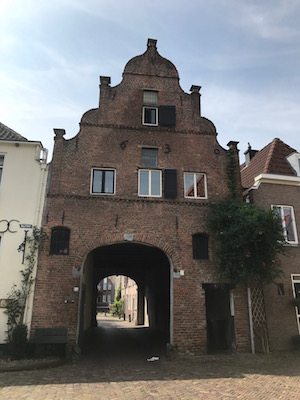
Wednesday was another ambling around Deventer day. Irina and I went off to various shops to pick up so specialty cheese and wurst to take to Sara & Co. on my next stop. (Also some cheese for me to take home, once I'd verified that their packaging technique would pass customs.) Then just more wandering with tour guide: tracing the old city walls (both the earthwork built against the Vikings and the medieval stone wall that can still be seen in fragments and lasted into the early 17th century (IIRC). Met the rest of the household at De Rode Kater (The Red Cat) for lunch, which was also where Irina and I returned for dinner. We also enjoyed a long pleasant evening on the rooftop patio, watching the bat go after insects and discussing books and philosophy and whatnot.
Today will be another travel day: local train back to Schiphol, Thalys high-speed rail to Brussels, Eurostar to London, the local train to Durham. The schedule is such that I actually go past to York and then backtrack to Durham. I'm idly wondering if there might be a day-trip to York possible, but I'm sticking to my plan of people-over-places so it will be as it falls out. Given that schedule, I don't anticipate (I hope!) having anything exciting to post about tomorrow.
Major category:
TravelWednesday, August 16, 2017 - 01:25

When I thought about what I wanted to do to extend my trip a little (because it seems silly to fly all the way to Europe and not do a bit of extra traveling), I decided that rather than focus on museums and castles and whatnot, I wanted to spend the time visiting people--especially people that I've known for quite some time and had never met in person. I met Irina way back during Usenet days on rec.arts.sf.composition, so that would be about 20 years ago or so. She's been a beta reader for a number of my stories and books, but up until last week we'd never been in the same time and place. So she was on the short-list of people I wanted to visit and here I am in Deventer, Netherlands.
Mind you, if I'd known that I'd get to stay in a building with a 12th century basement, I'd have been even more certain I wanted to visit! The picture above is the view from my (4th floor) bedroom. The basement and ground floor belong to the Russian Orthodox church that Irina belongs to, and she and her husband own the upper stories. The upper parts of the house are mostly 18-19th century with a few bits of older wall, but here's what the basement looks like:
Other than relaxing and chatting, I'm gotten to spend a lot of time wandering around with a personal tour of many of the older parts of the town. Deventer is a great example of integrating older buildings and newer construction into modern commercial and residential functions. Much of the older part of town has cobbled streets and restricted automobile access (though many bicycles!) so it has a slight feel of an extended pedestrian mall. Here's a random example--just an ordinary neighborhood.
I've been taking lots of notes and pictures relevant to early 19th century vernacular architecture and town layout. (I wonder why?) There will be more pictures and descriptions on facebook. And now, I'm going to go shopping for cheese...
Major category:
TravelTuesday, August 15, 2017 - 00:00

I'm drafting this up while sitting in the Helsinki airport Monday morning but don't plan to post it until Tuesday (to avoid bumping the week's LHMP entry off the front page). But then, I don't figure much of interest will happen for the rest of the day except travel and convention recovery. Sunday morning, having no panels of interest until 11am, I stopped by the WSFS business meeting and helped skate through the remaining agenda items (mostly various housekeeping votes) in record time. The panel I wanted to attend was "Moving Beyond Orientalism in SFF" which was a good solid introduction to "why orientalism is bad". After that, I moved into the realm of "I'm too tired to do much except wander around vaguely." I did finally bump into Tero (whose wedding to my late friend Judy was the occasion of my previous trip to Finland) -- he'd been cosplaying most of the event, so I think I can be forgiven not saying hi earlier!
The panel on "using history for worldbuilding" that I was moderator for went smoothly, except that we had one mic for five people so we punted and begged anyone with hearing impairments to move to the front. I sincerely apologize for this divergence from policy, but try to pass a single mic around during a panel discussion does great damage to the discussion flow. Passing a single mic also would have made it more difficult to try to do turn-taking management--at which I was not as good as I aim for. I hadn't quite expected the conversation dominance to come from the direction it did and wasn't prepared to manage the reins in the way that was needed. (Folks: even very very nice, knowledgeable, entertaining panelists need to self-monitor for hogging the speaking time.)
I hung around for the closing ceremonies, mostly because I needed the psychological closure. (I dislike it when the con just sort of dribbles down to a stop.) Then dashed off to drop stuff at my hotel and join Phiala and Thorvaldr for a nice dinner at a restaurant that specialized in traditional Finnish food. I had the pike-perch with wild mushroom sauce, but we traded around bites, so I also got some sauted reindeer and pan-fried herring.
And then it was a matter of setting my alarm early enough to get to the airport for an 8am flight. Except that the flight was overbooked and they were asking for volunteers to get bumped. I volunteered, despite it meaning changing planes in Copenhagen and not getting in to Schiphol until 2pm. I'd actually considered that flight when originally making my reservations, but opted for the early non-stop instead. Honestly, if I'd had the choice between the 200-Euro compensation and sleeping later, I would have picked sleeping later! But I volunteered, in part, because I could. So here I am, having time to finally watch the YouTube video of the con's opening ceremonies and then type this up for later posting.
Postscript: Arriving in Schiphol, it turned out my luggage was lagging behind somewhere. It had to happen at least once on the trip. It will be delivered sometime this morning (Tuesday) so no harm, no foul. Tomorrow I will blog about Irina & Boudewijn's lovely house with pictures of the view from my bedroom window.
Major category:
ConventionsSunday, August 13, 2017 - 20:30
The image of Spanish convent life in the age of colonial expansion often overlooks the social consequences of convents being the sole alternative to marriage for women of good birth and good reputation. That meant that a lot of the nuns were educated, sophisticated, and relatively lacking in religious vocation. Convent rules tried to find a middle gound between the ideals of exclusive devotion to God and the recognition that they were dealing with a lot of young women who were lonely and desperate for affection. While the dynamics discussed in this chapter are inspired by a consideration of lesbian desire in convents, a great deal of the material is less about sex and more about trying to manage that sort of hot-house emotional environment.
Major category:
LHMPFull citation:
Velasco, Sherry. 2011. Lesbians in Early Modern Spain. Vanderbilt University Press, Nashville. ISBN 978-0-8265-1750-0
Publication summary:
A study of the evidence and social context for women who loved women in early modern Spain, covering generally the 16-17th centuries and including some material from colonial Spanish America.
Chapter 5: Special Friendships in the Convent
[The following is duplicated from the associated blog. I'm trying to standardize the organization of associated content.]
The image of Spanish convent life in the age of colonial expansion often overlooks the social consequences of convents being the sole alternative to marriage for women of good birth and good reputation. That meant that a lot of the nuns were educated, sophisticated, and relatively lacking in religious vocation. Convent rules tried to find a middle gound between the ideals of exclusive devotion to God and the recognition that they were dealing with a lot of young women who were lonely and desperate for affection. While the dynamics discussed in this chapter are inspired by a consideration of lesbian desire in convents, a great deal of the material is less about sex and more about trying to manage that sort of hot-house emotional environment.
# # #
Concerns about same-sex relations in convents date back at least to the time of Saint Augustine in the 5th century. Those concerns covered even trivial actions like hand-holding and terms of endearment, showing that some of the concern was for the particularity of the friendship, not specifically the possibility of sex. Activities that were a cause for concern could be discouraged with corporal punishment as well as lesser penances.
Co-sleeping was a special concern, and care was taken that two women would not have private sleeping arrangements together. Sleeping arrangements in convents might involve single-person cells or communal dormitories, generally with rules against two people having privacy together. The forbidden activities that were specified included “talking together late at night” and thus breaking the rule of silence.
The rules against developing “special friendships” often mentioned a purpose of preserving harmony in the convent and avoiding favoritism. These concerns were not limited to same-sex interactions--there were similar concerns about relations between the nuns and the priests that attended to the spiritual needs of the institution, or visiting male relatives--but of course the demongraphics made female same-sex interactions the greatest temptation.
Visiting priests were sometimes instructed, in essence, to spy on the prioress to ensure that she herself didn’t have favorites (since she was supposed to prevent it in others). There’s an acknowledgement that the prioress may reasonably spend more attention on nuns “who are more discreet and intelligent” and thus might be assisting in administrative duties. In addition to the cautions and rules, there are regular loopholes, such as this type, that created the potential for a variety of approaches and responses. The visiting priests were also advised not to make a big deal out of unimportant behavioral infractions, lest the convent’s reputation be damaged. But visiting priests were not always on the enforcement side, witness an 1819 Inquestion investigation of a (male) confessor who urged the nuns in his care to engage in same-sex activity for his gratification.
Saint Teresa of Avila, in her instructions for convents, laid out the potential consequences of allowing particular friendships. They could cause jealousy between nuns, but also interfered with focusing one’s love on God. Even as instructions like this provided lists of detailed prohibiltions, they normalized the expectation that “particular friendships” woud occur in ordinary circumstances. And there was a contradictory expectation that nuns should show love and affection for each other--just not too much, and not too specifically.
Saint Boniface listed seven potential signs of forbidden carnal love between nuns. (Note that “carnal” is contrasted with “spiritual” and doesn’t necessarily imply “sexual”.) 1: Conversation that includes jokes and laughter, 2: looks of affection and accompanying each other everywhere, 3: experiencing worry and anxiety, 4: jealousy, 5: anger between the two women when they fight, 6: exchanging gifts and favors, 7: defending each other or covering up for each other.
Why was the primary focus on non-sexual behaviors? Were sexual activities considered less important, or was there concern that if sex were specifically mentioned it would “give women ideas”? Recall that lesbianism was called peccatum mutum “the silent sin” because it often was not mentioned in specific terms.
These concerns about favoritism played out in Saint Teresa’s own life and her special friendships with two protegés who laid claim to continuing her legacy. The description of Teresa’s relationship with Ana de San Bartolomé reads like a template for forbidden “particular friendships”. They shared a cell, talked together regularly, and were inseparable. After Teresa’s death, Ana had other particular friendships with nuns, resulting in jealousy and protestations of exclusive love, as recorded in her letters. Letters are a fertile ground for data on the actual emotional relationships between nuns that express particular love and longing and a desire for affirmation. Convent records of the 17th century record numerous investigations of passionate friendships, all of which are recorded as having successful reform as a conclusion, often with supernatural elements in how the issue was discovered.
The text digresses somewhat curiously into a Chilean folktale that is clearly based on the medieval tale of Yde and Olive. A woman takes on male disguise to escape her father’s incestuous advances, had adventures, and eventually marries a princess who is delighted to discover that her “husband” is actually a woman. When this secret is betrayed and they are near discovery, the disguised woman is granted a miraculous sex-change. The connection with the rest of the chapter is that, like one of the convent investigations, there is a magical flying crucifix involved. [I included the reference here to keep track of the Yde & Olive variant.]
Not all same-sex relations in convents were consensual. An early 18th century Colombian nun recourts unwanted sexual advances from other nuns and becoming a cause of jealousy between other women.
There is a discussion of theatrical performances in convents, including nuns performing as actors. This was not considered a sin if done only for entertainment. Topics of the plays could include passionate friendships between nuns, as well as similar allegorical themes. This is another indication of the normalization of these relationships.
Another source of potential concern, espeically in Spanish colonial areas, was relations between (upper class) nuns and the lay serving women who lived with them. This pattern seems to have been less prevalent in Spain itself.
Event / person:
Pages
