Blog
Saturday, January 27, 2018 - 07:00
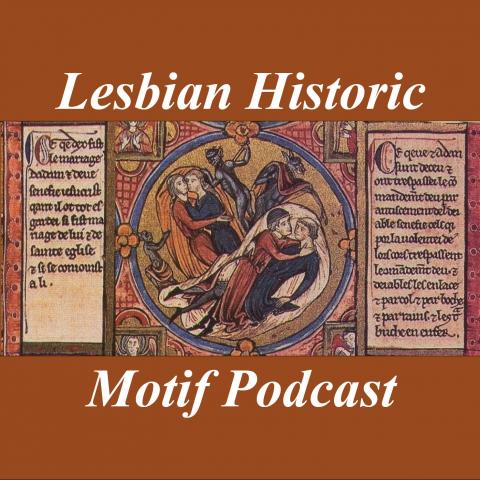
Lesbian Historic Motif Podcast - Episode 38 (previously 18d) - (Un)Conventional Women - transcript
(Originally aired 2018/01/27 - listen here)
There is a long, complicated, tangled, and contradictory history in Western culture between the idea of love between women and the institution of women in cloistered religious communities. That relationship has been inspired, in part, by the dynamic of a single-sex community, populated by women who by definition are not in sanctioned relationships with men, and who have a certain amount of internal autonomy in arranging their lives. It shares this dynamic with institutions such as gender-segregated schools, especially boarding schools and colleges that form a 24/7 community, but also to a lesser degree with gendered professions, especially those that form a separate community as well as providing a livelihood.
But the second factor in the association between lesbians and convents in the popular imagination has been the shifting stereotypes about women’s sexuality, and about the psychology of women who are officially removed from the mainstream sexual economy of marriage and from easy access to and by men. With the rise of the Reformation in the 16th century, cloistered women became a target of a particularly nasty combination of anti-Catholic sentiment and misogyny that added new twists to the image of convents as a hotbed of lesbianism.
But I’d like to look at the historic evidence and motifs from a position that strives for a positive understanding of both the religious and sexual contexts. And here I’m going to take a moment to emphasize and acknowledge that people in our culture can have some strong feelings and deep prejudices both on the topic of of lesbians and on the topic of organized religion and even specifically about the Catholic church. In doing this episode, it is in no way my intent to play into prejudices or to dismiss people’s negative experiences with respect to these topics. Given the audience for this podcast, it’s fairly easy to say, “We all know that many people in the past viewed lesbians negatively and portrayed them as being deviant or sinful, but we’re going to acknowledge that as the context of our historic records and move on to find a positive history for same-sex love in spite of it.”
I can’t assume the same uniformity of attitude from my listeners to both the reality and the fiction of the history of the Catholic church and its institutions. I have close friends who are Catholic; I have close friends who have had very traumatic experiences with organized religion and in some cases with Catholic institutions specifically; and as an atheist I have a somewhat privileged position of standing outside both those dynamics.
So to everyone listening, please believe that my intent here is to treat all my listeners’ experiences and beliefs as valid and worthy of respect. And if I fail--especially if I fail through my approach of treating the subject of religion dispassionately and clinically--I am happy to have those failures pointed out to me so that I can try to do better in the future.
In considering how the intersection of lesbianism and convents have been treated in literature across the ages, it’s important to separate out the experiences of individual people and the meaning given to those experiences by the society around them. Just as today we view desire between women as just one type of expression among the whole spectrum of normal experiences, regardless of how it was framed by past societies, similarly we need to recognize that the structures and ideals of Catholic religious institutions both shaped and were shaped by the times in which they existed, and that depictions of them in historic sources are not value-neutral, both for good and ill.
From the very beginning, Christianity has encouraged an ideal of transferring the emotional bonds typically associated with romantic and sexual relationships to a relationship with God. There has also always been an ideal of asceticism and the deliberate refusal of sensual pleasures as a way of elevating the mind and spirit. And, not to put to fine a point on it, Christianity has always had a bit of a hang-up about sex in general. These themes have manifested in different ways at different times, but as an overall guiding principle, it has meant that Christian ideals have tended to treat sexual pleasure as something that distracts from religious devotion and is to be constrained to specific acceptable circumstances and modes if it is to avoid condemnation.
This hasn’t always meant celibacy--even the requirement for Catholic priests to be celibate wasn’t strictly required until reforms of the 12th century, although it had been maintained as an ideal from the beginning. But the nature of Christian monastic orders meant a de facto expectation of celibacy, and the use of gender-seregated communities, even in orders that were open to both men and women, was intended to make it easier to live up to this ideal.
The hitch, of course, was that people didn’t always enter religious communities because of a vocation. Men might become monks or members of the clergy as a career path. Women might enter a convent--or be pressured into doing so--if their culture lacked other approved lifestyles for unmarried women and marriage were not an option for whatever reason. This wasn’t the case in all Catholic cultures in all eras, but in those where it was, young women with no religious vocation at all might find themselves warehoused in convents.
Furthermore, even those who did have a positive religious vocation were not exempt from the attractions of interpersonal emotional bonds with specific individuals. This was something that convents acknowledged and tried to manage with rules addressing behavior, the appearance of favoritism, and access to privacy. The concern was not always for the possibility of erotic relationships, but also for the challenges to community cohesion and the potential disruption of management hierarchies that romantic pairings could represent.
And then there is the issue of sex drive. European cultures have had many changing attitudes towards women’s sex drives and the hazards they might pose to social order. People who are familiar only with the Victorian myth of women as sexless beings might be surprised to learn that the pop culture attitude in the middle ages in much of Europe was that women had a much stronger and more overwhelming sex drive than men did, and that the primary concern was to control and manage women’s sexual desires such that they didn’t lead men into sin.
There is a regular theme in popular literature of medieval Western Europe that cloistered women were so frustrated by lack of sexual access to men, that they would take any and all opportunities to act out their desire. This resulted in endless jokes and ribald tales of orgies in convents between nuns and their priests--the men who always had access to religious women no matter how strict the rules. The mirror image of this motif was that women who didn’t have easy access to men for sexual encounters would be so driven by their desires that they would have sexual relations with each other to make do. The medieval imagination tended to have a hard time imagining women having erotic desires for women as a first preference.
One of the large set of problems that inspired the Reformation and the establishment of various Protestant churches was a recognition that the strict rules of religious celibacy in various Catholic institutions set a vast number of people up to fail in their religious ideals. In general, Protestant institutions preferred to emphasize “continence within marriage” over the more absolute approach of the Catholic celibate ideal. But this divergence of practice around the question of celibacy also led to many Protestant movements focusing on celibate institutions within the Catholic church as being both iconic of Catholicism and inherently problematic. One focus of this animus was on the idea of convents as creating an unnatural woman-only culture that inherently led to sexual deviance between the women involved, and especially led to predatory relationships between the women in the convent power hierarchy and young novices who were portrayed as “innocent victims” not only of the convent structure but of the Catholic church in general. Victims to be treated as damsels in distress who might be rescued by bold, virile Protestant men.
But enough of the historic background to all this, how did these themes play out in the historic and literary record?
One type of data that I’ve discussed in previous episodes has been convent regulations that tried to manage and control the possibility of special emotional relationships between nuns. There were guidelines about avoiding the possibility of two nuns being private together, especially not having private time sharing the same bed. Signs of affection, such as using endearments or physical contact like hand-holding or kissing might be discouraged. The concern was not only sexual but the potential for jealousies and favoritism among the nuns, or simply for distraction from a focus on God.
But the possibility that signs of affection might signal or lead to forbidden behavior were not solely a feature of religious same-sex institutions. The 16th century Ventian “Casa della Zitelle” was a secular institution that trained at-risk girls in approved household and job skills. Among their regulations was one that said, “When it is noted that one of the zitelle is too affectionate with another girl, the two must be separated from each other and accompanied by others.” This type of policing of affectionate behavior is a recurring, though never consistent, theme in all-woman institutions, up through girls’ school of the early 20th century.
Guidelines in convent handbooks for penances acknowledged the potential for nuns to engage in sexual activity with each other, often under vague terms like “practicing vice” but sometimes specifically mentioning the use of penetrative instruments. Based on the types of penances assigned, this activity was considered less serious than heterosexual transgressions, and much less serious than homosexual activity between men.
The evidence for sexual relations between nuns also includes investigations of specific cases, not all of which appear to have been consensual, so the later stereotype of the predatory abbess is not entirely a figment of anti-Catholic sentiment. The most sensational cases, such as the early 17th century investigation records of Bendetta Carlini in Italy, may have provided fuel for rumors of convent scandals as well. Benedetta had extensive sexual contact with a nun assigned to be her companion, while claiming that she was acting under a sort of possession by an angel.
There is also plenty of evidence for close emotional bonds between nuns creating concern or being noteworthy, even when there’s no mention of sexual concerns. Correspondence between the 12th century abbess Hildegard of Bingen and her close friend and protegée Richardis of Stade is full of passionate and even erotic language, and the conflict that arose when Richardis left to become abbess of another institution has all the air of a romantic breakup. Whatever the private nature of their relationship--and Hildegard elsewhere records disapproving opinions of women who “play a male role in coupling with another woman”--the disruption and bad feelings that fell out from their emotional relationship is a clear example of the sort of problem that convent regulations were trying to prevent.
But there are also examples of expressions of deep love and desire between nuns that are entirely positive in context. In the podcast episode I did on medieval love poetry between women, I included a 12th century poem translated from the Latin from one nun to another expressing sentiments and desires that are clearly both romantic and erotic yet show no evidence of either guilt or negative consequences. And correspondence between religious women in various centuries couch their relationships in the language of more than sisterly devotion. Although convents may have had valid concerns for the disruptive potential of romantic bonds, that doesn’t mean that romantic bonds were always disruptive or always repressed. It’s only that we’re more likely to have records of the occasions when they were.
This shows up particularly in the use of convents to warehouse young women in an environment protected from male attention, even when they weren’t intended for a religious life. This type of situation provides the occasional example of sexual hijinks between women that no doubt played into popular stereotypes. In the 17th century when the husband of Hortense Mancini, Duchess Mazarin wanted to break up her love affair with another young woman, both of them were sent to a convent to cool off. Though the tactic might have been more successful if they hadn’t both been sent to the same convent, where they played pranks on the nuns and escaped together. A similar failure of a convent to protect a young woman from female attentions features in the early life of 17th century opera singer and swordswoman Julie d’Aubigny, who infiltrated the convent where her lover was being kept and set fire to the place to cover their escape together.
The concerns about romantic and sexual relationships between nuns that can be traced within Catholic institutions--and especially those found prior to the Reformation--demonstrate that the motif was not solely a product of anti-Catholic prejudice in more recent times. Consider, for example, the fictionalized story used by Erasmus, a Dutch Renaissance theologian and Catholic priest, where a girl who expresses a religious vocation is warned not to enter a convent with the allusion that “there are more there who copy Sappho’s behavior than share her talent.” There is a streak of cynicism as well as garden variety misogyny, but it tends to be aimed at individuals rather than institutions.
But the most extreme literary examples of lesbian nuns include outright pornography as well as political assaults and function to attack Catholicism as an institution, whether penned by those promoting Protestant views, or by those criticizing organized religion as a whole. Up through the Renaissance, literary depictions of lesbianism within convents mostly focused on the motif of insatiable female desire. Women were portrayed as having such strong sex drives that if men were not available, then women could fill the need.
One example of this genre is the anonymous Venus dans la Cloître, or “Venus in the Covent”, originally published in 1683 and later republished and translated in expanded editions. The work takes the form of a dialogue between two fictional teenaged nuns, Sister Agnes and Sister Angelique, in which the elder, Angelique, comes upon the newly arrived Sister Agnes in the middle of masturbating and decides to give her a more formal instruction in sexual pleasure. As is typical in this sort of “sex education” genre, the scenario is depicted as an older, sexually experienced woman initiating a younger, sexually naive one who makes a show of being reluctant or embarrassed. Angelique’s past sexual experience is not limited to women but the convent setting provides the context for the description of same-sex acts. The work has a certain air of criticizing the sexual repression encouraged by the convent structure, but primarily it is simply a work of pornography. In fact, an English translation in the early 18th century may have been the subject of the first legal conviction for obscenity in the United Kingdom.
After the Reformation, a new theme emerges: that convents are an inherently corrupting force. This more polemical and specifically anti-Catholic approach can be found in Andrew Marvell’s poem “Upon Appleton House” which frames itself as a family history of his patron, centered around the eponymous Appleton House, which began life as a convent. The family connection is made through the patron’s ancestor who--in a fictionalized incident--is depicted as pursuing marriage with a young woman who is contemplating a life of religious devotion. But the convent, it turns out, is a hotbed of same-sex erotic activity, and the suitor not only “rescues” the object of his attention from this fate, but arranges for the convent to be legally dissolved and handed over to him, thus becoming the family seat.
Written in the mid-17th century when England was rife with religious conflicts of several flavors, the descriptions play up anti-Catholic sentiment and attribute the convent’s downfall to the alleged practice of vice, when in actual fact, it was privatized as part of Henry VIII’s dissolution of the monasteries after his schism with Rome. But religious history aside, we see the motif of the predatory abbess, taking advantage of the innocent girls in her charge. Somewhat unusually, here it is the innocent young girl who is encouraged to imagine herself as a future abbess, and tempted with the advantages and attractions of life in the convent:
"Here live beloved, and obey'd:
Each one your Sister, each your Maid.
And, if our Rule seem strictly pend,
The Rule it self to you shall bend.
Our Abbess too, now far in Age,
Doth your succession near presage.
How soft the yoke on us would lye,
Might such fair Hands as yours it tye!
Rather than offering her a life of pure devotion, they entice her with images of “pleasure mixed with piety” using the image of infusing fruit with candied syrup.
"Nor is our Order yet so nice,
Delight to banish as a Vice.
Here Pleasure Piety doth meet;
One perfecting the other Sweet.
So through the mortal fruit we boyl
The Sugars uncorrupting Oyl:
And that which perisht while we pull,
Is thus preserved clear and full.
"For such indeed are all our Arts;
Still handling Natures finest Parts.
Flow'rs dress the Altars; for the Clothes,
The Sea-born Amber we compose;
Balms for the griv'd we draw; and pastes
We mold, as Baits for curious tastes.
What need is here of Man? unless
These as sweet Sins we should confess.
The true meaning of the candy pastes they offer is intimated by the assurance, “What need is here of man?” And if that weren’t clear enough, it is followed by a suggestion that she will enjoy the nightly companionship of other nuns:
"Each Night among us to your side
Appoint a fresh and Virgin Bride;
Whom if Our Lord at midnight find,
Yet Neither should be left behind.
Where you may lye as chast in Bed,
As Pearls together billeted.
All Night embracing Arm in Arm,
Like Chrystal pure with Cotton warm.
This isn’t the pure pornography of Venus in the Convent. The purpose is not to arouse the listener, but to lay the groundwork for the suitor’s legal assault on the convent, in language that can only be justified by the presupposition of some enormous wrong.
Oft, though he knew it was in vain,
Yet would he valiantly complain.
"Is this that Sanctity so great,
An Art by which you finly'r cheat
Hypocrite Witches, hence avant,
Who though in prison yet inchant!
Death only can such Theeves make fast,
As rob though in the Dungeon cast.
"Were there but, when this House was made,
One Stone that a just Hand had laid,
It must have fall'n upon her Head
Who first Thee from thy Faith misled.
And yet, how well soever ment,
With them 'twould soon grow fraudulent
For like themselves they alter all,
And vice infects the very Wall.
"But sure those Buildings last not long,
Founded by Folly, kept by Wrong.
I know what Fruit their Gardens yield,
When they it think by Night conceal'd.
Fly from their Vices. 'Tis thy 'state,
Not Thee, that they would consecrate.
Fly from their Ruine. How I fear
Though guiltless lest thou perish there."
This text may seem rather tame by erotic standards. But it demonstrates how the two themes of anti-Catholicism and same-sex erotica became entwined in literature. A much more explicit form of that combination can be found in Denis Diderot’s novel La Religieuse or The Nun, published in 1760. Again we have the motif of the expreienced, predatory, older authority figure taking advantage of a rather improbably naive religious novice.
Susan, the object of the predatory Mother Superior’s attention, goes beyond all believability in maintaining her ignorance of the sexual nature of those attentions. At the same time, her seducer seems bent on inducing some recognition or response from Susan, not merely taking advantage of her position for her own gratification. When Susan is accused of having a “suspicious intimacy” with another nun and of enjoying improper desires, she protests that she doesn’t even understand what they could be talking about. It is after that incident (which primes the reader for the topic) that she comes under the authority of the predatory Mother Superior who immediately fastens on Susan as her new favorite, giving her compliments and caresses and undressing her.
Susan’s protestations of innocence and ignorance are somewhat undermined by the way she uses her influence over the Mother Superior to win concessions and favors for others, by offering and allowing her kisses and caresses. There are two scenes where a shared erotic encounter involving kissing bosoms and “squeezing all over the body” results in orgasmic swooning of both parties…which Susan still fails to recognize as sexual in nature.
It isn’t until the Mother Superior is pressuring Susan to admit her own erotic awareness that Susan finally recognizes their encounter together in bed as something that falls in the category of sin. There follows much angst and finally self-realization, at which point Susan flees the convent and immediately comes to a bad end.
Here is an excerpt that gives a sense of the depiction.
***
[Mother Superior] shed tears and then said: “Ah Sister Suzanne, you don't love me!"
"I don't love you, dear Mother?"
"No.”
“Tell me what I must do to prove it to you.”
"That you will have to guess."
“I am trying, but I cannot think of anything."
By now she had raised her collar and put one of my hands on her bosom. She fell silent, and so did I. She seemed to be experiencing the most exquisite pleasure. She invited me to kiss her forehead, cheeks, eyes and mouth, and I obeyed. I don't think there was any harm in that, but her pleasure increased, and as I was only too glad to add to her happiness in any innocent way, I kissed her again on forehead, cheeks, eyes and lips. The hand she had rested on my knee wandered all over my clothing from my feet to my girdle, pressing here and there, and she gasped as she urged me in a strange, low voice to redouble my caresses, which I did. Eventually a moment came, whether of pleasure or of pain I cannot say, when she went as pale as death, closed her eyes, and her whole body tautened violently, her lips were first pressed together and moistened with a sort of foam, then they parted and she seemed to expire with a deep sigh. I jumped up, thinking she had fainted, and was about to go and call for help. She half opened her eyes and said in a failing voice: "You innocent girl! it isn't anything. What are you doing? Stop..." I looked at her, wild-eyed and uncertain whether I should stay or go. She opened her eyes again; she had lost her power of speech, and made signs that I should come back and sit on her lap again. I don't know what was going on inside me, I was afraid, my heart was thumping and I breathed with difficulty, I was upset, oppressed, shocked and frightened, my strength seemed to have left me and I was about to swoon. And yet I cannot say it was pain I was feeling. I went over to her and she once again motioned me to sit on her lap, which I did; she was half dead and I felt as though I were dying myself. We remained in that peculiar state for some time.
***
It should be acknowleged here that this genre of literature typically is not portraying entirely consensual sex. There is generally a context of coercion or at least abuse of authority involved. And the interpretation of the scenarios as having anti-Catholic motivations must also be considered in the historic context of actual sexual abuse within hierarchical religious institutions--just as such abuse has existed within secular hierarchical institutions. In the same way, within a more general context, the fact that accusations of lesbian activity have historically been thrown at women who held positions of power--especially those, such as women within the convent hierarchy, who had some independence from male authorities--it did not mean that all accusations of lesbian activity within convents was motivated by animus. Here I’m focusing not on the truth or falsehood of the motifs, but on why they became part of popular literary culture.
One might expect the motif of lesbian nuns to figure more heavily in the French decadent literature of the 19th century, given the hostility of those writers to conventional morality and virtue, but I haven’t run across any obvious examples to share. The single-sex environment of convent schools was occasionally employed as a shorthand for implying lesbian desires. In the novel Mademoiselle Giraud, My Wife, Adolphe Belot attributes his character’s fatal lesbian obsession to a relationship begun in a convent school.
Although it doesn’t fit within the historic theme, I think no discussion of the complex history of lesbians and nuns would be complete without noting the 1985 book Lesbian Nuns: Breaking Silence, by Rosemary Curb and originally published by Naiad Press, that shared the lives and experiences of modern women dealing with the intersection of religious vocation and desire for women.
It brings us around again to a recognition that the ways in which these two themes have intersected or been played off against each other across the ages has been a function of social attitudes and assumptions about the nature of women’s lives in religious orders, and contrasting attitudes and assumptions about the nature of same-sex desire. As those attitudes have shifted across the ages, women’s desire for each other within the convent has been seen as a binding force, as a disruptive distraction, as a sign of human frailty, as an emotional relief valve, as an inevitable consequence of repression, as a subject of voyeuristic speculation, and as a weapon of political accusation. Each interpretation reflected the anxieties and preoccupations of its own era, with consequences for the actual women who found themselves targetted at that intersection.
Show Notes
A discussion of the long and tangled history of the historic fact and literary motif of lesbians in convents.
In this episode we talk about:
- A brief history of Christian attitudes toward sex and Western beliefs about women’s sexuality
- Convent regulations that address women’s romantic and sexual bonds
- Case histories of sexual activity between nuns
- How the Reformation changed the attitude toward convents in Protestant societies
- The lesbian nun in pornography
- The lesbian nun as religious polemic
- The lesbian nun in modern society
This topic is discussed in one or more entries of the Lesbian Historic Motif Project here:
- monastic communities
- Casa della Zitelle
- Benedetta Carlini
- Hildegard of Bingen
- Tegernsee Manuscript
- Julie d’Aubigny
- The girl with no interest in marriage (Erasmus)
- Venus dans le Cloitre
- Upon Appleton House
- La Religieuse (Denis Diderot)
- Mademoiselle Giraud, My Wife (Adolphe Belot)
Other References mentioned
Links to the Lesbian Historic Motif Project Online
- Website: http://alpennia.com/lhmp
- Blog: http://alpennia.com/blog
- RSS: http://alpennia.com/blog/feed/
- Twitter: @LesbianMotif
- Discord: Contact Heather for an invitation to the Alpennia/LHMP Discord server
- The Lesbian Historic Motif Project Patreon
Links to Heather Online
- Website: http://alpennia.com
- Email: Heather Rose Jones
- Twitter: @heatherosejones
- Facebook: Heather Rose Jones (author page)
Major category:
LHMP View comments (0)
Friday, January 26, 2018 - 07:00

My impressions of this book shifted a lot during the process or reading it. For much of the middle, I was afraid it was going to be one of those “liked but didn’t love” books, and then things really ramped up in the last couple of chapters. Ramped up almost too quickly, in fact, but the shift meant that I was left with a much stronger liking for the book than I thought I would.
The Tiger’s Daughter is a historically-inspired fantasy drawing on various Asian cultures: the dominant Hokkaran empire is primarily Japanese in inspiration, providing one of the protagonists, Shizuka, the niece and heir-apparant of the emperor, while the other protagonist, Shefali, is Qorin which is clearly a Mongolian-inspired culture. Other real-world historic Asian cultures provide less central worldbuilding and minor characters. The setting is simultaneously clearly drawing on this real-world history, while just as clearly placing it in an entirely invented world. (For one thing, the geography is entirely different, as are essential aspects of the social structures. Oh, and there’s magic and demons.) This wholesale borrowing has made some readers uncomfortable about appropriation issues. I don’t have the background to speak to that question one way or another. I found the worldbuilding solid, detailed, and nuanced and was happy that it located the story in a clearly secondary world as a distancing function. But it isn’t my cultures being borrowed in this way (nor is it the author’s culture, which is one of the concerns that has been raised). With that acknowledged, I’m going to talk about the story-that-it-is.
The protagonists are Chosen Ones, born almost simultaneously to mothers who were not only sworn friends, but also powerful and skilled warriors in their respective (and warring) cultures. The force that initially brought them together was the threat of malevolent demons that infect their human victims with “black blood”, turning them demonic in turn. The larger arc of Shizuka and Shefali’s stories (larger than this one book) is how they fight against the demons.
But this is a coming-of-age story, a story of origins. To some extent, an extended back-story for what comes after. That sense of back-story comes in part from the framing structure, with the majority of the text being now-Empress Shizuka (that isn’t her imperial name, but I’m going to stick to their original names to avoid confusion) reading an extended set of letters sent to her by Shefali that recounts their life together, their adventures and sorrows, their gradually developing love story, and the events that tore them apart. The letters are interspersed with Shizuka’s thoughts and interactions in the “now” as she is reading the letters. This device means that much of the narrative is in the second person--an ambitiously perilous voice to attempt, especially in a debut novel.
I have to say that, unlike some readers, this narrative device wasn’t an issue for me. The epistolary format rapidly became an invisible background. I had a certain amount of confusion about the relationship of the framing story to the main narrative, but it was resolved for me by the end. (A few offhand references at the beginning become far more meaningful in the last pages, well after most readers will have completely forgotten about them. A re-read of this book would be an entirely different story than a first read.)
The magical talents of the two protagonists felt seriously underplayed (though I expect they will be more significant in the sequel), serving primarily to make them functionally invulnerable to the perils and enemies they face. That might have felt more artificial if it weren't that the framing story clearly demonstrated that both characters are still alive at the end. Maybe I needed more sense that they truly were Chosen Ones, divinely gifted, rather than feeling that they were simply authorially-gifted. They would have been interesting characters without those gifts, and the gifts seemed to come and go in relevance as the plot required.
I very much enjoyed the slow-burn development of the romance between the two young women, and even more so, the carefully layered-in evidence of other same-sex relationships in the world, and the framing of the roadblocks to their romantic partnership as being political and class-based (“she’s going to be an empress, I’m a barbarian nobody”) rather than being moralistic. One very late twist to the relationship did feel like it came out of nowhere, rather than having been foreshadowed as a possibility, and this brings me to the structural pacing of the story.
During the long middle section of the novel--the point where I was certain it was going to be a “liked it but didn’t love it” book--we get a lot of everyday life, world-building, minor adventures and side-quests, and only very late in the game do we get the introduction of the events that build to the major conflict. Then, in the course of a very short period, everything builds to a climax, a big pile of Important Events happen, disaster strikes...and then it’s years later, the disaster is redeemed and the furniture gets rearranged for the sequel. It was as if the author said, "Oh shit, I have to wrap this up soon and I still have to throw in the Big Fight, the Long Separation, and the Joyous Reunion. We’re 85% through the story when we the ball gets rolling for the climax. And that’s very late indeed, because I came awfully close to DNFing the book in the long middle section. It was good, but it didn’t feel like it was going anywhere.
In summary: world-building, excellent (with the caveats on cultural borrowing mentioned above); character premises, good but with the magical elements a bit uneven; pacing, nearly a fatal flaw; narrative style, worked for me and delightfully different; love story, immensely satisfying.
Major category:
ReviewsThursday, January 25, 2018 - 07:00

This post brings to a close my doubled schedule of posts covering The Lesbian Premodern. Next week we go back to one post per week and publications that address people and events more directly, rather than examining the theoretical work of "doing history". I hope that this digression into theoretical concerns has added to my readers' understanding of the complex dynamics that lie behind "just the facts, ma'am." I've certainly enjoyed this tour through the landscape of historiography.
Major category:
LHMPFull citation:
Wiegman, Robyn. 2011. “Afterword: The Lesbian Premodern Meets the Lesbian Postmodern” in The Lesbian Premodern ed. by Noreen Giffney, Michelle M. Sauer & Diane Watt. Palgrave, New York. ISBN 978-0-230-61676-9
Publication summary:
A collection of papers addressing the question of what the place of premodern historical studies have in relation to the creation and critique of historical theories, and especially to the field of queer studies.
Wiegman, Robyn. 2011. “Afterword: The Lesbian Premodern Meets the Lesbian Postmodern”
Wiegman connects this volume to its thematic predecessor The Lesbian Postmodern and considers how theoretical approaches can provide the very responses they warn and react against. Resistance to a concept is a sign of attachment to it. Both the premodern and postmodern volumes show a desire to reanimate and reorient critical studies of “the lesbian.” The current book is filled with reactions against the postmodern reactions against identitarianism. Those postmodern reactions center the concept of the lesbian even when applying the tools of queer theory. If modern queer theory considers the lesbian an anachronism, she asks, “When was the lesbian not considered an anachronism--something always out of place in its own time?”
These papers, instead of seeking legibility and legitimacy, demand an entirely different approach--one not bound by the structures of periodicity and historicism. At the same time, other papers promote the importance of that other historiographic anachronism: material studies--the importance of identifying and interpreting things, not just playing with ideas.
Wiegman returns to the central question: why does “the lesbian” need a history and what does it benefit historians to work to provide it? What continues to unite scholars who seek “knowing” and those who consider knowing impossible? The answer, she concludes, is love--the theme of love between women is a through-line in the articles. There is a resonance underlying all the critical incompabilities that leads scholars to continue to forge alliances and connections across the divides. (The essay continues on this theme at some length, but I think that covers the essence.)
Wednesday, January 24, 2018 - 07:56

I'm in the unusual position of having a number of review to-dos stacked up. Rather than scheduling them for the next half dozen Fridays, let's just have some extras now.
My response to The Shape of Water is inextricably linked to my memories of, and response to, the movie it's a remake of: The Creature from the Black Lagoon (1954) which I saw as a child on tv. The shared plot structure is: amphibious humanoid being is kidnapped from the Amazon and forceable brought to "civilization" for study and display. He forms an emotional connection with a woman who is a peripheral adjunct to the kidnappers and this connection is relevant to the being's escape.
The 1954 film follows a standard and rather pernicious trope-structure popular among "monster movies" of the day, in which the non-human (and always male) "monster" fixates romantically/sexually on a decorative white "damsel" who then becomes a focal point of conflict between the "monster" and the white male protagonists who subdue, defeat, and often kill the "monster". It's inescapable that this trope is deeply steeped in racialized symbolism, bringing in the assumption that innocent/helpless white womanhood is an automatically desirable object, and that the racially-coded "monster" is a sexual threat to white womanhood. With the "monster" overtly standing for the Other and simultaneously behaviorally coded as deficient in civilization, intellect, and typically communication skills, the white male protagonists are given narrative authorization to capture, torture, and murder the "monster" at will. We may be signalled to transient sympathy for the "monster's" plight, but that sympathy is undermined by his agressive behavior toward the white woman, by which he is meant to destroy our sympathy and "earn" his own destruction.
As a child viewing the 1954 film, I was oblivious to the racial undertones (being a product of a comfortable white middle class upbringing in a region where everyday racism was not particularly overt). But I found myself wholeheartedly in sympathy with the Creature, feeling that the kidnapping and torture placed him in a position of moral superiority that justified any agressive actions taken. The "damsel", I felt, had bought into the creature's captivity by her presence and support, despite any pity she displayed, and therefore could not entirely be considered an innocent bystander. I entirely discounted the theme of "non-human creature is romantically/sexually attracted to human woman" and interpreted that aspect of the story as the Creature simply fixating on the only human who had shown any sort of "humanity" toward him. And, of course, the Creature received my sympathy by default precisely because of being an Other, which was my primary emotional identity as a child.
So that's what I bring to my viewing of del Toro's The Shape of Water. I've noted the plot-structure overlap, but what of the differences? TSoW has distracted greatly from the most problematic racial aspects of the original, in part by framing the female protagonist, Elisa Esposito, as Hispanic, as well as giving her a Black friend and ally. This move is weakened somewhat by the extent to which Zelda (the Black friend) represents a fairly stereotyped "Sassy Strong Black Woman with a Useless Boyfriend". To complete the set of marginalizations among the team of good guys, Elisa's housemate is a lonely middle-aged gay man also given a number of stereotyped characteristics. Oh, and Elisa is mute (but not Deaf), setting her up to be the ideal candidate to try to communicate by sign language with the also non-verbal Creature. (Elsa Sjunneson-Henry has an excellent analysis of disability issues in the movie over on Tor.com and her discussion helped me greatly in articulating some of my thoughts on that topic.)
The notion of the Creature's captors being framed as heros is completely undermined by portrayal of the project head as callous and sadistic. His villainy is also reinforced with a very broad brush by his behavior toward our female leads. As if it were needed, the last nail in the "white all-American man as hero" coffin is pounded in by the visual imagery of his life, taken from '50s advertising images of happy suburban families and fancy cars. (The use of advertising imagery is reinforced by the gay housemate's profession of painter of advertising images.) It's a stunning and effective use of visual symbolism, but it's far from subtle. Subtle is in the next universe over.
In TSoW, Elisa is not a passive pitying subject who exists to be a pawn for male erotic conflict, she is the driver of the action and the architect of the Creature's liberation. She is not Object but Other herself. But the way she is framed as Other due to her disability is itself problematic. One can easily see the overarching message being that being mute makes her a monster, and that therefore her only escape from isolation and loneliness is to partner with the more overt monster. It's an improvement on the 1954 film but still Has Issues. I will say that one high point of Elisa's characerization is showing her as a sexually desiring being (and eventually a sexually fulfilled one).
So what did I like about the movie? It presented the Creature as clearly the intended sympathetic protagonist and made a team of marginalized people the heros of the action. The visual imagery and effects are absolutely stunning. Within the understanding that certain elements of the plot are presented in a dream/fantasy context, we are allowed to believe that the ending is happy rather than tragic. And the film delivers on pretty much every piece of foreshadowing it offers up. (I'm thinking especially about the scars on Elisa's neck and how that reframes aspects of the resolution at the end.)
What didn't I like about the movie? In addition to the occasional issue with clumsy stereotyping in the characters, there are a few moments of gruesome body horror that I had to look away for. They were generally well telegraphed, but still...not my thing. The moral issues were painted with far too broad a brush for my taste, which detracts from what the film's message could have been. On the other hand, this is a monster movie at heart; they were never about being subtle.
But overall, the things I liked completely outweight the bits I didn't like.
Major category:
ReviewsTuesday, January 23, 2018 - 07:05

Deborah J. Ross, the editor of Lace and Blade 4, is posting a series of interviews with the contributors as a lead up to the book's release on February 14, 2018. (Have you pre-ordered yet?) This week, my interview went up. Check it out for some background on how I came to write "Gifts Tell Truth" and general chat about my writing.
I'm excited to have an Alpennia story published in a mainstream SFF context. Although I have a number of pieces of Alpennia short fiction planned, what I don't have is a clear plan for how to get them to readers. "Three Nights at the Opera" was always a free giveaway from the start, in part because I wanted to have an appetizer to offer people who'd never read anything of mine. And I have plans to make advance access to Alpennia shorts one of the benefits of subscribing to my mailing list, especially for the pieces that are more in the way of character sketches rather than free-standing stories. But the weird neither-this-nor-that nature of the series makes it hard to identify potential publication venues. In essence, "Gifts Tell Truth" was written specifically for the theme of Lace and Blade. The specific story wasn't one I'd been planning to write all along.
The eventual end-game, once the series as a whole is complete, will be to put out all the short fiction in a convenient collection, but that's quite a ways down the road.
What "fill-in" stories would you love to read about Alpennia? Especially if I'm not constrained to telling stories centering on the lesbian characters?
Major category:
PromotionPublications:
Gifts Tell TruthMonday, January 22, 2018 - 07:00
The cyclicity of both history and theories of history has been one of the themes in this collection. Vicinus looks at examples of those cycles through the lens of a Victorian writer she's been studying.
Major category:
LHMPFull citation:
Vicinus, Martha. 2011. “Lesbian Ghosts” in The Lesbian Premodern ed. by Noreen Giffney, Michelle M. Sauer & Diane Watt. Palgrave, New York. ISBN 978-0-230-61676-9
Publication summary:
A collection of papers addressing the question of what the place of premodern historical studies have in relation to the creation and critique of historical theories, and especially to the field of queer studies.
Vicinus, Martha. 2011. “Lesbian Ghosts”
Vicinus sees the problems of modern and premodern scholars as similar rather than distinct. She compares them to the issues she finds in studying Victorian writer Vernon Lee, who shared her life and love with women. Like the questions around medieval virginity as an identity/orientation, Lee dealt with negative reactions to tackling “male” topics and for her “passionate celibacy”. The concerns of the medieval church about “special friendships” between nuns is recapitulated in early 20th century uneasiness about schoolgirl same-sex crushes.
Vicinus discusses various metaphors used to discuss same-sex knowledge and understanding, both self-knowledge and historical knowledge, and how various theoretical communities have re-thought such dichotomies as “acts versus identities.” She sees this volume as a call for new paradigms and metaphors and looks at the mainstreaming of sexuality studies and how female same-sex relations can be an agent of social change, for example, women’s same-sex friendships (romantic or not) as a counter to rigid gender roles limiting women to marriage as a life goal.
Vicinus returns to Victorian author Vernon Lee, whose intellectual pursuits and personal style struck many as “masculine,” drawing the admiration of women and condemnation of men. Lee’s own studies of the past were often touch-centered, similar to considerations in some essays in this collection. She saw the past as a ghost still walking beside us as a companion.
Saturday, January 20, 2018 - 23:10
Lesbian Historic Motif Podcast - Episode 37 (previously 18c) - Book Appreciation with Kathleen Knowles - Transcript
(Originally aired 2018/01/20 - listen here)
Heather Rose Jones: This week we welcome Kathleen Knowles back to talk about historic fiction that she really has enjoyed reading. Welcome!
Kathleen Knowles: Hello!
H: So, why don’t we start out, you had mentioned that you’ve read a lot of, that you started getting interested in historic fiction by some early authors in that field. Why don’t you tell us a little bit about your favorites there?
K: Well, I think the one writer who I greatly, greatly, greatly admire, although she isn’t, certainly isn’t known for lesbian romance fiction or lesbian historic fiction, is Mary Renault. One of the first books I ever read as a gay person was The Persian Boy and I just loved it. I thought the writing was really, beautiful and the story was really romantic and the fact that it was set in ancient Greece and she seemed to describe it so well. I just thought it was great and I read everything else she wrote as well. Unfortunately, the one book that she ever wrote about lesbians, it wasn’t a historic one, it was, I think, contemporary, although it would have been in the 40s.
H: It’s historic now!
K: For her, her contemporary period of time.
H: Yes, yes.
K: It’s almost impenetrable to read. It’s not the greatest.
H: What’s the title?
K: The title is, oh my god, I’m blanking on the title sorry.
H: I’ll look it up and I will insert it in here somewhere.
K: Ok, so but the idea of gay fiction and historic fiction, that was planted in my head when I read Mary Renault. I started doing that almost 40 years ago. So, on my contemporaries, who I really, really enjoy. One is Rebecca S. Buck, these are both Bold Strokes Books writers as I am. One is Rebecca S. Buck, she has a couple titles out, you’ll have to look those up.
H: I know she’s got one about a highway woman because I was looking at it the other day, I’m going to do a special episode on that. I think it’s The Flintlock and the Locket or something like that?
K: Yeah, there’s that one and another one she wrote about a young museum worker. I can’t remember the name of it now, I’m very sorry. That was great. And my all-time favorite is Justine Saracen. Justine has written all kinds of different historical periods, from Biblical to WWII. It’s pretty amazing how she can dig up all of these… she makes… she says, “The best thing about writing historical fiction is you can pick something that there’s not much known about and then you can make all sorts of stuff up!” That’s how she likes to put it for historical fiction. The one, I think my favorite was the Tyger, Tyger, Burning Bright and it was about the Nazis and WWII and the destruction of Berlin. It’s pretty intense.
H: Yeah, I think I’ve heard her read from that one.
K: Really worthwhile as is her recent one about the Soviet fighter pilots who were women. They had a women’s… squadron of women who were fighter pilots. And that was really true in the Soviet Union in WWII.
H: Yeah, that one’s The Witch of Stalingrad, right?
K: Yeah, The Witch of Stalingrad, and I don’t know how to put it but Justine’s really special and it’s really fun to know somebody like that and actually be able to talk to her every now and then. So those are my two real favorites as far as… Two super favorites and one other that I really like, Rebecca Buck.
H: Uh huh. Well, thank you very much for sharing some of your favorite books with us.
K: Well, you’re welcome. Anytime!
Show Notes
In the Book Appreciation segments, our featured authors talks about her favorite books with queer female characters in a historic setting.
In this episode Kathleen recommends some favorite queer historical novels:
- The Persian Boy by Mary Renault (gay male fiction)
- The Friendly Young Ladies by Mary Renault (contemporary to when Renault write it in the ‘40s)
- The Locket and the Flintlock by Rebecca S. Buck
- Truths by Rebecca S. Buck
- Tyger, Tyger, Burning Bright by Justine Saracen
- The Witch of Stalingrad by Justine Saracen
Links to the Lesbian Historic Motif Project Online
- Website: http://alpennia.com/lhmp
- Blog: http://alpennia.com/blog
- RSS: http://alpennia.com/blog/feed/
- Twitter: @LesbianMotif
- Discord: Contact Heather for an invitation to the Alpennia/LHMP Discord server
- The Lesbian Historic Motif Project Patreon
Links to Heather Online
- Website: http://alpennia.com
- Email: Heather Rose Jones
- Twitter: @heatherosejones
- Facebook: Heather Rose Jones (author page)
Links to Kathleen Knowles Online
- Website: Kathleen Knowles at Bold Strokes Books
- Twitter: @knowleskathy
- Facebook: Kathy Knowles
Major category:
LHMPFriday, January 19, 2018 - 07:00
Another summing-up article that looks at the contents of the volume from a number of different angles. Although there is a great deal of repetition in this section of the collection, I like the focus on a deep understanding of the progression of theoretical frameworks that affected both what was studied and how it was interpreted.
Major category:
LHMPFull citation:
Garber, Linda. 2011. “Necessity is the Invention of Lesbians” in The Lesbian Premodern ed. by Noreen Giffney, Michelle M. Sauer & Diane Watt. Palgrave, New York. ISBN 978-0-230-61676-9
Publication summary:
A collection of papers addressing the question of what the place of premodern historical studies have in relation to the creation and critique of historical theories, and especially to the field of queer studies.
Garber, Linda. 2011. “Necessity is the Invention of Lesbians”
Garber reviews the progress of lesbian studies from an overly exuberant "laying claim", to the development of more nuanced criteria and engagement with Foucaultian social constructionism, as well as the overlap/intersection of lesbian and transgender themes in history. The 1970s were obsessed with how broadly or narrowly to define “lesbian,” both in the past and present. The nature of premodern evidence makes a strict social-constructionist approach problematic, even as the wide net premodern historians cast makes coherent boundaries impossible. Acknowledging a Foucaultian divide around 1869 doesn’t mean accepting that as the only definition for the scope of lesbian history. Like the other summing-up papers in this collection, Garber reviews the contents of the volume in the context of these contrasts. She reiterates the political nature of historical study and the place of fantasy and invention within that political context. Is there a direct comparison to the social history of, for example, ethnic minorities? Ethnic histories work to reconstruct the nature of a provable past, whereas lesbian history is often required to demonstrate the very existence of the past it wants to study.
Thursday, January 18, 2018 - 07:00

The second category of Jae's Lesbian Book Bingo 2018 challenge is Historical Fiction. Check here for the thread with suggestions of books for this category, and for a chance to win prizes if you comment.
As I announced previously, since I don't read enough books to have a chance at filling my bingo card, I thought I'd play along by writing short fiction pieces for each square, using a historic setting and tying them all up loosely in a single overall story. But what do I do for a historical fiction category given that I'm trying to do the whole thing in a historic setting? Obviously the solution is to include something that is historical fiction for the characters in my setting! We're still following the same two characters currently, but I've switched viewpoints. (There will be more characters later, but they'll all connect up in the end.) At this point, I've sort of narrowed down the setting of the current ficlets to the Nine Years' War some time in the early 1690s. I'm dodging making too-specific references to what military action my heroines might be taken part it since I haven't pinned down a more specific date (or exactly which regiment they're with). If you're interested in more details of passing women in the military in the Low Countries and Germany in this general era, there's no better source than The Tradition of Female Transvestism in Early Modern Europe by Dekker and van de Pol.
My book Daughter of Mystery will be one of the featured book suggestions for the fantasy category, but my work fits in a lot of different categories on the bingo card. For those who might be visiting here for the fiction and brainstorming for ideas for their bingo squares, here's a brief rundown of what categories the Alpennia books and my self-published novelette fit into.
- "The Mazarinette and the Musketter" (self-published novelette, see links below for information on all books) - LGBTQIA+ characters (bi women, trans man), historical fiction, you might possibly fit it into "women in uniform" since a Musketeer uniform is a key plot point.
- Daughter of Mystery (Alpennia #1) - friends to lovers, butch/femme (sort of), fantasy, historical fiction
- The Mystic Marriage (Alpennia #2) - LGBTQIA+ (one main character is demisexual), friends to lovers, age difference, fantasy, I think you could even use "workplace romance" since the romance develops in an alchemy lab, historical fiction
- Mother of Souls (Alpennia #3) - friends to lovers, fantasy, historical fiction, LGBTQIA+ (since both women are bi), but I'd rather people didn't use it for the "women of color" square because I'd prefer people to chose own-voices books for that in preference to mine
And now, on with the fiction!
All the Stage is a World (Lesbian Book Bingo: Historical Fiction)
The only thing more miserable than standing sentry through the wet miserable night on the edge of the army camp would have been sitting inside the walls of the town we were besieging. No, even worse for everyone would come when the siege broke into open battle but I mostly avoided thinking about that before time and tried to forget it afterward. The dark was thick with the smoke of campfires and the orange glow of them was scattered across the fields like a hellish reflection of the stars above.
Lena—no, I needed to think of her only as Pieter, and I’d only called her Lena for a few days anyway. Not long enough that the name should seek to betray us like that. Pieter shuffled a few steps to keep her legs warm. Another hour at least before we’d be relieved.
A trickle of wet fell into the collar of my uniform coat and I adjusted the wide brim of my hat to send the rain somewhere less uncomfortable. “Are you cold, Pieter?” I asked.
She snorted. “Of course I’m cold, Martijn! Times like this I wish I hadn’t traded skirts for breeches.”
Skirts for breeches, a job serving beer at De Leeuw in Zendoorn for the army life, but I knew she didn’t regret the gamble. I saw it in her eyes ever time we marched past towns and rivers she’d never seen before. No matter how sore our feet were or how quickly sleep seized us when we made camp, that look of wonder and surprise never dimmed.
I moved closer and huddled against her for a little more warmth but she stepped away with a shake of her head.
“You never know who might be watching.”
She was right. As bad as it would be for anyone to guess that we were women, it would be worse if they decided we were too-affectionate men. Sharing a bedroll for warmth was one thing, but embracing while on watch was another. The pleasant tumble we’d had back in Zendoorn rarely had a chance to be repeated.
“I’ll tell you a story to pass the time,” I offered. Even the stories I’d grown tired of were new to her. “What would you like?”
“Tell me about…” She thought in the darkness for a while. “Tell me a story about people like us. Tell me that we aren’t alone. You said you’d had sweethearts before…”
I didn’t want to tell her about Mayken, not all the private memories. But… “I know a story about people like us. I saw it on a stage when I was in London. A grand story set in olden times with pagan gods and two girls just like us. Would you like that one?”
“Oh yes!”
I tried to remember everything I could about the play, all confused with shepherds and gods and comic rustics. In the end, the play had left me shaking and filled with questions.
“Once upon a time, there was a band of shepherds who had angered the god Neptune, I don’t remember why. But Neptune demanded that every ten years they must sacrifice the most beautiful and most virtuous maiden in the land. You might think that fathers would be proud to have beautiful and virtuous daughters. Neptune wasn’t the only god in the story. The virgin goddess Diana roamed the woods near where the shepherds lived, and she loved chaste girls. Or you might think that the shepherds would encourage their daughters to be a little less virtuous, if it meant they would live. And the goddess Venus was happy to encourage them in that. But men are strange creatures, so they protected their daughters’ virtue carefully and the mourned what came of it.
“There was a girl named Gallathea who was so pretty and so pure that her father was certain that she would be chosen as the sacrifice, so he took her away to the woods and commanded her to dress in men’s clothing and hide herself away until after the choice was made. Gallathea was embarrassed to wear breeches and a doublet—just like you were at first, Pieter. I still remember how you blushed looking down to see your legs showing! But she did what her father commanded and went to hide in the woods.
“And there was another beautiful virgin named Phillida. Her father was also certain that she would be chosen to be the sacrifice. So he took her aside and said she must disguise herself as a man and hide away in the woods until Neptune had received his due. Phillida thought it was an immodest thing to do, but she obeyed her father and she, too, put on breeches and a doublet and went to hide herself.”
“Well that was a silly thing!” Pieter said. “Wouldn’t anyone notice they were gone? Wouldn’t they remember two such pretty girls and ask what happened to them?”
“Hush,” I scolded. “It’s a play. People do silly things in plays. Now let me continue. So Gallathea and Phillida chanced to meet each other in the wood, and of course each one thought that the other one was a boy. A very pretty boy.” I smiled at Pieter in that way I knew would make her blush, though I couldn’t see it in the dark. “And they fell in love.”
I couldn’t see her, but I heard her sigh—a quiet little sigh that I remembered from times when I’d touched her just so.
“Both Gallathea and Phillida, they each thought they were in love with a boy, you see? And while they’re hinting at being in love with each other, Diana’s virgin huntresses meet up with Cupid and mock him and he decides to make them all fall madly in love. Some of them fall in love with shepherds and some with Gallathea and Phillida, thinking they were men, but Gallathea and Phillida fall in love without Cupid’s help. But when they each see that the other spurns the love of Diana’s ladies, they begin to suspect that the other might be a woman in disguise.”
Pieter gave another disgusted snort. “I know you said people do silly things in plays, but why would they think that? There are lots of reasons to spurn a woman who’s chasing after you.”
“Ah,” I said, “but they both are thinking a lot about being in disguise, so maybe it just seemed more likely to them. Let me finish. Do you want a story or not?” It had worked to distract us from the cold, but now I wanted to tell Pieter how it ended.
“So Gallathea is worried that if Phillida is really a girl like her, then her love won’t be returned. But if Phillida is a boy like she seems, then falling in love puts her chastity at risk. And Phillida is thinking the same thing. And at the same time, the shepherds pick a different girl to be the sacrifice, but Neptune won’t take her because she isn’t pretty enough. And he gets mad at the shepherds for cheating him, and he’s mad at Diana for making girls all worried about being virgins and then Diana and Venus have a fight about whether it’s better to be in love or to be a virgin.”
“They don’t sound like gods, they sound like people arguing over the price of cabbages in the market.”
We both giggled at that, because it was true.
“Anyway, the fathers confess what they had done when Gallathea and Phillida come back and then the two know they’ve both fallen in love with a girl, and they’re unhappy because they think it means they can’t be together but they swear to all the gods that their love is true and they’ll never love anyone else.”
Pieter gave a little sigh again, but this time it was the kind of sigh you give when you see people being happy. I felt a bit of worry twisting up my belly, because I think Pieter thought we were in love like the girls in the play. And I…I wasn’t sure. I liked her well enough, but I wasn’t sure about being in love. Not like Gallathea and Phillida were in love.
“What happened next?” Pieter asked all in a rush.
“Venus tells everyone that love will triumph and that she’ll turn one of them into a boy so they can get married.”
“Oh.”
There was a long silence after that. I couldn’t tell what Pieter was thinking, just that she was disappointed in how the story ended.
“Martijn.”
“Yes?”
“Martijn…would you want to turn into a boy if it meant you could marry the girl you loved?”
I’d thought about it. I’d thought about it when I'd seen the play. I'd thought about it when I’d been with Mayken. We’d talked about getting married and me leaving the army to settle down with her. And I just…I wasn’t sure. In the army I was Martijn and Martijn was a soldier and a man. But I wasn’t sure I wanted to be Martijn for my whole life. Not even if it meant I could marry Mayken. That was why she’d stayed behind and I marched away.
I shook myself to push the memory away. “There aren’t really pagan gods, you know. They can’t do that. Only God can make miracles and God isn’t going to make that kind of miracle so it doesn’t matter. It’s just a story.”
I don’t know what I would have said after that, but I saw a lantern bobbing in the dark and two voices called out the sign. We answered with the countersign and the watch had changed.
Back in our tent, it took an hour of holding each other close to warm up enough to sleep. I lay there wondering what happened to Gallathea and Phillida after the end of the play.
(copyright 2018 Heather Rose Jones, all rights reserved)
[Continue to the next installment]
* * *
*Historic note: John Lyly’s play Gallathea was first performed in 1588. I haven’t yet pinned down the precise date of these sketches yet, but my current approximation is during the Nine Years’ War of the Grand Alliance, in the 1690s. It’s extremely unlikely that Lyly’s play was still being performed at that date, though some plays of the era did have long runs through multiple revisions and adaptations. But I’ve taken the liberty of having my character see a performance.
Major category:
PromotionMonday, January 15, 2018 - 07:00
In my focus on the "facts and documents" end of historic research, I tend to have little patience for discussions of "theories about theories" far removed from a consideration of the lives and experiences of actual people in history. That doesn't mean that I don't value them. The study of history is far from an objective, value-neutral practice, and if we don't examine and address the subjective, value-infused context in which history is done, we end up accepting those contexts as "fact" when they are far from any such thing. Freeman's discussion here brings exactly that sort of challenge to historic theory, using the imagery of a religious transformative experience as metaphor. I've ended up enjoying reading and thinking about these theoretical articles a lot more than I expected to. And if any of you find yourselves intrigued by the summaries of them that I'm presenting here, you might enjoy reading the collection itself as well.
Major category:
LHMPFull citation:
Freeman, Elizabeth. 2011. “Sacramentality and the Lesbian Premodern” in The Lesbian Premodern ed. by Noreen Giffney, Michelle M. Sauer & Diane Watt. Palgrave, New York. ISBN 978-0-230-61676-9
Publication summary:
A collection of papers addressing the question of what the place of premodern historical studies have in relation to the creation and critique of historical theories, and especially to the field of queer studies.
Freeman, Elizabeth. 2011. “Sacramentality and the Lesbian Premodern”
[The following is duplicated from the associated blog. I'm trying to standardize the organization of associated content.]
In my focus on the "facts and documents" end of historic research, I tend to have little patience for discussions of "theories about theories" far removed from a consideration of the lives and experiences of actual people in history. That doesn't mean that I don't value them. The study of history is far from an objective, value-neutral practice, and if we don't examine and address the subjective, value-infused context in which history is done, we end up accepting those contexts as "fact" when they are far from any such thing. Freeman's discussion here brings exactly that sort of challenge to historic theory, using the imagery of a religious transformative experience as metaphor. I've ended up enjoying reading and thinking about these theoretical articles a lot more than I expected to. And if any of you find yourselves intrigued by the summaries of them that I'm presenting here, you might enjoy reading the collection itself as well.
# # #
Where “lesbian” once signaled the avant-garde, it now is often interpreted as quietly normative, as pre-post-modern in comparison to “queer.” Freeman plays around with the semantics of “pre” and “post” for a while. She considers how the roots of historical theory are found among medievalists but that the primary texts and their analysis are often ignored by current theoreticians. She makes a comparison suggesting that lesbian/feminist scholarship occupies a similar relationship to queer theory: the concrete roots of the theory are ignored or unknown to those working in current theory. Freeman calls for a re-valuing of those roots, if only to better evaluate and critique the theory. There follows much discussion of that process of evaluation and critique. Freeman considers historical theories as “secular” but points out that this framing excludes a definition of religion as “a set of knowledge practices and embodied rituals.” From that point of view, secular modernity is a “habitus” of religion rooted in Protestantism, and conversely the critical avant-garde has a sort of sacramental approach to the concept of history as a systematic whole. In this framing, “sacramental” history includes more subjective “ways of knowing” that include desires, bodies, and fantasies. The acceptance of theory becomes like the experience of the Eucharist: a passive transformative acceptance. Can texts be treated as sacraments and experienced via transformative incorporation? Could this result not in expertise over, but community with, the past? The paper ends with an extensive discussion of how this framing would apply to the various papers in the volume.
Pages
