Blog
Saturday, August 2, 2025 - 08:00

I've blogged several articles on sapphic aspects of Bluestocking culture over the years. Since I was blogging a different article in this special issue on Bluestockings, I figured I'd include this general introduction to their history as well. (I confess that I have something of a "thing" for brainy women in women-centered historic contexts.)
Major category:
LHMP View comments (0)
Full citation:
Pohl, Nicole, and Betty A. Schellenberg. 2002. “Introduction: A Bluestocking Historiography” in Huntington Library Quarterly, vol. 65, no. 1/2, pp. 1–19.
This is a high-level overview of the English Bluestocking movement(?), as part of a special volume of Huntington Library Quarterly on “Reconsidering the Bluestockings.” As such, it doesn’t touch much on specifically sapphic topics, but provides a useful context for various individual Bluestockings.
The article starts off with two quotes, roughly contemporary with the heyday of the Bluestockings: one from Elizabeth Montagu talking about how wonderful the experience is, one by Frances Burney semi-satirizing Montagu’s autocratic rule over her circle. These serve to illustrate the poles of opinion about the group.
The Bluestockings were informal salons, including both sexes (though generally organized and presided over by women), primarily drawn from the gentry and upper classes (though professing social equality). Their goal was education, intellectual conversation, and engaging in polite socializing. The peculiarly English character of this movement rested, in part, on its conservative Anglican foundations.
Not all Bluestocking salons were as rigidly hierarchical as Montagu’s, as Montagu herself noted with respect to those of her friend Elizabeth Vesey. But rumors of factional competition within the movement were often fictions invented due to anxieties about women’s prominence in the movement and the widening of women’s social roles in general in the 18th century.
The name “Bluestocking” has been traced originally to an incident during the “Little Parliament” in 1653 in reference to the simple dress of some members, but was taken up in the 18th century in reference to one Mr. Stillingfleet who, having turned down an invitation to one of Vesey’s gatherings due to not being in the habit of dressing up, was told “Come in your blue stockings!” as the garment was still a symbol of informal dress. In the 1750s and 1760s the term became common for certain salon circles in London, Bath, and Dublin. Originally informal afternoon receptions, they evolved around principles of merit-based invitations resulting in a certain limited social mobility, equality between the sexes, and intellectual conversation. In common with the French salon tradition, they were organized and presided over by female hosts.
By the 1770s, the term Bluestocking increasingly came to refer only to female members of the salons and began having a negative tinge, especially when used by those who felt excluded. A second generation of hosts arose, including a few men. In addition to in-person gatherings, Bluestocking culture was maintained by large quantities of correspondence among the members. The expansion of membership helped lead to the application of the term Bluestocking to any intellectual woman. But in the anti-intellectual backlash in reaction to the French Revolution in the 1790s, the term acquired a much more negative sense, as intellectual and politically active women came to be associated with dangerous radicalism. In a general sense, the word continued in active use into the first decades of the 19th century for intellectual and literary women, but with an air of social privilege and conservatism.
Taken as a whole, “Bluestocking” covered a wide range of practices and attitudes, but certain progressions can be identified. The early Bluestockings took a socially progressive approach, though still from a position of aristocracy, addressing what they considered corrupt and libertine practices at court. Though channeled through female leadership, they took a gender-essentialist view that “feminization” was a civilizing force. But this left them open to the reverse charge: that they supported “effeminacy” in public life. The tightrope balance between these two positions meant that even as Bluestockings supported greater education and opportunities for women, they felt the need to enforce rigid standards of respectability and morality, especially around sexual issues. Moving into the 19th century, this led to an emphasis on Christian philanthropy, to some extent ceding the literary and artistic field to the masculine-coded Romantic movement.
As the Bluestockings moved into the realm of history, there was a tendency for specific participants to be singled out as noteworthy, while the movement as a whole was marginalized. (And at this point, the article moves on to the historiography of the Bluestockings, rather than their actual history, followed by a summary of the volume’s other contents.)
Place:
Event / person:
Wednesday, July 30, 2025 - 15:00
This publication is wildly out of order in the numbering system for logistical reasons. Specifically: It had a lot of primary source quotations which I was mining for my vocabulary project, which took quite a while to process. It didn't make sense to read through it to create a blog entry then come back to process the vocabulary. But in order to create the entries in the vocabulary database, I needed to assign it a LHMP publication number. So I've been posting a bunch of later numbers while working my way thorugh the data entry for this one. More details than you wanted to know! I still have a large backlog of earlier material to process for the vocabulary project. (The hazard of adding sub-tasks to the Project.) But it's more practical to make sure I process the current publications as I post them.
Major category:
LHMPFull citation:
Katz, Jonathan. 1978. Gay American History: Lesbians and Gay Men in the U.S.A. Avon Books, New York. ISBN 0-380-40550-4
This is a collection of excerpts from historic sources related to homosexuality in America. As with other publications of this sort, I’m mostly going to be cataloging the items of interest. Although it’s a very thick little paperback, the lesbian content is sparse. In fact, Katz notes, “In the present volume, Lesbian-related material is dispersed unequally within the parts, and not always readily identifiable by title—thus difficult to locate at a glance. For this reason, a female sign [i.e., the “Venus” symbol] is here placed beside the title of each text containing the most substantial references to women-loving women.” While this tagging doesn’t cover all the lesbian-related material, it provides me with a convenient way of skimming the rest.
The material is organized in thematic groups, and then chronologically within each group.
Trouble: 1566-1966
- John Cotton (1636) – A proposed law for Massachusetts that would have included sex between women under the anti-sodomy law.
- William Bradford (1642) – A history of Plymouth Plantation that includes references to an outbreak of “wickedness” including sexual sins of a wide range of types.
- New Haven Colony (1655) – A law code that included female homosexuality among crimes punishable by death.
- Moreau de St. Mery (1793-98) – A French diplomat living in Philadelphia comments on lesbian relations there.
- Irving C. Rosse (1892) – A paper read to a medical society that detailed a variety of “perversions” prevalent in Washington D.C. It includes a reference to the availability of French lesbian literature, as well as two instances of lesbianism he became aware of through his practice.
- F.L. Sim (1892) – An “expert witness” report submitted in defense of accused lesbian murderer Alice Mitchell.
- Bertrand Russell (1896) – A description of Bryn Mawr president Carey Thomas and her interpersonal conflicts with her “friend” Miss Gwinn.
- Allan McLane Hamilton (1896) – A legal opinion in the context of relatives arguing that homosexuals were mentally incompetent to manage their own property, in order to gain control of that property.
- East Hampton Star (1897) – A news article about a female famer who “dislikes men and dogs” and had several times attacked men who trespassed on her property.
Treatment: 1884-1974
- James G. Kiernan (1884) – Case history of a young woman who engaged in “mutual masturbation” with women, treatment by cold baths, and eventual resolution by marrying the brother of one of her female lovers in order to “secure her companionship”.
- F.E. Daniel (1893) – Argument for “asexualization” (castration or removal of the ovaries) as a sentence for sexual crimes (including masturbation). The article notes that in one institution the practice was ended due to public outcry.
- Havelock Ellis (1895) – An argument that it is not possible to “cure” homosexuality and that abstinence is the best possible outcome, but that the associated “nervous disorders” alleged to result from homosexuality can be treated.
Passing Women 1782-1920
(For this section, rather than listing by the author of the text, I’ll list by the names(s) of the subject unless not provided.)
- Deborah Sampson/Robert Shurtleff (1782-1797) – Dressed as a man to enlist in the Continental army, fought in several battles, physical sex discovered during a hospital stay, honorably discharged, married a man and had several children. The subject of a fictionalized biography by Herman Mann which includes descriptions of some romantic (but non-sexual) encounters with women. (That is, whether or not the encounters happened, they were felt to be an essential element of a “passing woman narrative.”)
- Lucy Ann Lobdell (1829-91) – Excerpts from Lobdell’s 1855 autobiography from an era before Lobdell was living as a man. Also excerpts from the medical report regarding Lobdell’s insanity much later in life.
- Mary East/James How (1863) – it’s misleading to include this in a book on American history. The incident occurred in England in the early 18th century. This excerpt is from a later publication collecting up several incidents of passing women.
- Philip H. Sheridan (author) (1863) – Description of an incident in the American Civil War involving two female cross-dressing soldiers who had “an intimacy.”
- Anonymous doctor (author) (1867) – An article published in London but that makes reference to the United States, discussing gender transgression.
- Ellen Coit Brown (1879-82) – Description of an incident of female cross-dressing (not by the author) while attending Cornell University.
- Anne Morris/Frank Blunt (1894) – The sentencing for theft of an assigned-female person living as a man, who had also married a woman.
Native Americans: 1528-1976
- Francisco de Pareja (1595-1616) – Examples of questions asked by a priest during confession. Pareja was translating the Spanish version into a Native American language (Timucuan). Questions include topics of homosexuality for both men and women.
- Claude E. Schaeffer (1811) – An account of a female “berdache” in the Kutenai tribe in Montana. (In 1966 Schaeffer published an account of this person drawn from both English written sources and Kutenai oral sources. With care, it could provide a useful basis for details on this cultural practice.)
- Pierre-Jean de Smet (1841) – Account of a Snake woman who dreamed that she was a man and afterward began living as a man and was accepted as such.
- George Devereux (ca. 1850-1895) – An account published in 1937 of gender crossing among the Mohave, filtered through a Freudian lens.
- Edwin T. Denig (1855-56) – An account of a Crow woman who took on a male role, including taking four wives, and became a chief, but did not dress as a man.
Resistance: 1859-1972
- Dr. K. (1897) – From a footnote included in editions of texts by Havelock Ellis and John Addington Symonds, attributed to a Dr. K., said to be a female physician in America. Some comments on female homosexuality.
- Miss S. (1897) – A brief statement by an American lesbian included with her case history in Sexual Inversion by Ellis and Symonds.
Love: 1779-1932
- Margaret Fuller (1823-50) – A memoir and discussion by Fuller about a crush she experienced on an older woman at age 13, as well as various comments by her and her associates on her romantic relations with women.
- Sarh Edgarton & Luella J.B. Case (1839-46) – Excerpts from letters between the two “documenting an ardent, loving friendship, filled with vague yearnings.”
- Mabel Ganson Dodge Luhan & Violet Shillito (1879-1900) – Memoirs by Luhan (multiply married and hostess of a feminist salon) about various erotic encounters in her girlhood, primarily involving fondling the breasts of other girls.
- Willa Cather (1895) – A discussion of women poets, including Sappho, though the discussion of her as a love poet makes no reference to loving women.
Place:
Event / person:
Sunday, July 27, 2025 - 14:43
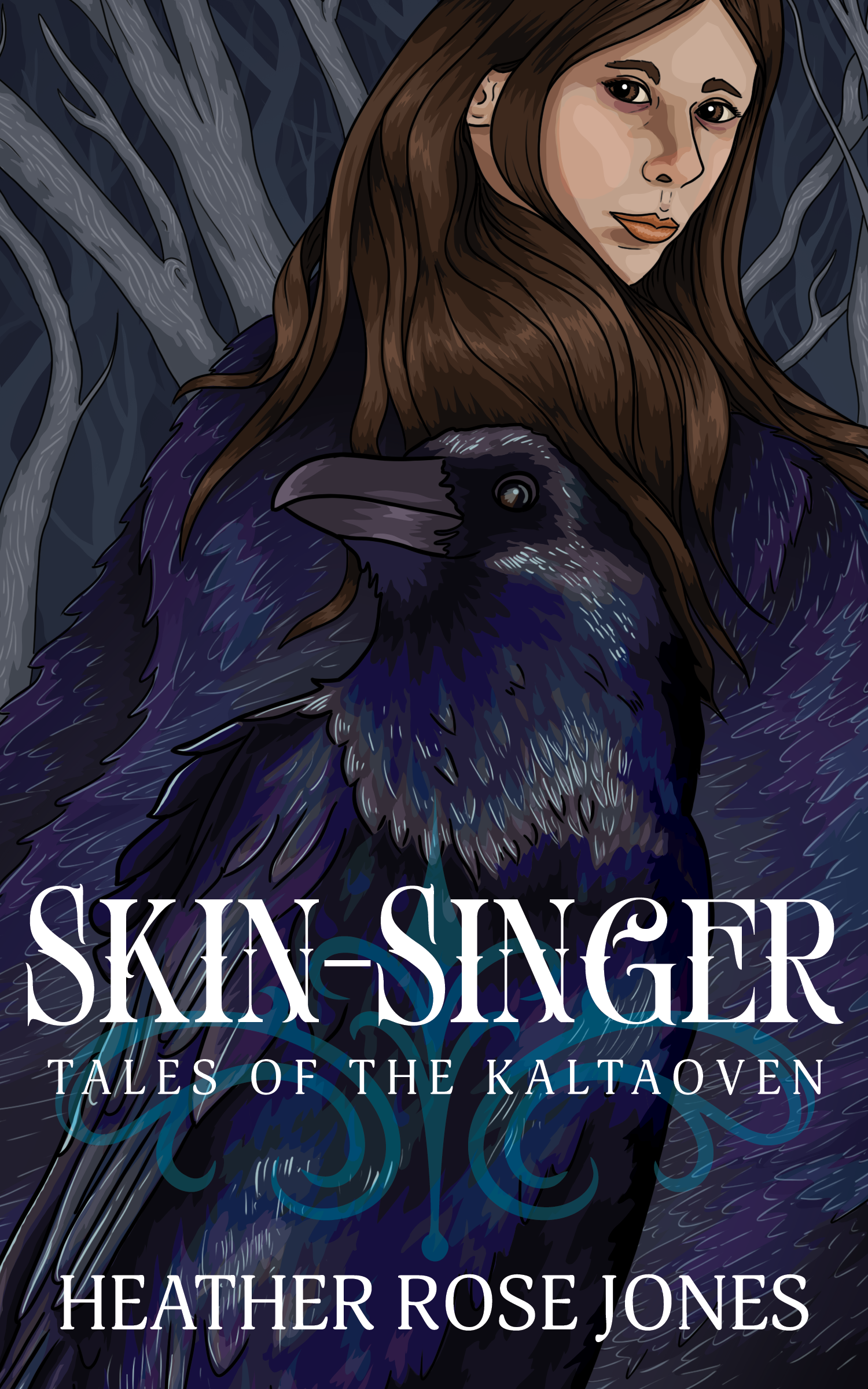
The collected skin-singer stories are now on their way to publication! I just pushed the buttons for the ebook and POD versions at Draft2Digital a few minutes ago. (I need to set up Kindle separately, so I haven't done that quite yet.) Official release date will be August 10 (assuming I did that correctly at the website).
This is my first professional (i.e., for-sale) self-published fiction, so I've been picking up a lot of new skills and experiences along the way. I worked with a fabulous cover artist: The Illustrated Page Book Design (Sarah Waites).
Next steps are to set up distribution for Kindle. (For various logistical reasons, as advised by more experienced people, everything is simpler if I do that separately from D2D.) Also look into distributing through at least one other outlet that D2D doesn't handle. Eventually I should set up a direct sale apparatus on my website, but that will take consultation with my web designers. I also plan to record it for audiobook.
Once I have buy links available, they will of course be added.
Major category:
PromotionPublications:
Skin-Singer: Tales of the KaltaovenSunday, July 27, 2025 - 12:00
Part chance and part strategy, I'm in the middle of a sequence of pairs of related articles: 2 on linguistics, 2 on Eliza Haywood, 2 on bluestockings, 2 on anatomical issues.
The other thing I'm in the middle of that I'll be posting more about in the near future is my first self-published book project. I just received the final versions of the cover art this morning and will be completing the set-up process in Draft2Digital. My target was to have the book out for Worldcon (just because it makes a useful deadline). Not sure if I'll have hardcopies in time, but the ebook will definitely be available. Oh...what's that you say? What is the book about? Well, let's save that for it's own separate post.
Major category:
LHMPFull citation:
Ingrassia, Catherine. 2014. “’Queering’ Eliza Haywood” in Journal for Early Modern Cultural Studies, Vol. 14, No. 4, New Approaches to Eliza Haywood: The Political Biography and Beyond: 9-24
In this article, Ingrassia challenges scholarship that views 18th century novelist Eliza Haywood’s work as depicting only heterosexual relationships and instead points out and discusses many aspects of her fiction that represent a wide spectrum of relations between women that range from the homosocial to the homoerotic. [Note: This article has a lot of literary theory jargon, which I tend to find of less interest, so I’ll mostly be focusing on the discussions of the content of Haywood’s work.]
Just because an author is working within a heteronormative framework doesn’t negate other underlying themes. Analysis that ignores those themes simply because they don’t represent the overt message of the work distorts our understanding of the era and the work. [Note: Another key factor here, though Ingrassia doesn’t state it explicitly, is how bisexual erasure works to cover up sapphic readings. As noted in the introduction to The Lesbian Premodern, there has long been a tendency to categorize a historic person as “lesbian” only in the complete absence of heterosexual relationships, while a historic man may be categorized as homosexual on the basis of any homosexual relations.] Thus same-sex intimacies in works like The British Recluse have been dismissed because they occur in a context where the two women are sharing their past betrayals by the same man. The two women admire each other from the moment they meet, then bond through a sharing of grief. In the end, they become a bonded couple living in “perfect tranquility, happy in the real friendship of each other” and shunning heterosexual relations. The details of their shared life from that point is not presented, only their attachment. This has allowed scholars to dismiss the motif as simply “female friendship,” ignoring the vast scope of experiences such a phrase contains in what Ingrassia calls a “failure of the historical imagination.”
Ingrassia observes that Haywood routinely “critique[s] and resist[s] heteronormative structures” with her characters finding ways to escape or transform those structures to exist outside of gender restrictions. The central relationship of The Rash Resolve presents a woman betrayed in a heterosexual relationship (with the aid of a female accomplice) who finds solace, safety, and emotional intimacy with a rich and beautiful widow.
In other works, Haywood emphasizes intimacies between women without the need for a precipitating event that turns them against heterosexuality. In the mosaic text of The Tea Table the connective tissue is the relations between a group of educated and literary women who support each other’s creative endeavors. In a wildly different context, The Masqueraders details the amorous adventures of a rake, whose female partners take even greater enjoyment in then sharing stories of their experiences with each other.
In The City Jilt two women who are intimate and loyal friends scheme together for financial revenge on one woman’s faithless ex, after which they (temporarily) renounce men and live together for a time until one is compelled by necessity to marry again. There are other examples of female intimacies embedded within otherwise heterosexual frameworks. In The History of Jemmy and Jenny Jessamy, the two title characters, engaged since childhood, are oddly indifferent to moving their marriage along, wanting a chance to enjoy the adventures of single life first. For Jenny, this consists of circulating in female spheres: living with two sisters in Bath, sharing gossip with friends (including an anecdote about the madcap adventures of a married woman which includes an “adventure in Covent-Garden—where she went in men’s cloaths—pick’d up a woman of the town, and was severely beaten by her on the discovery of her sex” in a rough acknowledgment of potential same-sex erotics, before the woman returns to her husband for enthusiastic make-up sex. She is background to the main story, but presents an illustration of imaginable possibilities.
This theme—of a secondary character illustrating wider erotic options—also occurs in The History of Miss Betsy Thoughtless in an episode late in the novel in which Betsy becomes instantly fascinated by Mademoiselle de Roquelair on encountering her in a shop. “There was something in this lady that attracted her in a peculiar manner…delight in hearing her talk…longed to be of the number of her acquaintance.” She attempts such an acquaintance and is rebuffed, but later Roquelair appears at her door, late at night in dishabille, confiding that her lover—Betsy’s brother—has thrown her out and asking for assistance. An imaginative space is opened in which Betsy’s fascination is rewarded by intimate friendship, but instead Roqualair moves in, becomes the mistress of Betsy’s husband, and supplants her. But this conclusion is made possible by Betsy’s flash of desire and attraction.
Time period:
Place:
Event / person:
Saturday, July 26, 2025 - 12:00
I've been trying to figure out how to write a podcast on Eliza Haywood without actually having to read a bunch of 18th century novels.
Major category:
LHMPFull citation:
Ingrassia, Catherine. 1998. “Fashioning Female Authorship in Eliza Haywood’s ‘The Tea-Table’” in The Journal of Narrative Technique, vol. 28, no. 3, pp. 287–304.
I’ve been meaning to track down as much queer-aligned scholarship on Eliza Haywood as I can find, with the aim of doing a podcast on her. (Mind you, it would make sense to actually read a bunch of Haywood’s fiction for that purpose, but working my way through older literature is a bit of a slog.) Catherine Ingrassia seems to have made Haywood a focus, so her work may end up being a large part of any essay I do.
# # #
This article looks at contrasting concepts of “woman writer” and “professional author” in the 18th century, using the lens of Eliza Haywood’s writing, and specifically the discussions around writing and authorship contained in her work The Tea-Table. In the early 18th century, resistance to the idea of women as “writers” (which had influenced many women to circulate their work only in manuscript among private social circles) was shifting to resistance specifically to women as professional writers, i.e., ones who aspired to make a living at it. The feeling (other than masculine jealousy) was that for a woman to become the sort of public figure that came from professional authorship was immodest and destructive of domestic happiness.
Haywood’s 1725 The Tea-Table: or, A Conversation between some Polite Persons of Both Sexes at a Lady’s Visiting Day challenges these ideas, showing a (fictional) literary circle enthusiastically sharing and commenting on each others’ literary output. The work included a number of the metafictional works (all written by Haywood, of course). The Tea-Table was intended to be a periodical, but was not continued. Haywood not only wrote professionally, but had her own print shop and engaged in the hands-on work of publishing and distributing her work.
The Tea-Table challenges the idea that a female domestic space (the “tea table”) concerns itself only with trivial gossip, instead creating a vision of a supportive female-centered community (though it doesn’t entirely exclude men, as long as they align with the interests of the women) focused on literature. Her fictional community is not simply “female centered” but is specifically one that valorizes and prioritizes connections between women across a wide range of manifestations. They comment on how society expects them to spend their time competing and criticizing other women and then reject those activities.
There are implications—those never outright admissions—of female romantic partnerships, or simply a rejection of heterosexuality, among the women. The hostess is described as having arranged her life so as to be able to avoid male bonds. She has a “long intimacy” with another member of the circle, and in the final episode of the story, she receives a letter from a long-absent female friend who will soon be returning—new which transforms her with happiness. One of the poems shared is a eulogy written by one woman on the death of her female companion. All these connections are taken as expected and usual by the women of the circle.
The narrative voice praises the beauty of women at the table, and the only positive intimate relationships in the narrative are between women, while the literature they share with each other touches on the hazards of being female in society: marital unhappiness, betrayal by men. They have carried these texts on them, not only to share, but to read for their own sake, and to receive suggestions for improvement or polishing. Their reading is a collaborative experience, repeating favorite passages, and overlapping in their commentary.
When the tea-table conversation is interrupted by the arrival of a woman who only wants to discuss fashion and gossip, the disruption and rejection is clear. And the cooperation and reciprocity of the literary sharing is specifically contrasted with the competitive air of male writers, desperate for attention.
Throughout the work, casually references and citations demonstrate Haywood’s familiarity not only with the standard literary canon, but with the publishing community of her day. Yet Haywood’s role itself—the female professional author—is not represented in The Tea-Table. Her characters are all writers, but not authors, sharing manuscript works, not published texts.
Time period:
Place:
Event / person:
Wednesday, July 23, 2025 - 08:00
Debate over the question of whether you can have "lesbian identity" without the use of the word "lesbian" as a type of person sucks a lot of oxygen out of the discussion of queer history. After all, a number of other words were clearly in use for a long time to describe women who have sex with women. But because the specific word "lesbian" is so iconic and is often a theoretical sticking point for questions of continuity, this one specific text bears a disproportionate amount of weight.
Major category:
LHMPFull citation:
Cassio, Albio Cesare. 1983. “Post-Classical Λεσβίας,” The Classical Quarterly, n.s., 33:1, pp. 296-297.
I’ve made a lot of references to this brief commentary in discussions of the history of the use of the word “lesbian”. This article doesn’t so much add any new information as provide the receipts for those mentions.
# # #
This is a very brief philological note about the appearance and context of the Greek word “lesbiai” (lesbians) after the classical period. It begins by noting usage of the verbs “lesbizo” and “lesbiazo” that refer to fellatio, not to same-sex relations. He also notes Lucian’s reference connecting women from Lesbos with same-sex relations (in the Dialogues of the Courtesans). He discounts a claim (which I reviewed at one point and discarded as irrelevant) that there is a reference to “lesbizo” referring to tribadism in the 15th century. But then he claims that French and Italian uses of “lesbian” in a (same-sex) sexual sense “do not seem to occur before the nineteenth century” evidently overlooking or silently discounting Brantôme and others. And (as usual) claims the same for English, citing the OED.
But the meat of this note is the 10th century commentary by Arethas on Clement of Alexandria’s Protrepticus Paedagogus. The base text by Clement reads:
Γυναΐκες άνδρίζονται παρά φύσιν
“women act as men against nature”
[Note: I’m transcribing this from a badly pixelated scan of a xerox and I’m not at all certain that the diacritic marks are correct. Corrections welcome.]
And Arethas’ commentary reads:
Τάς μιαράς τριβάδας λέγει, ‘άς και ‘εταιριστρίας και Λεσβίας καλοΰσιν
“the unclean tribades (tribadas) who are also called hetairistriai (hetairistrias) and lesbians (lesbias)”
[Note: Cassio declines to give translations, being of a generation who believes that if you can’t read Greek and Latin directly you have no business calling yourself an academic. I’ve drafted these translations by comparing a number of online sources.]
Cassio notes “There are strong reasons for believing that Arethas was not drawing on ancient sources for his comments…except for one instance; so his note is likely to reflect current [i.e., 10th century] Byzantine usage.” He concludes, “Clearly the ill repute of Lesbian women in antiquity was not exclusively due to their alleged propensity to fellatio, and female homosexuality may well have been regarded as typical of Lesbos, though tribads from other parts of the Greek world are also known.” He cites Lucian as a potential inspiration for this association, given its unambiguous reference to women from Lesbos having same-sex relations.
Time period:
Place:
Event / person:
Monday, July 21, 2025 - 10:00
Because I enjoy doing clusters of related publications, here's the first of two talking about the semantics of the word "lesbian."
Major category:
LHMPFull citation:
Blank, Paula. 2011. “The Proverbial ‘Lesbian’: Queering Etymology in Contemporary Critical Practice” in Modern Philology 109, no. 1: 108-34.
A great deal of this article isn’t directly of interest, so much will be glossed over. The “proverbs” in question are various Greek adages in reference to people from Lesbos that mostly are not in reference to female same-sex relations. [Note: I’ve seen some arguments that some of the interpretations are more ambiguous that indicated here, but I’ll stick to summarizing what’s in this article.]
Greek proverbs using words relating to Lesbos to refer to fellatio, or to deprecated sexual practices in general, were familiar to, and quoted by, Renaissance authors such as Erasmus. This article asks the question whether those senses continued to be associated with “lesbian” in the same-sex sense, even though the non-same-sex uses were functionally obsolete in the Renaissance and indeed into modern times. Contemporary use would appear not to invoke these other sexual implications at all, but Blank explores the question of whether it’s reasonable or possible to pick and choose etymological heritage in this way. To what extent is past usage a baggage that a word cannot leave behind. [Note: One could ask similar questions without some of the negative aspects about contemporary uses of “gay” or “queer”.]
The article spends a fair amount of time discussing the nature and history of etymological inquiry, and how “folk etymology” has always been a part of the conversation. Then we get a lot of discussion of queer theory and attitudes toward historic connections across time. Fifteen pages later, we get back to the history of the use of “lesbian” to refer to female same-sex relations, inspired by the popular understandings of the poet Sappho of Lesbos. There’s an interesting quote from David Halperin (who, in general, comes off as hostile to "queer continuity" positions) when he notes that, although the use of the word in this sense is relatively modern, the word itself “is in that sense by far the most ancient term in our current lexicon of sexuality.” But the article then repeats the prevalent erroneous claim that the word didn’t develop this sense until the late 19th century, although there has been regular use of “lesbian” in other senses (including the literal “person from Lesbos”) during the intervening time.
Blank refers to “the survival of alternative ‘lesbians’ well into the Renaissance and beyond.” [Note: This may be overstating the continuity, considering how much of the classical material in which it “survives” dropped out of sight for long periods, only being brought back into circulation as part of Renaissance scholarship. So I question the framing “survival…well into the Renaissance” as indicating any greater continuity of non-same-sex usage than the appearance of same-sex usage during roughly the same era with the renewed interest in Sappho’s work and reputation.]
Early Modern Greek and Latin lexicons reiterate the derogatory sexual senses of words deriving from Lesbos and notes that these continue to appear in Greek lexicons into the 19th century, though Blank notes that these senses do not appear to have migrated into vernacular languages. Earliest English dictionary citations are for “related to Lesbos” and an architectural tool called a “Lesbian Rule.” [Note: But see Turton 2024 on the deliberate and systematic exclusion of vocabulary for female same-sex relations from English dictionaries up until the early 20th century.]
Blank questions any earlier citations in which associations with female same-sex relations can be attributed to literal reference to “women from Lesbos,” as in Lucian’s Dialogues of the Courtesans distinguishing between “associations” and “denotations.” Thus, for example, Brantôme’s reference to “such women and lesbians in France, in Italy, and in Spain, in Turkey, Greece, and other sites” is considered an association rather than a new denotative meaning. Because the passage makes specific reference to the term being inspired by Sappho of Lesbos, she (and Halperin) consider it still a geographic/ethnic term rather than having acquired an autonomous definition related to same-sex relations. [Note: I strongly disagree with this analysis of Brantôme's use.] And, she notes, new meanings always arise out of polysemous ambiguity. [Note: This may possibly be the only point in the Project where a publication by my dissertation advisor gets a reference in one of the articles I’m reading.]
After discussing how one cannot simply treat the same-sex meaning of “lesbian” as entirely uncontaminated (my term) by earlier senses relating to other types of deviant sexual behavior, Blank questions whether that means we should reject it entirely for same-sex use, to which we can add the anachronism of using a 20th century definition when discussing sexuality in earlier ages. She asks, “If we want a real neologism for female homosexuality, a word that means ‘one thing and one thing only,’ we could consider abandoning ‘lesbian’ and creating one. That might solve the persistent dilemma facing scholars who work on the history of same-sex female desire.” [Note: I have so many issues with this suggestion that it’s hard to know where to start. Is a neologism invented in the 21st century going to eliminate the problem of it coming embedded in 21st century definitions of sexuality and identity? If writers have been using words derived from Lesbos to refer unambiguously to female same-sex relations since at least the 10th century (a commentary on Clement of Alexandria), then how are all those centuries of use not pertinent to considering “lesbian” to have a heritage of use crossing over a wide span of understandings of sexuality and identity? It can be very hard not to feel like people are saying “you have this word that has a rich, unique, beautiful history—'by far the most ancient term in our current lexicon of sexuality'—and we’re going to find every argument possible for taking it away from you.] Several other approaches are discussed, including terms like “proto-lesbian” or “lesbian-like” that only marginally address the concerns. She concludes by suggesting that we can’t claim rights to “lesbian” in the modern sense without also embracing all the other meanings the word has had, even ones in direct contradiction—and this is the choice Smart eventually supports. I’m going to quote part of the conclusion extensively because I want to quote it in my book and this is an easy way to keep track:
“Our current use of ‘lesbian’ goes back to Lesbos, I would add, because we keep talking about the word as if it were an island of language, curiously untouched by the full range of its past and therefore its present meanings. We treat it as an island, perhaps, because our vernacular lexicon has relatively few terms for female same-sex love and desire; apart from slang words such as ‘dyke,’ or ‘femme,’ or ‘butch,’ ‘lesbian’ is practically all we have, and we are protective of it. Though we may alternatively call ourselves ‘gay’ or ‘homosexual,’ such terms are, for some, invariably and problematically gendered male.”
[Note: I should be clear that I agree on many of the points of Blank’s article: that the specific “female same-sex relations” sense of “lesbian” is not original to ancient Greek, that the word has had a variety of senses over the centuries, and that one should not pick and choose among those in order to imply a teleological development of the dominant modern English meaning. But as often happens, there is a tendency to hold same-sex usage to a disproportionate standard of evidence and certainty, while accepting other definitions based on “common knowledge” that has actually been questioned. And it never helps when the same-sex evidence relies on a chronology that is simply incorrect.]
Event / person:
Sunday, July 20, 2025 - 11:03
Lesbian Historic Motif Podcast - Episode Sexology Changed Everything: or, Why the LHMP Ends Around 1900 - transcript
(Originally aired 2025/07/20 - listen here)
Introduction
The Lesbian Historic Motif Project has a fairly expansive scope, covering not only women-loving-women throughout history, but also themes and motifs that can be useful when writing lesbian or sapphic characters, such as gender-crossing (which is nearly impossible to separate out) and singlewomen (because they speak to the possibilities for women who don’t marry for whatever reason). There are some topics where my coverage is limited due to logistical reasons, such as non-Western cultures, where research may not have been done yet or may not be accessible to me for language reasons. But the one area where I have deliberately limited the scope is in cutting off coverage around the beginning of the 20th century.
There are two reasons for that. Partly, it’s to keep the Project manageable. There is so much more information on lesbian history available after 1900 that it would swamp the coverage of earlier centuries. Just as any queer history project that aims to take a gender-neutral approach will inevitably end up focusing primarily on men, any history project that covers the entire time-span up to the present day will inevitable end up focusing on the 20th century. And I’ll be honest: I’m simply less interested in 20th century history. I’d rather focus deeply on earlier periods.
But the second reason is philosophical. There was a massive change in both professional and popular understandings of sexuality around 1900. The attitudes and experiences that we, as contemporary people, take for granted as “how things are” are a product of that change. That means it’s far more difficult to understand what queer lives were like before the 20th century based simply on projecting backwards. There’s something of an illusion that queer history has been a steady march of progress toward greater acceptance, openness, and rights. And therefore, if you want to know what queer lives were like in earlier centuries, you can just take the status quo of the early 20th century and project backwards.
Well, you can’t. It’s much more complicated than that. Earlier queer history was qualitatively different along many axes. Ideas that we take for granted today were invented—and invented for specific social and political purposes—in the period covering roughly 1880 to 1920, that is, a couple decades to either side of 1900. Some people will frame this as: “the concept of homosexuality didn’t exist before the late 19th century.” That framing leans too hard on presentism—on the idea that the current definitions and understandings of queerness take priority. On the idea that specific words are important and that if the word “homosexual” didn’t exist, then the concept didn’t exist. Continuity exists as well, whether it’s the constant background radiation of “people experienced and acted on same-sex desire” or whether it’s recurring cycles of particular expressions of that desire.
But within those types of continuity, there is a disruption that invented new ways of thinking about same-sex desire. We are still feeling the effects of those ways of thinking to this day. And the name of that disruption is “sexology,” the idea that gender and sexuality can and should be studied as a medical phenomenon, whether biological or psychological, and that—because it is a medical phenomenon, it is defined as an illness to be treated or prevented. Now, to be clear, older attitudes toward queerness aren’t “better,” given that they include things like “it’s a sin,” “it’s a crime,” or “it’s a mistake of nature,” but they were different.
Today’s podcast looks at the rise of sexology, its principles, its cast of characters, and the ways in which it affected the lives of queer people ever since. With, of course, a specific focus on women-loving-women. Because sexology categorized all female-bodied people together, and because the question of distinguishing physiological sex from gender identity is one of the key concepts of sexology, I’m going to use “women” as a shorthand for “female-bodied people” most of the time. It’s not the ideal choice, but it’s a practical one.
The Roots of the Medicalization of Sexuality
The medicalization of sexuality did not suddenly pop into existence in the 1880s, elbowing out prior framings that it was an issue of morality, or in some cases criminality. We can trace medical theories about sexuality and health back to the “masturbation panics” of the 18th century, which alleged that masturbation (but not heterosexual intercourse) could lead to physical and mental debility. In the 19th century, the newly invented idea (associated with the Victorian age) that an active sex drive was a masculine characteristic and that women were “naturally” (in scare-quotes) passive during sex meant that women expressing active sexual desire could be diagnosed as abnormal. This had clear consequences for lesbian sex as it required one or both women to experience an active sex drive.
Medicalization of non-normative sex meant that even if specific sexual expressions were not criminalized—and this was generally the case for lesbianism—they could be stigmatized as an illness that required treatment or at least suppression. But this illness model of same-sex desire still viewed it as something that could happen to anyone, given the right (or rather, the wrong) conditions. One aspect of sexology was that it began associating this supposed illness with an identifiable type of person.
One precursor to sexological theories was the condition labeled “neurasthenia,” sometimes referred to as “nervous exhaustion”—a condition particularly assigned to women. The general idea was that an “irritation” of some part of the body or mind would trigger symptoms elsewhere in the body, such as fatigue, anxiety, headaches, depression, fainting, and heart palpitations. (Readers of 19th century novels should find this all very familiar.) And what types of irritation caused neurasthenia? Here every doctor had his own theories. In fact, if you had a patient with these symptoms, you could pretty much always find some sort of trigger to blame it on. It could be mental stress or intellectual exertion. (This was a popular reason for forbidding women to engage in intellectual pursuits.) It could be social isolation or, conversely, the stresses of urban life. And, most pertinently, it could be caused by insufficient sex, too much sex, or the wrong kind of sex. The most benign treatment recommended was a “rest cure,” separating the patient from the stresses that were believed to have caused the condition. Needless to say, this was a cure—and to some extent, a diagnosis—that was primarily available to middle and upper class patients.
Neurasthenia was generally considered to be distinct from hysteria, with the former being considered a physical illness and the latter a mental one. But the two had a significant overlap, though generally “hysteria” was a label only applied to women. In both cases, with the rise of sexological theories many of the symptoms previously attributed to neurasthenia and hysteria were attributed to the effects of psycho-sexual illness, with the added belief that it not only had a physical cause, but that there was an inherited component. This would bring eugenics into the mix.
One additional medical field that contributed to sexology was the study of intersex conditions. Western culture had long had ideas about biological sex existing as a sliding scale from masculine to feminine, with the possibility of people inhabiting an intermediate position, either in terms of physiology or psychology. This had primarily been a legal concern, to determine which gender category the person should be placed in under the law. Advances in the study of anatomy and improved understandings of the biology of reproduction in the later 18th and 19th centuries pared away some of the mythology around the topic, but the idea that there was a physiological basis to gender identity persisted. What the sexologists added was the idea that this physiologically-based gender identity could be at odds with one’s apparent anatomy. They were sooooo close but, as we’ll see, they hadn’t managed to escape rigid binary thinking.
The Political Context
In addition to setting the medical stage for the development of sexology, we need to review the legal and social context. Given that the medicalization of sex had been going on for about a century, and given that the Enlightenment had pushed all sorts of topics toward a more scientific approach, why did the “science of sex” arise in the specific era when it did?
One factor was changes in legal systems that gave certain people an incentive to address the topic. The legacy of medieval law in continental Europe identified sodomy as a crime, though it was confusing and ambiguous regarding whether sex between women was included. But the Napoleonic law code, which was promulgated well beyond the borders of France proper, removed homosexuality as a crime, although it did forbid public sex and any type of coerced sex. This resulted in Germany being a patchwork of approaches, depending on whether a particular region had adopted the Napoleonic Code or not, and of course England continued to outlaw male-male sex on the basis of the 16th century Buggery Act which did not cover women.
The rise of nation-states in Europe was accompanied by gendered socio-political concepts. Cultural and linguistic nationality tended to be viewed as feminine, with female virtue being essential to the purity of the national culture, while the political apparatus of the nation-state was viewed as masculine, with all the stereotypical masculine virtues associated with it. “Unmanly” men were a threat to the integrity of the nation-state while unfeminine women were a threat to its culture. To the extent that women in same-sex relations appeared “feminine” they were both legally invisible and politically unthreatening. But men in same-sex relations were an existential threat to the state.
At the same time, the coalescence of independent polities into nation-states, as in Germany and Italy, meant that legal systems needed to be standardized. In Germany, this meant standardizing on a prohibition of male-male sex in the 1871 law known as “Paragraph 175.” (There was later an attempt to add women to this statute, but it failed.)
In the United States, due to the federal legal structure, any laws specifically addressing homosexuality continued to be local, but a national tendency towards anti-sex laws can be seen in the Comstock Act of 1874 which banned “obscene” material from the U.S. Mail, covering personal correspondence as well as published material. Explicitly homosexual material would automatically be classified as obscene.
Why were these legal changes a trigger for the rise of sexology? Because some of the earliest proponents of sexological theories were homosexual men in Germany who had had the legal rug pulled out from under them and set out to convince the world that sexual orientation was a neutral, inborn condition that should not be criminalized. We’ll get back to that in a little bit.
Sexology, in theory, should have been gender-neutral in its principles and consequences, but the world is not gender-neutral and one other critical factor in how things played out was the rise of feminism and the “New Woman” who demanded equality in public life.
There have been a number of cycles of feminism across the centuries, but we’re talking about the one developing in the later part of the 19th century which focused on aspects like access to employment, the right to property, and eventually the right to vote. In part, women were agitating for structural changes, but in part they were just going out and doing the things. They were getting higher education, entering professions, and exploring ways of living that didn’t require marriage to a man. Because education and professions were strongly male-coded, many women saw adopting some aspects of a masculine presentation either as a practical necessity or as a way of being taken more seriously, or simply as aligning with their self-image. Because marriage to a man was, in general, incompatible with having a profession or with pursuing academic or artistic interests, such women often formed their primary emotional and social connections with other women.
These “New Women” came from many different backgrounds with many different economic, political, and social agendas. Some had the type of wealth that insulated them from other people’s opinions. Some were barely getting by and took on male-coded jobs out of economic necessity. Some were idealists who saw a feminist revolution as the salvation of humanity. Not all of those had the same vision of what a feminist revolution would look like. What they all had in common was that they challenged patriarchal ideas of what women should do and be. And that made men nervous. (It also made many women nervous.)
Based on both the actual lives of these women and satires poking fun at them, we can identify some of the features that were considered symptoms of rejecting a proper feminine role:
- Masculine-tailored clothing even, in some cases, trousers
- An aversion to corsets
- Male-coded activities like drinking, smoking, engaging in active sports, and whistling. (Yes, whistling. When I was a girl people would still scold girls for whistling because it was considered unfeminine.)
- Short (male-coded) hairstyles
- Engaging in romantic and sexual relationships with women
- And, in general being “very independent in her ways” or “rebelling against the lot of women in general”
These “New Women” were distinct from female-bodied people who presented as men—so-called female husbands and passing women—because the latter generally didn’t challenge gender roles, they simply quietly appropriated an existing one. But the former staked a claim on new ways of being women, as women.
In addition to the visibility of the feminist movement, in its many forms, there was a growing visibility of urban homosexual subcultures, in places like Paris, Berlin, and New York. These were primarily male-focused, but there was also a pattern of women with same-sex desires migrating to cites and creating their own communities, or integrating into gay male or artistic communities. Visibility generated anxiety as well as fascination, and it was becoming harder for conservative middle-class people to simply ignore the existence of same-sex erotics.
The Theoretical Framework
When all of these factors came together, Western culture was ripe for Something to happen. And that something was sexology. When putting together this episode, I went back and forth a lot on whether I should introduce the theoretical framework of sexology first, or discuss the people who developed it first. So I’m going to split the difference and give a brief overview of the ideas, then a chronology of the key figures and their contributions, then return to elaborating on the theories and their consequences.
The field of sexology encompasses several different theoretical models, but they all have certain principles in common. Masculine and feminine are distinct and identifiable states of being, composed of a group of features that include physiological features, including not only primary and secondary sex characteristics but other aspects of physical health and appearance, as well as intellectual and psychological features, including how romantic and erotic desire is expressed, and behaviors including preferences in dress. The default expectation is that these features will align either with a female archetype or a male archetype. If there is misalignment among these features—that is, if some fall in the masculine category and some fall in the feminine category—this represents an abnormal and even pathological state that will manifest either in deviant behavior or as illness, both physical and psychological.
The theories diverge on some other points. Is this misalignment—or at least a predisposition to misalignment—an inherent condition or is it acquired in some way? If it is acquired, is it due to some personal experience, perhaps in childhood, or because of some environmental factor? Can the misalignment itself be corrected, or is any treatment only focused on its secondary consequences?
We’ll come back to the specifics of these models after meeting our cast of characters.
The Big Names in Sexology
The earliest work in sexology was done in Germany, with interest spreading further as that research was disseminated and reacted to. The general consensus identifies Karl Heinrich Ulrichs as the starting point. Ulrichs was not a medical professional—he was a lawyer in the civil service—but he was also a gay man and believed that his sexual desire for men was a natural and inherent aspect of his being. Before he began publishing on the topic in the 1860s, he quit his legal position due to fears about blackmail, and came out to his family and friends, though initially he published under a pseudonym. In 1862 he came up with the term “Urning” or Uranian which he described as a female soul within a male body, the way he conceived of his identity. He considered this to represent a “third sex” neither male nor female. In theory there was a female equivalent—a male soul within a female body—but Ulrichs’ activism was focused on men and, like other sexologists who used the term, he viewed the “third sex” as an inherently masculine phenomenon. In the 1860s and ‘70s he published regularly arguing in defense of homosexuality and the need for legal reform, but later left Germany for exile in Italy.
He corresponded regularly with others entering the field, not only in Germany but elsewhere in Europe. These discussions are the context in which much of the standard terminology evolved including “homosexuality” (initially as German Homosexualität) and “contrary sexual feeling” (as German conträre Sexualempfindung). The biggest part of Ulrichs’ legacy was to start a conversation that quickly spread throughout the Western world, as seen by the first use of the term “sexology” in a U.S. publication in 1867, as well as “sexual inversion” which quickly became established as a standard term. But it was for others influenced by Ulrichs to blend his ideas with existing medical frameworks, especially his countryman, Richard von Krafft-Ebing.
Krafft-Ebing was the power-lifter of sexology, taking a very different approach from Ulrichs. He was a neurologist and psychiatrist and developed his theories primarily through case studies of criminals and patients being treated for psychological disorders. His theory was that “sexual inversion” was a congenital condition that reversed the alignment of gender characteristics and the physical body. His model rested on the principle that everyone was actually heterosexual (and therefore apparent homosexuality was due to having an inverted gender identity), and that gender identity was identical to the prevalent social stereotypes of gender (and therefore acting contrary to those social stereotypes was a symptom of gender inversion). His theories conflated what would later be distinguished as homosexuality and transsexuality.
Krafft-Ebing was not burdened with the empathy that Ulrichs and some other researchers derived from having same-sex desires themselves, and one of his specialties was the relationship between psychiatry and criminality. Given that all the homosexuals he studied were either criminals or mentally ill, he naturally concluded that homosexuality was a causal factor in criminality and mental illness. But wait! They couldn’t help it—their condition was due to hereditary factors and a family history of a “nervous taint.” These unfortunate homosexuals shouldn’t be pursued by the law, but rather should be treated by modern medicine. His arguments for decriminalization of male homosexuality were ignored, but his monumental work, Psychopathia Sexualis, became the foundational text of sexology, exploring in great detail all types of sexual deviancy, which he defined as any kind of non-procreative sexual activity.
Krafft-Ebing’s work had certain flaws. He developed his theories and then shopped around in his data to find cases that supported them. His data had no control set, relying entirely on individuals who came to his attention for some other problem. And he tended to discount the experience of people who aligned with the social stereotypes for their gender. There was no place in his classifications for femme-femme couples; his classification of female inverts only included feminine partners of “masculine” women, cross-dressers who took on some masculine attributes, “fully-developed” inverts who not only adopted masculine dress but took a male social role including a female partner, and the extreme case of women who lived completely male lives (which would previously have been called “female husbands” or “passing women”). He considered these four distinct categories, rather than points along a continuum of gender identity.
Given that Krafft-Ebing saw male and female homosexual acts as equivalent, he argued that since women’s acts weren’t criminalized, neither should men’s be. This had something of the opposite effect from what was intended, as sex between women had historically been treated as “not really sex,” and that was one basis for not criminalizing it. If, as he argued, women were, indeed, having real sex with each other, maybe that needed to be scrutinized more closely. We’ll discuss some of the fallout from that later.
We now move across the channel to the English physician and social reformer Havelock Ellis. Ellis was, let us say, an interesting character. He was at the same time a political progressive and a eugenicist. He experimented with psychedelic drugs and documented those experiences. He knowingly married a lesbian and had an open marriage, then proceeded to be grumpily jealous of her girlfriends. And he wrote the first English language textbook on homosexuality, Sexual Inversion, in 1897.
His work on homosexuality was full of contradictions. He didn’t consider it a disease, a moral impairment, or a crime, and yet he associated homosexuality with “lower races” and degenerate parts of society. He was fixated on the social and ethnic heritage of his patients. And one of his arguments for decriminalizing and destigmatizing homosexuality was so that homosexuals would be open about their orientation and would feel free to avoid marriage, thus taking themselves out of the gene pool in a self-correcting mechanism. (He also supported feminism and birth control for eugenics reasons.)
Although he considered male and female homosexuality to be equivalent, he thought they had distinct causes. Men might be homosexuals due to a congenital predisposition—after all, attraction to masculinity was perfectly natural and expected. But female homosexuality was due to a lack of access to heterosexual marriage. They were rejected or surplus women, thus they flourished in homosocial environments like schools and convents. Personality traits that he found admirable, such as intellect and forcefulness, were coded as masculine, therefore women who had these traits were inherently masculine and if they found no productive outlet for their abilities they would naturally turn to criminality. He constantly looked for physical characteristics of this inherent masculinity, but never considered their absence to be meaningful.
I don’t mean to overlook the sexological literature in other countries. Italy had a proliferation of publications beginning around 1880, with a special interest in female homosexuality, especially in all-female institutions. French researchers, too, had a particular interest in lesbianism. U.S. physicians read up on the literature coming out of Europe and began applying it to their own patients. A paper applying a sexological diagnosis to a “female husband” case appeared in the U.S. in 1883 and may well be the first such case study published there as well as an early example of the word “lesbian” used unambiguously in America for a female same-sex relationship.
But let us move on to another major player, Magnus Hirschfeld. Like Ulrichs, Hirschfeld was not simply a writer on the topic of queer sexuality, but also a gay man and an activist for the decriminalization and public acceptance of homosexuals and transgender people. He began studying gay subcultures in Germany and elsewhere in the mid 1890s and began publishing on the topic in 1896. His position was that homosexuality was a biologically-based, naturally-occurring phenomenon. Unlike some other sexologists, he made a clear distinction between homosexuality and cross-dressing or transsexuality. He subscribed to the idea that sex, gender, and sexual orientation all existed on independent spectrums and that individual identity was due to positioning on those sliding scales. This put him at odds with some of his followers who looked to a classical Greek model for male homosexuality and rejected the idea that there was any aspect of femininity involved. Hirschfeld supported feminism and was involved in successfully preventing an attempt to add lesbians to the anti-gay laws in Germany.
In 1908, Hirschfeld started publishing the Journal of Sexology (Zeitschrift für Sexualwissenschaft) and in 1919 he founded the Institute for Sexology, collecting and contributing to studies and publications on gender and sexuality. In the 1930s, the Institute was targeted by Hitler for elimination, and familiar photographs of Nazis burning bonfires of books are of the destruction of the Institute’s collections in 1933. At the time of the attack, Hirschfeld was abroad on a lecture tour. He never returned to Germany but continued to lecture and publish in exile.
The last of our prominent sexology pioneers, illustrating the shifts in focus of the field, is Sigmund Freud. While Freudian theories are probably familiar to most, the key elements with regard to sexual orientation are that he rejected the congenital theory of sexuality and gender identity and instead saw non-normative identities as deriving from experiences, especially in childhood, that disrupted what he considered to be the expected progress of sexual development. Like Havelock Ellis, Freud made qualitative distinctions between male and female homosexuality, rather than viewing them as directly equivalent. He viewed lesbianism as an imitation of masculinity due to the infamous “penis envy” that supposedly led women to take on male attributes (including desire for women) due to a deep-seated desire to become a man. He believed that homosexuality—like all neurosis—was curable by encouraging the patient to remember, identify, and come to terms with the experiences that had triggered it. Freudian approaches to psychiatry were industry-standard well past the mid-20th century, entrenching his attitudes towards sexuality into Western culture.
Concepts in Sexology
So let’s return to exploring the theories and consequences of the sexological approach as they addressed homosexuality.
Causation
As we noted in the brief overview, successive theories ascribed homosexuality to a succession of causes. In the 1880s, the popular theory was a physical cause, perhaps a “nervous disorder,” but there were also traces of earlier theories that specific anatomical features might predispose someone to same-sex desire. For women, this included the mythical enlarged clitoris—a motif that was still appearing in sex manuals in the 1960s, by the way. As a physical ailment, it could be treated by physical methods, including surgery to remove the clitoris. This recommendation appeared in medical manuals, though it appears to have been done rarely and was considered to have dangerous side effects.
By the 1890s, the focus had shifted to a congenital predisposition due to a mixing of male and female elements in the personality. If homosexuality was an inherited condition, then it should not be treated as criminal. The symptoms could be managed, but not cured. An extreme version of the congenital theory was to classify inverts as biological hermaphrodites, with “structural cellular elements of the opposite sex.” This helps explain the undue interest doctors took in recording the genital anatomy and menstrual habits of patients being examined for lesbianism. But all manner of behaviors were considered to be part of this inherited package, including preferences in play and dress, styles of social interaction, and whether one was passive or active during sex.
The principles of genetic inheritance were being developed in the mid-19th century and social scientists eagerly seized on the idea that certain personality characteristics could be bred into or bred out of a population. Hence, the birth of eugenics. We’ll get back to eugenics is a little bit. This congenital theory reached its apex around 1900, due to the support of people like Havelock Ellis, but then began to shift to focusing more on personality features than anatomy. This was summed up in the idea of a “female soul in a male body” or “male soul in a female body”—a concept raised decades earlier by Karl Ulrichs. As noted previously, this idea was rejected by some male homosexual activists in the first decade of the 20th century who drew on classical motifs and disliked being considered in any way feminine.
The final stage was the Freudian approach that homosexuality and other neuroses were acquired due to early experiences and was not an inherited condition.
Eugenics and Criminality
Freudian psychology failed to dissuade the eugenicists, who combined initial understandings of heredity with racism, sexism, and classism to conclude that civilization was undergoing a dangerous slide into “degeneracy” that could be addressed by controlling—or at least encouraging—human breeding restrictions to eliminate undesirable behaviors such as poverty, crime, and mental deficiency, among which they classified deviant sexuality.
Classism within sexological research meant that middle and upper class individuals who sought medical help for some unrelated issue tended to have their homosexuality classified as an illness, while lower class individuals who came to the attention of authorities for reasons related to poverty and crime tended to have their homosexuality classified as just another symptom of their underlying immorality.
Sexism meant that the relationship between homosexuality and criminality was proposed differently for men and women. Havelock Ellis, for example, despite his asserted belief that homosexuality should not be considered criminal, thought that lesbians were more likely to incline to crime due to their underlying masculine nature.
Researchers who considered homosexuality to be an inherited condition may have thought they were arguing for tolerance and acceptance, but they provided fodder for those who thought it could be bred out of the population. The most benign version argued that if queer people didn’t have to hide their natures, then they would choose not to breed on their own. Most opinions were not that benign.
Eugenicist theories of degeneracy tended to not only clump all undesired behaviors under that label, but considered them to be inherently associated. The preexisting criminalization of homosexual behavior resulted in an assumption that homosexuals were inherently criminal and that this would manifest in all manner of ways. If someone committed a crime and was then discovered to be homosexual, that was fastened on as the cause for their criminality, no matter how tenuous the connection.
For lesbians, the most persistent motif was their association with prostitution. Even when lesbianism itself was not illegal, as in France, its presence among communities of sex workers was considered an aggravating factor.
The influence of sexology on criminal cases varied considerably. In England, sexology seems to have had little impact on legal arguments, with courts continuing to divert anxieties around lesbianism (which, as you’ll recall, wasn’t illegal there) into convictions for fraud and such. The most public clash between sexological theories about lesbianism and the courts came in the obscenity trial over Radclyffe Hall’s novel The Well of Loneliness. We’ll talk about Hall a bit later.
In America, sexology might be used to successfully argue that a crime was due to insanity, if the defendant was homosexual, as in the case of accused murderer Alice Mitchell in the 1890s.
Implications of the Models
Let’s circle back to examine some of the structural implications of sexuality models such as “gender inversion” and “a third sex.” The basic concept of “gender inversion” was that a person’s physiological sex was at odds with the binary gender category associated with their personality and behavior. Since these gender categories included an assumption of heterosexuality, we can shorthand gender inversion as “everyone is heterosexual, but some people are transgender.” Early concepts of inversion were far more focused on gender presentation than the object of sexual desire, so even nominal heterosexuality was not a defense against being diagnosed as having gender inversion. But sexual desire for someone with the same physiological sex was a certain symptom of gender inversion.
In theory, this meant that only effeminate men and masculine women were classified as “inverts”. The femme partner of a masculine woman could escape the label—especially as there were still lingering traces of assumed female passivity. She could be assumed to be just accepting the attention, perhaps overwhelmed by the forceful (read: masculine) personality of her lesbian partner, or even specifically attracted to her partner’s masculinity. For men, there was a longstanding assumption that if you were always the “active” partner in sex and had no effeminate mannerisms, then you didn’t have to consider yourself homosexual. This assumption was beginning to weaken, as gender inversion diagnoses in men focused primarily on sexual behavior. But for women, the focus was much broader, encompassing social, not just sexual, behavior—especially behavior that challenged traditional roles for women. We’ll get back to that a bit later.
Eventually, the gender inversion model split into considering gender performance and sexual orientation as separate considerations, though still ascribing the results to an underlying disorder of gender identity. When this happened, femme lesbians became more visible to the professional establishment. Rather than treating them as passive objects who simply accepted the attentions of their partner, much in the same way that the wives of “female husbands” had been viewed over the previous couple of centuries, they were increasingly viewed as actively choosing to engage in lesbian partnerships. The underlying assumption that a femme partner could be “saved” by the intervention of a Real Man began to collapse. This had a number of other social consequences that we’ll get to later.
While the basic model for gender inversion relied on a binary understanding of gender—everything was classified according to male or female—some researchers proposed the idea of a “third sex” or “third gender” that was neither male nor female. (This wasn’t quite equivalent to the current concept of non-binary identity, as I understand it. Rather, it was a specific and distinct gender category—a gender “trinary” as it were.) Third gender concepts struggled for coherence because they were mostly developed focusing only on male-bodied people. Thus the “third gender” consisted of male-bodied people who didn’t behave according to traditional masculine gender stereotypes. But they behaved quite differently from female-bodied people who didn’t behave according to traditional feminine gender stereotypes. So either there was a masculine third gender entirely separate from a feminine third gender, or…well, let’s not try too hard to make it make sense.
When applied to women, the idea of a third gender wasn’t necessarily about sexual desire, but more about rejecting traditional roles and behaviors. As such, it was often applied to feminist activists or professional women, with the implication that they’d removed themselves from the category of “woman” and therefore were something different, but certainly not men.
One consequence of the third (or fourth?) gender model was that, rather than forcing people to confront challenges to traditional gender roles, it simply removed problematic people from those roles and put them in their own separate space.
Both the invert and third sex models were eventually displaced by Freud’s ideas about homosexuality representing a displacement of desire to an inappropriate object, lumping homosexuality in with fetishism, pedophilia, and bestiality.
Flaws in the Data
By this time, the careful listener should have noticed a handful of things that bring the validity of sexological research into question. The first item is problems with the data it’s based on. Most sexological research involved either individuals in the criminal justice system or individuals who had entered treatment due to serious emotional or behavioral problems. If you study homosexuality in people who are accused criminals or who have symptoms of mental illness, it’s hard not to conclude that homosexuality is associated with criminality or mental illness, even when the triggering problem had nothing to do with sexuality. There is no control group. These medical professionals had little access to homosexuals who were leading happy, problem-free lives, because those people weren’t talking to them. Havelock Ellis paid lip service to recognizing that many people were homosexual without any sort of morbid symptoms, but as his writings only focused on disturbed individuals, it was easy to miss that acknowledgement.
There was also a voyeuristic streak in sexological case reports. Psychiatrists were fascinated by—one might almost say obsessed with—the odd, the unusual, the shocking. Foucault calls it a “pornography of the morbid.” This can be especially notable in studies of lesbianism, where the (male, always male) researchers zero in on all manner of details of their patients’ sex lives and reproductive anatomy.
Misogyny and Gender
And that brings us to one of the larger elephants in the room. Sexology researchers—like the vast majority of medical professionals at the turn of the century—were men. They were men in a society that discouraged and set barriers against the open and candid discussion of social and political issues between men and women. They were men within a society that not only had unexamined assumptions and beliefs about gendered behavior but that viewed any challenge to those assumptions and beliefs as a type of mental illness itself.
Although some sexologists were themselves homosexual, they had a narrow focus on the experiences and concerns of gay men and more or less ignored female homosexuality except as it could be shoehorned into their theories about men. It was important to them to shape the field in a way that empowered and protected homosexual men, but in some cases their arguments actually harmed the position of lesbians.
Differential Consequences
When sexology wasn’t being indifferent or ignorant about the specific situation of women, it was being actively hostile. Because gender roles covered a broad scope of behavior, there were many aspects of life where women claiming the right to participate fully in society resulted in being accused of acting like a man. In the past, this might have been said with a hint of admiration, but sexology turned it into a symptom of mental illness.
This was particularly acute in relation to experiencing sexual desire. The idea that women were naturally sexually passive was a brand new idea in the 19th century, but that didn’t stop people from treating it as an incontrovertible fact. Therefore, while men with same-sex desires were judged for the object of their desire, women were judged for simply having desires in the first place. Desire was masculine. A desiring woman was acting from an inherent masculinity regardless of the object of her affection.
In turn, any evidence of rejecting a traditional feminine gender role could be seen as evidence of lesbianism. Havelock Ellis claimed that lesbians typically had some degree of “masculinity” in their clothing (despite making a distinction between transvestism and homosexuality for men) and noted that other symptoms of lesbianism included “…brusque, energetic movements…direct speech…[a] masculine straightforwardness and sense of honor…” alongside “a dislike and sometimes incapacity for needlework and other domestic occupations.” (Because, as we all know, sewing and housework are genetically-determined skills!) Whether rejecting feminine behavior led to lesbianism or lesbianism resulted in rejecting feminine behavior, sexologists generally agreed that the two went together. Feminism itself was viewed as a symptom of mental illness because it involved rejecting a role that was considered to be biologically based. To struggle against society’s view of woman’s place was to have an inverted gender identity.
This hostility is especially notable in contexts where sexologists are arguing for greater tolerance and compassion for male homosexuals, but persist in framing lesbians as simply “imitating men”.
Thus we see that the rise of sexology had very different consequences for women and men. By focusing attention on lesbians, it created a climate of homophobia for them that had previously leaned towards benign neglect. In some ways, one of the underlying purposes of sexology was to provide a scientific basis for male supremacy. Even when Freud’s followers shifted the focus from a biological basis for homosexuality to an experiential basis, this shift was applied to men earlier and more strongly than it was for women, whose behavior continued to be treated as congenitally determined.
Pathologization of Female Friendships
One of the most significant consequences of sexology for all women, regardless of gender presentation, was the way it pathologized all close female friendships. Since sexual activity, as such, was not a requirement for a diagnosis of lesbianism, and since it was being established that women did experience sexual desire, therefore the effusive expressions of love between romantic friends that had previously found approval, now were seen as symptoms of “inversion,” especially if one of the pair could in any way be found to have a “masculine” presentation. Keeping in mind that a “masculine presentation” could include things like a love of active sports, a desire for independence, or seeking a profession outside the home.
With the shift in models from “gender inversion” to “inappropriate sexual object” in the first decade of the 20th century, Krafft-Ebing’s category of “passive lesbians”—that is, women in same-sex partnerships that did not have a masculine presentation—became a topic of greater interest. Once femme partners were fully categorized as lesbians, raising the possibility of femme-femme lesbian couples, the medical establishment began pathologizing all intimate same-sex friendships This was a topic of special concern in single-sex institutions such as schools, convents, and gender-segregated work environments.
Any close emotional relationship between women was now viewed as symptomatic of lesbian potential and thus of indicating or causing mental illness. Therefore, for the health of all involved, such close friendships must be managed or suppressed. This was a massive change. Rather than society encouraging gender-segregated socializing and treating women’s friendships as a positive force, women now found themselves second-guessing any context in which an emotional connection with another woman might seem more important than their hypothetical relationships with men. We’ll come back to trace the consequences of this in the next section.
Consequences
We’ve said that sexology changed everything. We’ve looked at how sexological theories came into being, why they developed at the particular time they did, and what understandings of the world they reflected and promoted. Now let’s look at how things changed. What were the practical consequences, not only for those women who got caught up in the machinery of medical and psychiatric practice, but for all women?
Some consequences were societal. After initial victories of feminist movements to gain voting rights and access to broader employment opportunities, aided by the practical need for female labor during World War I, there was something of a retrenchment. The female social and political networks that had driven that progress had become suspect, and even many who had participated felt the need to step back from the spotlight for a while. Or they chose to clearly dissociate themselves from the more extreme figures in their movements who were now being labeled deviant. Within this context, shifting professional concern from “inversion” to “homosexuality” made it possible to overlook the unstoppable aspects of the feminist movement while narrowing the scope of persecution to more marginalized groups.
Some consequences were mixed in effect. Medical models of lesbianism didn’t create lesbian subcultures or identities, but they opened up conversation and exploration. They promulgated images that women could compare themselves to. The image of the lesbian “invert” as a sophisticated, urban, mannish socialite was based on existing social developments. The concept of a female-bodied person having a masculine identity had existed for centuries, but now people had a framework for considering themselves to be part of a larger picture, even if it was one that denigrated them.
By the early 1920s, many lesbians were internalizing the message that not only were their sex lives dangerous and perverse, but their underlying love of women was equally perverse even if never acted on sexually. Interviews with women in this era give evidence of pervasive internalized homophobia that was not generally evident in earlier decades. They saw their lives reflected in an increasing number of homosexual characters in novels in the 1920s and 1930s which typically echoed sexological models, even when depicting the characters sympathetically.
But even as newspaper accounts turned real women’s lives into fictional narratives that were, in turn, appropriated by sexologists as “case studies”, these images were being reclaimed by actual women as identities. As women reacted to sexological theories and began challenging their conclusions based on their own lived experience, we begin to have commentary, letters, diaries, and literature that express the queer female experience from a first-person viewpoint. Ironically, the sexological category of the “true congenital lesbian” gave some women a basis for embracing this identity and claiming a right to live their lives openly. And they didn’t swallow the sexological models uncritically. A study in 1929 regarding gender roles within lesbian partnerships found some women rejecting the idea of “husband-wife” roles, either by alternating who took on which gendered role or by refusing the label entirely.
When we study the lives of people whose lives spanned the rise of sexology, we can see them reacting to and being influenced by those theories. In the well-documented life of Francis “Frank” Shimer, we see her embracing a succession of models, from the “tomboy” to the romantic friend to the masculine-identified intellectual to the confident and secure “new woman” who rejected pathological interpretations of female masculinity.
The impact of sexology on the lives of female-bodied people was gradual and variable, but we can trace the process through several specific categories.
Female husbands/passing women
The group that most closely aligned with early sexological theories, but that may have been least impacted by them, was female-bodied persons living as men, historically identified as “female husbands” or “passing women.” For convenience, I’m going to refer to “passing women” with no intent to make claims about their individual identification. While newspaper accounts of passing women were part of the data that sexologists used in their analysis, it seems to have been relatively uncommon for such people to end up as psychiatric patients, short of some individual crisis. This may be related to the fact that they generally came from the working classes while psychiatric patients tended to be wealthy.
One notable exception is the case of Joseph, formerly Lucy Ann, Lobdell who was admitted to an asylum for depression and dementia and was written up in one of the earliest American sexology case studies in 1883. The study specifically references Krafft-Ebings work and uses the word “lesbian” in the context of Lobdell’s common-law marriage. Lobdell is unlikely to have been aware of sexology theories and simply considered himself a man. Lobdell’s wife, on the other hand, is on record stating that she saw “nothing strange in two women living together,” reflecting a pre-sexology attitude toward female partners.
We can see the gradual intersection of sexology and passing women in their treatment in popular media and interactions with medical professionals. In the mid 18th century, American media tended to “feminize” passing women, emphasizing (or inventing) conventionally femininity and backstories involving heterosexual relationships. In England, 19th century cases tended to be treated as isolated situations, generally driven by economic concerns, but public interest in passing women had faded in England by mid-century. During the trial of cross-dressing thief Lois Schwich in London in 1886, sexological theories were never mentioned. By then English law took little notice of passing women, as such.
By the 1890s, American passing women were more likely to be described as appearing and acting masculine, generally with an implication that people believed their outward appearance. But in the first couple decades of the 20th century, they were being described as physically robust and noted as being awkward and unattractive if required to wear women’s clothing. While these descriptions don’t directly reference sexological theories, they reflect the same changing attitudes.
But though the idea of the “sexual invert” was spreading in America by the 1890s, there wasn’t an instantaneous change in how it was applied or how individuals reacted. In 1903, after Joe Monahan’s physiological sex was identified after death, the media returned to an older pattern of retroactive feminization, complete with invented motivations involving “man troubles” and fake images of Monahan in a hoop skirt, two decades after Joseph Lobdell was being analyzed under Krafft-Ebing’s theories. In 1912, Oregon newspapers described Harry Allen as a “sexual invert,” while only a few years later in a California courtroom Eugene De Forest ascribed his gender identity to his parents’ desire for a son and no mention was made of “inversion.” In 1917, Alan Hart, having studied sexological theories in medical school, and having gone through cycles of depression as a result of internalizing those theories, went to a psychiatrist and asked for assistance in transitioning to living entirely as a man.
While earlier centuries had recognized a wide variety of motivations for passing women: economic, practical, personal, and romantic, sexology flattened all of these into a diagnosis of “gender inversion,” but at the same time offered new ideas of what to do with that diagnosis.
The Mannish Lesbian
Perhaps the most iconic image of lesbianism associated with sexological theory is British author Radclyffe Hall and her self-insert protagonist Stephen Gordon in The Well of Loneliness. Published in 1928 at a time when the concept of “sexual inversion” was solidly established in popular culture, Gordon reflected both Hall’s own experience of upper-class women who adopted male-coded dress and habits to assert their place in the literary and social world, and the image of the tragic mannish congenital invert, doomed to fall in love with a “normal” woman who must be allowed to leave for the love of a “real man.”
While the 19th century sexologists may have focused over-narrowly on the “mannish lesbian” type in their attempt to categorize sexual behavior, they did not invent the characteristics and behavior assigned to this model but rather pieced it together out of the rising urban lesbian culture they had access to. The roots of this type can be found in people like French painter Rosa Bonheur who, in the 1880s shared her life with a woman and habitually wore male-coded clothing, but didn’t identify her dress as part of a sexual identity, rather embracing the freedom from gender roles that it represented. Lesbian culture in the Parisian demi-monde of the Belle Epoque was another source of imagery. But such figures were not the only modus vivendi for self-identified women who loved women. To some extent this “mannish lesbian” archetype was fastened onto as the precise mirror to the “effeminate gay man,” rather than because it was the only model in existence.
Aimée Duc’s 1901 novel in German Sind es Frauen? (Are These Women?) provides a wider variety of images of women who loved women, and does it in a positive and non-tragic story. The story centers on a group of female friends, most of whom met as university students in Geneva. They refer to themselves as belonging to a “third sex” in contexts that make it clear this refers to their love for other women (or perhaps other female members of the “third sex”). These characters (and their real-life counterparts) don’t fit neatly into the categories set up by Krafft-Ebing and others. They are not “inverts” nor do they sort out into distinct categories of female masculinity. The characters spend much of their time discussing gender and sexual politics and critiquing sexological theories.
The predominance of the image of the “mannish lesbian” meant that the female partners of such women could escape the label of “lesbian” even as late as the mid-20th century. It also contributed to the temporary dominance of the archetypal butch-femme pairing, which pervaded lesbian culture well past mid-century.
Not only did the “mannish lesbian” archetype have little room for femme partners, it also glossed over those who used masculine presentation to critique cultural prescriptions and restrictions based on gender. But the lesbian archetype was used as a weapon against those women who adopted male-coded dress or behavior out of a desire for independence, education, and social freedom, but who did not have sexual or romantic desires for women. The conflict drove a wedge between potential allies.
Romantic Friendships and Schoolgirl Crushes
That alliance was perhaps more hypothetical than actual. Women of the romantic friendship/Boston marriage persuasion had long strategized to avoid scrutiny of just how erotic their relationships might be. Sexology blew the lid off, but that didn’t mean that women whose relationships had previously been open and accepted were now eager to make common cause with those who hadn’t been similarly flying under the radar.
But sexology didn’t mean a sharp end to romantic friendship-style relationships, or that such women automatically reclassified themselves as sexual deviants. For one thing, as noted, romantic friendships had always needed a certain amount of self-conscious public relations to avoid accusations of being dangerous or immoral. There was no idyllic era of blissful innocence.
At the same time, positive depictions of romantic friendships were still appearing in women’s and girls’ magazines in the first decade of the 20th century. Love poetry between schoolgirls was published in school magazines. Stories about college romances between women are common, and the gender-segregation of colleges encouraged these friendships to have the trappings of courtship and dating, via activities such as all-woman dances.
As a specific example, the relationship of Rose Cleveland and Evangeline Simpson Whipple began when they met in 1890 and clearly had an erotic aspect at the time. When they moved in together in 1910, there is no indication in their correspondence that they considered themselves to be sexual deviants, but they did take what may have been a precaution of choosing to live abroad.
General suspicion of close romantic friendships between women wasn’t common until the wake of World War I, in the context of much greater female autonomy and the rising influence of Freud both on psychiatric thought and on popular culture.
By the 1920s, an unselfconscious approach may have no longer been tenable, as even someone immersed in openly queer culture like Gertrude Stein couched her erotic expressions in stylized poetic language and allusions. Or maybe that was just Gertrude being Gertrude.
The transition from “innocence” to suspicion of passionate friendships can be traced fairly precisely in published works. In the 1928 novel We Sing Diana by Wanda Fraiken Neff, the protagonist contrasts her experiences at college in 1913, when “crushes” between girls were widespread and considered normal, and the 1920s when she returns there to teach and finds everyone talking about Freud and accepting the stereotype of the “masculine” lesbian. A similar comparison can be made between two autobiographical publications by Mary MacLane, written in 1902 and 1917 that show the same shift. Clemence Dane’s 1915 novel Regiment of Women focuses on a predatory lesbian schoolmistress. By the 1910s advice literature aimed at American schoolgirls had begun to warn of the dangers of “crushes” and too-close friendships. Schools and organizations in England were a bit behind America in this respect. Crushes continued to be a staple of single-gender organizations such as Girl Guides and in the genre of boarding school literature until perhaps the 1920s when they began being portrayed as a negative influence and suggestive of homosexual tendencies.
From these examples, we can see the shift—not in what women were feeling and doing, but in how they had been taught to understand those feelings and actions.
Summary
What I’ve tried to show in this, perhaps overlong, essay is how the introduction and dominance of sexological theories produced a sea change in the popular understanding of queer women during the decades around the turn of the 20th century. What had previously been a number of distinct types of experience—passing women, romantic friendships, gender transgression, sexual partnerships which may or may not have involved female masculinity—were conflated and flattened under the umbrella of “gender inversion” and labeled as a psychological illness, with only a slight modification to allow for distinguishing homosexuality and transsexuality.
Perhaps even more importantly, sexology moved discussion about homosexuality into the public forum and introduced the language and imagery of medicalized sexuality into general awareness. While medical or physical causes for lesbianism had been among the wide array of explanations in previous centuries, now they became the dominant model. Lesbianism could no longer be simply a personal taste, a libertine excess, or a natural expression of romantic love; it was a disease. It became much harder for any particular woman to avoid the knowledge that medical professionals considered the feelings she had for other women and the ways she wanted to express her identity to be not simply “unnatural” but perverted and sick. Not only the medical establishment, but one’s family, friends, and neighbors had all been given a framework for scrutinizing any indication of particular affection between women. The morality campaigns of the 1930s and the queer-baiting of the 1940s and ‘50s cast a pall whose shadows still linger today.
Regardless of the specific forms their lives took, the experiences of queer women before the 20th century and of queer women during the 20th century were vastly different in a way that can be difficult for us to imagine today. Sexology created the ocean we’re swimming in. But when writing fiction about those lives, the differences are crucial to an accurate depiction of the past.
Show Notes
In this episode we talk about:
- The historic context of the rise of sexology
- Sexological models and major names in sexology
- Gendered consequences of sexology
- How sexology infiltrated popular and professional culture
- References
- Bauer, Heiki. 2009. “Theorizing Female Inversion: Sexology, Discipline, and Gender at the Fin de Siècle” in Journal of the History of Sexuality 18:1 pp.84-102
- Beccalossi, Chiara. 2009. “The Origin of Italian Sexological Studies: Female Sexual Inversion, ca. 1870-1900” in Journal of the History of Sexuality 18:1 pp.103-120
- Black, Allida M. 1994. “Perverting the Diagnosis: The Lesbian and the Scientific Basis of Stigma.” Historical Reflections / Réflexions Historiques, vol. 20, no. 2, pp. 201–16.
- Boag, Peter. 2011. Re-Dressing America's Frontier Past. University of California Press, Berkeley. ISBN 978-0-520-27062-6
- Breger, Claudia. 2005. “Feminine Masculinities: Scientific and Literary Representations of ‘Female Inversion’ at the Turn of the Twentieth Century” in Journal of the History of Sexuality 14:1/2 pp.76-106
- Bronski, Michael. 2012. A Queer History of the United States (ReVisioning American History). Beacon Press. ISBN 978-0807044650
- Chauncey, George, Jr. 1982. “From Inversion to Homosexuality: Medicine and the Changing Conceptualization of Female Deviance” in Salmagundi 58-59 (fall 1982-winter 1983).
- Cleves, Rachel Hope. “Six Ways of Looking at a Trans Man? The Life of Frank Shimer (1826-1901).” Journal of the History of Sexuality, vol. 27, no. 1, 2018, pp. 32–62.
- Derry, Caroline. 2020. Lesbianism and the Criminal Law: Three Centuries of Legal Regulation in England and Wales. Palgrave Macmillan. ISBN 978-3-030-35299-8
- Diggs, Marylynne. 1995. “Romantic Friends or a ‘Different Race of Creatures’? The Representation of Lesbian Pathology in Nineteenth-Century America” in Feminist Studies 21, no. 2: 1-24.
- Duggan, Lisa. 1993. “The Trials of Alice Mitchell: Sensationalism, Sexology and the Lesbian Subject in Turn-of-the-Century America” in Queer Studies: An Interdisciplinary Reader, ed. Robert J. Corber and Stephen Valocchi. Oxford: Blackwell. pp.73-87
- Ehrenhalt, Lizzie and Tilly Laskey (eds). 2019. Precious and Adored: The Love Letters of Rose Cleveland and Evangeline Simpson Whipple, 1890-1918. Minnesota Historical Society Press, St. Paul. ISBN 978-1-68134-129-3
- Faderman, Lillian. 1981. Surpassing the Love of Men. William Morrow and Company, Inc., New York. ISBN 0-688-00396-6
- Foucault, Michel. 1990. The History of Sexuality. Vintage Books, New York. ISBN 978-0-679-72469-8
- Halberstam, Judith (Jack). 1997. Female Masculinity. Duke University Press, Durham. ISBN 978-1-4780-0162-1
- Hindmarch-Watson, Katie. 2008. "Lois Schwich, the Female Errand Boy: Narratives of Female Cross-Dressing in Late-Victorian London" in GLQ 14:1, 69-98.
- Kuefler, Mathew (ed). 2007. The History of Sexuality Sourcebook. Broadview Press, Ontario. ISBN 978-1-55111-738-6
- Manion, Jen. 2020. Female Husbands: A Trans History. Cambridge University Press, Cambridge. ISBN 978-1-108-48380-3
- Newton, Esther. “The Mythic Mannish Lesbian: Radclyffe Hall and the New Woman” in Signs 9 (1984): 557-575.
- Rouse, Wendy L. 2022. Public Faces, Secret Lives: A Queer History of the Women’s Suffrage Movement. New York: NYU Press. ISBN 9781479813940
- Sautman, Francesca Canadé. 1996. “Invisible Women: Lesbian Working-class Culture in Ferance, 1880-1930” in Homosexuality in Modern France ed. by Jeffrey Merrick and Bryant T. Ragan, Jr. Oxford University Press, New York. ISBN 0-19-509304-6
- Skidmore, Emily. 2017. True Sex: The Lives of Trans Men at the Turn of the 20th Century. New York University Press, New York. ISBN 978-1-4798-7063-9
- Vicinus, Martha. 1984. "Distance and Desire: English Boarding-School Friendships" in Signs vol. 9, no. 4 600-622.
- Vicinus, Martha. 1992. "'They Wonder to Which Sex I Belong': The Historical Roots of the Modern Lesbian Identity" in Feminist Studies vol. 18, no. 3 467-497.
- Vicinus, Martha. 2004. Intimate Friends: Women Who Loved Women, 1778-1928. University of Chicago Press, Chicago. ISBN 0-226-85564-3
- Wheelwright, Julie. 1989. Amazons and Military Maids: Women who Dressed as Men in the Pursuit of Life, Liberty, and Happiness. Pandora, London. ISBN 0-04-440494-8
Links to the Lesbian Historic Motif Project Online
- Website: http://alpennia.com/lhmp
- Blog: http://alpennia.com/blog
- RSS: http://alpennia.com/blog/feed/
- Twitter: @LesbianMotif
- Discord: Contact Heather for an invitation to the Alpennia/LHMP Discord server
- The Lesbian Historic Motif Project Patreon
Links to Heather Online
- Website: http://alpennia.com
- Email: Heather Rose Jones
- Mastodon: @heatherrosejones@Wandering.Shop
- Bluesky: @heatherrosejones
- Facebook: Heather Rose Jones (author page)
Major category:
LHMPTuesday, July 15, 2025 - 08:00
This is the second of the two papers on the history of sexology that I pulled out in preparation for a podcast.
Major category:
LHMPFull citation:
Chauncey, George, Jr. 1982. “From Inversion to Homosexuality: Medicine and the Changing Conceptualization of Female Deviance” in Salmagundi 58-59 (fall 1982-winter 1983).
This article focuses on the end of the 19th century as the era when a medical model of homosexuality replaced a religious/moral model, creating the conditions for the idea of belonging to a sexual minority. Starting with the first publication of a medical paper on “sexual inversion” in Germany in 1870, the next few decades saw increasing interest from medical professionals in the topic. However Chauncey argues that a direct connection between medical publications on the topic ad the rise of self-conscious identities is far from established, or that homosexuals accepted the medical model uncritically. In particular, that view—that sexology invented homosexual identity—ignores preexisting evidence for subcultures and concepts of identity, even when documented in the medical literature itself. The author notes other issues that complicate this connection, such as the restricted social class that most medical studies were drawn from. He recommends non-medical and more personal records, such as diaries and letters, as a field that would provide balance.
Rather, Chauncey suggests, medical literature in America (the article’s focus) could be understood as a response to social change around sexuality at the turn of the century, rather than a driver of it. Medical literature initially conceived of “sexual inversion” as a broad and diffuse category of behavior that deviated from normative sexual and gender roles. Only later, several decades into the development of sexology, was homosexual desire distinguished in this literature as a distinct concept, rather than being considered a simple consequence of an underlying gender identity.
Further, sexology did not develop in a social vacuum. The challenges that the women’s movement made to normative gender roles and the increasing awareness of urban gay male culture are among the factors causing social anxiety that medical sexology claimed to explain and manage. A parallel is drawn between the rise of the idea of “social Darwinism” and challenges to racism and colonialism. One of the implicit purposes of sexology was to justify male supremacy as biologically determined. And this helps explain some of the differences in how the field treated male and female homosexuality.
The heart of this article is a review of 85 medical publications in the USA between 1880 and 1930, discussing how they reflected and responded to changes in society.
The medicalization of sexuality can find roots in pseudo-scientific theories that shaped the Victorian era about male sexual agency and female sexual passivity. Within this framework even women who expressed active sexual desire within a heterosexual marriage were seen as suspect. This lesbianism was inherently deviant as it required at least one of the female partners to experience and express active sexual desire. Active desire was a masculine trait, therefore a woman expressing sexual desire for a woman was behaving in a masculine fashion. [Note: This idea dates far earlier than the Victorian era, of course.] As a consequence of this pre-existing framing, sexological literature described the sexuality of lesbians as a sort of pseudo-male aggressiveness. A corollary was that just as male sexuality was understood to be aggressive and uncontrolled (the onus was on women to “control” men either by being virtuous and untouchable, or by being prostitutes and unconditionally available), lesbian desire was assumed to be uncontrollable and thus required professional treatment to suppress it.
Nineteenth-century gender roles went beyond what happened in bed, therefore the required “feminine passivity” extended to social roles and interactions, and “inversion” was assumed to apply to all manner of behavioral interactions and personal presentation. This could be identified even in childhood by a preference for play associated with a different gender. A 1921 article asserted that female “inverts” could be identified by wearing male-coded garments like tailored suits (even those that included a skirt), certain hair styles, an aversion to corsets, by drinking, smoking, whistling, and being “very independent in her ways.” (Similar assertions were made about identifying male inverts.) In this all-encompassing view of gender identity, researchers could be contradictory. Havelock Ellis, while claiming that transvestism was separate from homosexuality, nonetheless claimed that lesbians typically had some degree of “masculinity” in their clothing, alongside “…brusque, energetic movements…direct speech…masculine straightforwardness and sense of honor…” alongside “a dislike and sometimes incapacity for needlework and other domestic occupations.” [Note: It’s hard not to connect these opinions with the classic “not like other girls” traits of supposedly progressive literary heroines, who habitually reject corsets and despise needlework. Gender essentialism comes in many forms.]
Early versions of the “inversion” theory of homosexuality meant that the object of desire was less relevant than gender presentation. A “masculine” woman was an invert even if happily married to a man (who then would be assumed to be effeminate to some degree, or else he wouldn’t be attracted to her). But by 1900 this had shifted to distinguish homosexuality more clearly from gender presentation, as in Freud’s language about “sexual object.” But this shift was more solidly and earlier applied to men than women and became part of arguments for tolerance and acceptance of male homosexuals, while the same was not argued for lesbians. Even as men were allowed to be “manly” and yet desire men, women were still being characterized as generally “masculine” if they desired women.
Early sexological literature functionally ignored the femme partner of women identified as “inverts,” treating them as passive objects who simply accepted the attentions of their partner, much in the same way that the wives of “female husbands” had been viewed over the previous couple of centuries. Toward the end of the period under consideration, these femme partners were increasingly viewed as actively choosing to engage in lesbian partnerships, rather than being hapless “victims” of the aggressive sexuality of the “actively inverted woman.” But the underlying assumption supported the idea that a femme partner could be “saved” by the intervention of a Real Man.
It can be easy to see how this assumed gender-role-binary works to reinforce itself by ignoring or shoehorning likely counterexamples. If lesbians are always inherently masculine, then a femme-femme couple will be overlooked by those trying to identify lesbians. A quote in the article from Havelock Ellis notes, “we are accustomed to a much greater familiarity and intimacy between women than between men, and we are less apt to suspect the existence of any abnormal passion.” [Note: And if both partners participate in female masculinity—whether in dress, or in behavior—it was common to assign one partner as the more masculine, based in minor differences in occupation or personal habits. This can be seen even before the application of sexological frameworks when partners in Boston Marriages are analyzed to determine “which was the husband and which the wife.”]
Once the shift from “gender inversion” to “sexual object” became established in the first decade of the 20th century, and “passive lesbians” became a topic of greater interest, the medical establishment turned their attention to pathologizing intimate same-sex friendships in single-sex institutions such as schools, convents, and gender-segregated work environments. Now that these relationships were a topic of study, surprise! researchers found that partners might alternate the “husband/wife” roles, or even claim “that they did not think of it in that way.” (Quoted from a 1929 study.) Such relationships had, of course, existed previously, but had been outside the scope of study due to not overtly challenging gendered behavioral norms.
The medical approach to homosexuality shifted in parallel with general medical trends. Where doctors in the 1880s had ascribed inversion and other “nervous disorders” to a physical cause with physical symptoms that could be treated, and argued that homosexuality was pathological rather than criminal, as the 1890s progressed, the “somatic cause” of nervous disorders was increasingly ascribed to congenital defects, which could be managed but not cured. An extreme version of the congenital theory was to classify inverts as biological hermaphrodites, with “structural cellular elements of the opposite sex.” This helps explain the undue interest doctors took in recording the genital anatomy and menstrual habits of patients being examined for lesbianism. This physiological approach faded early in the 20th century but lingered in a form of “psychic hermaphroditism”—the “male soul in a female body” explanation (initially raised as early as the 1860s by Karl Ulrichs). As eugenics became a popular theory, homosexuality was frame as part of a general “degeneration” of civilization to a less evolved state. [Note: Of course, eugenics and theories of degeneration applied to many other social anxieties, such as non-Anglo immigration.] Early proponents of gay acceptance in the 1910s countered this with arguments from Classical civilizations, which of course focused only on male-male relations.
Class issues infiltrated the medical literature in how patients from different social strata were differentially diagnosed: middle-class patients being identified as suffering from illness, while working-class patients were written off as immoral. Lesbianism was claimed to be rife among domestic servants (who might teach it to the children of their employers) and especially among prostitutes where it was assumed to go hand-in-hand with general criminality.
The congenital theory of homosexuality promulgated by Havelock Ellis and others was in the ascendent around 1900, but began to be challenged by Freud and his followers who saw it as an acquired condition due to interactions of family dynamics. (Though many professionals worked with a mixture of the two approaches.)
The article most to a conclusion with a consideration of why gender/sexuality became a topic of medical interest at the specific time when it did, and why the focus shifted in the ways it did. The author focuses strongly on the lesbian angle (in addition to the increasing visibility of gay male subcultures), in the context of challenges to Victorian sex/gender stereotypes and the “resexualization” of women at the beginning of the 20th century. The women’s movement in the late 19th century challenged social and political limitations placed on women (and were achieving a certain amount of success in that field). Declining marriage and birth rates among the white middle class and the intrusion of women into previously male-only fields, created what some identified as a “masculinity crisis” in the decades around 1900. There was a perception that women were having undue influence on society and in the workplace. Within all of this, the identification of women’s challenge to assumed norms as a “disease” enabled authorities to undermine and stigmatize it, rather than having to address the challenge on its merits. Not only were the women who challenged gender restrictions themselves “diseased” but their dismissal of domestic and material duties produced another generation of degenerates. Within this framework, gay men, rather than joining the crusade against the New Women, were rejecting their own masculinity and contributing to the degeneration of society. And to a limited but meaningful extent, the women were “winning.” Meaningful female employment increased. Campaigns for suffrage and prohibition were successful. [Note: Whatever one might think about the advisability or lasting impact of Prohibition, it was a symbol of female political power.] Women were once again recognized publicly as sexual beings. And professional attachment to the idea that gender roles were natural and inherent began to weaken. Within this context, shifting professional concern from “inversion” to “homosexuality” allowed a backing off from the unstoppable aspects of these changes while narrowing the scope of persecution to more marginalized groups. Women could be actively sexual, even outside marriage, but only heterosexually. The homosocial bonding that had supported suffrage and other aspects of the women’s movement could be stigmatized, weakening political momentum. Homosociality was replaced by a greater acceptance of mixed-sex socializing, including “dating culture” and the promotion of marriage as a woman’s primary social context.
Thus, Chauncey concludes, while the shifting medical discourse from 1880 to 1930 did not drive these social changes, it provides a fertile field for studying them in all their intertwined complexity.
Place:
Monday, July 14, 2025 - 09:00
In addition to tackling some USA-related articles, I've picked the rise of sexology as this month's podcast topic, hence the choice of a couple of items on this topic to post. Sexology and its consequences are about half the reason why the Lesbian Historic Motif Project cuts off around 1900. The other half of the reason is that information on lesbians in the 20th century is so much more plentiful that it would swamp earlier material (and the earlier material is where my heart is). But mostly, models and understandings of lesbianism changed significantly around 1900. It wasn't an instant change or an unprecedented change, but it marks a difference that writers and readers of sapphic historicals should keep strongly in mind. (Listen to the podcast next week for more on this.)
Major category:
LHMPFull citation:
Black, Allida M. 1994. “Perverting the Diagnosis: The Lesbian and the Scientific Basis of Stigma.” Historical Reflections / Réflexions Historiques, vol. 20, no. 2, pp. 201–16.
This is an overview of the rise of sexological theories about female homosexuality. The field consistently made connections between homosexuality and neurosis in women, as well as connecting the former with “inversion” or masculinity. Different part of the field gave different weight to ideas of genetic versus behavioral causes. There were also systematic ways in which the sexological approach to homosexuality differed for men and women. But the overall concept pressured women with homoerotic feelings to consider themselves mentally—and perhaps physically—ill.
Much of the theory came out of the idea of “neurasthenia”—an idea that ills in one part of the body could produce effects in a different part. Thus “unnatural” exertions of the mind (i.e., women thinking too much) or reproductive system (i.e., non-normative sex including masturbation or lesbianism) could cause chronic physical ailments of all sorts, and conversely, that all manner of physical ailments could be traced back to objectionable mental or sexual activities.
This combined with eugenicist theories that some women had a genetic predisposition to “sexual inversion,” which encompassed both female masculinity and homosexuality. To varying degrees, this genetic predisposition was thought to produce masculine attributes or even create a “third sex” that was no longer female but not fully male. In any degree, it was considered to predispose the woman to homosexuality.
Such was the acceptance of these theories within the field that diagnosis ignored possible non-biological factors. The genetic aspect led sexologists to believe they were arguing for tolerance of a condition that the woman couldn’t help, but in practice, homosexuality was depicted as a dangerous “disease” that could, at best, be suppressed in the individual. The only cure and only moral path was complete abstinence.
Due to this connection being made between lesbianism and mental illness, there was a general social shift to suspicion of any emotional relationships between women that were viewed as symptomatic of lesbian potential. And it was considered impossible for lesbian relationships to be happy and successful, even if deriving from an inherited predisposition. (For that matter, any behavior that deviated from the norm could be classified as “neurotic.”)
These theories of lesbianism as mental illness driven by genetic predisposition, developed by male professionals, based on case studies of women who had sought treatment for unrelated reasons, were then promulgated as fact. Any apparent contradictions could be explained away due to the inherent complexity and ambiguity of the theories.
(Male) sexologists such as Krafft-Ebing, Ellis, and Hirschfeld, while arguing for tolerance and compassion for male homosexuals, exhibited a distinct hostility toward lesbians and saw them as imitating men. This theoretical framework created a stereotype of the lesbian that included male-coded personality traits, an interest in active sports, a preference for male-coded hairstyles and clothing, and which fastened on the old myth of clitoral enlargement as either a cause or consequence of sex between women. Even when specific case studies of their patients contradicted this stereotype, sexologists dismissed their own recorded observations and searched for evidence of “neurasthenia” or “morbid” behavior.
Freudian theories of sexuality developed out of the field of sexology, further elaborating them based on the supposed dynamics of parental-object attachment. As with his predecessors, he could not work past the assumption that women’s resistance to gender-based social repression was itself a psychological “problem” to be cured. Thus, one patient’s “masculine” attributes and her desire for women was connected in his diagnosis with her feminism and “rebell[ion] against the lot of women in general.” The Freudian position that lesbianism was a toxic and “irreversible” abnormality persisted from the 1930s to the 1970s. Contrary evidence made no difference, as when one client of a prominent Freudian psychologist resolved her depression and suicidal thoughts only after accepting and embracing her lesbianism, but was dismissed with “but she’s still a lesbian.”
The basic Freudian position was that lesbianism was driven by envy of the penis (and what it stood for) leading to appropriation of masculinity to the extent possible, especially in terms of sexual object. Thus, went the theory, even if a lesbian achieved a successful relationship with a woman, she would be unhappy because her entire nature stemmed from an unaddressed (and unaddressable) frustration).
Some historians posit that by the early 1920s, lesbians were internalizing the message that not only were their sex lives dangerous and perverse, but their underlying love of women was equally perverse even if never acted on sexually. Interviews with women in this era give evidence of pervasive internalized homophobia that was not generally prevalent in society in earlier decades. The iconic example of this is Radclyffe Hall’s fictional alter ego in The Well of Loneliness. This era saw the rise of greater covertness and secrecy about lesbian relationships, even by those who had not succumbed to negative views of themselves. This, combined with socio-economic patterns regarding public socializing, contributed to the illusion that lesbians were less common than male homosexuals, and made lesbianism less easily studied (and thus, less studied).
[Note: One aspect of the sexological theories that is given little consideration in this article, but is discussed in other articles, is femme invisibility.]
Pages
