Blog
Wednesday, August 6, 2025 - 15:00

This article was cross-referenced in another of Susan Lanser's articles I blogged recently, so I took that as a cue to move it up in the queue. I'll follow it with yet another Lanser take on the long 18th century.
Major category:
LHMP View comments (0)
Full citation:
Lanser, Susan. 1998. “Befriending the Body: Female Intimacies as Class Acts.” in Eighteenth-Century Studies 32 (winter 1998-99): 179-98.
This article examines the interactions of class and sapphic desire in the “long 18th century,” arguing for a complex interaction between the two. That is, that class could insulate women from scrutiny of their intimate friendships with women, but that suspicion concerning women’s intimate friendships could degrade their class standing.
Some women, such as Butler & Ponsonby, could live together as a married couple, even using the language of marriage and sharing a bed, while being celebrated by society, while others such as sculptor Anne Damer and actress Mademoiselle de Raucourt were openly derided as lesbians. It wasn’t simply a matter of individual critics having a particular attitude, for Hester Thrale, for example, openly reviled “sapphists” both in England and France, while retaining friendships with other women in homoerotic relationships. In the same era that Scottish courts proclaimed it unthinkable that Pirie & Woods engaged in a sexual relationship, Anne Lister carried on courtships and affairs with a wide circle of women in Yorkshire.
The underlying question, Lanser argues, is whose interests it served to praise some female relationships while disparaging others. To answer this question, she traces the dynamics of female friendship in England from the 17th century through the early 19th following two themes: how female friendships served women struggling for “autonomy and authority” while simultaneously acted as a tool of the establishment of gentry sensibilities as a moral center. A reorganization of social hierarchies used perceptions of female intimacy as a way of drawing boundaries between the acceptable and unacceptable in a context where both status and sexuality were being redefined.
The official philosophical literature of friendship up through the 16th century focused entirely on men, rejecting both the viability of male-female friendship and the existence of female-female friendship. Even as authors like Katherine Philips were creating a literature of female friendship in the 17th century, male authors were only grudgingly admitting that a few women might have the qualities to be true friends. But by the mid-17th century, women across Europe were creating and publicly performing intimate friendships as an inherent part of their social networks.
Regardless of gender, in the 17th century friendships were in the process of not only supplementing but supplanting kinship as the primary social “glue”. Several things were happening in parallel: the rise in power of the bourgeoisie, an emphasis on merit, and a de-emphasis on inherited hierarchies of power. Among the elite, male friendships were a public as well as a private act. For women, this destabilization of previous social hierarchies raised the possibility of destabilizing gender hierarchies as well. And women were getting access to social contexts where non-familial bonds could be established, such as boarding schools, salons, and an increasing urban migration. Female-dominated courts in England and Sweden, female-dominated salons in France (and later England), and circles of educated, literary women were a breeding ground for female friendships that could become of central importance in their lives. The importance of such context is clear from the male satire they attracted.
Adopting the models and rhetoric of male friendships ran into the problem of women’s different material and legal status. Male friends could promise to have “one purse” but most women had only tenuous control over their own purses, much less the power to share them. To counter men’s arguments that women weren’t suited to be true friends, women raised the point that marriage was often so oppressive that female friendship was obviously superior to that state. Even if marriage could not be avoided, women’s friendships were a bulwark against its hazards. And a few women openly proposed with varying degrees of seriousness that women would be better off rejecting men entirely.
Herein lay the danger of women’s friendships to the status quo. Men could prioritize their friendships without upending existing social hierarchies, but if women prioritized their female friendships, the world was turned upside down. This was amplified when the physicality of friendship was considered. Emotional bonds were expected to be reflected in physical affection—kisses and embraces that might border on the sensual but were expected and acceptable behavior. For men, focusing their physical affection on friends had little impact on their marriages, but for women to turn to other women for their physical desires risked making men obsolete.
And yet, as Lanser catalogs in extensive detail, the 18th century saw a flood of open, public expressions of embodied female friendship, expressed in terms of passion, caresses, kisses, the treasuring of physical tokens of love, and a celebration of the physical presence of the friend. So how did some women embedded in this culture escape the accusation of sapphism, while others didn’t escape it? There is plenty of evidence that people (in general, though maybe not universally) were aware of the potential for sex between women, especially in medical and legal contexts, and certain versions of it were persecuted and satirized. [Note: I feel like Lanser misses an angle by not noting that legal prosecution was almost always in the context of gender-crossing, not simply same-sex relations.] So if so many of these intimate female friendships seem obviously “lesbian” to us today, how were they viewed by their contemporaries? [Note: Here Lanser notes that she does not require “proof of sex” to consider a historic relationship sapphic.] The answer, she asserts is public relations. “Female intimacies were perceived as chaste or sapphic according to the conventions through which they could be read.” And the women involved in them could actively manipulate these conventions to their benefit.
In the long 18th century, Lanser asserts, class was the key factor in how potentially sapphic relationships were judged, but class itself was decidedly unstable in this era, meaning that all such relations and judgments were in flux. The “Ladies of Llangollen” are a case in point. The label “lady” was no longer a fixed category of inherited rank, but could be “earned” through behavior and accomplishment. A new class consciousness was emerging from the “gentry” who distinguished themselves not only from the unlettered and uncultured working classes, but also from an aristocracy increasingly framed as degenerate, debauched, and decadent. Membership in the gentry could be derived from birth, but that was not necessarily guaranteed, and it could be acquired in other ways as long as one achieved the symbolic necessities.
Female friendship came to function as one of those symbolic necessities. Not only did the ability to create and maintain female friendships serve as a marker of being “well-connected and well-bred” but it served as a context in which the class status of potential friends could be evaluated and either judged sufficient or found wanting. This was established even in 17th century female friendship discourse in aristocratic circles, and served the emerging gentry class by creating a definition of worthiness that aligned with class sensibilities. Thus “female friendship…served contradictory feminist and patriarchal purposes” establishing gender-based bonds while drawing class-based boundaries.
One attribute of “virtuous female intimacy” was a clear distinction from the images of aberrant sexuality associated with “tribades” and inheriting suspicions of abnormal anatomy. Even as older anatomy-based theories of lesbianism were increasingly displaced and segregated to “foreign” (and especially, non-Christian) women, more local models of lesbianism were treated as a moral failing, associated with the both the lower classes and with decadent aristocrats. Advice literature warned of servants “corrupting” well-born children by “teaching” them sexual practices. 18th century literature introduces the motif of the predatory working-class woman who sexually preys on or threatens to corrupt the virtuous heroine. Certain religious sects were also suspect, especially Methodists and Catholics. (Remember this is from an English point of view.) Travel literature locates lesbian practices in the Ottoman Empire. Even in the Pirie-Woods legal case, the blame for imagining the possibility of f/f sex is assigned to a biracial Anglo-Indian girl.
Within this context, the promotion of (chaste) female friendship as restricted to the gentry is not simply a byproduct of the context in which it emerged, but an ongoing deliberate strategy to maintain it as a class marker. In Sarah Scott’s Millenium Hall, only the “ladies” who establish the hall are allowed to be “friends” while the unfortunate and working class women who are benefitted by their charity are depicted as incapable of establishing such friendships. (While primary evidence taken from working women’s lives clearly contradicts this attitude.) By the 1740s, Lanser observes, the program of using female friendship as a marker and mechanism for gentry class membership was practiced by both men and women. Rather than attacking women’s friendships, patriarchal forces took on the task of helping write the rules for how they must be enacted, shaping those rules to benefit the hetero-patriarchy. Women’s friendships could be framed as bleeding off frustration and unhappiness with the lot of woman, without challenging the causes of that situation.
Within this context, Lanser identifies three strategies used to resolve the instability of the class-sexuality intersection: re-centering sapphic relationships within a heterosexual context; deliberate “compensatory conservatism” practiced by women at risk of scrutiny; and idealization of such relationships in a way that removed them from everyday life.
Narratives of the 18th century embedded potentially sapphic relationships within heterosexual plots, as in Eliza Haywood’s The British Recluse when two women, wronged by the same man, share their stories and join their lives together. Other similar stories don’t even allow them women a resolution together, but allow their friendship to mitigate what is otherwise a tragic story. In other cases, a passionate declaration of love unto death between the women is yet set aside for a marriage plot. Such devices “domesticated” intimate female friendships as a supplement to (not a displacement of) heterosexual relations, directly parallel to the way that Cleland’s Fanny Hill offers up pornographic sapphic encounters as long as the protagonist rejects the idea that they could be as satisfying as heterosexuality. The heterosexual resolution is required in order to acknowledge, then defuse, the danger of same-sex intimacy. This diversion practice is reflected in the real-life memoirs of women lamenting that marriage resulted in the death of friendship as the friend’s attention and energy was claimed and redirected by a husband.
As this heterosexual redirection became an established motif, women who continued to resist and avoid marriage for whatever reason became more visibly “odd,” especially if co-habiting with a female friend. Here Lanser invokes the concept of “compensatory conservatism”—the idea that sapphic women (or in some cases, simply those at risk of being thought sapphic) deliberately invoked the symbols of respectability and carefully policed their public performance to deflect suspicion. Both Butler & Ponsonby and Anne Lister are excellent examples as some of the traditional signs of class status were precarious (finances for Butler & Ponsonby, ancestry for Lister) and they left copious documentation of how they managed social interactions that can be read for strategies. Butler & Ponsonby were strict about controlling social access to them, rejecting overtures from people they considered would not add to their consequence (a frequent occurrence as they were something of a “tourist destination”). Lister’s private diaries document her thoughts on the acceptability of various women as potential partners, rejecting some as “vulgar.” We also have documentation that all of them had their respectable status challenged on occasion—the Ladies when depicted in a newspaper article as something of a butch-femme couple, and Lister in regular encounters with working class men and women who commented on her “mannish” tailoring and affect. It is unlikely to be coincidental that both households expressed politically conservative views and worked to maintain a conceptual divide from the “lower classes” or even simply from those who they felt were on equally shaky social ground. In some cases, sapphically suspect women dissociated themselves not only from politically liberal principles but from feminist principles, presenting themselves as uniquely distinct from the run of femininity.
The argument that this conservative turn is specifically associated with suspect status is bolstered by comparing the behavior and writings of women in more ordinary female friendships, who are more likely to be open to social mobility and inclusiveness. It’s also bolstered by examples of how association with suspected sapphists explicitly threatens the status of their associates, as in the “sapphic epistle” threatening those who associated with Anne Damer. Avoidance behavior not only affects personal relationships but the content of women’s writing about female friendship. Lanser notes that after about 1760, the depiction of physical affection within women’s friendships is more prevalent from male authors and married female authors, but less present in the writings of unmarried women, whereas the latter are more likely to focus on the female gaze, with women admiring each other’s beauty but no longer enacting that admiration in physical terms.
The third strategy, used by writers in all categories, was to defuse the danger implied by female friendships by framing them in idealized terms: as sisterhood, as set within an imagined pastoral landscape, or as being spiritual rather than bodily (including the emerging theme of union in death rather than in life). Pastoral imagery was a prominent motif from the 17th century and continues not only in the use of classical nicknames, but in fantasizing about setting up household in a rural retreat (something the Ladies of Llangollen achieved in reality). Increasingly as the 18th century came to a close, relations framed in terms of a marriage-like arrangement were seen as suspect, to be replaced by kinship metaphors. Relationships that were performed or perceived as competing with heterosexual marriage were more likely to attract criticism, as in the case of Anne Lister’s overtly marriage-like partnership with Ann Walker. Even the much lesser degree of criticism directed at Ponsonby & Butler focused on the marriage-like symbolism of their partnership. A century earlier Queen Anne’s simultaneously intimate and political relationships with her favorites were a focus of sapphic satires. Much of the animosity against Queen Marie Antoinette took the form of criticizing relationships that were perceived as displacing the king from both her bed and government. Indeed, the increased anxiety and animosity toward sapphism (real or alleged) at the end of the 18th century was related to concerns about the influence of intimate friendships on public power. In the 1790s we see many different signs of suspicion and concern about relationships that seem to have been protected by class status previously. This is when the suggestive newspaper article about Ponsonby & Butler appears, when Hester Thrale turns her poison pen on “ladies [who] live too much together” and when St.-Méry criticizes American women for seeking pleasures with their own sex, and also when there is a wave of lesbian prosecutions in the Dutch Republic. [Note: See Van der Meer 1991 { https://alpennia.com/lhmp/publication/5384}] It is also the era when Mary Wollstonecraft, who had experienced female romance and featured it in her fiction, is found to be criticizing too great intimacies of that type.
Lanser notes that issues of class continued to impact the images of, and attitudes to, lesbians into the 20th century with working-class butch-femme culture considering itself distinct from the experiences of middle and upper class lesbians, as exemplified by Parisian salon culture of the 1920s.
Place:
Event / person:
Monday, August 4, 2025 - 08:00
Happy Big Round Number to the Lesbian Historic Motif Project!
Major category:
LHMPFull citation:
Donoghue, Emma. 2007. “Doing Lesbian History, Then and Now” in Historical Reflections / Réflexions Historiques, Vol. 33, No. 1, Eighteenth-Century Homosexuality in Global Perspective: 15-22
Being a firm believer in celebrating Arbitrary Round Numbers, I determined to find something appropriate to schedule for publication #500. I'd come up with several candidates when perusing my database of publications, but when I read this article I knew I'd found my choice. As I note below, Emma Donoghue's Passions Between Women was a major inspiration for the Lesbian Historic Motif Project (along with Lillian Faderman's Surpassing the Love of Men). Although I didn't blog Passions Between Women itself until publication #100 (another case of scheduling for an Arbitrary Round Number), it was a constant presence in my mind in the decades between when I first encountered the book and when I published the first Lesbian Historic Motif Project blog back in 2014-06-09. So just as Donoghue takes this moment to reflect on where she started and where she was then (when the article was published), it makes a good publication to mark where we started and how far we've come.
Periodically I like to do a "check-in" on how I'm progressing through the blogging of publications I'd identified as potentially relevant. Currently, my database has exactly 1200 publication records. (That round number wasn't planned--I only realized it when I went to check for this write-up.) Of those, as noted, I've blogged 500. Another 107 have been flagged as not relevant after all, on consideration. (I keep them in the database because if I once thought they might be relevant, I don't want to duplicate the effort if I run into them again in someone's bibliography.) So that means I've reviewed almost exactly half of the citations I've logged. I've occasionally taken note of similar stats, so here's a comparison:
- In September 2016, I had 400 entries of which I'd blogged 125 (31%).
- In April 2021, I had 882 entries, with 330 blogged and 35 marked N/A (41%)
- In December 2022, I had 974 entries, with 385 blogged and 40 N/A (44%)
I won't do a statistical analysis projecting when I can expect to be entirely caught up, because the amount of time I have to devote to the Project has been variable. I'll also reach a point when I have a substantial residue of references that someone else has cited that I don't have access to, however interesting they might be. And as I've noted on previous occasions, there are some subjects where I'm reaching diminishing returns in terms new information from reviewing additional sources. (I strongly suspect that there's nothing more to learn about Sappho, unless someone turns up new primary source material.)
I constantly regret how skewed the Project has been toward the subjects most accessible through English-language research (and subjects of interest to those academics). When it comes to writing The Book, I'll have a focused section on the peri-Mediterranean Islamicate world and then maybe brief pointers toward information on the rest of the non-Western world, but the book's focus will necessarily be narrow (though in a way that corresponds to levels of interest in historical fiction).
I never aspired to doing new original research, simply to gather, collate, summarize, and synthesize existing reserach toward a specific and highly subjective purpose: the writing of historical fiction. So it seems fitting that the "patron saint" of my Project, if you will, is both a historian and a historical novelist.
# # #
Emma Donoghue takes the occasion of having been an invited speaker at a history conference to reflect on her own life, motivations, and accomplishments in the field of sexuality history. As such, it doesn’t present any new information but is a fun roadmap of a career (that is still in process).
[Note: Some day I would love to have Donoghue on the podcast. I once queried her agent on the occasion of a book release but got no response. I probably know someone who could put me in contact but I haven’t had the nerve to make it a serious project yet. Maybe for the 10th anniversary of the podcast. That gives me two years to work up to it.]
Donoghue’s inspiration was the initial publication of material from Anne Lister’s diaries that contradicted the accepted wisdom that there was no context for early 19th century women constructing a self-aware identity as a woman who was “too fond of women.” There was, for all practical purposes, no field of lesbian history at that time and the history of homosexuality was dominated by men.
Donoghue notes that she didn’t pursue a topic in lesbian history for her PhD, not having any confidence that she could find administrative support for it. But at the same time, she conceived of the idea of assembling a sourcebook of material on lesbian topics in Britain between 1668 and 1801. [Note: regular readers will be unsurprised that the publication of Passions Between Women in the early 1990s was a major force in the inspiration for my own project.] With no apparatus for finding relevant material directly, she cast a wide net, pursuing what might seem to be tangential topics. Rather than finding a desert, she was surprised at the volume of material that came to light, especially in the fields of medicine and journalism. She records her sense of betrayal at finding the Oxford English Dictionary’s unreliability on the usage dates for “lesbian.” The wealth of different terms for women who loved women in the long 18th century challenged the claim that such women had no context for understanding themselves as belonging to a “type” of person.
The resulting book was written in two years (during a break from her PhD), having become a personal passion project related very much to Donoghue’s own queer identity. While groundbreaking, she acknowledges that the book is very much a product of its time, existing in reaction to what came before (just as Faderman’s Surpassing the Love of Men was of its time a decade earlier and reacting to a different set of predecessors). In reacting against what she perceived as an overly uniform lesbian feminist culture of the 1990s, Donoghue emphasized variety, eccentricity, a lesbian-bisexual continuum, and aspects of sexuality (like pornography) that were considered taboo among feminist circles of the time. She also rejected the idea of conflating male and female homosexual history, seeing a need to view lesbian history from a woman-centered point of view. One aspect of the book that is very much “of its time” is the treatment of female masculinity, which was not yet informed by the work done and questions raised since then by transgender studies.
Donoghue discusses the tension between presentism [i.e., viewing the past in terms of how it relates to the present] and an excessive over-emphasis on the avoidance of anachronism only when it touches on marginalized topics, whose study is so often driven by personal connections to the material.
She concludes the article by discussing how her study of history has intertwined with her work as a historical novelist (with a side comment on how many of her historical studies have ended up involving women named Anne).
Time period:
Place:
Sunday, August 3, 2025 - 17:32
Lesbian Historic Motif Podcast - Episode 320 - On the Shelf for August 2025 - Transcript
(Originally aired 2025/08/03 - listen here)
Welcome to On the Shelf for August 2025.
I have a busy month or so coming up. In about a week I’ll be heading off to the World Science Fiction Convention in Seattle. Then a couple weeks after that, I’m headed off to New Zealand for my official, if belated, retirement celebration trip.
I have a couple of things to celebrate this year at Worldcon. The most exciting is my Hugo Award nomination in the category of Best Related Work. I’m just finishing sewing my outfit for the awards ceremony and looking forward to being able to fasten the little nominee rocket pin on the lapel.
But the second exiting thing is that after several years of promising myself that I’d get my act together and publish my story collection in time for release at Worldcon, I actually did it this year! The collection is Skin-Singer: Tales of the Kaltaoven and includes all my stories from the Sword and Sorceress anthology series, plus a brand new novelette that finishes off the story arc. Official publication date is August 10 and I’ll have print copies with me at Worldcon. Skin-Singer is not historic fiction, except to the extent that the secondary world it’s set in is very, very roughly inspired by Iron Age Europe, but it does have a low-key sapphic romance that develops across the series. I’ve put a buy link in the show notes, though I’m still working on setting up with a couple of distributors.
Also on the excitement front, the Bella Books collection Whispers in the Stacks, which includes my Restoration-era short story “Bound in Bitterness” was awarded the Golden Crown Literary Society award for best fiction anthology or collection. So all in all, exciting times.
It's the time of year when I need to decide about whether to continue the podcast fiction series for another year. This year is the first time when finances are a consideration, what with the whole retirement thing. Although the Lesbian Historic Motif Project has a Patreon, it doesn’t raise anywhere near enough to cover story royalties, much less narrators’ fees. I’ve never wanted to tie the fiction series directly to fundraising, but I don’t feel able to continue funding it out-of-pocket indefinitely. But here’s the deal. I like round numbers, so I’ll commit to running the fiction series for another two years, to bring it to an even ten. But unless something changes drastically on the funding support, that will be it. I’ll update the Call for Submissions soon, but it will be functionally identical to last year, in case you want to get started.
Publications on the Blog
When blogging publications for the Project, I didn’t quite match last month’s count of 15 separate items, but I did manage 11 this month. After posting the 5 that I currently have queued up, I’m going to take a bit of a break, partly due to the upcoming travel, and partly because I need to spend time on some other writing projects.
This month, aside from a couple of articles on random topics—Ula Lukszo Klein’s “Busty Buccaneers and Sapphic Swashbucklers,” Tess Wingard’s “The Trans Middle Ages,” and Jonathan Katz’s Gay American History—I fell into a pattern of pairs of related articles. I finished up the research for the Sexology podcast with Allida Black’s “Perverting the Diagnosis: The Lesbian and the Scientific Basis of Stigma” and George Chauncey’s “From Inversion to Homosexuality: Medicine and the Changing Conceptualization of Female Deviance.” Then a pair on linguistics: Paula Blank’s “The Proverbial ‘Lesbian’: Queering Etymology in Contemporary Critical Practice” and an early discussion of a 10th century use of “lesbian” in a homosexual sense, Albio Cesare Cassio’s “Post-Classical Λεσβίας.” Next a pair of articles on 18th century author Eliza Haywood by Catherine Ingrassia: “Fashioning Female Authorship in Eliza Haywood’s ‘The Tea-Table’” and “’Queering’ Eliza Haywood.” And finishing with two items from a special journal volume on the Bluestockings: Nicole Pohl’s “A Bluestocking Historiography” and Susan Lanser’s “Bluestocking Sapphism and the Economies of Desire.”
Book Shopping!
No new book shopping for the Project, though I did pick up a fascinating history of women’s detachable pockets.
Recent Lesbian/Sapphic Historical Fiction
Looking at the new fiction spreadsheet, I have startlingly few books to announce this month. These things come in waves: with some months very full and others not, but I worry that the books are out there and I’m just not finding them through my usual avenues. In particular, I’d expect more indie books than I’m currently seeing, and since I mostly have to rely on Amazon keyword searches for those, I’m concerned that the algorithms may be failing me. Once again, I’ll remind people that dropping me a note about your upcoming book, or pointing me to book you’ve heard about can mean the difference in whether they get included or not.
It appears—maybe—that the flood of cookie-cutter series books that have hallmarks of AI generation has slowed, at least for historicals. A listener helpfully pointed out a couple titles that had made it through my filtering process, which is a hazard of trying not to be overly paranoid. I won’t intentionally promote a book generated using large language models, but we know that there’s no perfect way of detecting it.
So here are the 5 new titles I found since last month.
June gives us The Painter's Palette (The Legacy Lane Series #2) by Gina Everleigh. The series is all queer focused, but this is the only f/f title. The stories have cross-time plots, with the current inhabitants of Legacy Lane turning up evidence of older lives.
When restoration artist Jax Miller returns to his hometown to settle his late aunt’s estate, he expects a quick trip and a quiet goodbye. Instead, he uncovers a hidden mural behind the town hall’s walls—vivid portraits of forbidden love, erased by time and prejudice. As Jax peels away the layers, he stumbles upon something far more personal: a link to his own fractured family history.
With the help of Emma Winters, the town’s historical society director, Jax begins to unravel the mural’s story—and his own. A surprise email from the mural’s mysterious artist, long-lost family secrets, and letters from the 1920s ignite a search for truth that challenges everything Jax thought he knew.
As Jax uncovers the courage of those who came before him, he must decide whether to step into the light of his legacy—or leave it hidden forever.
There’s also one July book that turned up in this month’s search: The Needfire by M.K. Hardy from Solaris Books. I’m not entirely certain of the date of the setting, though the cover art suggests maybe late Victorian, which fits with the gothic mood.
You are afraid of the border places. You are afraid of the fork in the road.
Fleeing her mistakes in Glasgow for a marriage of convenience, Norah Mackenzie’s new home on an estate far in the north of Scotland is a chance for freedom, a fresh start. But in the dim, draughty corridors of Corrain House, something is very wrong. Despite their warm correspondence, her distant, melancholic husband does not seem to know her. She is plagued by ghost ships on the sea, spectres at the corner of her eye, by winding, grasping roots. Her only possible companion, the housekeeper Agnes Gunn, is by turns unnerving and alluring, and harbours uncanny secrets of her own.
As the foundations crumble beneath her feet, Norah must uncover the truth about Corrain House, her husband, Agnes, and herself, if she is to find the freedom she has been chasing.
August gives us three titles. The Worst Spy in London (The Luckiest With Love #2) by Anne Knight is another series where the previous book is not sapphic.
Damaris Dunham doesn't understand what all the fuss about love and marriage is all about. Annette de Morand is aching for a chance to show her love for Damaris, but knows it can never be.
When the two young women discover a secret plot to further Napoleon's cause against the English crown, they band together to defeat the threat. As the conspiracy grows more dangerous, they both realize it's not the only threat--their hearts are on the line, too.
You almost expect a book with “heiress” in the title to be a Regency Romance, but The Unexpected Heiress by Cassidy Crane from Bold Strokes Books is set during the Depression—a time when an inheritance would definitely be a plus.
All Clara Cooper wants is something exciting to happen to her for a change. She chafes against the constraints of her society, which would rather see her married off than achieve her artistic dreams. A surprise inheritance turns her life on its head, opening doors she’d never dreamed of.
Addie Barnes is nothing if not pragmatic. Getting by on nothing but her wits and her looks, she turns her savvy eye to Clara and her secret fortune. If she can become Clara’s companion, she’ll be set for life. She initially sees Clara as a means to an end, but as their connection deepens, she grapples with conflicting emotions.
Amidst the tumultuous backdrop of the Great Depression, can they find redemption and love in the face of adversity?
It feels like there’s quite a fashion lately for books re-telling versions of Nathaniel Hawthorne’s Rappaccini’s Daughter. This Vicious Hunger by Francesca May from Orbit Books is at least very reminiscent of that story about a poison garden and the woman who tends it.
Thora Grieve finds herself destitute and an outcast after the sudden death of her husband, but a glimmer of hope arrives when a family friend offers her the chance to study botany under the tutelage of a famed professor. Once at the university, Thora becomes entranced by a mysterious young woman, Olea, who emerges each night to tend to the plants in the private garden below Thora's window.
Hungry for connection, Thora befriends Olea through the garden gate and their relationship quickly and intensely blossoms. Thora throws herself into finding a cure for the ailment confining Olea to the garden and sinks deeper into a world of beauty, poison, and obsession. Thora has finally found the freedom to pursue her darkest desires, but will it be worth the price?
What Am I Reading?
And what have I been reading? I could have sworn that I read more than two books in the last month—and one of them more like a novelette. But evidently not. At least they were both sapphic and historical.
The Tapestry of Time by Kate Heartfield is a historic fantasy set during World War II focused around the war efforts of a family with various psychic powers who are connected in some way to the Bayeux Tapestry. Told through multiple viewpoints, the novel gradually builds up a fragmentary picture of how all the parts relate until it all comes together. There’s a fair amount of violence and peril, as one might expect in a wartime espionage story. Heartfield writes dense, twisty books that can take some concentration but I’ve enjoyed every one that I’ve tackled.
Murder by Post by Rachel Ford introduces her detective couple, Meredith and Alec Thatch, set in the wake of World War I in England. Alec is passing as a man in order for them to marry, but is not presented as transgender as far as I can tell. This adds an extra element of risk and danger when the resident of a neighboring flat is found dead with signs of poison. This is a classic cozy-style mystery, with lots of clues and red herrings, allowing the reader to think just one step ahead of the characters. This initial story—really just a novelette—is free on the author’s website. I hope that some day she’ll decide to release the rest of the series more widely than just Kindle Unlimited. It deserves a wider audience.
Show Notes
In this episode we talk about:
- Upcoming travel and events
- My new book
- Recent and upcoming publications covered on the blog
- Klein, Ula Lukszo. 2021. “Busty Buccaneers and Sapphic Swashbucklers” in Transatlantic Women Travelers, 1688-1843 edited by Misty Kreuger. Lewisburg PA: Bucknell University Press.
- Wingard, Tess, 2024. “The Trans Middle Ages: Incorporating Transgender and Intersex Studies into the History of Medieval Sexuality”, The English Historical Review.
- Black, Allida M. 1994. “Perverting the Diagnosis: The Lesbian and the Scientific Basis of Stigma.” Historical Reflections / Réflexions Historiques, vol. 20, no. 2, pp. 201–16.
- Chauncey, George, Jr. 1982. “From Inversion to Homosexuality: Medicine and the Changing Conceptualization of Female Deviance” in Salmagundi 58-59 (fall 1982-winter 1983).
- Blank, Paula. 2011. “The Proverbial ‘Lesbian’: Queering Etymology in Contemporary Critical Practice” in Modern Philology 109, no. 1: 108-34.
- Cassio, Albio Cesare. 1983. “Post-Classical Lesbias,” The Classical Quarterly, n.s., 33:1, pp. 296-297.
- Ingrassia, Catherine. 1998. “Fashioning Female Authorship in Eliza Haywood’s ‘The Tea-Table’” in The Journal of Narrative Technique, vol. 28, no. 3, pp. 287–304.
- Ingrassia, Catherine. 2014. “’Queering’ Eliza Haywood” in Journal for Early Modern Cultural Studies, Vol. 14, No. 4, New Approaches to Eliza Haywood: The Political Biography and Beyond: 9-24
- Katz, Jonathan. 1978. Gay American History: Lesbians and Gay Men in the U.S.A. Avon Books, New York. ISBN 0-380-40550-4
- Pohl, Nicole, and Betty A. Schellenberg. 2002. “Introduction: A Bluestocking Historiography” in Huntington Library Quarterly, vol. 65, no. 1/2, pp. 1–19.
- Lanser, Susan S. 2002. “Bluestocking Sapphism and the Economies of Desire” in Huntington Library Quarterly, Vol. 65, No. 1/2, Reconsidering the Bluestockings: 257-275
- Recent Lesbian/Sapphic Historical Fiction
- What I’ve been consuming
- The Tapestry of Time by Kate Heartfield
- Murder by Post by Rachel Ford
Links to the Lesbian Historic Motif Project Online
- Website: http://alpennia.com/lhmp
- Blog: http://alpennia.com/blog
- RSS: http://alpennia.com/blog/feed/
- Twitter: @LesbianMotif
- Discord: Contact Heather for an invitation to the Alpennia/LHMP Discord server
- The Lesbian Historic Motif Project Patreon
Links to Heather Online
- Website: http://alpennia.com
- Email: Heather Rose Jones
- Mastodon: @heatherrosejones@Wandering.Shop
- Bluesky: @heatherrosejones
- Facebook: Heather Rose Jones (author page)
Major category:
LHMPPublications:
Skin-Singer: Tales of the KaltaovenSunday, August 3, 2025 - 07:00
A look at female relations within Bluestocking circles and what sorts of evidence exist that some relations were queerer than others.
Major category:
LHMPFull citation:
Lanser, Susan S. 2002. “Bluestocking Sapphism and the Economies of Desire” in Huntington Library Quarterly, Vol. 65, No. 1/2, Reconsidering the Bluestockings: 257-275
This article examines the question “were the Bluestockings queer?” Also the converse “were Bluestocking and ‘lesbian’ mutually contradictory?” On the Bluestocking side, Lanser places 5 women generally considered the movers and shakers: Elizabeth Robinson Montagu, Elizabeth Carter, Catherine Talbot, Hester Mulso Chapone, and Sarah Robinson Scott. The Bluestockings weren’t a clearly defined group and membership was sometimes assigned from outside, rather than being a self-identification—a process in which historians have participated. (The article goes into some of the complexities of how either their contemporaries or historians have sorted out the question.) When it comes to a question of how scholars have considered the potential queerness of Bluestockings, the same reflex towards protection that the Bluestockings themselves exhibited can come into play, with scholars arguing that the close friendships among Bluestocking women cannot be considered sapphic as they did not avoid friendships with men, their friendships were not exclusive, and that the sometimes passionate language they used toward each other was simply the ordinary way women expressed themselves at the time.
Lanser points out that in the 18th century a distinction was beginning to appear between “chaste female intimacies” and problematic relationships, and that the Bluestockings used stereotypes of class and gender to keep their own friendships within the “acceptable” group. What Lanser challenges is whether that line of acceptability is aligned with a line between sapphic and non-sapphic, or whether we can identify evidence for a middle space where relationships could be primary and potentially erotic while still being treated as within acceptable bounds.
As examples, Lanser offers the relationship between Sarah Scott and Barbara Montagu that was acknowledged as significant by their contemporaries. The question of whether it could have been erotic runs up against the “extraordinary evidence” fallacy. If a similar relationship had existed between a man and woman, it would be assumed to have a sexual component even without a shred of evidence, but between two women, positive evidence is demanded. Positive evidence for sexual relationships is rarely forthcoming for any historic individuals, aside from pregnancy. Anne Lister is an incredibly rare exception in the candidness (and survival) of her diaries. Even Butler and Ponsonby—considered by their contemporaries to have been a married couple—left no positive evidence of a sexual relationship, despite recording that they shared a bed their entire lives. When looking for sapphic relationships in history, Lanser argues, we need to stop expecting or demanding proof of sex.
If that standard is adopted—i.e., that a range of erotic possibilities always exist—then we can more equitably compare how Bluestockings managed their potentially erotic relationships with both men and women. When compared to the generality of women of their era, most of the Bluestockings were clearly more invested in primary relationships with women than the average woman was, or than they were invested in relationships with men. And for those Bluestockings where this wasn’t the case, as with Hester Chapone, we can compare how Chapone wrote about her female friendships compared to how other, more-invested Bluestockings wrote. Lanser goes into some detail making these comparisons and identifies systematic differences in intensity and tone.
Focusing specifically on Sarah Scott and Barbara Montagu, she notes their long cohabitation, combined finances, and perhaps most tellingly, cautionary letters from Elizabeth Montagu alluding to a different female couple, saying “those sorts of reports hurt us all…one cannot have men intimates and at this rate the women are more scandalous…I cannot think what [the female couple] can mean by making such a parade of their affection.” (Somewhat confusingly, Elizabeth Montagu is Sarah Scott’s sister and is not closely related in any way to Barbara Montagu, as far as I can tell.) So there was clearly an awareness that the public affection between two women could reclassify their relationship as suspect. Other references in Scott’s correspondence suggest an active managing of how people perceived their relationship, and Lanser suggests that the avoidance of a degree of verbal and physical affection between the protagonists of Scott’s Millenium Hall that would have been expected and normal between women of that era may be another sign of overcompensating out of concern for how her own relationship might be perceived.
Bluestocking friendships were performed in a variety of ways. The one between Elizabeth Montagu and Elizabeth Carter played out through letters and temporary visits, not cohabitation, and appears to have received less scrutiny, despite the intensity of emotion that Montagu’s letters convey. Carter, on the other hand, recorded her “passion” (using that word) for writer Catherine Talbot, and their letters expressed deep frustration with their inability to spend more time together.
Examining the language in these several correspondences, Lanser identifies several strategies they used to manage the expression of their desires. A significant method was to create an imagined time and place when they could be together—a reality often frustrated by finances and family obligations. There is also an emphasis on “signs and tokens” of the relationship—ways of connecting through shared objects (including the letters themselves, but also keepsakes) or shared parallel activities (such as reading the same book). The third method is a displacement of bodily connection from pleasure to distress. The letters rarely express appreciation or desire for the other’s physical body, but frequently reference shared or empathized pain and illness.
What is solidly absent from the correspondence of these women is any sort of longing or regret for men in their lives (and several were, at some point, married). Well before meeting Talbot, Carter expressed a disinclination—indeed a horror—for ever marrying. And she had repeated close attachments to women throughout her life, complaining when she “loses” them to marriage. After they had become a couple, Talbot would tease her about “falling in love” with other women.
In conclusion, Lanser suggests (referencing another article of hers, that I have now moved up in the queue) that the reputation Bluestockings had for virtue and propriety, rather than being in conflict with sapphic desires, could have been over compensation—performing conservatism in order to deflect suspicion from the ways in which they departed from acceptable behavior.
Place:
Event / person:
Saturday, August 2, 2025 - 08:00
I've blogged several articles on sapphic aspects of Bluestocking culture over the years. Since I was blogging a different article in this special issue on Bluestockings, I figured I'd include this general introduction to their history as well. (I confess that I have something of a "thing" for brainy women in women-centered historic contexts.)
Major category:
LHMPFull citation:
Pohl, Nicole, and Betty A. Schellenberg. 2002. “Introduction: A Bluestocking Historiography” in Huntington Library Quarterly, vol. 65, no. 1/2, pp. 1–19.
This is a high-level overview of the English Bluestocking movement(?), as part of a special volume of Huntington Library Quarterly on “Reconsidering the Bluestockings.” As such, it doesn’t touch much on specifically sapphic topics, but provides a useful context for various individual Bluestockings.
The article starts off with two quotes, roughly contemporary with the heyday of the Bluestockings: one from Elizabeth Montagu talking about how wonderful the experience is, one by Frances Burney semi-satirizing Montagu’s autocratic rule over her circle. These serve to illustrate the poles of opinion about the group.
The Bluestockings were informal salons, including both sexes (though generally organized and presided over by women), primarily drawn from the gentry and upper classes (though professing social equality). Their goal was education, intellectual conversation, and engaging in polite socializing. The peculiarly English character of this movement rested, in part, on its conservative Anglican foundations.
Not all Bluestocking salons were as rigidly hierarchical as Montagu’s, as Montagu herself noted with respect to those of her friend Elizabeth Vesey. But rumors of factional competition within the movement were often fictions invented due to anxieties about women’s prominence in the movement and the widening of women’s social roles in general in the 18th century.
The name “Bluestocking” has been traced originally to an incident during the “Little Parliament” in 1653 in reference to the simple dress of some members, but was taken up in the 18th century in reference to one Mr. Stillingfleet who, having turned down an invitation to one of Vesey’s gatherings due to not being in the habit of dressing up, was told “Come in your blue stockings!” as the garment was still a symbol of informal dress. In the 1750s and 1760s the term became common for certain salon circles in London, Bath, and Dublin. Originally informal afternoon receptions, they evolved around principles of merit-based invitations resulting in a certain limited social mobility, equality between the sexes, and intellectual conversation. In common with the French salon tradition, they were organized and presided over by female hosts.
By the 1770s, the term Bluestocking increasingly came to refer only to female members of the salons and began having a negative tinge, especially when used by those who felt excluded. A second generation of hosts arose, including a few men. In addition to in-person gatherings, Bluestocking culture was maintained by large quantities of correspondence among the members. The expansion of membership helped lead to the application of the term Bluestocking to any intellectual woman. But in the anti-intellectual backlash in reaction to the French Revolution in the 1790s, the term acquired a much more negative sense, as intellectual and politically active women came to be associated with dangerous radicalism. In a general sense, the word continued in active use into the first decades of the 19th century for intellectual and literary women, but with an air of social privilege and conservatism.
Taken as a whole, “Bluestocking” covered a wide range of practices and attitudes, but certain progressions can be identified. The early Bluestockings took a socially progressive approach, though still from a position of aristocracy, addressing what they considered corrupt and libertine practices at court. Though channeled through female leadership, they took a gender-essentialist view that “feminization” was a civilizing force. But this left them open to the reverse charge: that they supported “effeminacy” in public life. The tightrope balance between these two positions meant that even as Bluestockings supported greater education and opportunities for women, they felt the need to enforce rigid standards of respectability and morality, especially around sexual issues. Moving into the 19th century, this led to an emphasis on Christian philanthropy, to some extent ceding the literary and artistic field to the masculine-coded Romantic movement.
As the Bluestockings moved into the realm of history, there was a tendency for specific participants to be singled out as noteworthy, while the movement as a whole was marginalized. (And at this point, the article moves on to the historiography of the Bluestockings, rather than their actual history, followed by a summary of the volume’s other contents.)
Place:
Event / person:
Wednesday, July 30, 2025 - 15:00
This publication is wildly out of order in the numbering system for logistical reasons. Specifically: It had a lot of primary source quotations which I was mining for my vocabulary project, which took quite a while to process. It didn't make sense to read through it to create a blog entry then come back to process the vocabulary. But in order to create the entries in the vocabulary database, I needed to assign it a LHMP publication number. So I've been posting a bunch of later numbers while working my way thorugh the data entry for this one. More details than you wanted to know! I still have a large backlog of earlier material to process for the vocabulary project. (The hazard of adding sub-tasks to the Project.) But it's more practical to make sure I process the current publications as I post them.
Major category:
LHMPFull citation:
Katz, Jonathan. 1978. Gay American History: Lesbians and Gay Men in the U.S.A. Avon Books, New York. ISBN 0-380-40550-4
This is a collection of excerpts from historic sources related to homosexuality in America. As with other publications of this sort, I’m mostly going to be cataloging the items of interest. Although it’s a very thick little paperback, the lesbian content is sparse. In fact, Katz notes, “In the present volume, Lesbian-related material is dispersed unequally within the parts, and not always readily identifiable by title—thus difficult to locate at a glance. For this reason, a female sign [i.e., the “Venus” symbol] is here placed beside the title of each text containing the most substantial references to women-loving women.” While this tagging doesn’t cover all the lesbian-related material, it provides me with a convenient way of skimming the rest.
The material is organized in thematic groups, and then chronologically within each group.
Trouble: 1566-1966
- John Cotton (1636) – A proposed law for Massachusetts that would have included sex between women under the anti-sodomy law.
- William Bradford (1642) – A history of Plymouth Plantation that includes references to an outbreak of “wickedness” including sexual sins of a wide range of types.
- New Haven Colony (1655) – A law code that included female homosexuality among crimes punishable by death.
- Moreau de St. Mery (1793-98) – A French diplomat living in Philadelphia comments on lesbian relations there.
- Irving C. Rosse (1892) – A paper read to a medical society that detailed a variety of “perversions” prevalent in Washington D.C. It includes a reference to the availability of French lesbian literature, as well as two instances of lesbianism he became aware of through his practice.
- F.L. Sim (1892) – An “expert witness” report submitted in defense of accused lesbian murderer Alice Mitchell.
- Bertrand Russell (1896) – A description of Bryn Mawr president Carey Thomas and her interpersonal conflicts with her “friend” Miss Gwinn.
- Allan McLane Hamilton (1896) – A legal opinion in the context of relatives arguing that homosexuals were mentally incompetent to manage their own property, in order to gain control of that property.
- East Hampton Star (1897) – A news article about a female famer who “dislikes men and dogs” and had several times attacked men who trespassed on her property.
Treatment: 1884-1974
- James G. Kiernan (1884) – Case history of a young woman who engaged in “mutual masturbation” with women, treatment by cold baths, and eventual resolution by marrying the brother of one of her female lovers in order to “secure her companionship”.
- F.E. Daniel (1893) – Argument for “asexualization” (castration or removal of the ovaries) as a sentence for sexual crimes (including masturbation). The article notes that in one institution the practice was ended due to public outcry.
- Havelock Ellis (1895) – An argument that it is not possible to “cure” homosexuality and that abstinence is the best possible outcome, but that the associated “nervous disorders” alleged to result from homosexuality can be treated.
Passing Women 1782-1920
(For this section, rather than listing by the author of the text, I’ll list by the names(s) of the subject unless not provided.)
- Deborah Sampson/Robert Shurtleff (1782-1797) – Dressed as a man to enlist in the Continental army, fought in several battles, physical sex discovered during a hospital stay, honorably discharged, married a man and had several children. The subject of a fictionalized biography by Herman Mann which includes descriptions of some romantic (but non-sexual) encounters with women. (That is, whether or not the encounters happened, they were felt to be an essential element of a “passing woman narrative.”)
- Lucy Ann Lobdell (1829-91) – Excerpts from Lobdell’s 1855 autobiography from an era before Lobdell was living as a man. Also excerpts from the medical report regarding Lobdell’s insanity much later in life.
- Mary East/James How (1863) – it’s misleading to include this in a book on American history. The incident occurred in England in the early 18th century. This excerpt is from a later publication collecting up several incidents of passing women.
- Philip H. Sheridan (author) (1863) – Description of an incident in the American Civil War involving two female cross-dressing soldiers who had “an intimacy.”
- Anonymous doctor (author) (1867) – An article published in London but that makes reference to the United States, discussing gender transgression.
- Ellen Coit Brown (1879-82) – Description of an incident of female cross-dressing (not by the author) while attending Cornell University.
- Anne Morris/Frank Blunt (1894) – The sentencing for theft of an assigned-female person living as a man, who had also married a woman.
Native Americans: 1528-1976
- Francisco de Pareja (1595-1616) – Examples of questions asked by a priest during confession. Pareja was translating the Spanish version into a Native American language (Timucuan). Questions include topics of homosexuality for both men and women.
- Claude E. Schaeffer (1811) – An account of a female “berdache” in the Kutenai tribe in Montana. (In 1966 Schaeffer published an account of this person drawn from both English written sources and Kutenai oral sources. With care, it could provide a useful basis for details on this cultural practice.)
- Pierre-Jean de Smet (1841) – Account of a Snake woman who dreamed that she was a man and afterward began living as a man and was accepted as such.
- George Devereux (ca. 1850-1895) – An account published in 1937 of gender crossing among the Mohave, filtered through a Freudian lens.
- Edwin T. Denig (1855-56) – An account of a Crow woman who took on a male role, including taking four wives, and became a chief, but did not dress as a man.
Resistance: 1859-1972
- Dr. K. (1897) – From a footnote included in editions of texts by Havelock Ellis and John Addington Symonds, attributed to a Dr. K., said to be a female physician in America. Some comments on female homosexuality.
- Miss S. (1897) – A brief statement by an American lesbian included with her case history in Sexual Inversion by Ellis and Symonds.
Love: 1779-1932
- Margaret Fuller (1823-50) – A memoir and discussion by Fuller about a crush she experienced on an older woman at age 13, as well as various comments by her and her associates on her romantic relations with women.
- Sarh Edgarton & Luella J.B. Case (1839-46) – Excerpts from letters between the two “documenting an ardent, loving friendship, filled with vague yearnings.”
- Mabel Ganson Dodge Luhan & Violet Shillito (1879-1900) – Memoirs by Luhan (multiply married and hostess of a feminist salon) about various erotic encounters in her girlhood, primarily involving fondling the breasts of other girls.
- Willa Cather (1895) – A discussion of women poets, including Sappho, though the discussion of her as a love poet makes no reference to loving women.
Place:
Event / person:
Sunday, July 27, 2025 - 14:43
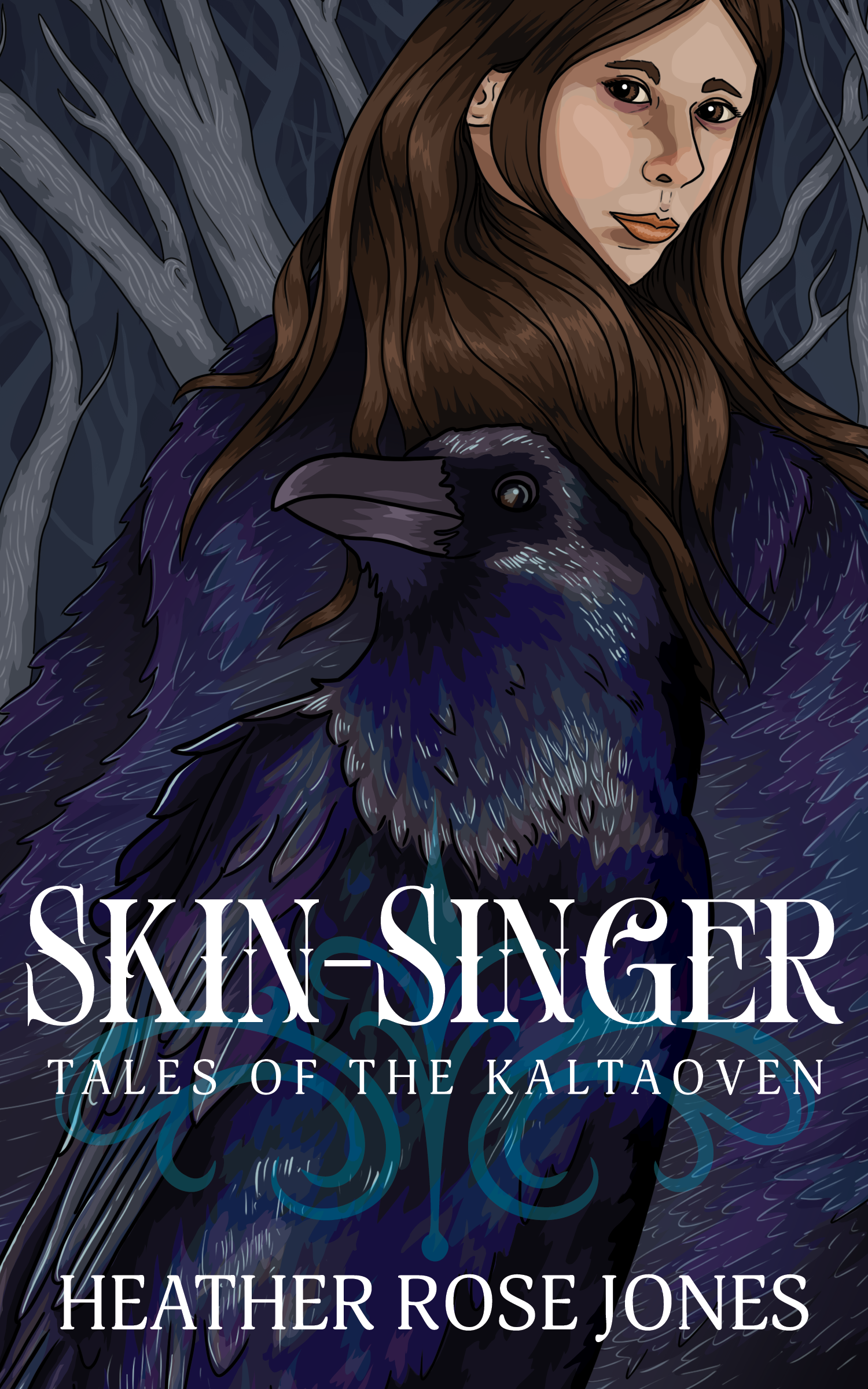
The collected skin-singer stories are now on their way to publication! I just pushed the buttons for the ebook and POD versions at Draft2Digital a few minutes ago. (I need to set up Kindle separately, so I haven't done that quite yet.) Official release date will be August 10 (assuming I did that correctly at the website).
This is my first professional (i.e., for-sale) self-published fiction, so I've been picking up a lot of new skills and experiences along the way. I worked with a fabulous cover artist: The Illustrated Page Book Design (Sarah Waites).
Next steps are to set up distribution for Kindle. (For various logistical reasons, as advised by more experienced people, everything is simpler if I do that separately from D2D.) Also look into distributing through at least one other outlet that D2D doesn't handle. Eventually I should set up a direct sale apparatus on my website, but that will take consultation with my web designers. I also plan to record it for audiobook.
Once I have buy links available, they will of course be added.
Major category:
PromotionPublications:
Skin-Singer: Tales of the KaltaovenSunday, July 27, 2025 - 12:00
Part chance and part strategy, I'm in the middle of a sequence of pairs of related articles: 2 on linguistics, 2 on Eliza Haywood, 2 on bluestockings, 2 on anatomical issues.
The other thing I'm in the middle of that I'll be posting more about in the near future is my first self-published book project. I just received the final versions of the cover art this morning and will be completing the set-up process in Draft2Digital. My target was to have the book out for Worldcon (just because it makes a useful deadline). Not sure if I'll have hardcopies in time, but the ebook will definitely be available. Oh...what's that you say? What is the book about? Well, let's save that for it's own separate post.
Major category:
LHMPFull citation:
Ingrassia, Catherine. 2014. “’Queering’ Eliza Haywood” in Journal for Early Modern Cultural Studies, Vol. 14, No. 4, New Approaches to Eliza Haywood: The Political Biography and Beyond: 9-24
In this article, Ingrassia challenges scholarship that views 18th century novelist Eliza Haywood’s work as depicting only heterosexual relationships and instead points out and discusses many aspects of her fiction that represent a wide spectrum of relations between women that range from the homosocial to the homoerotic. [Note: This article has a lot of literary theory jargon, which I tend to find of less interest, so I’ll mostly be focusing on the discussions of the content of Haywood’s work.]
Just because an author is working within a heteronormative framework doesn’t negate other underlying themes. Analysis that ignores those themes simply because they don’t represent the overt message of the work distorts our understanding of the era and the work. [Note: Another key factor here, though Ingrassia doesn’t state it explicitly, is how bisexual erasure works to cover up sapphic readings. As noted in the introduction to The Lesbian Premodern, there has long been a tendency to categorize a historic person as “lesbian” only in the complete absence of heterosexual relationships, while a historic man may be categorized as homosexual on the basis of any homosexual relations.] Thus same-sex intimacies in works like The British Recluse have been dismissed because they occur in a context where the two women are sharing their past betrayals by the same man. The two women admire each other from the moment they meet, then bond through a sharing of grief. In the end, they become a bonded couple living in “perfect tranquility, happy in the real friendship of each other” and shunning heterosexual relations. The details of their shared life from that point is not presented, only their attachment. This has allowed scholars to dismiss the motif as simply “female friendship,” ignoring the vast scope of experiences such a phrase contains in what Ingrassia calls a “failure of the historical imagination.”
Ingrassia observes that Haywood routinely “critique[s] and resist[s] heteronormative structures” with her characters finding ways to escape or transform those structures to exist outside of gender restrictions. The central relationship of The Rash Resolve presents a woman betrayed in a heterosexual relationship (with the aid of a female accomplice) who finds solace, safety, and emotional intimacy with a rich and beautiful widow.
In other works, Haywood emphasizes intimacies between women without the need for a precipitating event that turns them against heterosexuality. In the mosaic text of The Tea Table the connective tissue is the relations between a group of educated and literary women who support each other’s creative endeavors. In a wildly different context, The Masqueraders details the amorous adventures of a rake, whose female partners take even greater enjoyment in then sharing stories of their experiences with each other.
In The City Jilt two women who are intimate and loyal friends scheme together for financial revenge on one woman’s faithless ex, after which they (temporarily) renounce men and live together for a time until one is compelled by necessity to marry again. There are other examples of female intimacies embedded within otherwise heterosexual frameworks. In The History of Jemmy and Jenny Jessamy, the two title characters, engaged since childhood, are oddly indifferent to moving their marriage along, wanting a chance to enjoy the adventures of single life first. For Jenny, this consists of circulating in female spheres: living with two sisters in Bath, sharing gossip with friends (including an anecdote about the madcap adventures of a married woman which includes an “adventure in Covent-Garden—where she went in men’s cloaths—pick’d up a woman of the town, and was severely beaten by her on the discovery of her sex” in a rough acknowledgment of potential same-sex erotics, before the woman returns to her husband for enthusiastic make-up sex. She is background to the main story, but presents an illustration of imaginable possibilities.
This theme—of a secondary character illustrating wider erotic options—also occurs in The History of Miss Betsy Thoughtless in an episode late in the novel in which Betsy becomes instantly fascinated by Mademoiselle de Roquelair on encountering her in a shop. “There was something in this lady that attracted her in a peculiar manner…delight in hearing her talk…longed to be of the number of her acquaintance.” She attempts such an acquaintance and is rebuffed, but later Roquelair appears at her door, late at night in dishabille, confiding that her lover—Betsy’s brother—has thrown her out and asking for assistance. An imaginative space is opened in which Betsy’s fascination is rewarded by intimate friendship, but instead Roqualair moves in, becomes the mistress of Betsy’s husband, and supplants her. But this conclusion is made possible by Betsy’s flash of desire and attraction.
Time period:
Place:
Event / person:
Saturday, July 26, 2025 - 12:00
I've been trying to figure out how to write a podcast on Eliza Haywood without actually having to read a bunch of 18th century novels.
Major category:
LHMPFull citation:
Ingrassia, Catherine. 1998. “Fashioning Female Authorship in Eliza Haywood’s ‘The Tea-Table’” in The Journal of Narrative Technique, vol. 28, no. 3, pp. 287–304.
I’ve been meaning to track down as much queer-aligned scholarship on Eliza Haywood as I can find, with the aim of doing a podcast on her. (Mind you, it would make sense to actually read a bunch of Haywood’s fiction for that purpose, but working my way through older literature is a bit of a slog.) Catherine Ingrassia seems to have made Haywood a focus, so her work may end up being a large part of any essay I do.
# # #
This article looks at contrasting concepts of “woman writer” and “professional author” in the 18th century, using the lens of Eliza Haywood’s writing, and specifically the discussions around writing and authorship contained in her work The Tea-Table. In the early 18th century, resistance to the idea of women as “writers” (which had influenced many women to circulate their work only in manuscript among private social circles) was shifting to resistance specifically to women as professional writers, i.e., ones who aspired to make a living at it. The feeling (other than masculine jealousy) was that for a woman to become the sort of public figure that came from professional authorship was immodest and destructive of domestic happiness.
Haywood’s 1725 The Tea-Table: or, A Conversation between some Polite Persons of Both Sexes at a Lady’s Visiting Day challenges these ideas, showing a (fictional) literary circle enthusiastically sharing and commenting on each others’ literary output. The work included a number of the metafictional works (all written by Haywood, of course). The Tea-Table was intended to be a periodical, but was not continued. Haywood not only wrote professionally, but had her own print shop and engaged in the hands-on work of publishing and distributing her work.
The Tea-Table challenges the idea that a female domestic space (the “tea table”) concerns itself only with trivial gossip, instead creating a vision of a supportive female-centered community (though it doesn’t entirely exclude men, as long as they align with the interests of the women) focused on literature. Her fictional community is not simply “female centered” but is specifically one that valorizes and prioritizes connections between women across a wide range of manifestations. They comment on how society expects them to spend their time competing and criticizing other women and then reject those activities.
There are implications—those never outright admissions—of female romantic partnerships, or simply a rejection of heterosexuality, among the women. The hostess is described as having arranged her life so as to be able to avoid male bonds. She has a “long intimacy” with another member of the circle, and in the final episode of the story, she receives a letter from a long-absent female friend who will soon be returning—new which transforms her with happiness. One of the poems shared is a eulogy written by one woman on the death of her female companion. All these connections are taken as expected and usual by the women of the circle.
The narrative voice praises the beauty of women at the table, and the only positive intimate relationships in the narrative are between women, while the literature they share with each other touches on the hazards of being female in society: marital unhappiness, betrayal by men. They have carried these texts on them, not only to share, but to read for their own sake, and to receive suggestions for improvement or polishing. Their reading is a collaborative experience, repeating favorite passages, and overlapping in their commentary.
When the tea-table conversation is interrupted by the arrival of a woman who only wants to discuss fashion and gossip, the disruption and rejection is clear. And the cooperation and reciprocity of the literary sharing is specifically contrasted with the competitive air of male writers, desperate for attention.
Throughout the work, casually references and citations demonstrate Haywood’s familiarity not only with the standard literary canon, but with the publishing community of her day. Yet Haywood’s role itself—the female professional author—is not represented in The Tea-Table. Her characters are all writers, but not authors, sharing manuscript works, not published texts.
Time period:
Place:
Event / person:
Wednesday, July 23, 2025 - 08:00
Debate over the question of whether you can have "lesbian identity" without the use of the word "lesbian" as a type of person sucks a lot of oxygen out of the discussion of queer history. After all, a number of other words were clearly in use for a long time to describe women who have sex with women. But because the specific word "lesbian" is so iconic and is often a theoretical sticking point for questions of continuity, this one specific text bears a disproportionate amount of weight.
Major category:
LHMPFull citation:
Cassio, Albio Cesare. 1983. “Post-Classical Λεσβίας,” The Classical Quarterly, n.s., 33:1, pp. 296-297.
I’ve made a lot of references to this brief commentary in discussions of the history of the use of the word “lesbian”. This article doesn’t so much add any new information as provide the receipts for those mentions.
# # #
This is a very brief philological note about the appearance and context of the Greek word “lesbiai” (lesbians) after the classical period. It begins by noting usage of the verbs “lesbizo” and “lesbiazo” that refer to fellatio, not to same-sex relations. He also notes Lucian’s reference connecting women from Lesbos with same-sex relations (in the Dialogues of the Courtesans). He discounts a claim (which I reviewed at one point and discarded as irrelevant) that there is a reference to “lesbizo” referring to tribadism in the 15th century. But then he claims that French and Italian uses of “lesbian” in a (same-sex) sexual sense “do not seem to occur before the nineteenth century” evidently overlooking or silently discounting Brantôme and others. And (as usual) claims the same for English, citing the OED.
But the meat of this note is the 10th century commentary by Arethas on Clement of Alexandria’s Protrepticus Paedagogus. The base text by Clement reads:
Γυναΐκες άνδρίζονται παρά φύσιν
“women act as men against nature”
[Note: I’m transcribing this from a badly pixelated scan of a xerox and I’m not at all certain that the diacritic marks are correct. Corrections welcome.]
And Arethas’ commentary reads:
Τάς μιαράς τριβάδας λέγει, ‘άς και ‘εταιριστρίας και Λεσβίας καλοΰσιν
“the unclean tribades (tribadas) who are also called hetairistriai (hetairistrias) and lesbians (lesbias)”
[Note: Cassio declines to give translations, being of a generation who believes that if you can’t read Greek and Latin directly you have no business calling yourself an academic. I’ve drafted these translations by comparing a number of online sources.]
Cassio notes “There are strong reasons for believing that Arethas was not drawing on ancient sources for his comments…except for one instance; so his note is likely to reflect current [i.e., 10th century] Byzantine usage.” He concludes, “Clearly the ill repute of Lesbian women in antiquity was not exclusively due to their alleged propensity to fellatio, and female homosexuality may well have been regarded as typical of Lesbos, though tribads from other parts of the Greek world are also known.” He cites Lucian as a potential inspiration for this association, given its unambiguous reference to women from Lesbos having same-sex relations.
Time period:
Place:
Event / person:
Pages
