Blog
Saturday, July 18, 2020 - 07:00
Lesbian Historic Motif Podcast - Episode 167 (previously 48c) - Book Appreciation with Luci Dreamer
(Originally aired 2020/07/11 - listen here)
[Note added 2023/03/28: Luci Dreamer now goes by Luc and pronouns are now he/him.]
Transcript pending.
Show Notes
In the Book Appreciation segments, our featured authors (or your host) will talk about one or more favorite books with queer female characters in a historic setting.
In this episode we talk about:
- The book that started her love of historic fiction
- Text versus audio-books
- Books mentioned
Links to the Lesbian Historic Motif Project Online
- Website: http://alpennia.com/lhmp
- Blog: http://alpennia.com/blog
- RSS: http://alpennia.com/blog/feed/
- Twitter: @LesbianMotif
- Discord: Contact Heather for an invitation to the Alpennia/LHMP Discord server
- The Lesbian Historic Motif Project Patreon
Links to Heather Online
- Website: http://alpennia.com
- Email: Heather Rose Jones
- Twitter: @heatherosejones
- Facebook: Heather Rose Jones (author page)
Links to Luci Dreamer Online
- Website: Luci Dreamer
- Twitter: @LuciDreamer70
Major category:
LHMP View comments (0)
Monday, July 13, 2020 - 07:00

I should probably set up a topic-tag for the LHMP for books that are intended either as textbooks or general reference works (e.g., encyclopedia-type texts) because I'm starting to get a number of them and it seems like a category that people might find useful. Not sure how to handle that, because it doesn't really fit with the types of tags I already have set up. But, hey, I can just add it to the "topics" list and sort it out later if I decide to do it differently.
For me, personally, this sort of basic reference work isn't very interesting at this point. I'm always looking for new ideas and new information that I haven't encountered before. But for someone who wants to get a basic grounding in the structure and source materials available for the history of sexuality? This sort of reference may be just the thing.
Major category:
LHMPFull citation:
Kuefler, Mathew (ed). 2007. The History of Sexuality Sourcebook. Broadview Press, Ontario. ISBN 978-1-55111-738-6
This book would make a good companion to Crawford’s European Sexualities, 1400-1800, covered a couple weeks ago. While Crawford offered an analytic textbook on sexuality in history, Kuefler provides a collection of readings of historic texts (though covering a larger geographic and chronological scope) that demonstrate how sexuality was described, experienced, and managed. Note that, as with Crawford’s work, this is “sexuality” in the broadest sense, encompassing all types of desire and activity, and not “sexuality” in the narrow sense of sexual orientation.
This is an encyclopedia-style collection of texts that speak to specific topics in the history of sexuality. It is far from exhaustive, either in intent or execution, but rather picks specific works to use as discussion or thinking points. It was compiled for use as a set of study texts for a college course on the history of sexuality and that purpose can be seen in the inclusion of study questions after each text.
This summary will note the texts that include content relevant to the LHMP, but I won’t discuss those texts in detail. (Most of them have been covered in other entries in a more analytic form.)
#19 - Plato (5th c BCE, Greece): Aristophanes’ speech from the Symposium that includes the “two halves seeking their other part” model of desire that includes same-sex desire.
#30 - Sappho (7th c BCE, Greece): Several fragments of poems, especially those expressing desire for women.
#68 - Penitential manual (7-8th c CE, England): Examples of penances for fornication, including ones from same-sex activity.
#83 - Bieiris de Romans (12-13th c CE, France): Troubadour love song apparently by a woman to a woman.
#115 - Misc. (19th c France): Medical case studies on the theme of masturbation, including same-sex activity classified as masturbation. Medical interventions to prevent masturbation, including genital mutilation and torture.
#116 - Misc. (19th c France): As a counterpoint to the preceding, recommendation of sexual stimulation to orgasm (including use of a vibrating dildo) as a treatment for “hysteria” in women.
#119 - Krafft-Ebbing (19th c Germany): Case studies of psychological issues attributed to sexual history or to family history of “nervous taint.” The examples include references to cross-dressing, female same-sex desire, and transgender feelings.
#160 - Rekhti erotic poetry (17-18th c India): Excerpts from a genre of erotic poetry describing female same-sex love by traditionally written by male poets.
Time period:
Saturday, July 11, 2020 - 07:00
Lesbian Historic Motif Podcast - Episode 166 (previously 48b) - Interview with Luci Dreamer
(Originally aired 2020/07/11 - listen here)
[Note added 2023/03/28: Luci Dreamer now goes by Luc and pronouns are now he/him.]
Transcript pending.
Show Notes
A series of interviews with authors of historically-based fiction featuring queer women.
In this episode we talk about:
- Luci’s plans for the trilogy
- The call of the Klondike
- Handling cross-gender performance
- The book’s origins in Wynona Earp fanfic
- Books mentioned
Links to the Lesbian Historic Motif Project Online
- Website: http://alpennia.com/lhmp
- Blog: http://alpennia.com/blog
- RSS: http://alpennia.com/blog/feed/
- Twitter: @LesbianMotif
- Discord: Contact Heather for an invitation to the Alpennia/LHMP Discord server
- The Lesbian Historic Motif Project Patreon
Links to Heather Online
- Website: http://alpennia.com
- Email: Heather Rose Jones
- Twitter: @heatherosejones
- Facebook: Heather Rose Jones (author page)
Links to Luci Dreamer Online
- Website: Luci Dreamer
- Twitter: @LuciDreamer70
Major category:
LHMPTuesday, July 7, 2020 - 07:00

The year is half past and it's not too early to start thinking about next year's fiction series. The call for submissions is essentially identical to the one for this year's series. You are encouraged to publicize this Call widely. My goal is to have so many excellent submissions that it breaks my heart that I can only pick four.
Full details on the Call for Submissions can be found here (and will be prominent on the drop-down menu for the duration).
I hope to see even more wonderful story submissions in January than I did last time!
Major category:
LHMPThe Lesbian Historic Motif Podcast will be open for submissions in January 2021 for short stories in the lesbian historic fiction genre, to be produced in audio format for the podcast, as well as published in text on the website.
Technical Details
- We will accept short fiction of any length up to 5000 words, which is a hard limit. We will be buying a total of four stories. (If we get some really great flash fiction, there’s the possibility of more.)
- We will be paying professional rates: $0.08/word.
- The contract will be for first publication rights in audio and print (i.e., the story must not have appeared in either format previously) with an exclusive one year license. (Exceptions can be arranged by mutual consent for “best of” collections within that term.)
- Instructions on how to submit are given below. NO SUBMISSIONS WILL BE ACCEPTED OUTSIDE THE SUBMISSION PERIOD OF JANUARY 2021.
What We’re Looking For
- Stories must be set in an actual historic culture--i.e., a specific time and place in history--and the plot and characters should be firmly rooted in that time and place. (No time-travel or past memories, please.)
- Stories may include fantastic elements that are appropriate to the historic setting. For example, they can include fantastic or supernatural events or beings that people of that era considered to be real. Or stories may be modeled on the fantastic literature of a specific historic era and culture. The limits to this will necessarily be subjective.
- Stories must be set before 1900. We’d love to see stories that reach beyond the popular settings of 19th century America and England unless you do something new and interesting in them. [Also: see sensitivity note below.]
- Romance is optional, and romance stories should have some other significant plot element in addition to the romance.
- We are not looking for erotica. Sex may be implied but not described. (It’s difficult to include both erotic content and a substantial non-romantic plot in short fiction. I’d rather that stories focus on the plot and characters.)
- Stories should feature lesbian-relevant themes. What do I mean by that, especially given the emphasis the LHMP puts on how people in history understood sexuality differently than we do? This is where we get into “I know it when I see it” territory. The story should feature protagonist(s) who identify as women, whose primary emotional orientation within the scope of the story is toward other women. This is not meant to exclude characters who might identify today as bisexual or who have had relationships with men outside the scope of the story. But the story should focus on same-sex relations. Stories that involve cross-gender motifs (e.g., "passing women," "female husbands") should respect trans possibilities [see sensitivity note below].
- Stories need not be all rainbows and unicorns, but should not be tragic. Angst and peril are ok as long as they don’t end in tragedy.
- Authors of all genders and orientations are welcome to submit. Marginalized authors are strongly encouraged to submit, regardless of whether you are writing about your own cultural background.
Please feel free to publicize this call for submissions.
Submission Information
- Do not send submissions before January 1, 2021 or after January 31, 2021. Submissions sent outside this window will not be considered (with allowance for time zones).
- Send submissions to alpennia@heatherrosejones.com
- Submit your story as an rtf or doc(x) file attached to your email
- The file name should be “[last name] - [story title, truncated if long]”
- The subject line of your email should be “LHMP Submissions - [last name] - [story title]”
- There is no need to provide a synopsis or biographical information in the cover letter.
- By submitting your story, you are verifying that the material is your own original work and that it has not been previously published in any form in a publicly accessible context.
- Submissions will be acknowledged within 2 days of receipt. If you haven’t received an acknowledgment within 5 days, please query.
- Based on previous years, I will generally have the submissions read and responded to within the first week of February. If you haven't received a response by mid-February, please query as the email may have gone astray.
Formatting
Use your favorite standard manuscript format for short fiction with the following additions:
- In addition to word count, please provide the date/era of your setting and the location/culture it is set in. (These can be in general terms, but it helps for putting the story in context, especially if it uses a very tight point of view where the time/place are not specifically mentioned in the story.) If you are including fantasy elements and think I might not be familiar with the historic background for those elements, a very brief note in the cover e-mail is ok.
If you don’t have a favorite manuscript format, here are the minimum essential elements it should have:
- Use courier or a similar monospaced serif font, 12-point size
- Lines should be double-spaced with paragraphs indented. (Use your word processor’s formatting for this, do not use tabs or manual carriage returns.)
- Do not justify the text, leave a ragged right margin.
- Margins should be at least 1-inch or equivalent all around
- On the first page, provide the following information:
- Your name (legal name, the name I’ll be putting on the contract)
- email address
- (standard formats generally require a mailing address but I don’t need one at this point)
- word count (please use your word processor’s word count function, rounded to the nearest 100)
- date/era of story
- location/culture of story
- Centered above the start of the story, include the title, and on the next line “by [name to appear in publication]”. This is where you may use a pen name, if you choose.
- Please use actual italics rather than underlining for material meant to appear in italics.
- Please indicate the end of your story with the word “end” centered below the final line.
As I will be reading stories electronically, there is no need to include page numbers or a header on each page. (If this is part of your standard format, you don’t need to remove them.)
Notes on Sensitivity
I strongly welcome settings that fall outside the "white English-speaking default". But stories should avoid "exoticizing" the cultural setting or relying on sterotypes or colonial cultural dynamics. What does that mean? A good guideline is to ask, "If someone whose roots are in this culture read the story, would they feel represented or objectified?"
What do I mean by "stories that involve cross-gender motifs should respect trans possibilities"? I mean that if the story includes an assigned-female character who is presenting publicly as male, I should have confidence that you, as the author, have thought about the complexities of gender and sexuality (both in history and for the expected audience). It should be implied that the character would identify as a woman if she had access to modern gender theory, and the way the character is treated should not erase the possibility of other people in the same setting identifying as trans men if they had access to modern gender theory. This is a bit of a long-winded explanation, but I simultaneously want to welcome stories that include cross-gender motifs and avoid stories that could make some of the potential audience feel erased or mislabeled.
Monday, July 6, 2020 - 07:00
Consider today's entry as a teaser for this month's podcast essay, entitled "Humors, Horoscopes, and Homosexuality." I'm always happy to sieze on convenient inspiration.
Major category:
LHMPFull citation:
Armenian astrology text (British Library Ms. Or. 6471)
Today’s item is a bit outside of how I usually cover material. An image showed up in my Twitter feed posted by Dr Alex MacFarlane (@aghvesagirk) who was perusing Armenian manuscripts held in the British Library. It’s rare to find pre-modern art showing women in same-sex erotic encounters, so I asked further about it and Dr. MacFarlane was able to provide me with some additional background, as well as gracious permission to use the image and to cite them.
So this is really just a brief squib--not even a squib in the usual sense--to point to further information.
There is a long tradition, starting with the ancient Greeks, of attributing particular sexual tastes to specific astrological alignments. This wasn’t as simple as heterosexual versus homosexual, but included things like whether one preferred sex within marriage or outside of it, what type of partner one preferred in terms of class, age, etc., whether one preferred to take a sexual role that aligned with social expectations or contradicted them (in terms of active/passive participant). Within this context, some astrology texts discussed conditions that would predispose a woman to take the active role in sex with another woman.
One should be wary of interpreting this as “a woman who prefers sex with women” in the modern sense because the focus was often on the question of gender expression. If a woman’s stars aligned to give her a more masculine nature with regard to sex, then she would naturally prefer to be the active partner (by the gender models of the time) and therefore would default to engaging in sex with “normal” women who were expected to default to taking the passive role. (Such a “masculine woman” might also engage in sex with a man, but in that case he would also be acting against gender role expectations in accepting a passive role.)
You can find LHMP entries that I’ve tagged as discussion of astrological texts here. I plan to do a podcast that looks more closely at both astrology and humoral theory with regard to sexual desires/orientation, so I won’t go into the history in detail here, but suffice it to say that the astrological tradition persisted over time, including adaptations and translations into many different languages.
Thus we come to Ms. Or. 6471. It’s cataloged in A Catalogue of the Armenian Manuscripts in the British Museum, by Frederick Cornwallis Conybeare (London, 1913) starting on page 320. (The book is available through the Internet Archive here.) The basic description is: “The MS. is a treatise on Magic, Astrology, and the Calendar.” It includes something resembling a table of contents which also explains how the author collected the contents and their sources, as well as naming the author and the man who commissioned the work and giving the date it was written (1610 CE, but recorded in a different calendar system). The catalog describes the language as follows: “Parts of it, especially the first paragraphs of the early sections, are written in a fairly correct, if vulgar, Armenian, but the greater part of the text is a jargon of popular Armenian dialects of the sixteenth century, mixed with Arabic, Persian, and Turkish.” This gives you a sense of the culture context in which the author was working.
Dr. MacFarlane offers some additional information on the source of the 17th century text, suggesting that the name given (Sěṙi Mak't'um) can be connected with an Arabic text Al-Sirr al-Maktūm, which is discussed in Michael Sebastian Noble’s 2017 doctoral thesis (University of London) abstracted here and soon to be published by DeGruyter (see link). (It isn’t entirely clear that Noble’s book is concerned with the specific part of the manuscript in which this image appears.)
As described in the catalog, the astrology section of the manuscript includes a number of full-page illustrations of the planets and the Zodiac signs, primarily in the form of human figures with symbolic accessories.

This is followed by a series of pages with multiple smaller pictures that appear to depict the consequences of particular astrological alignments. And it’s here that our attention is caught:

Dr. MacFarlane provides a transcription and transliteration of the caption for the second image from the bottom:
կինմիորզկինմիկուպղծէ("a woman who defiles a woman")
This image shows two women, with their upper garments hiked up around their waists and their legs bare. One is lying on her back with the near (visible) leg elevated and the other woman is kneeling between her legs, pressing their vulvas together. Their hands are touching each other and they are gazing at each other.

The exact context would require identifying and translating the context of the other images, as well as looking at the the other parts of the text associated with the image. But given the usual context of astrology manuals, we can guess that it describes the planetary alignments that would predispose a woman to behave this way.
It is tempting to connect the sexual position shown in this illustration with the 13th century description in Al-Tifashi.
Time period:
Event / person:
Saturday, July 4, 2020 - 11:00
Lesbian Historic Motif Podcast - Episode 165 (previously 48a) - On the Shelf for July 2020 - Transcript
(Originally aired 2020/07/04 - listen here)
Welcome to On the Shelf for July 2020.
How are you all holding up through the quarantimes? Are you finding enough fluffy comfort reads to get you through? Or are you surviving on unleashed rage alone...against all the shitty things going down in the world?
For me, the rhythms of my life keep turning upside down. It used to be I had no time for television and now I’m binging costume dramas on Netflix. I used to complain that my commute meant I rarely saw my house in daylight except on weekends, and now I rarely leave the property except for my daily bike ride. There have been two main beneficiaries of my day-job shifting to home: my yard and garden is in the best shape it’s been since I bought the place almost ten years ago, and I’ve made massive progress on a piece of needlepoint I started in college and left languishing for decades, barely started.
But I’m finally getting my reading brain back for the history blog, at least.
Publications on the Blog
June seems to have been the month for the blog to cover articles that I’ve already included in a different form. It started with a primary source article on John or Eleanor Rykener, a 14th century English transvestite prostitute, who raises a lot of questions about medieval categories of gender, though Rykener is tangential to the topic of female same-sex love.
Anna Klosowska’s study of same-sex encounters in medieval French literature, in Queer Love in the Middle Agesis a bit more literary criticism than history for my taste. And the two relevant articles in the collection Queering the Renaissanceare mostly rehashing material I’ve already looked at, especially Valerie Traub’s article ,which turned into a chapter in her book The Renaissance of Lesbianism in Early Modern England, previously covered in the blog.
June closed with a re-visitation of a different type: Catherine Crawford’s European Sexualities 1400-1800is intended as a college textbook on the history of sexuality and lightly skims through many familiar topics.
I had a whole theoretical schedule set up for the next several months which is being messed up by my inability to go to a library. So July is going to start with a spontaneous substitution of an image from an early 17th century Armenian astrology manual which shows two women having sex. With the help of the woman who posted the image on twitter, I’ll be able to give it a little context. After that comes a very brief survey of the relevant contents of Kuefier’s History of Sexuality Sourcebook, followed buy a couple of articles on non-European material -- one on case studies of lesbian or transmasculine women in 19th century Russia, and one on female same-sex “love suicides” in early 20th century Japan.
Book Shopping!
No new hardcopy book purchases, for the blog, which is probably just as well, given how much I have stacked up. But I did pick up an e-book copy of Ruth Morgan and Saskia Wieringa’s study of contemporary female same-sex traditions in Africa: Tommy Boys, Lesbian Men, and Ancestral Wives.
2021 Fiction Series
Since the year is half-gone, it’s time to confirm that yes, I’ll be continuing the LHMP fiction series in 2021. I’ll be continuing this year’s modification in accepting historical fiction with certain types of fantastic elements as well as regular historical stories. There’s a full explanation of the call for submissions on the website -- see the show notes for a link -- but the short version is that I’ll be buying four short stories of up to 5000 words at the benchmark rate of 8 cents per word. The story should be set in some actual specific time and place, any where in the world, before 1900. And the central character should identify as a woman who feels attraction or desire for other women, although the story itself need not be a romance. And, in fact, if the central plot is the formation of a romantic couple, the story should have some other strong non-romantic plot element as well. I accept submissions from all genders and orientations, and I especially welcome submissions by marginalized authors.
Check out the full description on the website and start brainstorming. Submissions will be open in January, as usual, and expect me to keep talking about it from now until then.
Author Guest
This month’s author guest hasn’t been recorded yet and I’m superstitious enough not to announce names until I have the recording in the can. But I put out a call for authors interested in appearing on the show and have some really great guests lined up for the next half year.
Essay
I didn’t have an essay topic picked out yet, but in writing up this script, I think I’ll be inspired by that Armenian astrology manual and talk about historic theories of how astrology and the balance of humors affected one’s sexual desires. In some ways, it’s an analog of modern ideas about innate sexual orientation.
(Sponsor break)
Recent Lesbian Historical Fiction
Are you ready for the recent, new and forthcoming books? We have eight titles to talk about this month. Two of them are books published in May that didn’t turn up in my search until now--both of them set around World War II.
Love, Wherever it Fallsself-published by Katherine Chandler is the sort of cross-time story that could be an entire genre by itself, in which a contemporary woman finds correspondence that reveals a historic same-sex romance.
In pre-war 1936, two women fall in love and begin a long-distance love affair between London and Paris. Seventy years later they help an overwhelmed 21st century woman make a decision. After the death of the writer Cleo Brierley her great-niece inherits a remote stone cottage nestled deep in the wilds of Dartmoor. In the attic she finds a worn cardboard box containing diaries and love letters dating from the mid 1930s. She begins reading and a story of passion, joy, heartbrea,k and resilience emerges as Cleo grows from a naive young woman inevitably towards and through the Second World War.
Do you like horse stories? This next one might be up your alley: I Love You, Nora Whisperedby Kathy L. Salt from Triplicity Publishing.
England, 1948. Nora Lakes suffers from post polio syndrome and very low self-esteem. She has spent her entire life in the chaos of her huge family, always feeling less than and without any future dreams. When her sister Martha manages to get her a job at Waterhouse Acre Stables, she can hardly believe it. She had never imagined that anyone would have employed her, damaged as she is. She also never imagined she would meet anybody like Katherine. Katherine Waterhouse was born with a silver spoon in her mouth. She has a mean streak and doesn't like people in general. What she does like, is horses. She wants to be a professional rider but growing up in a conservative house where her choices are limited by her sex, Katherine has always been trapped in her role as a woman. Nora and Katherine - two women with very different backgrounds, drawn to each other with an intensity neither of them are prepared for. Do they stand a chance?
There are three June books, the first two of which are very short--barely novelettes.
Budding Romanceself-published by Lara Kinsey has a Victorian setting.
A budding romance between a sweet-talking gardener and a spinster headmistress blooms to full flower in this steamy lesbian love story. On the cusp of the 20th century, France is where libertines indulge poetic desires. Dorothea has fled the structure of dreary old England for a place in the sun. She’s opening a school for elegant young ladies, but it’s an experienced lady gardener who has caught her eye. Madame Laurent works with her hands, but it’s her words that cultivate Dorothea’s fallow heart.
I somehow missed the precursor to Resurrectionist: The Diary of Doctor Du, Book Two, self-published by M.S. Linsenmayer, probably because it isn’t tagged as having queer content. This is a very tongue-in-cheek fantasy historical with a protagonist that I might guess started life as a gender-flipped version of real-life Elizabethan astrologer and alchemist John Dee.
Imprisoned for crimes she absolutely committed, Astrologer Jan Du plots her escape, determined to save the world from the Horrible Demonic Armies... oh who am I kidding, it's Jan. She mostly just wants a decent sandwich before her just and well deserved execution. So join her now as she battles drunken wyverns, vegetarian demons, and the worst threat of all: the 16th-century legal system.
Another historic fantasy that came out in June is A Matter of Blood (The Unlikely Adventures of Mortensen & Spurlock Book 2)by Lucy True (aka Jea Hawkins) from Persephone Press. The first book in the series came out just a month earlier, so this may be something in the way of a serial?
It takes little effort to save the world from power-obsessed madmen when you’ve been doing it for years. For once, however, it’s not an artifact hunt that has Alice Mortensen vexed. It’s her beloved Nora’s mother, Lady Spurlock. With their dissimilar Aetheric natures called into question, Alice and Nora undertake a journey halfway around the world for answers. Whether by railway, steamer, or airship, Alice and Nora will not rest until they can allay Lady Spurlock’s concerns about their union. Nor will they realize the unimaginable discovery or danger to which their inquiries will lead until a chance meeting leads to a long overdue reunion… All our heroines want is a happy ending, but will they encounter too much danger—and not enough cake—to save the day in the finale to their unlikely adventures?
I found three July releases, all of them from mainstream publishers.
Girl, Serpent, Thornby Melissa Bashardoust from Hodder & Stoughton is based on Persian legends. Trust me when I tell you that the cover copy gives you entirely the wrong impression of where the romantic relationships go in this book.
There was and there was not, as all stories begin, a princess cursed to be poisonous to the touch. But for Soraya, who has lived her life hidden away, apart from her family, safe only in her gardens, it’s not just a story. As the day of her twin brother’s wedding approaches, Soraya must decide if she’s willing to step outside of the shadows for the first time. Below in the dungeon is a demon who holds knowledge that she craves, the answer to her freedom. And above is a young man who isn’t afraid of her, whose eyes linger not with fear, but with an understanding of who she is beneath the poison. Soraya thought she knew her place in the world, but when her choices lead to consequences she never imagined, she begins to question who she is and who she is becoming...human or demon. Princess or monster.
The Care and Feeding of Waspish Widows (Feminine Pursuits 2)from Harper Collins is the follow-on to Olivia Waite’s immensely popular The Lady’s Guide to Celestial Mechanics.
When Agatha Griffin finds a colony of bees in her warehouse, it’s the not-so-perfect ending to a not-so-perfect week. Busy trying to keep her printing business afloat amidst rising taxes and the suppression of radical printers like her son, the last thing the widow wants is to be the victim of a thousand bees. But when a beautiful beekeeper arrives to take care of the pests, Agatha may be in danger of being stung by something far more dangerous… Penelope Flood exists between two worlds in her small seaside town, the society of rich landowners and the tradesfolk. Soon, tensions boil over when the formerly exiled Queen arrives on England’s shores—and when Penelope’s long-absent husband returns to Melliton, she once again finds herself torn, between her burgeoning love for Agatha and her loyalty to the man who once gave her refuge. As Penelope finally discovers her true place, Agatha must learn to accept the changing world in front of her. But will these longing hearts settle for a safe but stale existence or will they learn to fight for the future they most desire?
And lastly, Emma Donoghue -- who, in her academic guise, is a significant reason the Lesbian Historic Motif Podcast exists -- has a new novel out: The Pull of the Starsfrom Little, Brown and Company. Some day I dream of having Emma Donoghue as a guest on the podcast.
Dublin, 1918: three days in a maternity ward at the height of the Great Flu. A small world of work, risk, death, and unlooked-for love, by the bestselling author of The Wonderand ROOMIn an Ireland doubly ravaged by war and disease, Nurse Julia Power works at an understaffed hospital in the city center, where expectant mothers who have come down with the terrible new Flu are quarantined together. Into Julia's regimented world step two outsiders -- Doctor Kathleen Lynn, a rumoured Rebel on the run from the police , and a young volunteer helper, Bridie Sweeney. In the darkness and intensity of this tiny ward, over three days, these women change each other's lives in unexpected ways. They lose patients to this baffling pandemic, but they also shepherd new life into a fearful world. With tireless tenderness and humanity, carers and mothers alike somehow do their impossible work.
What Am I Reading?
And what am I reading? I’m still having trouble concentrating on books, but I finished N.K. Jemisin’s The City We Becamein audiobook, which is a gripping fantasy of the living avatars of New York City in their struggle to be born. It’s very queer-inclusive and I highly recommend the audio version to get the real feel of the voices. I’m halfway through the audiobook of The Deepby Rivers Solomon, inspired by the song of the same name by the band Clipping, headed by Daveed Diggs. It’s an alternate fantastic history of the water-dwelling descendents of enslaved Africans thrown overboard during the Atlantic crossing.
But I may have some actual text-on-the-page books consumed by next month because I have couple of fluffy romances lined up and they feel like just my speed. What have you been reading lately?
Show Notes
Your monthly update on what the Lesbian Historic Motif Project has been doing.
In this episode we talk about:
- Recent and upcoming publications covered on the blog
- Boyd, David Lorenzo & Ruth Mazo Karras. 1995. "The Interrogation of a Male Transvestite Prostitute in Fourteenth-Century London" in GLQ vol. 1, 459-465.
- Klosowska, Anna. 2005. Queer Love in the Middle Ages. New York: Palgrave Macmillan. ISBN 1-4039-6342-8
- Traub, Valerie. 1994. “The (In)Significance of ‘Lesbian’ Desire in Early Modern England” in Queering the Renaissance ed. by Jonathan Goldberg. Duke University Press, Durham and London. ISBN 0-8223-1381-2
- Stephens, Dorothy. 1994. “Into Other Arms: Amoret’s Evasion”” in Queering the Renaissance ed. by Jonathan Goldberg. Duke University Press, Durham and London. ISBN 0-8223-1381-2
- Crawford, Katherine. 2007. European Sexualities, 1400-1800. Cambridge University Press. ISBN 978-0521548403
- An early 17th century Armenian astrology manual depicting sex between women
- Kuefler, Mathew (ed). 2007. The History of Sexuality Sourcebook. Broadview Press, Ontario. ISBN 978-1-55111-738-6
- Engelstein, Laura. 1990. "Lesbian Vignettes: A Russian Triptych from the 1890s" in Signs vol. 15, no. 4 813-831.
- Robertson, Jennifer. 1999. "Dying to Tell: Sexuality and Suicide in Imperial Japan" in Signs vol. 25, no. 1 1-35.
- This month’s author guest is still being arranged.
- New and forthcoming fiction
- Love, Wherever it Falls by Katherine Chandler
- I Love You, Nora Whispered by Kathy L. Salt
- Budding Romance by Lara Kinsey
- Resurrectionist: The Diary of Doctor Du, Book Two by M.S. Linsenmayer
- A Matter of Blood (The Unlikely Adventures of Mortensen & Spurlock Book 2) by Lucy True (aka Jea Hawkins)
- Girl, Serpent, Thorn by Melissa Bashardoust
- The Care and Feeding of Waspish Widows (Feminine Pursuits 2) by Olivia Waite
- The Pull of the Stars by Emma Donoghue
- Call for submissions for the 2021 LHMP audio short story series. See here for details.
Links to the Lesbian Historic Motif Project Online
- Website: http://alpennia.com/lhmp
- Blog: http://alpennia.com/blog
- RSS: http://alpennia.com/blog/feed/
- Twitter: @LesbianMotif
- Discord: Contact Heather for an invitation to the Alpennia/LHMP Discord server
- The Lesbian Historic Motif Project Patreon
Links to Heather Online
- Website: http://alpennia.com
- Email: Heather Rose Jones
- Twitter: @heatherosejones
- Facebook: Heather Rose Jones (author page)
Major category:
LHMPTuesday, June 30, 2020 - 21:00
I got behind a bit, which is why this is going up Tuesday evening rather than Monday morning. Strange and terrifying as it may seem, that enormous bolus of journal articles I downloaded and had all written up in advance is almost at an end. I guess that means I need to find my reading brain again. This book was not a good candidate for finding my brain again. It wasn't new material (for me) and was structurally very difficult to summarize. That doesn't mean it isn't a useful book. It just wasn't fun to blog.
Major category:
LHMPFull citation:
Crawford, Katherine. 2007. European Sexualities, 1400-1800. Cambridge University Press. ISBN 978-0521548403
One of the problems with trying to summarize this sort of encyclopedic work is that either you take far too many notes or you simply sketch out an outline. I started out doing the former and ended up with the latter. But in typing up my notes, I’ve pared it all down to more of an outline. This isn’t a commentary on the quality of the book, only on the genre.
Overall, my assessment is that the book does what it sets out to do: provide an overview and context for understanding sexuality topics in the 15-18th centuries. As part of that context, it includes a fair amount of earlier history, and here I think it is slightly flawed in sometimes not clearly distinguishing time era being discussed at any given point. It also doesn’t necessarily to a clear job of explaining how the book’s focus period differed from what came before and after (or noting specifically when it didn’t).
That sometimes makes it hard to understand why the specific period “1400-1800” was called out. The knowledgeable reader could make their own guesses and interpretations, but for the intended audience it feels like a bit more guidance might have been helpful.
Introduction
This is intended as a survey book aimed at the college undergraduate level. It opens by discussing a specific painting and talking about the complex and subtle sexual symbolism in it that would not have the same meaning in other eras. Sexual identities are not stable--the question is how and why they change. How do they relate to marital, social, and legal status? The nature and object of one’s desire was not considered to define one’s sexual identity until the late 19th century. This book looks at how that change happened. [Note: as mentioned in my introduction, I’m not actually sure that the book does a good job of that.]
The book tries to negotiate between the concepts of social construction versus essentialism. Both individual experience and how identity is represented are taken into account. The book discusses how changes in the practice of history have made topics relating to sexuality more accessible. Foucault’s role in the field is noted but also critiqued. There are examples of categories of early modern sexuality and a discussion of how vocabulary will be used in the book, for example the definition of what constitutes “sex” (as an act).
Chapter 1: Marriage and Family
In Western culture the attitude that sex was only truly licit within marriage means that changing conceptions and practices around marriage affect sexuality in general. The understanding of marriage was built from widely differing sources: ideas about health and reproduction, legal status, and moral principles. Looking from another angle, changes in attitudes about the function of pleasure, desire, and affection drove changes in attitudes toward marriage.
Marriage as a social institution was never simple or “natural” but needed to constantly shaped and controlled. One shift during the 1400-1800 era was from a view of marriage shaped by Christian antipathy toward physical pleasure to an emphasis on spousal complementarity, i.e., the “companionate” marriage. There was also a shift from marriage as an economic contract between lineages to an affective bond between individuals. The home became privileged as a site of sensual pleasure.
The book discusses and challenges theories that pre-modern families were not “affectionate” and were sites of autocratic authority and violent conflict. Individual texts can both support and contradict this view. Further, the companionate marriage, as conceived at the time, was still highly patriarchal and did not replace earlier forms in any consistent way.
Some economic theories of marriage focus instead on the shift from land as wealth (with marriage used to control transmission) to a market economy based on moveable wealth. The market economy involved more individual risk, but this could be balanced by the mutual commitment brought to it in a companionate marriage.
Demographic studies have contributed to the analysis showing that the image of the large extended family doesn’t hold. The average household size in many parts of Europe in the 16-19th centuries was 3-5, more aligned with the idea of the “nuclear family”. (It’s unclear if this average includes household servants in the calculation.)
Europe saw two general family patterns. In one, a man and woman of roughly equal age set up an independent household, with marriage occurring in the late 20s due to the need to accumulate resources for that goal. For non-elite couples, this might mean delaying marriage until the death of a parent passed on wealth.
In the second model, an older man (typically in his 30s) who was economically established married a younger woman (often in her later teens), with the marriage often arranged by the parents. Dowry (a monetary payment by the woman’s family) was often part of this system, putting economic limits on a woman’s marriage options.
Based on the premise that most people have sexual desires, these models create different social strains. In the first marriage pattern, the delay in marriage age risked sexual frustration and illicit sex for both parties. In the second marriage pattern, unmarried men were expected to seek sexual outlets outside of the marriage pool (either with prostitutes or with other men) while the sexual “purity” of unmarried women was controlled by physical seclusion. In the case of never-married women, convents were one means of seclusion.
Thus we wee that the overall pattern of marriage affected sexuality well beyond the specific couple in question.
Demographics point to other sexual practices such as family planning. But demographics can’t provide data on emotions, so this approach leads to seeking out purely functional causes rather than emotional ones. Some demographic patterns are confounding, such as an association of lower illegitimacy rates when marriage is later. Family planning techniques and lore were widespread, which might lend some explanation. Among elite populations, shifts in marriage age were more drastic and harder to explain by simple economic factors.
As noted above, late marriage meant a person could spend much of their live living without a licit sexual outlet. A certain percentage (depending on class and locale) never married. Up to 25% of the English elite in the 18th century never married, in part due to the tension between the need to ensure an heir and the desire to funnel wealth to a single heir. This tended to produce “surplus” offspring who did not have the resources to establish an independent household.
In Catholic lands, convents functioned to house “surplus” women to ensure chastity, regardless of vocation. As men were not held to the same standard of chastity, unmarried men were allowed more options. And in Protestant lands after the Reformation, religious institutions weren’t an option.
By 1800, though marriage was still the only licit context for sex, it was unavailable to many adults for extended periods of time, creating a crisis due to the Christian position that procreation was the only legitimate purpose of sex. Protestant sects sometimes held that sexual pleasure could be a benefit in creating a stronger marriage bond, but Protestant positions on sex and marriage only gradually began to diverge and allow more flexibility, e.g., with regard to divorce, and generally this was accessible only to the elite.
Protestant positions of marriage could be extremely varied, but a general consensus began to emerge that considered religious celibacy undesirable, and mutual, companionate marriage a preferred for as a guard against adultery. Within this context, control over marriage began to shift from the church to the state.
When family-arranged marriages were the default, love was separated from marriage as a concept. Not until the shift to companionate marriage did passionate love within marriage become promoted as the ideal. As women were considered to be even more sexually driven than men, the image of the “uncontrolled wife” emerged--a woman whose husband was not satisfying her and therefore sought other outlets. Entire genres of humor and satire operated on this premise. But despite this motif, in practice, men were more sexually disruptive and the tacit allowance for prostitution was intended to “protect” the chastity of respectable women as much as to allow for the satisfaction of men’s desires.
Forms of marriage contract and various rituals around the creation of a marriage are discussed. The conclusion is that gradually, between 1400-1800 , there was a shift to an expectation that marriage would be based on the mutual love and desire between the prospective spouses.
Chapter 2: Religion and Sexuality
Note: I originally took a lotof notes on this chapter, but really it’s just a recapitulation Christian attitudes toward sex and pleasure. There is significant discussion of how the rise of Protestantism shifted some of these attitudes. The chapter includes an extended history of classical attitudes toward sex and the evolution of Christian thought through the medieval period.
I don’t think the reader is served by my attempts to summarize. This is detailed stuff and any attempt to summarize boils down to: Sex bad; non-procreative sex worse; all pleasure suspect; confess and do penance unless you’re a Protestant then just hope for the grace of God. But that oversimplification isn’t really useful, so I’m tossing most of the notes I made and will simply point out that if you want to understand social attitudes toward sexuality in Western culture, you need to understand both Christianity’s official attitudes and the varied ways in which those attitudes were expressed and adopted in everyday culture.
As with the control of marriage, the control of sexuality began to shift from the church to the state during the target era of this book.
Chapter 3: The Science of Sex
This chapter recapitulates the historical understandings of the body, gender, and sexuality, as well as the medical and philosophical concepts that shaped those understandings. The text covers humoral theory, theories of anatomical difference, medical theories around sex and procreation, and treatments based on those theories. It looks at the consequences of the “one sex” model and the place of sexual pleasure in theories of health. Medical text of the 16-17th century discuss the importance of female pleasure in procreation and how to enhance it.
The impact of venereal diseases on sexual attitudes starts around 1500. From being the subject of bawdy humor in the 17th century it began to reshape sexual practice in the 18th.
Chapter 4: Sex and Crime
This is another chapter where I took entirely too many notes and am going to trim my summary way down.
In the texts quoted in the introduction to this chapter, it’s strike to what extent sexual crimes are consistently defined as crimes of women. Adultery? The woman is “stealing” her husband’s property for another man’s child. Rape? The victim has failed to be virtuous. Infanticide? Always assumed to be the mother’s act.
This book classifies sexual crimes according to what social structure they disrupt. While there was concern about sexual crimes in the abstract, especially given the community’s role in identifying and pursuing offenders, it is this disruptive potential that was often key.
Crimes against the family structure were a major focus: adultery, rape, bastardy, bigamy. In the medieval period these were treated more as property crimes, but opinions shifted to considering them more personal offenses. But crimes against the family could be viewed as responses to the failure of society to address structural problems within that family. For example, bigamy was most often a response to the inability to dissolve a marriage in the case of desertion or extended absence.
Crimes against nature was an ambiguous category, but the term generally attracted the harshest disapproval. Sodomy was the central example, but it was variously defined. Official penalties were often harsh, including death, but studies show they were rarely and unevenly enforced. By 1400-1800 “sodomy” had primarily come to mean male-male anal sex, but it was still used occasionally in other senses. Sex between women, though technically a “crime against nature,” rarely came to the attention and concern of the law unless there was also a gender offense, such as cross-dressing or the use of a penetrative instrument. Other crimes in this group include bestiality and infanticide. [Note: although the text doesn’t seem to address this specifically, the “against nature” label was because it was felt that human beings naturallydesired heterosexual relations with human beings, and that a parent naturallywould protect rather than harm a child.]
Crimes against the community covered things like incest (though the consanguinity rules meant this label could be applied broadly, not only to immediate family members), sexual slander, and prostitution.
The final category is crimes against God, where religious offences intersected with sex. This could include sex with a non-Christian or sex with those in holy orders.
Chapter 5: Deviancy and the Cultures of Sex
This chapter discusses sex as situated within culture frameworks that add meaning to particular practices. Examples include the rise of “molly houses” (subcultures catering to sex between men), and the culture of pornography and “deviant” sexual acts. The chapter looks at sexual aspects of the revival of classical literature in the Renaissance, and from a slightly different angle, the evolution of the neo-platonic ideal of love. These inputs fueled a culture of sex for the sake of pleasure, rather than purely for procreation.
There is a brief acknowledgement of the tendency of historians to overlook the idea of cultures of female homoeroticism, followed by a discussion of parallel cultures of women’s romantic friendships and the evidence of a lively vocabulary describing sex between women. Also noted is the 17-18th century obsession with the image of macro-clitoral women. Other f/f sexual cultures include the phenomenon of “female husbands” and imagined all-female societies in literature.
The rise of pornography is also noted as a sexual culture.
Time period:
Place:
Saturday, June 27, 2020 - 07:00
Lesbian Historic Motif Podcast - Episode 164 (previously 47d) - Lesbian-Like History and Racial Othering - transcript
(Originally aired 2020/06/27 - listen here)
I regularly both lament and apologize for the Eurocentricity of the Lesbian Historic Motif Project. As I’ve mentioned on previous occasions, it’s both a consequence of my own specific writing interests shaping the research I do, and of the ways that academic communities cluster around topics of interest. So when I follow up on sources mentioned by the books and articles I read, they tend to be about similar topics, written by people with similar backgrounds and interests.
That means that even when I happen across works on non-Western cultures, I often consider them of dubious value, if written from a Western anthropologist’s point of view, or if working from a position that Western models of gender and sexuality have some sort of universal status. Works written by historians who are cultural insiders and who can present the nuances of how variant sexualities work from within their own context are a treasure, but a rare one.
Those treasures include Samar Habib’s work on the history of female same-sex relations in the Islamicate world. Habib not only provides a detailed exploration and critique of Arabic texts that discuss female same-sex relations--dating from the 9th century up through the present--but speaks as an insider about the problem of resisting Western cultural frameworks both in a historic and modern context.
Another researcher doing fascinating insider research is Ruth Vanita, working on the interplay of many different cultural traditions within India, as well as the relationship of historic traditions to queer identities in modern India.
I have yet to find any good or reliable work on historic same-sex practices in sub-Saharan Africa, though there is some interesting contemporary ethnographic work being done on modern varieties of same-sex relations, such as Tommy Boys, Lesbian Men, and Ancestral Wives: Female Same-Sex Practices in Africaedited by Ruth Morgan and Saskia Wierenga.
But what I do have in abundance within the Western historic sources that form the majority of my bibliography, is the ways in which those sources viewed, discussed, and interpreted the intersection of women’s same-sex relations and the racial “other”. This may seem an odd topic to focus on for an episode in support of racial justice and awareness, but one of the things that I can do, as a white author, is to be aware of the long history of that othering and be able to identify tropes and motifs that can be harmful when casually included in historic fiction. To that end, here are some themes to be aware of when reading or writing about queer women of color in the past.
They Do it Over There, not Here
The conflict in Western culture between a fascination with sex between women, and the condemnation of it, manifests in a repeating motif that such practices happen over there, not here; back then, not now. Just exactly where “over there” is has varied, but tends to be whatever cultures lie on the edges of awareness that can be safely classified as “not us.”
For writers in classical Rome, “not us” was Greece, conveniently represented by the figure of Sappho, as in Ovid’s Heroides. Women interested in sex with women--or those assigned as women, such Lucian’s Megillus--are described as being Greek, or are described with Greek names as with Martial’s Philaenis. Respectable Roman women, as Juvenal has one such say, do not fuck each other.
The idea of associating sex between women with foreign locations subsides somewhat during the medieval era, where the focus was more on individual practices than social patterns. But around the later 16th century we again see references to associations with specific cultures, and as a practice that might be imported or picked up by contagion. Blame might be placed on a close-by rival, as when the French writer Brantôme--in the midst of telling all manner of stories of what French ladies got up to--claims, “the fashion was imported from Italy by a certain lady of quality.”Though he acknowledges, “by what I have heard say, there be in many regions and lands plenty of such dames and Lesbian devotees, in France, in Italy, in Spain, Turkey, Greece and other places.”
We see in Brantôme’s list a hint of the rising association of female homosexuality with the Ottoman Empire, a topic that I’ll treat separately in a moment.
Geographic othering is often a companion to other motifs associated with sex between women. The idea that an enlarged clitoris was associated with same-sex activity arose in the late 16th century and continued to be popular for quite some time. It, too, rapidly picked up associations with foreignness, and especially with Middle Eastern and North African cultures. But this, too, I’ll expand on in a moment.
A refrain that Susan Lanser picks up on in her book The Sexuality of Historyis how, during the 16th and 17th centuries, writers throughout western Europe continually claimed that female same-sex desire was something “new” and “never seen before in our land”, sometimes with explicit reference to it being prevalent elsewhere, sometimes in contrast to classical references. The underlying purpose of these claims is to isolate expressions of love between “our” women as chaste and noble, while warning of the dangers of letting outside influences corrupt them. There is something of a contagion model, in contrast to the morality model that prevailed earlier.
This desperate defense of white western European women as somehow naturally innocent of homoerotic desires still features prominently in the late 19th century court case of Pirie versus Woods, in which the argument boiled down to “nice English women would never do such a thing, it must be a false accusation made up by an Anglo-Indian student because they do unnatural things like that in India.
[Sponsor break]
They Especially Do it in Turkey
For Europeans of the 16th and 17th centuries the ultimate anxiety-provoking nearby Other was the Ottoman Empire. Even as Europeans were just beginning their own colonial enterprises overseas, the Ottomans, especially under the rule of Suleiman the Magnificent, expanded into Europe throughout the Balkans and to the gates of Vienna. Although multi-cultural in many ways, the official face of the Ottoman Empire was non-Christian, non-European, and non-white. European travelers and diplomats to Constantinople were deeply fascinated by the dynamics of a severely gender-segregated society and their imaginations ran rampant around the topic of what women might be doing together in the isolation of the harem and in the sensual environment of the Turkish bath houses.
In the late 16th century, Ogier Ghiselin de Busbecq, the Flemish ambassador to the Ottoman Empire, wrote of women’s homoerotic encounters in the baths, inviting the reader to imagine “young maids, exceeding beautiful, gathered from all parts of the world, exposed naked to the view of other women, who thereupon fall in love with them.” Busbecq ascribes this behavior in part to the strict gender seclusion of the women that makes them “burn in love toward one another” and in part to the stimulation of shared nudity in the bath houses.
The French diplomat Nicolas de Nicolay, a contemporary of Busbec, similarly describes the habit of using the public baths as a social escape for women from domestic seclusion. This, as well as communal nudity and mutual washing led to “feminine wantonness.” Though one does wonder how all these male diplomats had such a detailed knowledge of the activities in the women’s baths.
In the mid 17th century, the travel writer Jean-Baptiste Tavernier acknowledges this difficulty, noting that he is passing on information supplied by one of the eunuchs who served in the women’s quarters. Tavernier specifically ascribes the prevalence of homosexual activity to a lack of access to men and goes on at some length about how superior the social dynamics back home are where women with unfulfilled sexual urges can just commit adultery with men.
Mary Whortley Montagu, whose husband was the British ambassador to the Ottoman Empire in the early 18th century, had more direct access to the lives of the women she wrote about. In contrast to the male authors, she provides very sensuous, but non-sexual descriptions of women in the baths. “Not the least wanton smile or immodest gesture...,” she writes, knowing what her audience has been primed to expect. However she describes being entertained at the baths by female dancers and notes “...I am very positive that the coldest and most rigid prude upon Earth could not have looked upon them without thinking of something not to be spoke of...”
But it was too late for milder eye-witness accounts to undermine the motif of rampant lesbianism among Turkish women. In the mid 18th century, an English religious tract against lesbianism refers to it being “practiced frequently in Turkey”.
Masculinizing Women of Color
But if Turkish travelogues called up sensual images of bath houses full of naked women fondling each other, the same era created a new sexual stereotype: the tribade who used an enlarged clitoris to perform penetrative sex with other women. And nearly as soon as this figure had been invented, she became strongly associated with women of color.
While a number of books refer to this era as seeing “the discovery of the clitoris” it had not actually been lost but merely ignored by medical writers for many centuries. Now, as part of a shift in understanding the relationship between female and male anatomy, it was recognized as an analogue of the penis in both structure and erotic function. And as an organ that had no use other than for sexual pleasure, that recognition provoked a lot of cultural anxiety. The heteronormative imagination saw this anatomical variant as inherently masculine, and expected masculine women to sexually desire other women.
One contributing factor to the association of an enlarged clitoris with Egypt and northern Africa was an awareness of the practice of female genital mutilation, which suggested to the European imagination that the enlargement of the organs must have been one reason for it, in addition to control of female sexuality.
The Spanish writer Rodrigo de Castro remarks on this practice in Egypt, though he does not suggest that there is any greater frequency of the condition there.
However Jane Sharp, writing in 1671, claims that clitoral enlargement is rare in England but common “in the Indies and Egypt” and specifically cites stories of “Negro women” with enlarged genitals. Egypt becomes a particular focus of the othering of tribade physiology.
English writers displaced various types of female homoeroticism into different locations: as decadence it is French or Italian, as a consequence of the frustrations of female seclusion it was Turkish or Persian, cross-dressing women might occur anywhere in western Europe, but the macro-clitoris was specifically assigned to India and Africa, especially Egypt. Thomas Gibson in 1682 extends this geographic othering by assigning it to the indigenous people of Florida and Virginia, as well as to Arabia and Ethiopia.
But the English were not alone in attributing anatomical masculinity to these locations. At the end of the 17th century, Italian author Ludovico SInistrari similarly attributed clitoral enlargement to the Middle East, citing as proof the practice of clitoridectomy there. Curiously all these authors were citing examples of the feature in their own countries while simultaneously claiming it was most characteristic of women of color in foreign lands.
At least one person used this belief to their own advantage. Eleno de Cespedes, born Elena and assigned female at birth, testified at his trial for gender impersonation that he had genuinely transformed into a physiological man for a period, and cited classical sources (and relying on the beliefs of his contemporaries) that this sort of transformation was more likely for someone of African heritage as he was.
Conclusions
But I begin to stray afield from the point of this essay.
In writing historical fiction featuring women of color, and in the reception we give the same as readers, it is important to examine the myths, tropes, and prejudices that have haunted the history of women loving women in order to avoid viewing the world through biased filters.
Do we write, or expect, characters of color to have systematic differences from white characters? Do we write or expect them to be more uninhibitedly sexual? To be the sexual aggressor? The social myth that black women are inherently more masculine, more aggressive, more stoic can be subtler than early modern myths about masculinized anatomy, but they come from a similar source. Have we examined those myths in our own thinking or swallowed them whole? Do we write or expect characters of Middle Eastern or Islamic heritage to walk out of an Orientalist fantasy of harems and bath-houses? To have an inherent predisposition to same-sex love because of the historic gender dynamics of Islamicate cultures? When writing or reading an f/f historical novel, what function do geography, ethnicity, and culture play in your expectations? Who do you see as Self and who do you see as Other.
Who do you see as deserving of a happy ending?
Show Notes
An unblinking look at the historic intersection of women’s same-sex relations and racial othering
In this episode we talk about:
- Finding historic writing from within non-Western cultures
- Habib, Samar. 2009. Arabo-Islamic Texts on Female Homosexuality: 850-1780 A.D. Teneo Press, Youngstown. ISBN 978-1-934844-11-3
- Vanita, Ruth and Saleem Kidwai, eds. 2000. Same-Sex Love in India: Readings from Literature and History. St. Martin’s, New York. ISBN 0-312-22169-X
- Morgan, Ruth and Saskia Wierenga. 2005. Tommy Boys, Lesbian Men, and Ancestral Wives: Female Same-Sex Practices in Africa .Jacana Press, Johannesburg.
- ”They Do it Over There; Not Here”
- ”They Especially Do it in Turkey”
- Masculinizing Women of Color
Links to the Lesbian Historic Motif Project Online
- Website: http://alpennia.com/lhmp
- Blog: http://alpennia.com/blog
- RSS: http://alpennia.com/blog/feed/
- Twitter: @LesbianMotif
- Discord: Contact Heather for an invitation to the Alpennia/LHMP Discord server
- The Lesbian Historic Motif Project Patreon
Links to Heather Online
- Website: http://alpennia.com
- Email: Heather Rose Jones
- Twitter: @heatherosejones
- Facebook: Heather Rose Jones (author page)
Major category:
LHMPThursday, June 25, 2020 - 13:00

The Pride StoryBundle is always packed full of wonderful authors and stories. And who knows better about that than the authors themselves? To entice you to check it out, we contributors are interviewing each other. You can find the full list of contents and purchasing information here: https://storybundle.com/blog/2020pridemonthbundle/
Today’s featured author is Melissa Scott, whose historical fantasy The Armor of Lightis included in the bonus bundle. Melissa Scott is a queer Southern writer who abandoned academia for SF/F back in the mid-1980s and never looked back. She has published more than 40 novels, and is noted both for her worldbuilding, and for her emphasis on queer themes and characters. She has won the Lambda Literary Award for LGBT SF/F four times as well as four Gaylactic Spectrum Awards. She currently lives in Chapel Hill, North Carolina, among a tangle of family, friends, and cats. Her most recent novel is Finders, space opera about a team of salvage operators.
HRJ:I read The Armor of Light, your contribution to this year’s StoryBundle, back when it first came out in the ‘80s. Why don’t you tell the readers what it’s about and why authors love to play with the figure of Christopher Marlowe.
Melissa Scott: The Armor of Light is essentially an alternate history novel set in Elizabethan England — in 1595, specifically — in which Sir Philip Sidney, poet, courtier, and soldier, survived the Battle of Zutphen and saved Christopher Marlowe, poet, playwright, and quondam government agent, from being murdered by other government agents. Both are accomplished magicians, though of very different schools, and when James VI of Scotland is threatened by magical attack, Elizabeth sends the unlikely pair north to save the man she has reluctantly accepted as her heir.
As for why Marlowe… Well, he’s one of those historical figures that readers would disbelieve if if he didn't exist. He reinvented English drama with the first part of Tamburlaine, was considered Shakespeare’s superior through the 1590s, wrote six plays that are still performed today (and probably contributed to several more), and was involved with Sir Walter Raleigh’s circle of mathematicians, scholars, and magicians known as the School of Night. (It is that last, plus the evidence of both Dr. Faustus and testimony offered against him at the time of his death, that suggests considerably knowledge of hermetic science and Neo-Platonic philosophy: Marlowe the magician.) He was also almost certainly employed by Elizabeth’s secret service as an agent in France and the Netherlands, and was murdered at the age of 29 while under investigation for atheism and treason, while in the company of men who were also known government agents. He was also about as out and proud as a man could be in Elizabethan England: his play Edward II is the first sympathetic portrait of gay relationships on the English stage, and his poetry is full of homoerotic descriptions even in the middle of ostensibly heteroerotic subjects—his Hero and Leander features an interlude in which Neptune attempts to seduce Leander as he swims. Among the accusations pending against him at his death was that he had said “all those who love not tobacco and boys are fools” and that he had claimed that “St John the Evangelist was Christ’s bedfellow and leaned always in his bosom, that he used him as the sinners of Sodom.” There’s just so much to play with, and all of it can be justified by the historical sources.
HRJ: Why do you think LGBTQ/queer fiction speaks to all readers -- other than the obvious answer that we’re all human and nothing human should be uninteresting to us?
Melissa Scott: One of the things that I think queer fiction offers to all readers is a vision of identity as mutable, conditional, and as often playful as serious; it’s capable of being chosen and created rather than simply being, and one may wear more than one at a time. And, yes, some of this ability to shift identities is grounded in oppression and the need for secrecy, but the community and culture have embraced that mutability and made a virtue of it. There are thousands of roles and archetypes within the community and we treat them with great seriousness and tremendous irreverence simultaneously, but always with the awareness that they are constructs and are therefore at least somewhat under our control. I think that’s one reason that queer SF/F works so well: the imagined futures and other worlds foreground this part of the queer experience.
HRJ: You’ve written in a lot of different corners of the SFF landscape, but I suspect that people who enjoy The Armor of Light might also enjoy your Astreiant series. It has an Early Modern feel to it, although it’s set in a completely invented world. Can you give the readers a sense of the flavor of that series?
Melissa Scott: The Points novels (Point of Hopes, Point of Knives, Point of Dreams, Fairs’ Point, and Point of Sighs) do indeed have a strong Early Modern sensibility to them, though they are set in a secondary world in which astrology not only works but is the underpinning of the society. The magic is similar to that in Armor in that it’s part of the background of daily life. Nearly everyone knows their horoscope, and knows how it fits them for their profession; there’s a thriving business of legal (and illegal) broadsheet prophecy, astrologers serve as counsellors, and alchemists also investigate the transformations in dead bodies. The novels are set in the city of Astreiant, capital of Chenedolle, and are in essence fantasy police procedurals exploring the relationship between Nicolas Rathe, Adjunct Point (a sort of senior policeman; the policing system is in the process of being created in these novels) and Philip Eslingen, a mercenary lieutenant turned bodyguard turned… several other professions.
* * *
For StoryBundle, you decide what price you want to pay. For $5 (or more, if you're feeling generous), you'll get the basic bundle of four books in any ebook format—WORLDWIDE.
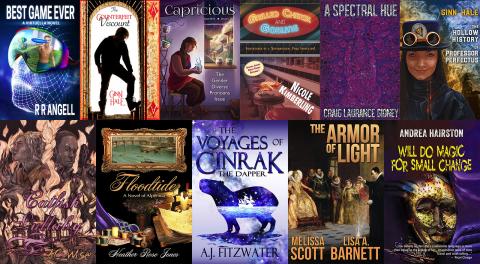
- Best Game Ever by R. R. Angell
- The Counterfeit Viscount by Ginn Hale
- A Spectral Hue by Craig Laurance Gidney
- Capricious: The Gender Diverse Pronouns Issue by Andi C. Buchanan
If you pay at least the bonus price of just $15, you get all four of the regular books, plus seven more more books, for a total of eleven!
- Grilled Cheese and Goblins by Nicole Kimberling
- The Armor of Light by Melissa Scott and Lisa A. Barnett
- Floodtide by Heather Rose Jones
- The Hollow History of Professor Profectus by Ginn Hale
- Will Do Magic For Small Change by Andrea Hairston
- The Voyages of Cinrak the Dapper by A.J. Fitzwater
- Catfish Lullaby by A.C. Wise
This bundle is available only for a limited time via http://www.storybundle.com. It allows easy reading on computers, smartphones, and tablets as well as Kindle and other ereaders via file transfer, email, and other methods. You get multiple DRM-free formats (.epub, .mobi) for all books!

Major category:
PromotionTuesday, June 23, 2020 - 19:00

The Pride StoryBundle is always packed full of wonderful authors and stories. And who knows better about that than the authors themselves? To entice you to check it out, we contributors are interviewing each other. You can find the full list of contents and purchasing information here: https://storybundle.com/blog/2020pridemonthbundle/
Today’s featured author is A.J. Fitzwater, whose debut novelThe Voyages of Cinrak the Dapper is included in the bonus bundle. A.J. lives and writes in New Zealand.
HRJ: Your contribution to the StoryBundle, The Voyages of Cinrak the Dapper, has a rather striking premise: an elegant, lesbian, capybara pirate. Why don’t you tell the readers a little about how that concept came to you?
A.J. Fitzwater: Cinrak's origin was all about fun. I wrote what I thought at the time would be a one time only story for a competition centered around rodents, mashing up my heart-eyes for capybara and the theme, and Cinrak popped out of my brain blender. I wanted to do something different and queer with the old rat pirate trope. With their broad chests and chill nature with other species, capybara come across as cool butch house parents. And so the House of Dapper was born.
HRJ: What does centering queer characters in your fiction mean to you personally?
A.J. Fitzwater: Finding the courage to, and pride in, writing queer characters came in parallel to the discovery of courage and pride in myself. When I began writing (again, after a very long time of repressing my joy...oh the layers!), I made an effort to explore different people, to understand and educate myself about the beautiful diversity of the world. It took me a long time to realize I was exploring myidentity, untangling the internalized fear and repression I'd used as a survival technique. While I cringe at some of my early stories, and understandings, it shows growth I'm proud of, and I'm proud to be on a lifelong journey of growth and change.
HRJ: Cinrak is a very recent release, but you have another brand new book out--I know, because I included it in the new releases segment of my podcast. I suspect fans of the StoryBundle would also be interested in No Man’s Land, though it’s a rather different flavor of story. Why don’t you tell the readers a little about it.
A.J. Fitzwater:Thank you for the signal boost! It's a strange thing to be bringing out two completely different books during a tough time, but the way I've reckoned it, we still need to envision joy, to find the light to move towards. No Man's Land is a queer fantasy novella set in New Zealand during World War 2, and is about two land girls who find each other in the chaos. It goes into the ignored history of the manpowered farming land girls and queer people during war time, and uses shape-shifting magic to explore purpose, body, and identity. It's available from paperroadpress.co.nz, or on your favourite e-retailer platform.
* * *
For StoryBundle, you decide what price you want to pay. For $5 (or more, if you're feeling generous), you'll get the basic bundle of four books in any ebook format—WORLDWIDE.
- Best Game Ever by R. R. Angell
- The Counterfeit Viscount by Ginn Hale
- A Spectral Hue by Craig Laurance Gidney
- Capricious: The Gender Diverse Pronouns Issue by Andi C. Buchanan
If you pay at least the bonus price of just $15, you get all four of the regular books, plus seven more more books, for a total of eleven!
- Grilled Cheese and Goblins by Nicole Kimberling
- The Armor of Light by Melissa Scott and Lisa A. Barnett
- Floodtide by Heather Rose Jones
- The Hollow History of Professor Profectus by Ginn Hale
- Will Do Magic For Small Change by Andrea Hairston
- The Voyages of Cinrak the Dapper by A.J. Fitzwater
- Catfish Lullaby by A.C. Wise
This bundle is available only for a limited time via http://www.storybundle.com. It allows easy reading on computers, smartphones, and tablets as well as Kindle and other ereaders via file transfer, email, and other methods. You get multiple DRM-free formats (.epub, .mobi) for all books!
Major category:
PromotionPages
